A keg is not a brewing vessel. It replaces your bottles — the cold, carbonated, finished end of the process — and the first fermentation still happens in an open-topped jar under a cloth. If all you want is reliable fizz, a ten-dollar carbonation cap and a cartridge regulator get you there without a keg at all. Buy a keg when washing bottles has become the reason you brew less often.
What a keg actually replaces
This is the part most kegging pages skip, and it is the part that decides whether you are about to waste a hundred and fifty dollars.
The first fermentation is aerobic. The culture needs air exchange, which is why every brewing jar on this site takes a cloth and a band rather than a lid, and why sealing that stage is the one thing you must not do. A keg is a sealed pressure vessel. It cannot host a first fermentation and nothing you buy on this page changes that. Your brewing vessel stays exactly where it is.
What a keg replaces is the seven swing-top bottles a gallon fills. Instead of distributing the finished drink into glass and waiting days for a second fermentation to build pressure, you move the whole batch into one vessel, push CO2 into it, and pour from it. The carbonation stops being a fermentation you wait out and becomes a dial you set.
That swap buys three things. Washing one keg instead of seven bottles. Carbonation you choose rather than guess at, which is the entire subject of why kombucha does not carbonate. And cold storage that stops the ferment dead, because a keg in a refrigerator is a batch that stops getting more sour on Thursday.
It costs you cupboard space, a gas supply, and the acceptance that your kitchen now contains a pressure vessel.
What decides a kombucha keg setup
Kegging gear is sold to beer brewers, and beer brewers make five gallons at a time of something that is finished fermenting when it goes in. Neither of those is true here, which changes what matters.
Capacity against a real batch. The default corny keg is five gallons. A gallon of kombucha in a five-gallon keg is four gallons of headspace you have to fill with CO2 before anything carbonates. Size the keg to the batch, not to the category.
A named steel grade. Kombucha sits at roughly pH 2.5 to 3.5 and a keg holds it for weeks. This site accepts 304 or better, by name — the same standard applied to spigots. "Stainless steel" on its own is not a grade.
A relief valve on the lid. This is the kombucha-specific one. Kombucha goes into the keg alive and keeps fermenting, so the pressure inside can rise on its own. A pull-ring relief valve means the keg can vent. A keg without one can only be vented by pulling a poppet, which means opening it deliberately.
A published pressure figure. Not because you will ever approach it — kombucha carbonates in single digits to low teens of psi — but because a maker willing to publish a number is a maker who measured one.
Whether it fits a refrigerator. Cold is how you stop a live drink from turning to vinegar. A keg you cannot refrigerate is a keg that keeps fermenting, and a standard five-gallon corny keg is two feet tall.
The four parts, and what each one does
A working setup is a vessel, a gas source, a way to connect them and a way to pour. You can skip the vessel entirely, which is the route most people should try first.
Compiled from each maker's published listing, 2026-09-14.
Part
What it does
Can you skip it?
Keg
Holds the batch sealed and under pressure, and dispenses from a dip tube
Yes — a carbonation cap puts a PET bottle in its place
CO2 source
Supplies the gas. A cartridge regulator or a refillable cylinder
No. Force carbonation is the whole point
Disconnects
Ball lock fittings that clip onto the gas and liquid posts
Sometimes — some kegs and regulators ship with them
Line and tap
Carries the drink from the liquid post to a glass
Only if you are carbonating in bottles rather than a keg
Ball lock is the fitting standard worth committing to. Gas posts and liquid posts are different sizes so they cannot be crossed, the disconnects clip on by hand, and everything on this page speaks it. The alternative standard, pin lock, is older and harder to buy parts for.
The picks
Start here, in this order
The cap is the cheap experiment. The two kegs are the commitment, and which one depends entirely on whether you brew in batches or run a continuous brew.
FERRODAY
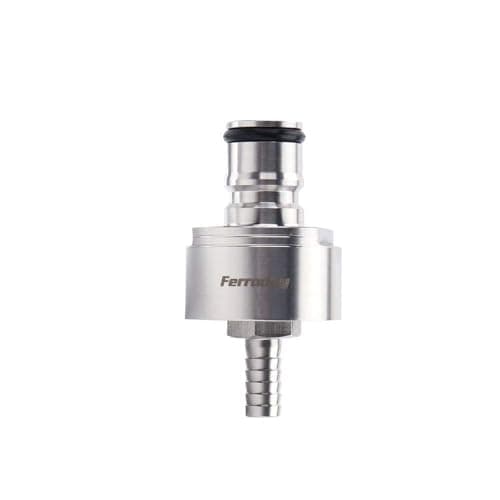
Stainless Steel Carbonation Cap, 5/16 in Barb
A stainless ball-lock cap that turns an ordinary soda PET bottle into something you can push CO2 into, which is the cheapest honest way to decide your own fizz.
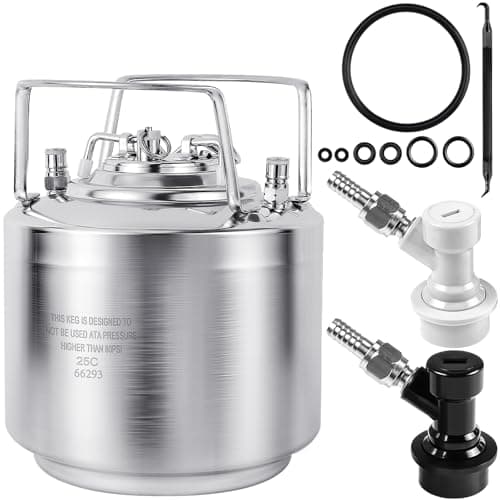
The only keg here sized for the batch this site's readers actually brew, in a named 304 stainless, with both disconnects and a full gasket set already in the box.
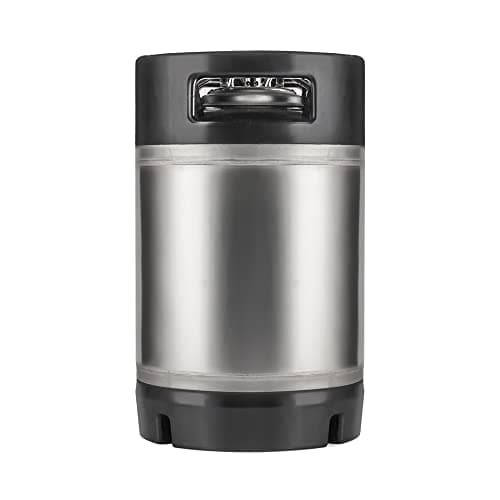
Fourteen and a half inches tall with a published 130 psi ceiling and a pull-ring relief valve on the lid — the only keg here that fits a fridge shelf and the only one that can vent itself.
Two sizes are worth considering for kombucha and the five-gallon default is not one of them. Here is what each maker actually publishes.
Every figure from the maker's own published listing, retrieved 2026-09-14. A blank means the maker does not state it.
Keg
Capacity
Steel grade stated
Pressure stated
Height
Relief valve
MRbrew ball lock
1.6 gal / 6 L
Food-grade 304
80-90 psi “safety value”
Not published
Not stated
TMCRAFT ball lock
2.5 gal
Not named
Up to 130 psi
14.5 in
Pull-ring on the lid
Typical 5 gal corny
5 gal
Varies by maker
Varies by maker
About 24 in
Varies by maker
The two candidates trade exactly the things you would want them not to. MRbrew names its grade — food-grade 304, which is the answer this site wants — and then publishes no dimensions, no weight and no relief valve. TMCRAFT publishes a pressure ceiling, a height you can measure against a fridge shelf and a pull-ring relief valve on the lid, and then describes its steel only as "fully passivated". Passivation is a surface treatment. It is not a composition, and it does not tell you what alloy is underneath.
Neither omission is disqualifying and both are worth knowing before you order. If the keg will live in a refrigerator and hold a live drink, the relief valve and the published height are worth more. If it will hold a finished, refrigerated batch and you want the alloy named, the 1.6 gallon is the one.
On size: a 1.6 gallon keg takes a standard one-gallon batch with genuine headspace and nothing wasted. A 2.5 gallon keg suits someone drawing off a continuous brew a couple of gallons at a time. The five-gallon keg that dominates this category is sized for a beer batch and is the wrong purchase for almost everyone reading this.
How much pressure kombucha actually needs
This is where beer guidance will mislead you, because the numbers are not the same and the reason is temperature.
Forced carbonation works by holding a liquid under CO2 until the gas dissolves into it, and how much dissolves depends on pressure and on how cold the liquid is. Cold liquid absorbs far more gas at the same pressure. A refrigerated keg therefore needs modest pressure; a keg at room temperature needs much more to reach the same fizz, which is the practical argument for refrigerating before you carbonate rather than after.
The specific numbers depend on how fizzy you want it and how cold your fridge runs, and this page is not going to publish a table of psi values as though they were a standard. What is worth stating plainly is the shape: a 0-60 psi regulator has far more range than kombucha will ever use, and the risk in this hobby is not that your regulator cannot reach high enough.
The kombucha-specific complication is that the drink is not finished. Beer goes into a keg fermented out. Kombucha goes in alive, with residual sugar and an active culture, and it will keep producing CO2 of its own accord unless it is cold. That is a second pressure source you did not set on the dial, and it is the reason a relief valve on the lid is worth paying attention to.
The gas side: cartridges or a cylinder
There are two honest routes to CO2 and the right one depends on how often you will do this, not on how serious you are.
A mini regulator threads onto a disposable CO2 cartridge, reads out on a small dial and fits in a drawer. It is the low-commitment route and it is genuinely sufficient: the FERRODAY unit here publishes a 0-60 psi range, takes 3/8 in threaded cartridges and ships with a ball lock gas disconnect, so it works with either a keg or a carbonation cap the day it arrives. What it does not publish — and this is a real gap — is how much carbonating one cartridge does. Nobody in this category publishes that figure, which means the running cost is something you discover rather than something you can plan.
The other route is a refillable aluminum cylinder with a CGA-320 valve and a full-size regulator. Cylinders ship empty, need filling at a welding-gas or homebrew supplier, and cost several times what a mini regulator does before they have delivered a single bubble. Per ounce of gas they are dramatically cheaper, and the crossover comes quickly if you keg regularly. They also take floor space and have to be driven somewhere.
For a kombucha brewer carbonating a gallon every week or two, the cartridge route is the sane starting point. Buy the cylinder when you have annoyed yourself buying cartridges.
Getting it back out
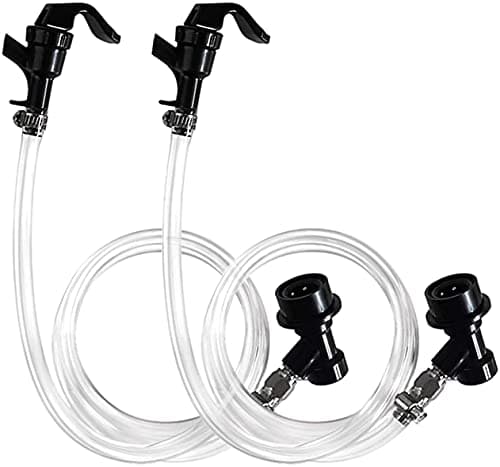
A sealed keg pours nothing until there is a liquid disconnect, a line and a tap on the other end of it. A picnic tap assembly is the cheap version of all three: a squeeze faucet on a few feet of tubing with the ball lock disconnect already fitted.
Two things about it are worth knowing in advance. The first is foam. How fast a carbonated drink can move down a line without breaking out of solution depends on the length and the internal bore of that line, and three feet is short. Most makers, including this one, publish neither the bore nor the tubing polymer, so balancing a pour is trial and error rather than arithmetic. If pours foam, a longer line is the usual fix.
The second is sediment. A corny keg draws from a dip tube that reaches the bottom of the vessel, and the bottom of the vessel is exactly where kombucha yeast settles. The first pour off a freshly filled keg is often cloudy for that reason. It is cosmetic, not a fault, and it clears. Straining at transfer with a fine mesh strainer reduces it.
The route that skips the keg entirely
Most people reading this do not need a keg. They need carbonation they can rely on, and there is a ten-dollar answer to that.
A carbonation cap is a ball lock post on a threaded cap that screws onto an ordinary soda PET bottle. Fill the bottle, cap it, clip the gas disconnect on, apply pressure, shake, leave it cold. You get the same forced carbonation a keg gives you, on one bottle at a time, using the same regulator you would have bought anyway. The cap and the regulator together cost a fraction of the cheapest keg here.
The honest limits: it carbonates one bottle at a time, that bottle is plastic rather than the swing tops you probably already own, and the maker publishes no pressure rating on the cap and no thread standard beyond "most soft drink PET bottles". For finding out whether force carbonation is something you actually want, none of that matters much.
The picks
The two parts that are not optional
Whichever route you take, there has to be a gas source. The tap is only needed once there is a keg to pour from.
FERRODAY
0-60 PSI Mini Keg Regulator, CO2 Cartridge
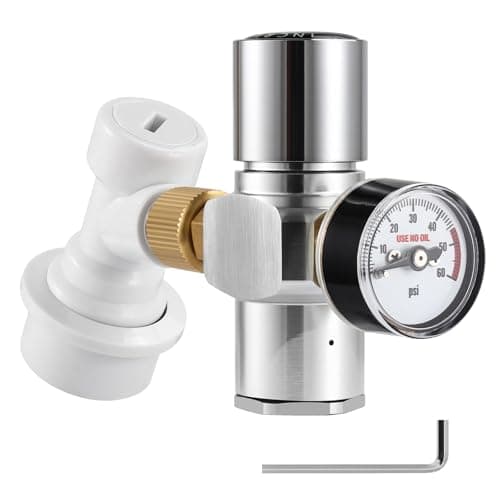
A cartridge regulator with a 0-60 psi dial and a gas disconnect already in the box — every pressure kombucha needs, in something that lives in a drawer.
Two pre-assembled tap-and-line sets with the liquid disconnects already fitted, which is the cheapest way to turn a sealed keg into something you can pour from.
Buying five gallons of keg for one gallon of kombucha. The headspace has to be filled with CO2 before anything dissolves into the drink, and you paid for a vessel that will not fit in your refrigerator.
Kegging a warm batch. Warm liquid absorbs very little CO2, so it seems not to be working, so people raise the pressure. Chill first.
Leaving a live keg at room temperature. The culture keeps working and the pressure keeps climbing with nothing telling you so. Cold storage is not optional with a drink that is still fermenting.
Foaming every pour and blaming the carbonation. Usually the line is too short for the pressure. Lengthen the line before you lower the pressure.
Never replacing the O-rings. A corny keg has a lid seal, two post seals, two poppet seals and two dip tube seals. They are consumables. A keg that will not hold pressure has almost always failed at one of the seven.
Trying to ferment in it. The first fermentation needs air. A keg is the last stage, not the first.
What the whole thing costs
In relative terms, because the live figures are on the buy rows above and they move.
The carbonation-cap route — one cap plus a cartridge regulator — lands in the same bracket as a decent set of swing-top bottles, and less than a mid-range brewing kit. It is a genuinely small purchase.
A keg setup is roughly four to six times that: the keg is the largest line item by a wide margin, with the regulator and a tap assembly adding meaningfully on top. A keg costs more than most one-gallon brewing jars and more than most starter kits. Nothing about it makes better kombucha. It makes the finishing end of the process faster and more repeatable, which for some people is the difference between brewing monthly and brewing weekly, and for others is a stainless cylinder in the cupboard.
Cartridges are a running cost with no published figure behind it. A refillable cylinder moves that cost down and moves the up-front cost up. If you cannot tell which side of that you are on yet, you are on the cartridge side.
Heads up: some links on this page are affiliate links. If you buy through one we may earn a commission at no extra cost to you. It never changes a ranking, and we take no payment for placement. The full version.
The short answer
Quick picks
Ranked on the published rubric. Every row jumps to that product's full write-up below; the button goes straight to Amazon.
#
Product
Best for
Score
Price
1
FERRODAY
Stainless Steel Carbonation Cap, 5/16 in Barb
A stainless ball-lock cap that turns an ordinary soda PET bottle into something you can push CO2 into, which is the cheapest honest way to decide your own fizz.
The only keg here sized for the batch this site's readers actually brew, in a named 304 stainless, with both disconnects and a full gasket set already in the box.
Fourteen and a half inches tall with a published 130 psi ceiling and a pull-ring relief valve on the lid — the only keg here that fits a fridge shelf and the only one that can vent itself.
Continuous brew, and a keg that fits a refrigerator
A cartridge regulator with a 0-60 psi dial and a gas disconnect already in the box — every pressure kombucha needs, in something that lives in a drawer.
Two pre-assembled tap-and-line sets with the liquid disconnects already fitted, which is the cheapest way to turn a sealed keg into something you can pour from.
FERRODAY Stainless Steel Carbonation Cap, 5/16 in Barb
A stainless ball-lock cap that turns an ordinary soda PET bottle into something you can push CO2 into, which is the cheapest honest way to decide your own fizz.
Who it is for. Anyone whose second ferment keeps coming out flat, and anyone who wants the carbonation level decided on purpose.
Published specifications
Type
Ball lock carbonation cap for PET bottles
Material
“High quality stainless steel”
Gas fitting
Ball lock post with a 5/16 in barb
Weight
About 3.6 oz
Spares included
Two extra O-rings and one extra gasket, stated as added to the package
Bottle fit
“Fit for most soft drink PET bottles”. No closure standard is named
Pressure rating
Not published. The maker states no maximum working pressure anywhere on the listing
Source: FERRODAY published Stainless Steel Carbonation Cap listing (high quality stainless steel construction, ball lock fitting with 5/16 in barb, ideal for forced carbonation in PET bottles, food-safe rubber gaskets with two spare O-rings and one spare gasket added to the package, about 3.6 oz), Amazon B01K4GGYT0, retrieved 2026-09-14
Rubric — 7.4 / 10
Materials8/10 · weight 28%
Documentation5/10 · weight 22%
Capacity fit6/10 · weight 16%
Cleaning9/10 · weight 18%
Value9/10 · weight 16%
What it gets right
Stainless on the one part that sees gas pressure and an acidic drink at the same time
It makes carbonation a setting instead of a wait — you pick the pressure rather than hoping the yeast gets there
Spare gaskets ship in the box, and the gasket is the part that actually fails on a ball lock cap
It costs less than a bag of loose leaf tea, so finding out whether you like force carbonation is cheap
What it costs you
No published pressure rating, which on a pressure fitting is a genuine omission rather than a minor one
“Most soft drink PET bottles” is not a thread specification. More than one PET closure standard exists and the maker names none of them
It does nothing on its own. A CO2 source and a gas disconnect are both required before the cap carbonates anything
One bottle at a time, and that bottle is plastic — you cannot thread this onto the glass swing tops you already own
Skip it if. Your second ferment already carbonates reliably in swing tops. This solves a problem you do not have.
The only keg here sized for the batch this site's readers actually brew, in a named 304 stainless, with both disconnects and a full gasket set already in the box.
Who it is for. A one-gallon brewer tired of washing seven bottles, who wants the whole batch cold, carbonated and on tap in a single vessel.
Published specifications
Capacity
1.6 gallon (6 L)
Material
“Food-grade 304 stainless steel”
Pressure
“Recommended safety value: 80-90 PSI”. That is the maker's phrasing, not a certified rating
Posts
Dual 19/32 in-18 threaded ball lock posts, gas and liquid
Fittings included
Two ball lock quick disconnects — gray for gas in, black for liquid out
Gasket set
8 pieces of silicone: 1 lid O-ring, 2 post, 2 poppet, 2 dip tube, plus a removal tool
Dimensions
Not published. No height, footprint or weight is stated
Pressure relief
Not stated. The listing does not describe a lid relief valve
Source: MRbrew published 1.6 Gallon Ball Lock Keg listing (food-grade 304 stainless steel, 1.6 gallon / 6 L capacity, recommended safety value 80-90 PSI, dual 19/32 in-18 threaded ball lock posts, two included ball lock fittings for gas and liquid, 8-piece silicone gasket set with removal tool), Amazon B0F7XQRNDF, retrieved 2026-09-14
Rubric — 8.4 / 10
Materials9/10 · weight 28%
Documentation7/10 · weight 22%
Capacity fit9/10 · weight 16%
Cleaning9/10 · weight 18%
Value8/10 · weight 16%
What it gets right
304 named outright, which is the grade this site accepts against a pH-3 liquid and the grade most keg listings quietly decline to state
1.6 gallons takes a full one-gallon batch with real headspace, so you are not buying five gallons of vessel to hold one
Both disconnects and a complete silicone O-ring set are in the box, which is two follow-up orders you do not have to place
A corny keg strips down completely — lid, both posts, both poppets, both dip tubes — so there is no crevice you cannot reach
What it costs you
No lid pressure-relief valve is described anywhere on the listing, and a keg of live kombucha keeps making gas after you seal it
“Recommended safety value” is not a pressure rating. It is a number with no standard behind it
No published height or footprint, so you cannot check it against a refrigerator shelf before ordering
Silicone O-rings are the right material and still wear out, and reseating a ball lock post is a fiddly ten minutes
Skip it if. You brew a gallon a fortnight and drink it out of swing tops happily. A keg is a dispensing convenience, not a brewing upgrade.
#3 · Continuous brew, and a keg that fits a refrigerator
TMCRAFT 2.5 Gallon Ball Lock Keg with Rubber Handles
Fourteen and a half inches tall with a published 130 psi ceiling and a pull-ring relief valve on the lid — the only keg here that fits a fridge shelf and the only one that can vent itself.
Who it is for. A continuous-brew brewer drawing off a couple of gallons at a time who would rather have it sealed, cold and carbonated than standing in bottles.
Published specifications
Capacity
2.5 gallon
Material
“Fully passivated stainless steel construction”. The grade is not named
Pressure
“Designed to food-safe NSF and ISO 9001 standards and can withstand pressure up to 130psi”
Lid
Stainless lid with a pull-ring style pressure release valve
Posts
Double ball lock post design, gas and liquid
Dimensions
14.5 in tall on a 9 x 8.5 in footprint in the catalog fields; the description states 8.3 x 8.3 x 14.4 in
Warranty
One year, stated
Source: TMCRAFT published 2.5 Gallon Ball Lock Keg listing (fully passivated stainless steel construction, stainless lid with pull-ring style pressure release valve, designed to food-safe NSF and ISO 9001 standards, withstands pressure up to 130psi, double ball lock post design, stated 8.3 x 8.3 x 14.4 in against catalog dimensions of 9 x 8.5 x 14.5 in, one year warranty), Amazon B0C1NB6F3J, retrieved 2026-09-14
Rubric — 7.9 / 10
Materials7/10 · weight 28%
Documentation8/10 · weight 22%
Capacity fit9/10 · weight 16%
Cleaning9/10 · weight 18%
Value7/10 · weight 16%
What it gets right
A published pressure ceiling of 130 psi and a stated NSF design reference, which is more than almost any keg in this price band publishes
A pull-ring relief valve on the lid. On a vessel holding a live culture that is a safety feature, not a convenience
At 14.5 in it goes on a refrigerator shelf. A 5 gallon corny keg is 24 in tall and does not
2.5 gallons is a far better match for a continuous brew draw than either a gallon jar or a 5 gallon keg
What it costs you
“Fully passivated stainless steel” names no grade. Passivation is a process, not a composition, and this site's bar is a named 304 or better
The listing publishes its own dimensions twice and the two sets disagree
Rubber handles and a rubber base are practical, and they are also two more surfaces to wipe down after a sticky transfer
It is the most expensive vessel on this page and it still pours nothing until you add gas, a disconnect and a line
Skip it if. You brew one gallon at a time. Two and a half gallons of keg for one gallon of kombucha is a lot of headspace to fill with CO2.
FERRODAY 0-60 PSI Mini Keg Regulator, CO2 Cartridge
A cartridge regulator with a 0-60 psi dial and a gas disconnect already in the box — every pressure kombucha needs, in something that lives in a drawer.
Who it is for. Anyone carbonating a bottle or a small keg occasionally, who wants the gas to live in a drawer rather than on the kitchen floor.
Published specifications
Type
Mini CO2 regulator for threaded cartridges
Range
0-60 psi on a dial gauge
Adjustment
A knob, stated by the maker in place of a traditional trigger valve
Cartridge fit
3/8 in threaded CO2 cartridges. “Cartridges are not included”
Included
A 3/8 in adapter and one ball lock gas disconnect
Body
Anodized aluminum, with a refined copper base for the cartridge
Cartridge yield
Not published. The maker states no figure for how many bottles or kegs one cartridge carbonates
Source: FERRODAY published 0-60 PSI Mini Keg Regulator listing (0-60 psi dial display, knob adjustment stated in place of a trigger valve, fits 3/8 in threaded CO2 cartridges with cartridges not included, ships with a 3/8 in adapter and one ball lock gas disconnect, anodized aluminum body with a refined copper cartridge base), Amazon B0B4B4J76D, retrieved 2026-09-14
Rubric — 7.2 / 10
Materials7/10 · weight 28%
Documentation7/10 · weight 22%
Capacity fit6/10 · weight 16%
Cleaning8/10 · weight 18%
Value8/10 · weight 16%
What it gets right
0-60 psi covers kombucha comfortably. Force carbonating a soft drink lives at the bottom of that dial, not the top
The cartridge adapter and a gas disconnect are both in the box, so it works with a keg or a carbonation cap on arrival
A knob rather than a trigger means you set a pressure and walk away, which is what carbonating overnight actually needs
It stores in a drawer. A 5 lb aluminum cylinder does not, and it has to be driven somewhere to be refilled
What it costs you
Cartridges are not included and no yield figure is published, so the running cost is genuinely unknown until you have used a few
Disposable cartridges are the expensive way to buy CO2 by the ounce. A refillable CGA-320 cylinder wins the moment you keg regularly
One gas disconnect means one keg or one bottle at a time
A dial this small is a coarse instrument. Fine for a soft drink, not for anyone who wants a number they can repeat exactly
Skip it if. You expect to keg every week. Buy a CGA-320 cylinder and a full-size regulator instead and stop paying per cartridge.
FERRODAY 3 ft Ball Lock Beer Line Assembly with Picnic Tap
Two pre-assembled tap-and-line sets with the liquid disconnects already fitted, which is the cheapest way to turn a sealed keg into something you can pour from.
Who it is for. Anyone who has just bought a keg and currently has no way of getting the drink back out of it.
Published specifications
Included
2 picnic taps, 2 x 3 ft clear lines, 2 ball lock disconnects, 2 swivel nuts, 4 hose clamps
Assembly
Stated pre-assembled
Disconnects
“High quality safe ABS ball lock disconnect”
Hardware
Swivel nuts and clamps stated to be stainless steel
Line
“Food safe clear tube”. Neither the polymer nor the internal bore is published
Package dimensions
11.8 x 7.8 x 2.3 in
Source: FERRODAY published 3 ft Ball Lock Beer Line Assembly listing (2 picnic taps, 2 x 3 ft clear food-safe lines, 2 ball lock disconnects, 2 swivel nuts and 4 hose clamps, all pre-assembled, ABS ball lock disconnects with stainless steel swivel nuts and clamps, 11.8 x 7.8 x 2.3 in package), Amazon B07VVNRZHM, retrieved 2026-09-14
Rubric — 6.7 / 10
Materials6/10 · weight 28%
Documentation6/10 · weight 22%
Capacity fit7/10 · weight 16%
Cleaning7/10 · weight 18%
Value8/10 · weight 16%
What it gets right
It arrives assembled, which on a handful of barbed fittings and hose clamps is worth more than it sounds
Two complete sets, so a second keg or a spare line costs nothing extra
Swivel nuts mean the line can be changed later without cutting anything
A picnic tap is the only dispensing part here that needs no fridge drilled and no tower mounted
What it costs you
The tubing polymer and internal bore are both unpublished, and bore is exactly what decides whether a carbonated pour foams
ABS rather than stainless on the disconnects, and those sit on the liquid side in contact with a pH-3 drink every time you pour
Three feet is a short line for balancing a carbonated pour. Foaming is the standing complaint with any picnic tap
It duplicates the disconnects that ship with some kegs, so you may finish with spares you did not need
Skip it if. Your keg already came with liquid disconnects and you own food-grade tubing. This set is convenience, not capability.
Not the first fermentation. That stage is aerobic — the culture needs air exchange, which is why brewing jars take a cloth cover rather than a lid. A keg is a sealed pressure vessel and belongs at the other end of the process, holding the finished drink cold and carbonated. Some brewers do run a second fermentation in a keg, but at that point they are usually force carbonating instead.
What size keg do I need for kombucha?+
Match it to your batch. A one-gallon brewer wants roughly 1.6 gallons, which takes the batch with real headspace. Someone drawing off a continuous brew wants around 2.5 gallons. The standard five-gallon corny keg is sized for a beer batch, is about 24 inches tall so it will not go in a domestic refrigerator, and leaves a one-gallon batch sitting under four gallons of headspace you have to pressurize.
How many psi to carbonate kombucha?+
Less than beer guidance suggests, and it depends on temperature more than on anything else. Cold liquid absorbs far more CO2 at the same pressure, so a refrigerated keg needs modest pressure and a warm one needs a lot. The practical advice is to chill the batch first, start low, and give it time — a 0-60 psi regulator has far more range than kombucha will ever ask for.
Do I need a CO2 tank to keg kombucha?+
Not to start. A mini regulator that threads onto a disposable CO2 cartridge does the same job, reads out on a dial and stores in a drawer. It is the cheaper entry and the more expensive gas per ounce. A refillable CGA-320 cylinder is worth buying once you are kegging often enough to resent buying cartridges — cylinders ship empty and need filling at a welding-gas or homebrew supplier.
Is a stainless keg safe for kombucha?+
A named 304 or better is the standard this site applies to anything holding kombucha for weeks, the same standard used for spigots. The problem in this category is that many keg listings say only “stainless steel” or “fully passivated stainless” without naming a grade. Passivation is a surface treatment, not a composition. Prefer a listing that states the alloy.
Why is my first pour from the keg cloudy?+
The dip tube draws from the very bottom of the keg, and that is where kombucha yeast settles. The first pour after filling is often cloudy for exactly that reason. It is cosmetic and it clears after a pour or two. Straining through a fine mesh on the way into the keg reduces how much settles there in the first place.
Can I carbonate kombucha without a keg?+
Yes, and for most people it is the better first purchase. A carbonation cap is a ball lock post on a cap that screws onto an ordinary soda PET bottle. With a cartridge regulator and a gas disconnect it force carbonates one bottle at a time for roughly a tenth of what a keg setup costs. The limits are real — one bottle at a time, and the bottle is plastic — but it answers the question cheaply.
Sources
Every specification cited on this page came from one of these documents, retrieved on the date shown against the product it belongs to.