Acidity is what makes kombucha safe. It is also invisible, which is why a vial of strips is the cheapest useful thing you can buy.
By Scooter M.·Published September 1, 2026 · Updated September 21, 2026
The short answer
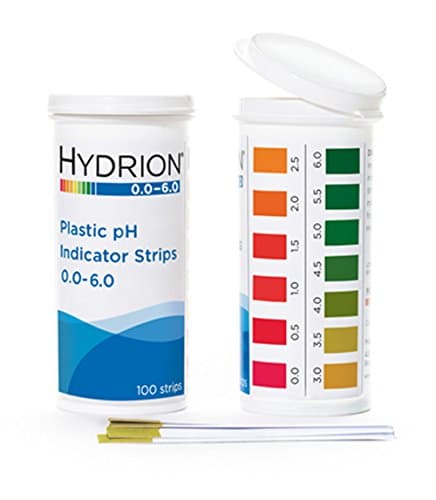
Finished kombucha typically sits between pH 2.5 and 3.5. A new batch should drop below about 4.2 within the first two or three days, and that drop is what makes it safe. Use a narrow-range strip: the Hydrion 9200 runs 0.0 to 6.0 in 0.5 steps, so the kombucha window covers four separate color matches instead of one.
The numbers, in the order you meet them
Working reference points for a home brewer.
Stage
pH
What it means
Fresh sweetened tea
About 5 or above
Not protected. This is the vulnerable window.
After adding starter tea
Typically 4.5 or below immediately
The starter's acid does this on contact.
Day 2-3, warm room
Below about 4.2
The new culture has taken over. Out of the risky zone.
Finished, sweet-tart
3.0 - 3.5
Ready for most people.
Finished, sharp
2.5 - 3.0
Sour. Excellent base for a second ferment with fruit.
Below 2.5
Below 2.5
Heading to vinegar. Still usable, less drinkable.
The number worth memorizing is 4.2. Above it, a batch is relying on whatever protection the starter tea gave it. Below it, the batch has built its own defense and the risky part of the process is behind you.
Why a narrow-range strip matters
A general-purpose 1-to-14 strip compresses the entire useful kombucha range into a single color match. Everything between 2.5 and 3.5 looks the same, which means the strip cannot tell you what you actually want to know.
Micro Essential Lab publishes the Hydrion 9200 as a 0.0 to 6.0 plastic strip with single-color matches at 0.5 intervals — 0.0, 0.5, 1.0 and so on to 6.0. Inside kombucha's window that gives you four distinct readings: 2.5, 3.0, 3.5 and 4.0. That is the difference between an instrument and a decoration.
The limitation is honest too: 0.5 steps mean you can distinguish 3.0 from 3.5 and not 3.1 from 3.4. If you need one decimal place for a written record, that requires a calibrated meter, and strips are not pretending otherwise.
How to test without contaminating the batch
The mistake is dipping the strip into the jar. Do not — you are putting a handled object into a live culture.
Draw a small sample into a clean glass or spoon. A tap makes this trivial, which is one of the better arguments for a spigot vessel.
Dip the strip in the sample, not in the vessel.
Read it immediately against the chart on the vial, in daylight if possible. Color matching under warm kitchen bulbs is genuinely harder.
Discard the sample. Do not pour it back — it has been in contact with a strip and with air outside the vessel.
A pipette makes this tidier, which is why the fuller kits include one. Both The Kombucha Shop and Fermentaholics publish a pipette in their kit contents alongside the strips.
The picks
Strips, or kits that include them
A vial of narrow-range strips is the standalone answer. If you are still buying a kit, the two that publish pH strips in their contents cover it in the same order.
Micro Essential Lab
Hydrion 9200 Spectral pH Strips, 0.0-6.0
A 0.0 to 6.0 range in 0.5 steps, which puts four separate color matches inside the 2.5 to 3.5 window kombucha lives in — a 1-to-14 strip gives you one.
#ad No live price feed yet, so no number is shown rather than a stale one. How this is funded.
Fermentaholics
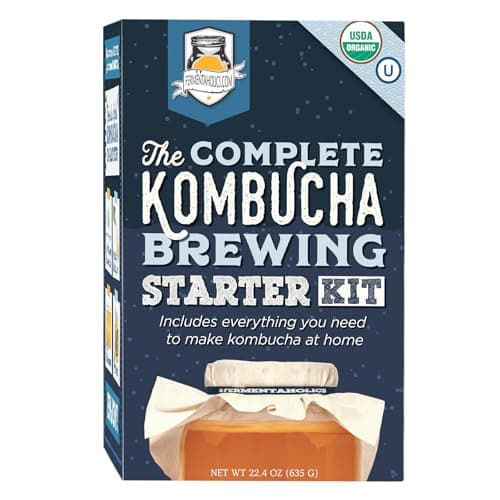
Complete Kombucha Brewing Starter Kit (1 Gallon)
Twelve fluid ounces of mature starter tea with the pellicle, measured against the maker’s own published ten percent rule — the fullest kit of the group.
The only kit here that ships pH strips, a pipette and a temperature gauge in the box, which is the difference between brewing kombucha and guessing at it.
Still above 4.2 after three days. Almost always temperature, sometimes too little starter tea. Move the jar somewhere warmer. If the room is genuinely cold, that is what a heat mat is for.
Below 2.5 and too sour to drink. Not a safety problem — it is working too well. It makes an excellent starter tea for the next batch, and it is usable as a drinking vinegar. Shorten the next ferment or run the jar cooler.
The reading is not moving at all. Check the temperature strip first. A stalled batch is nearly always cold, not dead.
Strips answer the safety question well enough for almost everyone, and the case for spending more than that is narrower than the market suggests. Do you need a pH meter for kombucha? compares two pocket meters on published accuracy against the 4.2 line — including one whose stated tolerance is wider than the decision it is being asked to make.
One case runs the other way, where a falling pH is the point rather than the warning. Making kombucha vinegar on purpose covers that deliberately sour end of the range — including why a pH reading still cannot tell you how strong the finished vinegar is.
Heads up: some links on this page are affiliate links. If you buy through one we may earn a commission at no extra cost to you. It never changes a ranking, and we take no payment for placement. The full version.
The short answer
Quick picks
Ranked on the published rubric. Every row jumps to that product's full write-up below; the button goes straight to Amazon.
#
Product
Best for
Score
Price
1
Micro Essential Lab
Hydrion 9200 Spectral pH Strips, 0.0-6.0
A 0.0 to 6.0 range in 0.5 steps, which puts four separate color matches inside the 2.5 to 3.5 window kombucha lives in — a 1-to-14 strip gives you one.
Twelve fluid ounces of mature starter tea with the pellicle, measured against the maker’s own published ten percent rule — the fullest kit of the group.
The only kit here that ships pH strips, a pipette and a temperature gauge in the box, which is the difference between brewing kombucha and guessing at it.
A 0.0 to 6.0 range in 0.5 steps, which puts four separate color matches inside the 2.5 to 3.5 window kombucha lives in — a 1-to-14 strip gives you one.
Who it is for. Every kombucha brewer. This is the cheapest instrument on the site and the one that answers the safety question.
#ad No live price feed yet, so no number is shown rather than a stale one. How this is funded.
#2 · Reading the jar, not the room
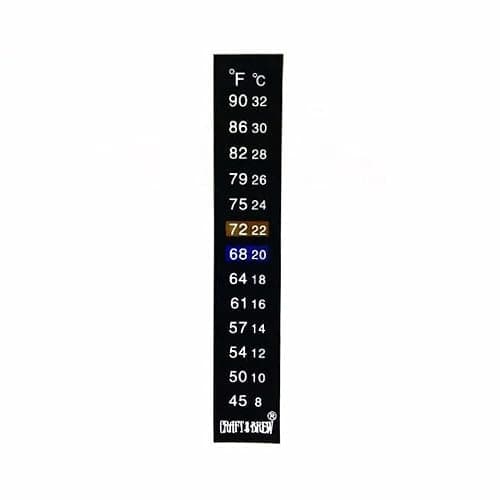
Craft a Brew Fermometer Adhesive Strip Thermometer
A four-inch liquid crystal strip that sticks to the glass and reads the liquid rather than the air, which is the distinction that matters.
Who it is for. Every brewer. This is the cheapest way to stop guessing what temperature the batch is at.
Published specifications
Size
Approximately 0.75 x 4 in
Reads
Fahrenheit and Celsius
Application
External fermenter surface
Compatible surfaces
Glass, plastic and stainless steel fermenters
How it works
“changes color to display the current temperature of the fermenting liquid inside the vessel”
Temperature range
Not published by this maker. Comparable fermentation strips are sold in bands such as 46-82 F, 57-90 F and 46-93 F.
Accuracy
Not published
Sold as
A 5 pack on the Amazon listing; the maker's own store lists it as a single strip
Source: Craft a Brew published Fermometer specification (size, display units, compatible surfaces, operating principle), craftabrew.com/products/fermometer-adhesive-strip-thermometer, fetched 2026-09-01. Comparable-strip ranges from retailer listings, cited as comparisons only.
Rubric — 7.4 / 10
Materials7/10 · weight 28%
Documentation5/10 · weight 22%
Capacity fit8/10 · weight 16%
Cleaning8/10 · weight 18%
Value10/10 · weight 16%
What it gets right
It reads through the glass, so it tells you what the kombucha is at rather than what the shelf is at — those differ by several degrees on a sunny afternoon
It costs less than a cup of coffee and never needs a battery
It sticks to glass, plastic and stainless, so it moves with you if you change vessels
Always visible, which means you actually look at it
What it costs you
Neither range nor accuracy is published for this specific strip
Liquid crystal strips read in bands, so you get “about 76” rather than 76.2
The two listings disagree on whether it is reusable — the Amazon listing calls it reusable, the maker's own spec page says nothing about removing or reapplying it
Skip it if. You want a logged, numeric record. A strip is a glance, not a measurement you can write down with confidence.
Twelve fluid ounces of mature starter tea with the pellicle, measured against the maker’s own published ten percent rule — the fullest kit of the group.
Who it is for. Someone who wants the culture to be the strongest part of the kit rather than the jar.
Published specifications
Batch size
1 gallon
Culture
Kombucha starter culture: pellicle plus 12 fl oz of mature starter tea, measured for a 1-gallon batch
Jar
1-gallon brew jar
Tea and sugar
Tea blend, organic cane sugar, reusable cotton tea bag
Measurement gear
Adhesive thermometer, pH strips, pipette
Cover
Cotton cloth cover and rubber band
Certification
USDA Certified Organic; also stated Kosher, Non-GMO and vegan
Starter tea ingredients
Organic cane sugar, filtered water, organic black tea, live cultures
Documentation
Detailed instructions and a flavoring guide
Source: Fermentaholics published kit contents and culture specification, fermentaholics.com/product/the-complete-kombucha-brewing-starter-kit/, retrieved 2026-09-01
Rubric — 8.0 / 10
Materials8/10 · weight 28%
Documentation9/10 · weight 22%
Capacity fit8/10 · weight 16%
Cleaning7/10 · weight 18%
Value8/10 · weight 16%
What it gets right
12 fl oz against a 128 oz gallon is 9.4 percent, within a rounding error of the maker’s own 10 percent rule — the quantity matches the instruction
Both instruments a first batch needs, thermometer and pH strips, are in the box
The starter tea’s ingredients are published, which almost no culture seller does
USDA Organic, Kosher, Non-GMO and vegan claims are all stated together rather than implied
What it costs you
No jar dimensions published
The jar is plain glass with no volume markers, so the 10 percent reserve is a judgment call
Nothing in the kit addresses bottling — you finish the batch with nowhere to put it
Skip it if. You want to bottle at the end of week one. Nothing here holds pressure; budget for swing-top bottles at the same time.
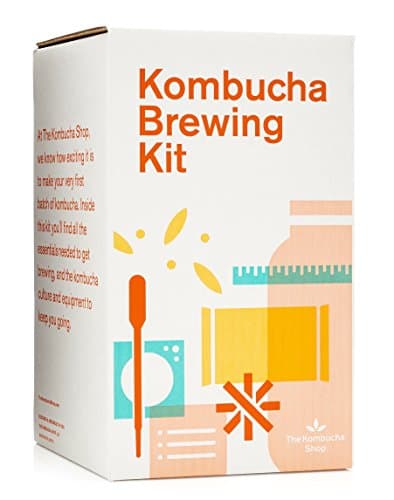
The only kit here that ships pH strips, a pipette and a temperature gauge in the box, which is the difference between brewing kombucha and guessing at it.
Who it is for. Someone brewing their first batch who wants the measurement gear included rather than ordered separately three days in.
Published specifications
Batch size
1 gallon
Jar
One Gallon Brew Jar with plastic lid, thick American glass, screen-printed Brew Notes on the side
Culture
Organic kombucha culture plus 1 cup liquid starter
Culture aging
Stated to ferment for a minimum of 6 weeks before shipping
Tea
Organic loose leaf black and oolong, with a reusable cotton tea bag
Measurement gear
pH test strips, pipette, temperature gauge, wet-erase marker
Cover
Cotton cover and rubber band
Certification
USDA Organic Certified
Spigot
None. The jar takes a plastic lid, not a tap.
Source: The Kombucha Shop published kit contents and product description, thekombuchashop.com/products/kombucha-brewing-kit, fetched 2026-09-01
Rubric — 7.4 / 10
Materials8/10 · weight 28%
Documentation7/10 · weight 22%
Capacity fit8/10 · weight 16%
Cleaning7/10 · weight 18%
Value7/10 · weight 16%
What it gets right
pH strips and a pipette in the box mean you can answer “is this safe yet” on day three instead of guessing
The culture is stated to ferment a minimum of six weeks before it ships, which is a long lead time and shows in how fast a first batch takes off
Brew Notes screen-printed on the glass keep the start date on the jar rather than on a sticky note
USDA Organic certification covers the tea, sugar and culture together
What it costs you
No jar dimensions are published anywhere, so you cannot check it against a shelf before ordering
No spigot, so bottling means lifting a full gallon and siphoning or pouring
The most expensive of the four kits here, and some of that is the marker
Skip it if. You already own a gallon jar. You are paying for glass you have, and a culture-plus-ingredients pack costs far less.
Finished kombucha typically sits between 2.5 and 3.5. A new batch should drop below about 4.2 within the first two or three days, which is the point at which it has built its own acid protection.
What pH strips are best for kombucha?+
A narrow-range strip. The Hydrion 9200 is published as 0.0 to 6.0 in 0.5 intervals, which puts four separate color matches inside kombucha's working window. A general 1-to-14 strip compresses that whole window into one color.
How do I test the pH of kombucha?+
Draw a small sample into a clean glass or spoon, dip the strip in the sample rather than in the vessel, read it immediately against the chart in good light, and discard the sample. Never dip a strip directly into the brewing jar.
My kombucha pH is not dropping. What is wrong?+
Almost always temperature. Below roughly 70 F the culture slows sharply and a batch can sit for days barely changing. Check a thermometer strip on the jar before concluding anything is wrong with the culture.
Is kombucha at pH 2.5 safe to drink?+
It is very sour rather than unsafe — a low pH is the protective mechanism, not a hazard. Most people find it unpleasantly sharp below about 2.5, at which point it makes better starter tea or drinking vinegar than a beverage.
Sources
Every specification cited on this page came from one of these documents, retrieved on the date shown against the product it belongs to.
Chlorine versus chloramine, what boiling and standing overnight actually remove, and the published flow rate a carbon filter needs to handle chloramine.