Keep brewing a finished batch for another two to four weeks at the warm end of the range, under a cloth rather than a lid, then strain it hard and bottle it somewhere dark. That is the whole method. The one thing to be clear about before you start: there is no home test for acetic acid concentration, so you will never know the strength of what you made — which rules it out for canning and pickling, and rules it in for almost everything else.
What you are actually making
A kombucha culture is a partnership between yeasts and bacteria. The yeasts turn sugar into alcohol; the acetic acid bacteria turn that alcohol into acid. During a normal brew you stop while both halves are still in balance, which is what gives drinking kombucha its sweet-sour edge.
Making vinegar means letting the second half win. You stop feeding the process sugar, you keep it warm, you give it air, and you wait. The residual sugar goes, the alcohol goes, and what remains is a sharp acetic liquid that is no longer a soft drink.
The important word there is air. Acetic acid bacteria need oxygen to do their half of the job, which is why this stage stays under a cloth cover and never goes into a sealed bottle. It is the exact opposite of a second fermentation, where you seal the bottle specifically to trap gas. Sealing a vinegar ferment does not make it sour faster; it starves the bacteria you are trying to favor.
This is also the difference between making vinegar and a batch that got away from you. Same chemistry, different intent — and a couple of adjustments that make the result better than an accident.
What the job needs
Very little, and most of it is already in a kombucha kitchen. What matters is the shape of the vessel and the discipline about air.
A wide vessel, not a tall one. Acetic acid bacteria work at the surface where the oxygen is. A gallon jar with a wide mouth converts faster than the same volume in a narrow carboy, and it is the same wide-mouth argument made on the gallon jar page.
A cloth cover and a band. Not a lid, not an airlock. This stage wants gas exchange, and a tight-woven cloth keeps fruit flies out of a jar that is about to smell strongly of vinegar for a month.
Warmth, at the top of the normal band. The acetic half of the culture works faster warm. This is the one process on the site where the warm end is the goal rather than a risk.
A fine strainer. A long ferment throws a lot of yeast sediment. Straining is what separates pleasant vinegar from cloudy vinegar with a layer in the bottom of the bottle.
Dark, sealable storage. Once it is finished, the air that helped it is no longer wanted. Amber glass and a real closure keep it stable for months.
Drinking kombucha against kombucha vinegar
The same culture and the same jar, run two different ways. Working figures used consistently across this site.
Drinking kombucha
Kombucha vinegar
First ferment
7 to 14 days
That, plus another 2 to 4 weeks
Temperature aim
About 75-85 F
The warm end of that band
Cover
Cloth and band
Cloth and band, throughout
Sugar at the end
Some left
Essentially none
Sealed at any point?
Yes, for a second ferment
No. It wants air the whole time
Typical finished pH
About 2.5 to 3.5
Lower, and not a measure of strength
Storage
Refrigerated, weeks
Dark and sealed, months
Two rows are worth pausing on. The cover row is the one people get wrong, because "stronger" sounds like it should mean "sealed tighter". And the pH row is the one that matters most, for a reason covered below: pH and acidity are not the same measurement, and the number your strips give you is not the number a recipe means when it says five percent.
The picks
What the process actually needs
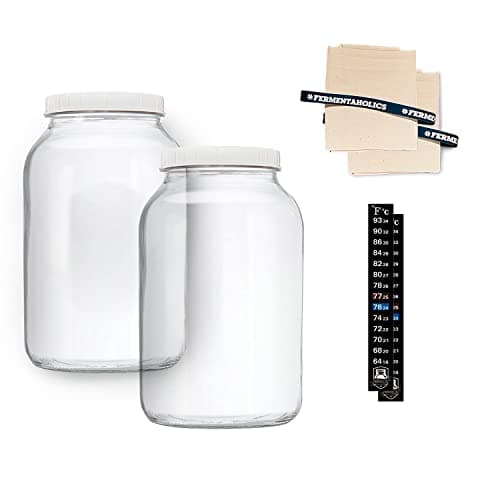
A pair of plain gallon jars with the cloth covers and bands this stage requires, a fine mesh strainer for a ferment that throws real sediment, and amber bottles for storing the result out of the light.
Fermentaholics
One Gallon Plain Glass Kombucha Jars, 2-Pack
Two identical gallon jars, each with its own cover, band and temperature strip — which is how you stop having a week with no kombucha in it.
The only strainer here whose maker states in writing that it is non-reactive and safe for acidic foods, which is the entire question a fermenter is asking.
Nothing here is difficult. The hard part is leaving it alone for a month.
Start with a batch you would otherwise be bottling. Take out the pellicle and set it aside in a SCOBY hotel if you want to keep brewing drinking kombucha with it, because the culture you leave in a vinegar jar for a month comes out stressed. Then leave the liquid where it is, under cloth, somewhere warm, and start tasting weekly.
Do not add sugar to "feed" it. Sugar restarts the yeast half of the process and gives you a sweeter, weaker result. Do not add store-bought vinegar either: it will make the jar taste of that vinegar rather than of yours, and it tells you nothing about the strength of the finished liquid.
Knowing when it is ready, and what you cannot know
Taste is the test. It is ready when it stops tasting like sour kombucha and starts tasting like vinegar — flat, sharp, with the fruity kombucha character receding into the background. That transition is obvious when it happens.
What you cannot do is put a number on it. A pH strip or meter measures how strong the acid is, not how much of it is in there. Two liquids can read the same pH and contain very different quantities of acetic acid, which is exactly why commercial vinegar is sold on percentage rather than pH. There is no home instrument for that percentage — it needs a titration — so any figure you see attached to homemade kombucha vinegar is a guess.
That is not a reason to avoid making it. It is a reason to treat it as a strong, unstandardized vinegar: excellent on food, fine for cleaning, and never a substitute where a recipe specifies a percentage.
Straining and storing it
A month-long ferment produces a surprising amount of yeast sediment and usually a thick new pellicle across the top. Lift the pellicle off, then pour the liquid through a fine mesh strainer — twice if it is very cloudy. The result keeps far better and pours far more pleasantly.
Then get it out of the light and close it. Amber glass is doing real work here because the bottle may sit on a shelf for months rather than days, and swing tops close well enough for a liquid that is not under pressure. This is the one product on this site where a sealed bottle is right and a breathable cover is wrong, because the fermentation is over and air now only dulls it.
It will keep for months at room temperature. It is, after all, an environment almost nothing else will grow in. A new pellicle forming in the bottle is normal and harmless — strain it out or ignore it.
What to do with it
Dressings and finishing. The obvious use. It is fruitier and rounder than distilled white vinegar and works where you would reach for cider vinegar.
Shrubs and drinking vinegars. A spoonful in sparkling water is the traditional use, and it is the closest thing to getting your kombucha back.
Deglazing and marinades. Heat drives off the sharpness and leaves the fruit, which is the opposite of what it does to the drink.
Cleaning, diluted. Vinegar of unknown strength is perfectly good on a countertop, and this site already recommends distilled white vinegar for descaling brewing gear on the cleaning page.
Not as a health product. This site makes no health claims for kombucha or for vinegar, and nothing about making it at home changes that.
The pellicle, and whether the culture survives
The disc that forms on a vinegar ferment looks like a kombucha pellicle because it is one. It is often called a mother of vinegar, and in a kombucha jar it is the same cellulose raft doing the same thing under more acidic conditions.
Can you brew drinking kombucha with it afterward? Usually, but not well. A culture held at vinegar acidity for a month is stressed, and the first batch back tends to be slow. The cheap insurance is to pull a healthy pellicle and some starter tea out before you start the vinegar run, and keep it in a hotel. Then the vinegar jar can go as far as it likes without costing you your brewing culture.
What goes wrong
Sealing it. The commonest mistake. A sealed jar starves the bacteria doing the work and can build pressure from any residual sugar.
Adding sugar along the way. It restarts the yeast side and gives a sweeter, weaker result.
Not straining. Yeast sediment in a bottle you will keep for months is the difference between a good-looking vinegar and a murky one.
Using it for pickling. Covered above, and it is the one that actually matters.
Sacrificing your only culture. Pull a pellicle and starter tea out first, or accept a slow batch when you go back to drinking kombucha.
Heads up: some links on this page are affiliate links. If you buy through one we may earn a commission at no extra cost to you. It never changes a ranking, and we take no payment for placement. The full version.
The short answer
Quick picks
Ranked on the published rubric. Every row jumps to that product's full write-up below; the button goes straight to Amazon.
#
Product
Best for
Score
Price
1
Fermentaholics
One Gallon Plain Glass Kombucha Jars, 2-Pack
Two identical gallon jars, each with its own cover, band and temperature strip — which is how you stop having a week with no kombucha in it.
The only strainer here whose maker states in writing that it is non-reactive and safe for acidic foods, which is the entire question a fermenter is asking.
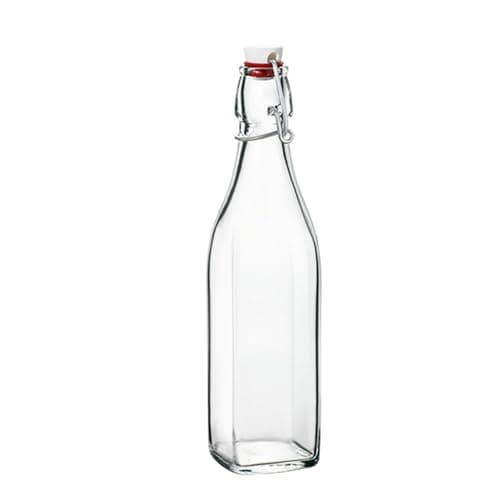
Italian soda-lime glass with a published height and diameter and a hermetic clamp seal — the bottle that looks like a bottle, with the dimensions to check it fits a fridge door.
#2 · Straining a ferment without metal in the acid
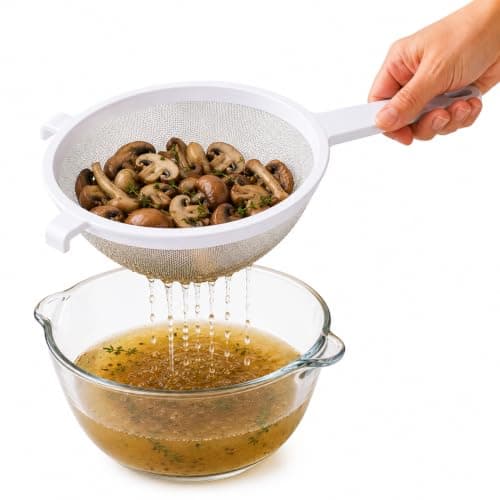
HIC Kitchen Double-Ear Fine Mesh Strainer, 7 in
The only strainer here whose maker states in writing that it is non-reactive and safe for acidic foods, which is the entire question a fermenter is asking.
Who it is for. Anyone straining a finished ferment on bottling day who wants the acid-contact question answered by the maker rather than by a forum.
Published specifications
Diameter
7 in
Material
BPA free plastic
Published acid claim
“durable, lightweight, non reactive, and safe for acidic foods”
Overall dimensions
13.25 x 7 x 3.25 in
Rim
Double-ear design that “rests securely across pots, pans, and bowls”
Dishwasher
“top-rack dishwasher safe”
Storage
Hangs for compact storage
Mesh aperture
Not published
Smaller size
The same strainer is listed at 5.5 in
Source: HIC Kitchen published Double-Ear Fine Mesh Strainer listing (7 in, BPA free plastic, “non reactive, and safe for acidic foods”, 13.25 x 7 x 3.25 in, double-ear rim, top-rack dishwasher safe, hangs for storage), Amazon B0042X9XAY, retrieved 2026-09-13
Rubric — 8.4 / 10
Materials8/10 · weight 28%
Documentation9/10 · weight 22%
Capacity fit8/10 · weight 16%
Cleaning9/10 · weight 18%
Value8/10 · weight 16%
What it gets right
A published “safe for acidic foods” claim is exactly the sentence this site spends a whole page on elsewhere, and almost no strainer maker writes it down
Plastic sidesteps the metal question entirely — no grade to verify, no alloy claim to trust, nothing to pit
The double-ear rim sits across a jug or bowl so both hands are free, which matters when you are pouring a full gallon
Top-rack dishwasher safe, which a fine mesh badly needs after sugary, yeasty liquid
What it costs you
The mesh aperture is not published, so how fine a strain you get is unknown until it arrives
Seven inches is generous for a gallon pour and far too wide to sit in a quart jar for daily kefir straining
Plastic mesh is more easily deformed than steel; a bent rim never quite sits flat again
No stated maximum temperature, and top-rack dishwasher safe is the only heat guidance given
Skip it if. You strain kefir grains daily out of a quart jar. This is the wrong size and shape for that; a small non-metal sieve set is the tool.
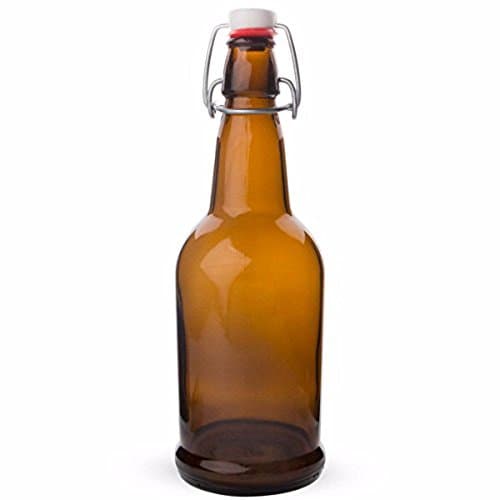
EZ Cap Swing Top Bottles, Amber Glass, 16 oz (Case of 12)
The only bottle here with a published pressure rating — 100 PSI — in amber glass, which is the combination a second ferment actually asks for.
Who it is for. Anyone doing a second ferment who wants a bottle with a number behind it rather than a shape that looks strong.
Published specifications
Capacity
16 oz
Glass color
Amber
Pressure rating
“Pressure rated to 100 PSI which means they can easily handle the carbonation of soda pop and hard seltzer”
Case quantity
12 bottles, includes 12 swing tops
Closure
Reusable swing top; also accepts a 26 mm pry-off crown cap
Maker’s note
“These swing tops are designed to be primarily sealed with a crown cap closure for long term storage.”
Dimensions
Not published
Source: MoreBeer published EZ Cap product specification (capacity, pressure rating, case contents, crown cap compatibility), morebeer.com/products/ez-cap-swing-top-bottles-amber-glass-16-oz-case-12, fetched 2026-09-01
Rubric — 8.3 / 10
Materials9/10 · weight 28%
Documentation9/10 · weight 22%
Capacity fit8/10 · weight 16%
Cleaning7/10 · weight 18%
Value8/10 · weight 16%
What it gets right
A published 100 PSI rating is the single most useful number in this whole category, and almost nobody publishes one
Amber glass blocks the light that degrades a bottle sitting out on a counter through a second ferment
The dual finish means you can crown-cap a batch you want to leave for months and swing-top the ones you will drink this week
16 oz is one serving, so a bottle gets opened once and drunk rather than losing its carbonation over three days
What it costs you
Swing-top gaskets perish, and a tired gasket is the commonest cause of a flat second ferment
No dimensions published, so fitting twelve of them on a fridge shelf is a measuring job when they arrive
Crown caps are sold separately if you want the long-storage option the maker recommends
Skip it if. You want to see the color of the finished drink. Amber hides it; the clear version of the same bottle does not.
Italian soda-lime glass with a published height and diameter and a hermetic clamp seal — the bottle that looks like a bottle, with the dimensions to check it fits a fridge door.
Who it is for. Someone bottling a lightly carbonated kombucha for the table, or storing finished kombucha in the fridge rather than conditioning it on a counter.
Published specifications
Capacity
33.75 oz (1 liter)
Height
12.13 inches
Diameter
3.5 inches
Glass
BPA-free and lead-free soda-lime glass
Origin
Glass and components made in Italy
Closure
Hermetic swing top: metal clasp, stopper and gasket
Care
Dishwasher safe without the swing top. Hand wash the metal clamp, stopper and gasket.
Pressure rating
Not published
Source: Bormioli Rocco published Swing bottle specification (capacity, 12.13 in height, 3.5 in diameter, soda-lime glass, hermetic seal, care instructions), retailer specification listings retrieved 2026-09-01
Rubric — 8.0 / 10
Materials8/10 · weight 28%
Documentation8/10 · weight 22%
Capacity fit8/10 · weight 16%
Cleaning8/10 · weight 18%
Value8/10 · weight 16%
What it gets right
Height and diameter both published, so you can check a fridge shelf before ordering
Lead-free soda-lime glass is stated, which matters for a container holding a pH-3 liquid for weeks
The bottle body is dishwasher safe, and only the small parts need hand washing
Genuinely presentable — this is the bottle to hand someone
What it costs you
No published pressure rating, which is the one number a second ferment cares about most
Clear glass, so light gets to the drink
A liter is a lot to open at once
Skip it if. You are chasing hard carbonation. Without a stated pressure rating, a bottle you are deliberately building pressure inside is a bottle you are guessing about — use the rated EZ Cap instead.
Keep a finished batch going for another two to four weeks at the warm end of the normal range, under a cloth cover rather than a lid, adding nothing. The acetic acid bacteria consume the remaining sugar and alcohol and the liquid turns sharp and flat. Then strain it hard and bottle it somewhere dark.
How strong is homemade kombucha vinegar?+
Nobody can tell you, including anyone selling you a method. Acetic acid concentration is measured by titration, not by any home instrument, and pH does not substitute — two liquids can read the same pH with very different amounts of acid in them. Treat it as a strong vinegar of unknown percentage.
Can you use kombucha vinegar for pickling or canning?+
No. Home-canning guidance recommends vinegar of a known 5 percent acidity because the safety of a preserved product depends on the acid concentration, and homemade kombucha vinegar has no measured concentration. Use commercial 5 percent vinegar for anything sealed in a jar for storage, and keep the homemade vinegar for dressings, cooking and cleaning.
Should kombucha vinegar be covered or sealed while it ferments?+
Covered with cloth, the whole time. Acetic acid bacteria need oxygen to convert alcohol into acid, so sealing the jar starves the half of the culture you are trying to favor. Sealing also traps gas from any residual sugar. The bottle only gets sealed once the ferment is finished and you are storing it.
How long does homemade kombucha vinegar keep?+
Months, stored dark and sealed at room temperature — it is an environment almost nothing will grow in. A new pellicle forming in the bottle over time is normal and harmless; strain it out or leave it. Straining well before bottling is what keeps it clear and pleasant to pour.
Can I still brew kombucha with the SCOBY afterward?+
Usually, but the first batch back tends to be slow, because a culture held at vinegar acidity for a month is stressed. The reliable approach is to pull a healthy pellicle and some starter tea out into a hotel before you begin the vinegar run. Then the vinegar jar can go as far as you like at no cost to your brewing.
Sources
Every specification cited on this page came from one of these documents, retrieved on the date shown against the product it belongs to.