Four steps, one of which is waiting. Here is the whole process with the numbers that actually matter, and nothing that does not.
By Scooter M.·Published September 1, 2026 · Updated September 27, 2026
The short answer
Brew a gallon of strong sweet tea, cool it completely, add a culture with about 12 oz of starter tea, cover with cloth, and leave it at 75 to 85 F for seven to fourteen days. Hold back a tenth for the next batch, bottle the rest with a little fruit, and leave the bottles sealed for one to five days if you want it fizzy.
What you need
Six things, and two of them are in most kitchens already. A one-gallon wide-mouth glass jar, a tight-weave cloth and a rubber band, a live culture with starter tea, plain black tea, plain white cane sugar, and — for the second stage — bottles that can hold pressure. The full equipment checklist covers what is genuinely required against what is merely sold.
Two more that are not required and are worth having on day one: pH strips and an adhesive temperature strip. Between them they diagnose the only two things that commonly go wrong.
The ratios for one gallon
A standard one-gallon batch. These are working ratios, not a formula to follow to the gram.
Ingredient
Quantity
Notes
Water
About 14 cups
Filtered or left to stand. Chlorine suppresses the culture.
Plain white cane sugar
1 cup
Ordinary granulated. Not honey, not a sweetener.
Black tea
8 bags or 2 tbsp loose
True tea only. Herbal infusions are not tea.
Starter tea
About 12-13 oz
Roughly 10 percent of the batch. Published rule.
Culture
1 pellicle
Optional in principle, standard in practice.
The starter tea figure is the one people get wrong. Fermentaholics publishes the rule outright — ten percent of batch size — and ships 12 fl oz with its gallon culture, which against 128 oz is 9.4 percent. Why starter tea matters more than the disc.
The method
1. Brew the tea. Bring about four cups of water to the boil, take it off the heat, and steep the tea for ten to fifteen minutes. Remove the tea, stir in the sugar until it fully dissolves, then top up with the remaining cold water.
2. Cool it completely. This is the step people rush and it is the one that kills cultures. The tea must be at room temperature — genuinely, not "warm" — before the culture goes anywhere near it. Topping up with cold water does most of the work; give it an hour to finish.
3. Add the culture and its starter tea. All of the liquid, then the pellicle. It may float, sink or sit at an angle. None of that means anything.
4. Cover and wait. Cloth and a band, never a lid — the first fermentation is aerobic and the culture needs air. Covers and lids. Put it somewhere warm, dark and undisturbed, away from bins and fruit bowls.
5. Start tasting on day seven. Draw a small sample, taste it, and test the pH. Sweet means it needs longer; sharply sour means you have gone past your preference. Somewhere between 3.0 and 3.5 suits most people.
6. Bottle, holding back the starter. Reserve about 13 oz plus the pellicle for the next batch. Bottle the rest. How to bottle kombucha.
The picks
What a first batch actually needs bought
A kit if you own nothing, the strips that answer the safety question, and bottles — because no kit includes them and the batch will be ready in a fortnight.
Fermentaholics
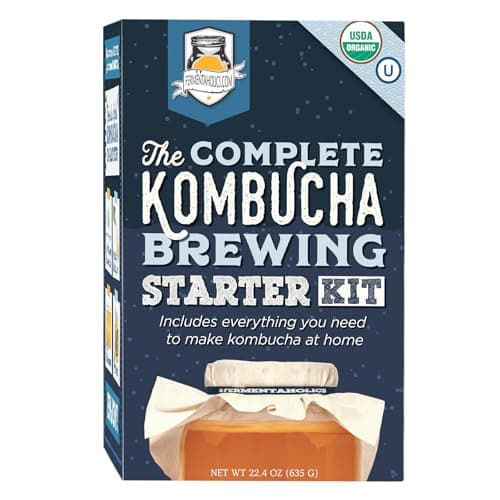
Complete Kombucha Brewing Starter Kit (1 Gallon)
Twelve fluid ounces of mature starter tea with the pellicle, measured against the maker’s own published ten percent rule — the fullest kit of the group.
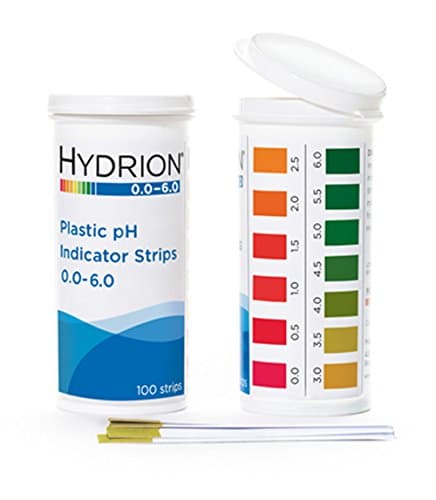
A 0.0 to 6.0 range in 0.5 steps, which puts four separate color matches inside the 2.5 to 3.5 window kombucha lives in — a 1-to-14 strip gives you one.
The first is open to the air under a cloth. The culture needs oxygen, and the carbon dioxide it produces simply escapes. This is where the sourness comes from, and it is not supposed to be fizzy.
The second is sealed, in a bottle, with a little fruit or juice for the yeast to work on. Now the gas cannot escape, so it dissolves into the liquid, and that is the carbonation. It is entirely optional — kombucha from the first fermentation is a finished drink, just a flat one. Second fermentation.
What goes wrong, in order of likelihood
It stalls. Cold, almost every time. A jar at 66 F can sit for three weeks tasting like sweet tea. Temperature.
It goes too sour. Warm room, long ferment, or both. Not a problem — it is excellent starter tea and a good base for a second ferment. Shorten the next one.
Something grew on top. Usually a new pellicle, sometimes yeast, rarely mold. Mold versus SCOBY before you throw anything away.
It will not carbonate. A seal problem, a sugar problem or a cold problem, in that order. The full diagnostic.
All of this assumes you already have a culture. If you do not, and you would rather not order one, growing a SCOBY from a bottle covers the slower free route and what it costs you in time.
Heads up: some links on this page are affiliate links. If you buy through one we may earn a commission at no extra cost to you. It never changes a ranking, and we take no payment for placement. The full version.
The short answer
Quick picks
Ranked on the published rubric. Every row jumps to that product's full write-up below; the button goes straight to Amazon.
#
Product
Best for
Score
Price
1
Fermentaholics
Complete Kombucha Brewing Starter Kit (1 Gallon)
Twelve fluid ounces of mature starter tea with the pellicle, measured against the maker’s own published ten percent rule — the fullest kit of the group.
A 0.0 to 6.0 range in 0.5 steps, which puts four separate color matches inside the 2.5 to 3.5 window kombucha lives in — a 1-to-14 strip gives you one.
Twelve fluid ounces of mature starter tea with the pellicle, measured against the maker’s own published ten percent rule — the fullest kit of the group.
Who it is for. Someone who wants the culture to be the strongest part of the kit rather than the jar.
Published specifications
Batch size
1 gallon
Culture
Kombucha starter culture: pellicle plus 12 fl oz of mature starter tea, measured for a 1-gallon batch
Jar
1-gallon brew jar
Tea and sugar
Tea blend, organic cane sugar, reusable cotton tea bag
Measurement gear
Adhesive thermometer, pH strips, pipette
Cover
Cotton cloth cover and rubber band
Certification
USDA Certified Organic; also stated Kosher, Non-GMO and vegan
Starter tea ingredients
Organic cane sugar, filtered water, organic black tea, live cultures
Documentation
Detailed instructions and a flavoring guide
Source: Fermentaholics published kit contents and culture specification, fermentaholics.com/product/the-complete-kombucha-brewing-starter-kit/, retrieved 2026-09-01
Rubric — 8.0 / 10
Materials8/10 · weight 28%
Documentation9/10 · weight 22%
Capacity fit8/10 · weight 16%
Cleaning7/10 · weight 18%
Value8/10 · weight 16%
What it gets right
12 fl oz against a 128 oz gallon is 9.4 percent, within a rounding error of the maker’s own 10 percent rule — the quantity matches the instruction
Both instruments a first batch needs, thermometer and pH strips, are in the box
The starter tea’s ingredients are published, which almost no culture seller does
USDA Organic, Kosher, Non-GMO and vegan claims are all stated together rather than implied
What it costs you
No jar dimensions published
The jar is plain glass with no volume markers, so the 10 percent reserve is a judgment call
Nothing in the kit addresses bottling — you finish the batch with nowhere to put it
Skip it if. You want to bottle at the end of week one. Nothing here holds pressure; budget for swing-top bottles at the same time.
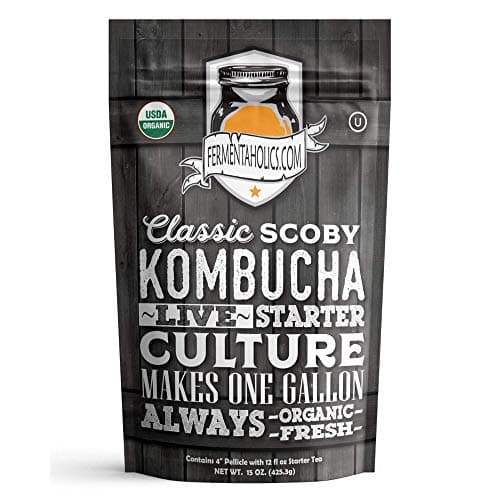
Fermentaholics Organic Kombucha SCOBY with 12 fl oz Starter Tea
A hand-selected pellicle with twelve fluid ounces of mature starter tea, measured against the maker’s own published ten percent rule for a gallon.
Who it is for. Anyone starting a standard one-gallon batch who wants the starter tea measured for them.
Published specifications
Batch size
One gallon
Starter tea volume
12 fl oz of mature, active starter tea
Pellicle
Hand-selected
Starter tea ingredients
Organic cane sugar, filtered water, organic black tea, live cultures
Certification
USDA Certified Organic, Kosher, Non-GMO, vegan
Production
Grown in the maker’s licensed lab
Maker’s dosing rule
“the rule of thumb is to use 10% starter tea per batch size”
Source: Fermentaholics published SCOBY specification (12 fl oz starter tea, 1-gallon dosing, ingredients, certifications) and its published 10 percent starter rule, retrieved 2026-09-01
Rubric — 8.5 / 10
Materials9/10 · weight 28%
Documentation9/10 · weight 22%
Capacity fit8/10 · weight 16%
Cleaning8/10 · weight 18%
Value8/10 · weight 16%
What it gets right
12 fl oz against a 128 oz gallon is 9.4 percent, within a rounding error of the maker’s own 10 percent rule — the quantity matches the instruction
Starter tea is the part that actually acidifies a new batch and protects it from mold; the pellicle is mostly a raft
Ingredients of the starter tea are published, which almost no culture seller does
Certified organic, kosher, non-GMO and vegan are stated together
What it costs you
A live culture in transit is a live culture in transit — heat and delay are real risks nobody controls
No stated shelf life once it arrives
You still need tea, sugar and a jar
Skip it if. You are brewing half a gallon. Buy the half-gallon version instead; a gallon’s worth of starter in a half-gallon batch drives the acidity too far, too fast.
A 0.0 to 6.0 range in 0.5 steps, which puts four separate color matches inside the 2.5 to 3.5 window kombucha lives in — a 1-to-14 strip gives you one.
Who it is for. Every kombucha brewer. This is the cheapest instrument on the site and the one that answers the safety question.
#ad No live price feed yet, so no number is shown rather than a stale one. How this is funded.
#4 · Second ferment, one serving at a time
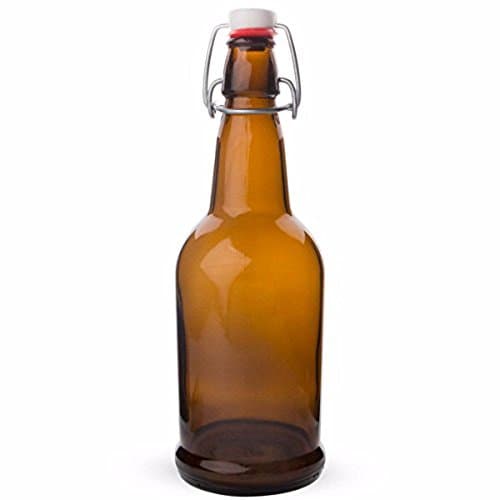
EZ Cap Swing Top Bottles, Amber Glass, 16 oz (Case of 12)
The only bottle here with a published pressure rating — 100 PSI — in amber glass, which is the combination a second ferment actually asks for.
Who it is for. Anyone doing a second ferment who wants a bottle with a number behind it rather than a shape that looks strong.
Published specifications
Capacity
16 oz
Glass color
Amber
Pressure rating
“Pressure rated to 100 PSI which means they can easily handle the carbonation of soda pop and hard seltzer”
Case quantity
12 bottles, includes 12 swing tops
Closure
Reusable swing top; also accepts a 26 mm pry-off crown cap
Maker’s note
“These swing tops are designed to be primarily sealed with a crown cap closure for long term storage.”
Dimensions
Not published
Source: MoreBeer published EZ Cap product specification (capacity, pressure rating, case contents, crown cap compatibility), morebeer.com/products/ez-cap-swing-top-bottles-amber-glass-16-oz-case-12, fetched 2026-09-01
Rubric — 8.3 / 10
Materials9/10 · weight 28%
Documentation9/10 · weight 22%
Capacity fit8/10 · weight 16%
Cleaning7/10 · weight 18%
Value8/10 · weight 16%
What it gets right
A published 100 PSI rating is the single most useful number in this whole category, and almost nobody publishes one
Amber glass blocks the light that degrades a bottle sitting out on a counter through a second ferment
The dual finish means you can crown-cap a batch you want to leave for months and swing-top the ones you will drink this week
16 oz is one serving, so a bottle gets opened once and drunk rather than losing its carbonation over three days
What it costs you
Swing-top gaskets perish, and a tired gasket is the commonest cause of a flat second ferment
No dimensions published, so fitting twelve of them on a fridge shelf is a measuring job when they arrive
Crown caps are sold separately if you want the long-storage option the maker recommends
Skip it if. You want to see the color of the finished drink. Amber hides it; the clear version of the same bottle does not.
Brew a gallon of strong sweet tea, cool it completely, add a live culture with about 12 oz of starter tea, cover with cloth and leave it at 75 to 85 F for seven to fourteen days. Hold back a tenth for the next batch and bottle the rest.
How much sugar and tea for one gallon of kombucha?+
One cup of plain white cane sugar and eight tea bags, or about two tablespoons of loose black tea, in roughly fourteen cups of water. Plus 12 to 13 fluid ounces of starter tea, which is the published ten percent of batch size.
How long should kombucha ferment?+
Seven to fourteen days for the first fermentation, driven mostly by temperature. Craft a Brew publishes exactly that window for its kit and names temperature as the variable. Start tasting on day seven and stop when it suits you.
Why did my kombucha not do anything?+
Almost always temperature. Below roughly 70 F the culture slows so much that a batch can sit for weeks tasting like sweet tea. The other common cause is adding the culture to tea that was still warm, which damages it.
Do I have to do a second fermentation?+
No. Kombucha from the first fermentation is a finished drink; it is simply flat. The second fermentation exists to add carbonation and flavor in a sealed bottle, and it is entirely optional.
Sources
Every specification cited on this page came from one of these documents, retrieved on the date shown against the product it belongs to.
Chlorine versus chloramine, what boiling and standing overnight actually remove, and the published flow rate a carbon filter needs to handle chloramine.
What you buy once versus what you buy repeatedly, the published yields that decide the running cost, and when brewing your own is honestly not worth it.