Draw finished kombucha off the spigot and immediately replace it with fresh sweet tea, repeating indefinitely. Kombucha Kamp's published guidance is to “replace no more than 25–35% of the total volume at once to maintain microbial balance”, with the first batch fermenting 7 to 10 days and subsequent batches needing only 5 to 7. A full clean and reset is published as every 6 to 12 months.
What actually changes versus batch brewing
Batch brewing is a cycle with a beginning and an end: brew tea, add culture, wait a fortnight, empty the jar, start again. Continuous brewing removes the emptying. The vessel stays permanently occupied by a large volume of mature kombucha, and you take from the bottom and give back at the top.
That one change has consequences that are easy to miss. The culture never gets diluted to a fresh, vulnerable state, so it never spends days in the risky window above pH 4.2. The flavor stabilizes, because you are always tasting an average rather than a snapshot. And the vessel is opened far less often, since the spigot does the work a ladle used to do.
The published advantages list from the same source is short and honest: less cleaning and maintenance, consistent flavor, and safer brewing. The first and last of those are straightforwardly true and follow directly from the mechanics above.
The proportion is the whole method
There is one number that makes a continuous brew work, and it is a ratio rather than a volume. The published guidance is to replace no more than 25 to 35 percent of the total volume at once — described elsewhere in the same guidance as refilling around 25 percent with sweet tea while 75 percent stays as mature fermented tea.
What the published 25-35 percent replacement rule means in practice at common vessel sizes.
Vessel
Total volume
Draw off at 25%
Draw off at 35%
1 gallon
128 oz
32 oz
45 oz
1.5 gallons
192 oz
48 oz
67 oz
2 gallons
256 oz
64 oz
90 oz
3 gallons
384 oz
96 oz
134 oz
5 gallons
640 oz
160 oz
224 oz
Look at the one-gallon row and the problem with small vessels becomes obvious. Twenty- five percent of a gallon is a quart — barely two bottles. That is why a gallon is not enough for this method, and why the published sizing guidance for a continuous brew vessel is 2 to 5 gallons, on the grounds that “a smaller vessel will become overrun with too much SCOBY and sour Kombucha, making flavor balance difficult to achieve”.
Setting it up
The first fill is an ordinary batch brew, just larger. Sweet tea at the published ratio — one cup of sugar per gallon of tea, with four to six tea bags or two tablespoons of loose leaf per gallon — cooled to room temperature, plus the culture and its starter tea. Then the first fermentation runs 7 to 10 days, which is longer than subsequent ones because the vessel is starting from nothing.
Fill height matters more here than in a batch. The liquid level must sit above the spigot inlet with a margin, because the bottom of a continuous brew accumulates yeast sediment and you do not want to be drawing it into every glass. Leave a few inches between the spigot and the floor of the vessel, which is a spigot placement question as much as a filling one.
The picks
What a continuous brew needs
A vessel large enough that a quarter of it is a useful draw, a spigot you can trust against a low pH, and something to confirm the vessel is where you think it is.
Score8.5no photo yet
Kombucha Kamp
Glass Continuous Brewer with Stand
About 2.2 gallons of glass on an acacia stand with a stainless spigot, and the only vessel here where you can see the pellicle, the yeast strands and the fill line at a glance.
#ad No live price feed yet, so no number is shown rather than a stale one. How this is funded.
Craft a Brew
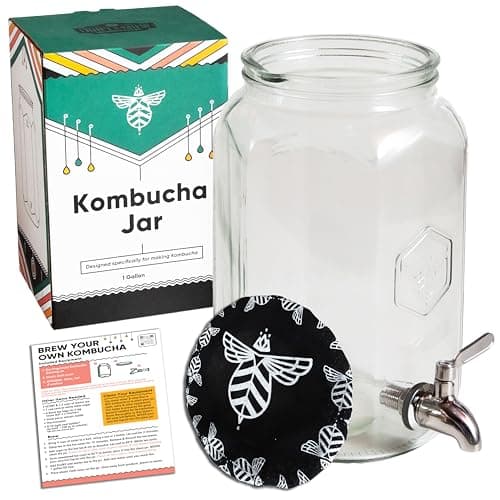
Kombucha Jar with Valve (1 Gallon)
The one gallon jar in this group whose valve grade is published — 304 stainless — which is the single specification that decides whether a spigot belongs anywhere near kombucha.
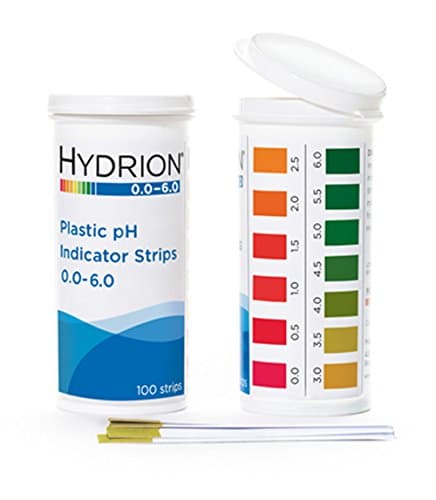
A 0.0 to 6.0 range in 0.5 steps, which puts four separate color matches inside the 2.5 to 3.5 window kombucha lives in — a 1-to-14 strip gives you one.
#ad No live price feed yet, so no number is shown rather than a stale one. How this is funded.
The weekly routine
Once running, the routine is short. Brew sweet tea at the published ratio and let it cool completely. Draw off up to a third of the vessel through the spigot into bottles. Pour the cooled sweet tea back in. That is the whole cycle, and subsequent batches are published as needing only 5 to 7 days.
Two rules keep it stable. Never add warm tea — it stresses the culture and it is the fastest way to turn a healthy continuous brew into a sluggish one. And never draw off more than the published third, because the remaining mature liquid is what acidifies the new tea quickly enough to keep the vessel safe.
The drawn-off kombucha goes straight into pressure-rated bottles for a second ferment, exactly as it would from a batch. Nothing about continuous brewing changes the bottling stage.
The part everybody puts off
A continuous brew accumulates two things: pellicles at the top and yeast sediment at the bottom. Neither is a problem in the short run and both eventually become one — pellicles take up volume that should be liquid, and heavy sediment starts finding its way into the spigot.
The published interval for a full clean and reset is every 6 to 12 months. That means decanting the mature kombucha, removing the excess pellicles, cleaning the vessel and the spigot properly, and refilling with the kombucha you set aside plus fresh sweet tea. The surplus pellicles go to a SCOBY hotel or to another brewer.
The spigot is the part that needs real attention at a reset. It is the one component in constant contact with an acidic liquid, it comes apart, and things grow inside it that you cannot see from outside. Cleaning kombucha equipment covers taking one down.
When a continuous brew goes wrong
Everything tastes too sour. You are drawing off too little, too rarely. The vessel has drifted acidic because fresh tea is not arriving fast enough. Draw a full third and refill.
Everything tastes weak and sweet. The reverse — too much replaced at once, or replaced too often, so the mature fraction never rebuilds. Wait longer between draws.
Sediment in every glass. The liquid level is too close to the spigot, or the vessel is overdue a reset. Both are fixed at a full clean.
A slow trickle from the spigot. Almost always yeast strands in the spigot body rather than a failing vessel. It comes apart; clean it.
Is continuous brewing actually better?
For some people, plainly yes. For others it is a worse fit than the batch method they already have, and the honest answer depends on three things that have nothing to do with the kombucha.
The first is consumption. Continuous brewing only makes sense if you drink enough to draw off a quarter of a large vessel on a regular cycle. A household getting through two bottles a week will find a three-gallon vessel drifting steadily more sour, because the draws are too small and too infrequent to keep it fed.
The second is counter space. A two-to-five-gallon vessel with a spigot lives permanently in one place, at a height where a bottle fits underneath the tap. That is a real piece of kitchen real estate, and it is the reason a lot of continuous brews end up back as batch brews.
The third is variety. A batch brewer can change tea, change flavoring and start again in a fortnight. A continuous brewer is committed to one profile until the next reset, which is either restful or restrictive depending on temperament.
Heads up: some links on this page are affiliate links. If you buy through one we may earn a commission at no extra cost to you. It never changes a ranking, and we take no payment for placement. The full version.
The short answer
Quick picks
Ranked on the published rubric. Every row jumps to that product's full write-up below; the button goes straight to Amazon.
#
Product
Best for
Score
Price
1
Score8.5
Kombucha Kamp
Glass Continuous Brewer with Stand
About 2.2 gallons of glass on an acacia stand with a stainless spigot, and the only vessel here where you can see the pellicle, the yeast strands and the fill line at a glance.
The one gallon jar in this group whose valve grade is published — 304 stainless — which is the single specification that decides whether a spigot belongs anywhere near kombucha.
Roughly 2.5 gallons of US-made handmade stoneware with a stainless spigot, and the only vessel here whose dimensions are given as a range because each one is thrown by hand.
A 0.0 to 6.0 range in 0.5 steps, which puts four separate color matches inside the 2.5 to 3.5 window kombucha lives in — a 1-to-14 strip gives you one.
About 2.2 gallons of glass on an acacia stand with a stainless spigot, and the only vessel here where you can see the pellicle, the yeast strands and the fill line at a glance.
Who it is for. A continuous brewer who wants to see what is happening, and who has an open shelf or an island to put it on.
Published specifications
Capacity
Approximately 2.2 gallons
Vessel height
13 inches
Vessel width
9 inches
Height with stand
18 inches
Spigot
Stainless steel
Stand
Acacia wood
Material
Glass
Source: Kombucha Kamp published vessel specifications (capacity, vessel and stand heights, spigot material), kombuchakamp.com/glass-continuous-brewer.html, retrieved 2026-09-01
Rubric — 8.5 / 10
Materials9/10 · weight 28%
Documentation9/10 · weight 22%
Capacity fit9/10 · weight 16%
Cleaning8/10 · weight 18%
Value7/10 · weight 16%
What it gets right
Glass is chemically inert at kombucha’s pH and shows you the state of the culture without opening anything
A stainless spigot as standard rather than as an upgrade
18 in on the stand is published, so you can check the clearance to a cabinet before ordering
2.2 gallons sits inside the 2-to-5-gallon band Kombucha Kamp recommends for continuous brew
What it costs you
Light reaches the culture, and continuous brew is a long exposure — it needs a dark corner or a cloth over it
Glass at 2.2 gallons is heavy and unforgiving of a knock against a tap
18 in tall on the stand rules out most under-cabinet counters
Skip it if. Your only free counter is under a cabinet. At 18 in with the stand you will not get the cover off, let alone the pellicle out.
#ad No live price feed yet, so no number is shown rather than a stale one. How this is funded.
#2 · A spigot you can check
Craft a Brew Kombucha Jar with Valve (1 Gallon)
The one gallon jar in this group whose valve grade is published — 304 stainless — which is the single specification that decides whether a spigot belongs anywhere near kombucha.
Who it is for. A batch brewer who wants a tap for tasting and bottling, and who wants the spigot’s material in writing.
Published specifications
Capacity
1 gallon
Height
10 inches
Diameter
6 inches
Diameter including valve
7.75 inches
Valve material
304 grade stainless steel
Volume markers
1 gallon and 2 cup markers
Care
Hand wash only — not dishwasher safe
Mouth diameter
Not published
Source: Craft a Brew published dimensions, valve grade and care instructions, craftabrew.com/products/kombucha-jar-with-valve, fetched 2026-09-01
Rubric — 8.0 / 10
Materials9/10 · weight 28%
Documentation9/10 · weight 22%
Capacity fit7/10 · weight 16%
Cleaning6/10 · weight 18%
Value8/10 · weight 16%
What it gets right
304 grade is stated outright, so you are not inferring a spigot’s alloy from a photograph
10 in tall by 7.75 in across including the valve is a published footprint you can check against a counter and a cupboard
Volume markers at 1 gallon and 2 cups line up exactly with a batch and its starter reserve
A tap means you can taste on day six without lifting the jar or dropping anything into it
What it costs you
Hand wash only, and a spigot is the part that most wants a dishwasher
Mouth diameter is not published, which matters because a pellicle grows to the width of the vessel and has to come back out
At one gallon it is small for true continuous brewing — Kombucha Kamp is explicit that a 1-gallon jar is not a good continuous-brew choice
Skip it if. You want to run continuous brew. One gallon does not hold enough liquid to keep a stable culture while you draw off a bottle at a time; go to 2 gallons or more.
Kombucha Kamp USA Handmade Stoneware Continuous Brewer Crock
Roughly 2.5 gallons of US-made handmade stoneware with a stainless spigot, and the only vessel here whose dimensions are given as a range because each one is thrown by hand.
Who it is for. A committed continuous brewer with counter space, who wants the biggest published capacity and a stainless tap in the box.
Published specifications
Capacity
Approximately 2.5 gallons
Vessel height
12 to 14 inches
Vessel width
10 to 12 inches at the shoulders
Material
Stoneware, handmade in the USA
Spigot
Brew-safe stainless steel upgrade included
Dimension variance
Published as a range because each crock is individually made
Source: Kombucha Kamp published crock specifications (capacity, height and shoulder-width ranges, stainless spigot), kombuchakamp.com/usa-handmade-stoneware-continuous-brewer-crock.html, retrieved 2026-09-01
Rubric — 8.3 / 10
Materials9/10 · weight 28%
Documentation8/10 · weight 22%
Capacity fit10/10 · weight 16%
Cleaning7/10 · weight 18%
Value7/10 · weight 16%
What it gets right
2.5 gallons is the largest here and sits in the middle of the 2-to-5-gallon continuous brew band
Stainless spigot included rather than offered as an extra
Opaque stoneware keeps light off the ferment
Publishing dimensions as a range rather than a false precision is the honest way to spec a handmade vessel, and it tells you to leave clearance
What it costs you
Up to 14 in tall and 12 in wide at the shoulders — you have to plan for the top of the range, not the bottom
Handmade stoneware at 2.5 gallons is heavy before you fill it and very heavy after
No visibility into the vessel at all
Skip it if. You measure your shelf to the inch. A vessel whose height can be 12 in or 14 in is not the one to buy for a tight gap.
A 0.0 to 6.0 range in 0.5 steps, which puts four separate color matches inside the 2.5 to 3.5 window kombucha lives in — a 1-to-14 strip gives you one.
Who it is for. Every kombucha brewer. This is the cheapest instrument on the site and the one that answers the safety question.
#ad No live price feed yet, so no number is shown rather than a stale one. How this is funded.
FAQ
Questions people actually ask
How much kombucha can I take from a continuous brew at once?+
No more than 25 to 35 percent of the total volume, per Kombucha Kamp's published guidance, so the mature fraction left behind can acidify the fresh sweet tea quickly. On a two-gallon vessel that is 64 to 90 fluid ounces.
What size vessel do I need for continuous brewing?+
Two to five gallons is the published recommendation. A one-gallon vessel is too small: a quarter of it is only a quart, and the published guidance warns that a smaller vessel becomes overrun with too much SCOBY and sour kombucha, making flavor balance difficult.
How often do I need to clean a continuous brew vessel?+
A full clean and reset is published as every 6 to 12 months. Between resets you are only drawing off and refilling. The spigot deserves the real attention at a reset, since it is the component in constant contact with acidic liquid.
How long does each continuous brew cycle take?+
The first fermentation is published as 7 to 10 days because the vessel starts from nothing. Subsequent batches need only 5 to 7 days, since the mature kombucha already in the vessel acidifies the fresh tea far faster than a new culture could.
Why does my continuous brew taste too sour?+
Usually because you are drawing off too little, too rarely, so fresh tea is not arriving fast enough and the vessel has drifted acidic. Draw a full third and refill. The opposite problem — weak and sweet — means too much is being replaced too often.
Sources
Every specification cited on this page came from one of these documents, retrieved on the date shown against the product it belongs to.