Five causes, and they are not equally likely. Work through them in this order and you will usually find it on the first one.
By Scooter M.·Published September 1, 2026 · Updated September 21, 2026
The short answer
Check the bottle seal first. A gasket that leaks slowly produces a completely flat batch, because the gas escapes as fast as the yeast makes it and pressure never builds. Only after that should you look at sugar, temperature, timing and yeast.
1. The seal — start here, every time
This is the most common cause and the least suspected, because people reason about the recipe rather than the hardware. A slow leak does not give you slightly less fizz. It gives you none, because carbonation requires pressure to build, and a leaking bottle never builds any.
The two-minute test: fill the bottle with plain water, close it, invert it over a sink and squeeze firmly. Bubbles or a hiss at the closure means the seal is not holding. For a slower leak, leave the inverted bottle standing on a paper towel for an hour.
Gaskets perish, go hard, crack and take permanent flat spots. EZ Cap states its swing tops are reusable and can be replaced as needed, which is exactly the right way to think about them: consumable. Gaskets and seals.
2. Not enough sugar in the bottle
The yeast needs something to eat. A batch bottled from a very long first fermentation may have almost no residual sugar left, and if you also added nothing at bottling there is nothing to ferment.
Add one to two tablespoons of fruit juice or chopped fruit per 16 oz bottle, or half a teaspoon of plain sugar if you do not want to change the flavor. Start modest — over -carbonation is a messier problem than under-carbonation.
3. Too cold
Bottle conditioning is temperature-driven in exactly the way the first fermentation is. Bottles left in a cool room take four or five days rather than one or two, and in a genuinely cold room they may not get there at all before you give up.
Move them somewhere warmer and give them another two days before concluding anything. Temperature is the same variable that governs the first ferment, and the same fixes apply.
4. Not long enough
One to five days is the published range and people frequently check at 24 hours, find it flat, and refrigerate. Cold effectively stops the process, so a batch refrigerated too early stays flat permanently.
The reliable answer is the plastic tester: fill one food-grade PET soda bottle from the same batch and squeeze it daily. When it goes hard, it is ready. Until it does, it is not.
The picks
The two things that fix most flat batches
A bottle whose closure is designed to be maintained and replaced, and a way to know whether the room the bottles are sitting in is warm enough to condition them.
EZ Cap
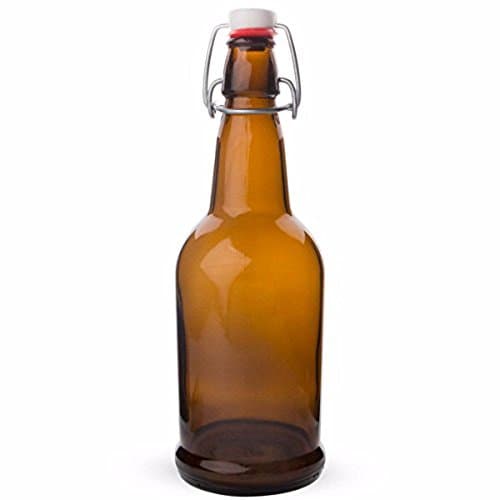
Swing Top Bottles, Amber Glass, 16 oz (Case of 12)
The only bottle here with a published pressure rating — 100 PSI — in amber glass, which is the combination a second ferment actually asks for.
#ad No live price feed yet, so no number is shown rather than a stale one. How this is funded.
5. Too little yeast left in the bottle
The least common cause, and the one to consider only after the other four. Heavy straining removes yeast, and yeast is what does the work in the bottle. A very carefully filtered batch has less to ferment with.
If everything else checks out, strain less next time — or add a spoonful of the sediment from the bottom of the brewing vessel to each bottle.
The checklist
Work down this list. Most flat batches are resolved on the first row.
#
Check
Fix
1
Does the bottle hold water pressure when inverted and squeezed?
Replace the gasket, or use a crown cap
2
Did you add sugar, fruit or juice at bottling?
1-2 tbsp juice per 16 oz bottle
3
Is the room where the bottles sit above 70 F?
Move them somewhere warmer
4
Have they had at least 3 days?
Wait. Use a plastic tester bottle.
5
Did you strain very heavily?
Strain less, or add a little sediment
Everything above is a diagnosis of a fermentation you are waiting on. There is a route that removes the waiting: push CO2 into the drink directly and the carbonation stops being something the yeast decides. Kegging kombucha covers the four-part setup, and the ten-dollar carbonation cap that does it on a plastic bottle without a keg.
If your problem is the opposite one — bottles that gush, or a batch you are nervous about opening — kombucha bottles exploding covers what drives a runaway second ferment and how to read the pressure before you open anything.
Heads up: some links on this page are affiliate links. If you buy through one we may earn a commission at no extra cost to you. It never changes a ranking, and we take no payment for placement. The full version.
The short answer
Quick picks
Ranked on the published rubric. Every row jumps to that product's full write-up below; the button goes straight to Amazon.
#
Product
Best for
Score
Price
1
EZ Cap
Swing Top Bottles, Amber Glass, 16 oz (Case of 12)
The only bottle here with a published pressure rating — 100 PSI — in amber glass, which is the combination a second ferment actually asks for.
Italian soda-lime glass with a published height and diameter and a hermetic clamp seal — the bottle that looks like a bottle, with the dimensions to check it fits a fridge door.
EZ Cap Swing Top Bottles, Amber Glass, 16 oz (Case of 12)
The only bottle here with a published pressure rating — 100 PSI — in amber glass, which is the combination a second ferment actually asks for.
Who it is for. Anyone doing a second ferment who wants a bottle with a number behind it rather than a shape that looks strong.
Published specifications
Capacity
16 oz
Glass color
Amber
Pressure rating
“Pressure rated to 100 PSI which means they can easily handle the carbonation of soda pop and hard seltzer”
Case quantity
12 bottles, includes 12 swing tops
Closure
Reusable swing top; also accepts a 26 mm pry-off crown cap
Maker’s note
“These swing tops are designed to be primarily sealed with a crown cap closure for long term storage.”
Dimensions
Not published
Source: MoreBeer published EZ Cap product specification (capacity, pressure rating, case contents, crown cap compatibility), morebeer.com/products/ez-cap-swing-top-bottles-amber-glass-16-oz-case-12, fetched 2026-09-01
Rubric — 8.3 / 10
Materials9/10 · weight 28%
Documentation9/10 · weight 22%
Capacity fit8/10 · weight 16%
Cleaning7/10 · weight 18%
Value8/10 · weight 16%
What it gets right
A published 100 PSI rating is the single most useful number in this whole category, and almost nobody publishes one
Amber glass blocks the light that degrades a bottle sitting out on a counter through a second ferment
The dual finish means you can crown-cap a batch you want to leave for months and swing-top the ones you will drink this week
16 oz is one serving, so a bottle gets opened once and drunk rather than losing its carbonation over three days
What it costs you
Swing-top gaskets perish, and a tired gasket is the commonest cause of a flat second ferment
No dimensions published, so fitting twelve of them on a fridge shelf is a measuring job when they arrive
Crown caps are sold separately if you want the long-storage option the maker recommends
Skip it if. You want to see the color of the finished drink. Amber hides it; the clear version of the same bottle does not.
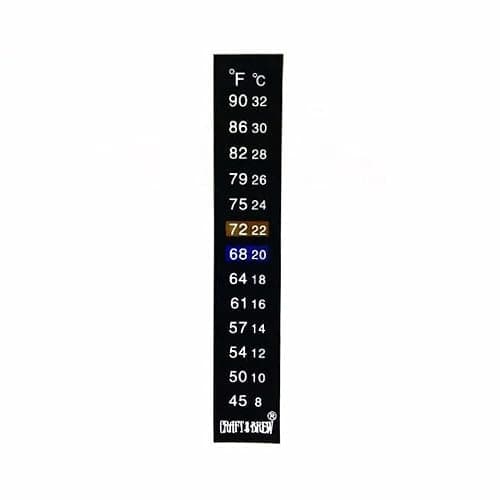
Craft a Brew Fermometer Adhesive Strip Thermometer
A four-inch liquid crystal strip that sticks to the glass and reads the liquid rather than the air, which is the distinction that matters.
Who it is for. Every brewer. This is the cheapest way to stop guessing what temperature the batch is at.
Published specifications
Size
Approximately 0.75 x 4 in
Reads
Fahrenheit and Celsius
Application
External fermenter surface
Compatible surfaces
Glass, plastic and stainless steel fermenters
How it works
“changes color to display the current temperature of the fermenting liquid inside the vessel”
Temperature range
Not published by this maker. Comparable fermentation strips are sold in bands such as 46-82 F, 57-90 F and 46-93 F.
Accuracy
Not published
Sold as
A 5 pack on the Amazon listing; the maker's own store lists it as a single strip
Source: Craft a Brew published Fermometer specification (size, display units, compatible surfaces, operating principle), craftabrew.com/products/fermometer-adhesive-strip-thermometer, fetched 2026-09-01. Comparable-strip ranges from retailer listings, cited as comparisons only.
Rubric — 7.4 / 10
Materials7/10 · weight 28%
Documentation5/10 · weight 22%
Capacity fit8/10 · weight 16%
Cleaning8/10 · weight 18%
Value10/10 · weight 16%
What it gets right
It reads through the glass, so it tells you what the kombucha is at rather than what the shelf is at — those differ by several degrees on a sunny afternoon
It costs less than a cup of coffee and never needs a battery
It sticks to glass, plastic and stainless, so it moves with you if you change vessels
Always visible, which means you actually look at it
What it costs you
Neither range nor accuracy is published for this specific strip
Liquid crystal strips read in bands, so you get “about 76” rather than 76.2
The two listings disagree on whether it is reusable — the Amazon listing calls it reusable, the maker's own spec page says nothing about removing or reapplying it
Skip it if. You want a logged, numeric record. A strip is a glance, not a measurement you can write down with confidence.
EZ Cap Swing Top Bottles, Amber Glass, 32 oz (Case of 12)
The same swing top and amber glass at quart size, which turns a gallon batch into six bottles instead of ten and roughly halves the bottling job.
Who it is for. An established brewer bottling a gallon a week who is tired of filling ten bottles.
Published specifications
Capacity
32 oz
Glass color
Amber
Case quantity
12 bottles
Closure
Reusable swing top
Product line
Same EZ Cap swing-top line as the 16 oz
Pressure rating
Not published for this size; the 16 oz in the same line is rated to 100 PSI
Source: MoreBeer published EZ Cap 32 oz amber listing, same product line as the specified 16 oz, morebeer.com/products/ez-cap-swing-top-bottles-amber-glass-32-oz-case-12, retrieved 2026-09-01
Rubric — 7.8 / 10
Materials9/10 · weight 28%
Documentation6/10 · weight 22%
Capacity fit9/10 · weight 16%
Cleaning7/10 · weight 18%
Value8/10 · weight 16%
What it gets right
Six bottles per gallon instead of ten is a real reduction in a job most people find tedious
Amber glass, same as the 16 oz
A quart is the right size for a household that drinks kombucha with dinner rather than alone
Fewer closures means fewer gaskets to keep track of
What it costs you
The pressure rating is published for the 16 oz in this line but not stated for the 32 oz — do not assume it carries over
Once opened, a quart goes flat before most people finish it
A quart of over-carbonated kombucha is a bigger mess than a pint of it
Skip it if. You are new to second ferment. Learn what your kitchen does to carbonation in 16 oz bottles, where the consequences are smaller.
#ad No live price feed yet, so no number is shown rather than a stale one. How this is funded.
#4 · A bottle you would put on a table
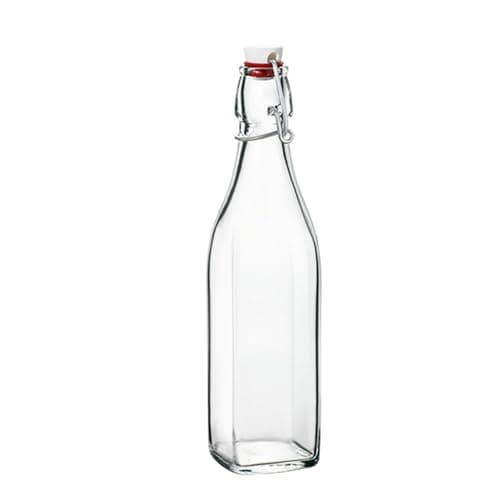
Bormioli Rocco Swing Top Bottle, 33.75 oz (1 L)
Italian soda-lime glass with a published height and diameter and a hermetic clamp seal — the bottle that looks like a bottle, with the dimensions to check it fits a fridge door.
Who it is for. Someone bottling a lightly carbonated kombucha for the table, or storing finished kombucha in the fridge rather than conditioning it on a counter.
Published specifications
Capacity
33.75 oz (1 liter)
Height
12.13 inches
Diameter
3.5 inches
Glass
BPA-free and lead-free soda-lime glass
Origin
Glass and components made in Italy
Closure
Hermetic swing top: metal clasp, stopper and gasket
Care
Dishwasher safe without the swing top. Hand wash the metal clamp, stopper and gasket.
Pressure rating
Not published
Source: Bormioli Rocco published Swing bottle specification (capacity, 12.13 in height, 3.5 in diameter, soda-lime glass, hermetic seal, care instructions), retailer specification listings retrieved 2026-09-01
Rubric — 8.0 / 10
Materials8/10 · weight 28%
Documentation8/10 · weight 22%
Capacity fit8/10 · weight 16%
Cleaning8/10 · weight 18%
Value8/10 · weight 16%
What it gets right
Height and diameter both published, so you can check a fridge shelf before ordering
Lead-free soda-lime glass is stated, which matters for a container holding a pH-3 liquid for weeks
The bottle body is dishwasher safe, and only the small parts need hand washing
Genuinely presentable — this is the bottle to hand someone
What it costs you
No published pressure rating, which is the one number a second ferment cares about most
Clear glass, so light gets to the drink
A liter is a lot to open at once
Skip it if. You are chasing hard carbonation. Without a stated pressure rating, a bottle you are deliberately building pressure inside is a bottle you are guessing about — use the rated EZ Cap instead.
Most often the bottle seal. A gasket that leaks slowly lets gas escape as fast as the yeast makes it, so pressure never builds and the result is completely flat. After that: not enough sugar at bottling, too cold, not enough time, and heavy straining.
How do I test whether a bottle seal is leaking?+
Fill it with plain water, close it, invert it over a sink and squeeze firmly. Bubbles or a hiss at the closure means the seal is not holding. For a slow leak, leave the inverted bottle on a paper towel for an hour.
How much sugar do I need for kombucha to carbonate?+
One to two tablespoons of fruit juice or chopped fruit per 16 oz bottle, or half a teaspoon of plain sugar if you do not want to change the flavor. A batch bottled with nothing added may have too little residual sugar left to work with.
Can kombucha carbonate in the fridge?+
Effectively no. Cold slows the yeast almost to a stop, which is exactly why refrigeration is how you stop a second fermentation. A batch refrigerated before it carbonated will generally stay flat.
Why is my kombucha flat straight out of the brewing jar?+
Because it is supposed to be. The first fermentation is open to the air under a cloth, so the carbon dioxide escapes as it is produced. Carbonation only happens in the sealed second fermentation.
Sources
Every specification cited on this page came from one of these documents, retrieved on the date shown against the product it belongs to.