Temperature sets the speed. pH tells you whether it is safe. Everything else about brewing kombucha is downstream of those two readings, and both instruments are cheap.
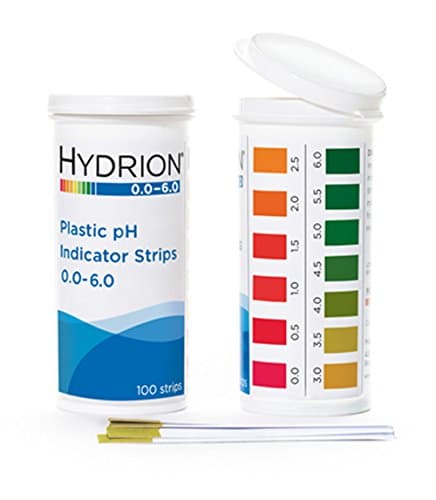
A 0.0 to 6.0 range in 0.5 steps, which puts four separate color matches inside the 2.5 to 3.5 window kombucha lives in — a 1-to-14 strip gives you one.
#ad No live price feed yet, so no number is shown rather than a stale one. How this is funded.
The short answer
Brew between about 75 and 85 F, and expect finished kombucha to land around pH 2.5 to 3.5. A pH strip vial and an adhesive temperature strip together cost less than a single bottle of shop kombucha and remove almost all of the guesswork.
Temperature sets the speed
Kombucha is a warm ferment. Below about 70 F the yeast slows dramatically, the batch stalls, and a stalled batch is a batch spending days at a pH where mold can still take hold. Above about 85 F it runs fast and thin, tipping to vinegar before the flavor is worth drinking. The band in between is where the culture does what you want.
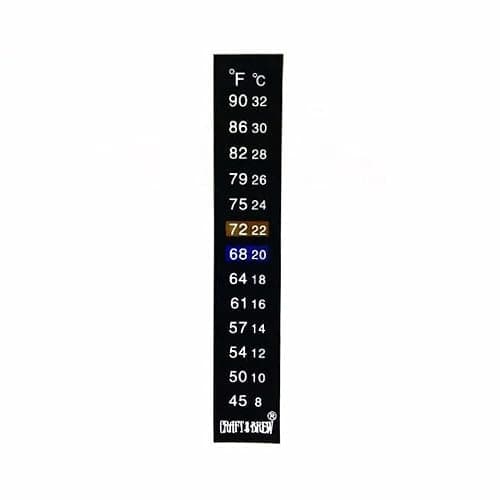
The important detail is that the liquid is not the room. A jar in a sunny window can run several degrees above ambient; a jar on a stone counter in a cold kitchen runs below it. That is the whole argument for an adhesive strip stuck to the glass rather than a thermometer on the wall — it reads the batch. Kombucha brewing temperature has the bands and what each one does.
pH tells you it is safe
Fresh sweet tea sits near neutral. As the culture works, acetic and gluconic acids drop the pH, and once it is low enough the liquid is genuinely hostile to the organisms you do not want. That drop is the safety mechanism of the whole process. It is also invisible: you cannot see it, and taste is a poor instrument for it early on.
A narrow-range strip is what makes the reading useful. A general 1-to-14 strip puts the entire kombucha window inside a single color match. The Hydrion 9200 runs 0.0 to 6.0 in 0.5 steps, so 2.5, 3.0, 3.5 and 4.0 are four different colors instead of one. What pH should kombucha be covers the numbers and how to read a strip without ruining the batch, and do you need a pH meter works through when a digital instrument is worth the money and when its published accuracy is too coarse to answer the question you are asking.
Working reference points for a home brewer, in the order you meet them.
Stage
Typical pH
What it means
Fresh sweet tea
Around 5 or above
Not protected yet. The vulnerable window.
Day 2-3 with good starter
Below about 4.2
Acid defense established.
Finished, sweet-tart
3.0 - 3.5
Ready for most people.
Finished, sharp
2.5 - 3.0
Sour. Good for a second ferment with fruit.
Below 2.5
Below 2.5
Heading for vinegar. Still usable, less drinkable.
Adding heat, safely
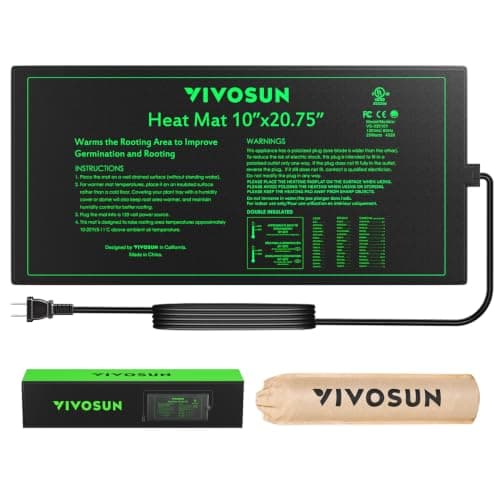
If your kitchen sits below 70 F for months of the year, heat is worth adding — and it is worth adding correctly. A seedling heat mat is the usual choice and it is a good one: VIVOSUN publishes 18 W, IP67 and UL and MET certification for its 10 x 20.75 in mat. It also publishes that the mat reaches around 104 F from a 68 to 77 F ambient, which is well above the band kombucha wants.
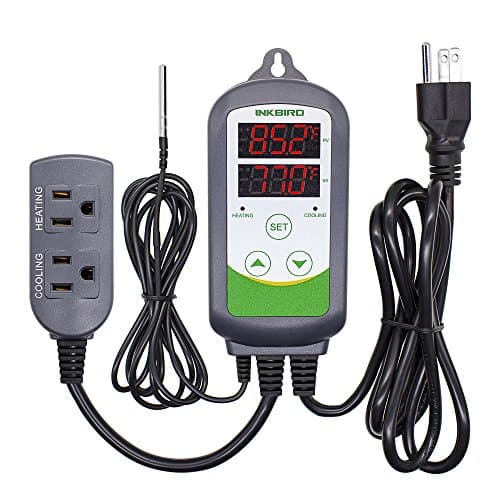
That published maximum is the argument for a controller rather than an argument against the mat. An Inkbird ITC-308 holds a setpoint to a stated plus or minus 1 C and switches the mat off when the jar reaches it. Heating mats and temperature controllers cover the pairing.
The third input, and the one nobody measures
Temperature and pH are the two readings this hub is built around. There is a third input that is invisible in both of them: the water. Municipal supplies are disinfected specifically to suppress microbial life, and a kombucha culture is microbial life — so a batch on treated water runs slow rather than dying visibly, which is the hardest failure to diagnose.
The part worth knowing before you buy anything is that free chlorine and chloramine behave completely differently. One leaves water that stands overnight and is driven off by boiling; the other does neither, which is why half the advice online works and half of it does not. Can you use tap water for kombucha? covers how to find out which one you have — free, from your utility — and what each removal method actually does.
The three instruments, reviewed one at a time
The comparison pages above rank these against each other. Where you have narrowed it to a single product and want the full specification, the honest cons and the case against buying it at all, each of the three has its own review: the Apera PH60, which is better specified than most kombucha brewers need; the Inkbird ITC-308, which is the part that makes a heat mat safe to own; and the VIVOSUN seedling mat, whose published maximum is the reason the controller is not optional.
The cheaper of the two pocket meters now has its own page. The Apera PH20 review works through whether its published tolerance clears the 4.2 line, and why a probe that cannot be replaced is the figure that actually decides between the two.
The cheapest instrument here now has its own page. The Craft A Brew Fermometer review covers what the maker publishes about its stick-on strip, the temperature range and accuracy it never states, and where on the jar to put it.
Heads up: some links on this page are affiliate links. If you buy through one we may earn a commission at no extra cost to you. It never changes a ranking, and we take no payment for placement. The full version.
The short answer
Quick picks
Ranked on the published rubric. Every row jumps to that product's full write-up below; the button goes straight to Amazon.
#
Product
Best for
Score
Price
1
Micro Essential Lab
Hydrion 9200 Spectral pH Strips, 0.0-6.0
A 0.0 to 6.0 range in 0.5 steps, which puts four separate color matches inside the 2.5 to 3.5 window kombucha lives in — a 1-to-14 strip gives you one.
A dual-stage thermostat with published relay ratings and a stated plus or minus 1 C accuracy, which is what turns a 104 F heat mat into a jar held at 78 F.
Eighteen watts, IP67, MET-certified, and published to reach about 104 F from a 68-77 F ambient — which is more heat than kombucha wants, so it belongs under a controller.
The only meter here whose published accuracy — ±0.01 pH — is finer than the decision you are using it to make, with a probe you can replace instead of the whole instrument.
The only cheap thing on this page that deals with chloramine as well as chlorine, at a published dose of one 500 mg tablet per 20 gallons, acting essentially on contact.
A 0.0 to 6.0 range in 0.5 steps, which puts four separate color matches inside the 2.5 to 3.5 window kombucha lives in — a 1-to-14 strip gives you one.
Who it is for. Every kombucha brewer. This is the cheapest instrument on the site and the one that answers the safety question.
#ad No live price feed yet, so no number is shown rather than a stale one. How this is funded.
#2 · Reading the jar, not the room
Craft a Brew Fermometer Adhesive Strip Thermometer
A four-inch liquid crystal strip that sticks to the glass and reads the liquid rather than the air, which is the distinction that matters.
Who it is for. Every brewer. This is the cheapest way to stop guessing what temperature the batch is at.
Published specifications
Size
Approximately 0.75 x 4 in
Reads
Fahrenheit and Celsius
Application
External fermenter surface
Compatible surfaces
Glass, plastic and stainless steel fermenters
How it works
“changes color to display the current temperature of the fermenting liquid inside the vessel”
Temperature range
Not published by this maker. Comparable fermentation strips are sold in bands such as 46-82 F, 57-90 F and 46-93 F.
Accuracy
Not published
Sold as
A 5 pack on the Amazon listing; the maker's own store lists it as a single strip
Source: Craft a Brew published Fermometer specification (size, display units, compatible surfaces, operating principle), craftabrew.com/products/fermometer-adhesive-strip-thermometer, fetched 2026-09-01. Comparable-strip ranges from retailer listings, cited as comparisons only.
Rubric — 7.4 / 10
Materials7/10 · weight 28%
Documentation5/10 · weight 22%
Capacity fit8/10 · weight 16%
Cleaning8/10 · weight 18%
Value10/10 · weight 16%
What it gets right
It reads through the glass, so it tells you what the kombucha is at rather than what the shelf is at — those differ by several degrees on a sunny afternoon
It costs less than a cup of coffee and never needs a battery
It sticks to glass, plastic and stainless, so it moves with you if you change vessels
Always visible, which means you actually look at it
What it costs you
Neither range nor accuracy is published for this specific strip
Liquid crystal strips read in bands, so you get “about 76” rather than 76.2
The two listings disagree on whether it is reusable — the Amazon listing calls it reusable, the maker's own spec page says nothing about removing or reapplying it
Skip it if. You want a logged, numeric record. A strip is a glance, not a measurement you can write down with confidence.
A dual-stage thermostat with published relay ratings and a stated plus or minus 1 C accuracy, which is what turns a 104 F heat mat into a jar held at 78 F.
Who it is for. Anyone who has bought a heat mat. The mat without the controller is the mistake; this is the other half.
Published specifications
Control range
-50 to 120 C (-58 to 248 F)
Accuracy
+/- 1 C (+/- 2 F)
Display resolution
0.1 C/F below 100 C/F; 1 C/F at or above 100 C/F
Relay capacity
Heating 10 A at 100-240 VAC; cooling 10 A at 100-240 VAC
Maximum load
1100 W at 110 VAC; 2200 W at 220 VAC
Input
100-240 VAC, 50/60 Hz, 10 A maximum
Outputs
Dual relay, separate heating and cooling setpoints, dual display
Protection
Compressor delay protection, high and low temperature alarms, sensor fault alarm
Source: Inkbird published ITC-308 specification (control range, accuracy, resolution, relay capacity, maximum load, alarms), inkbird.com/products/temperature-controller-itc-308, retrieved 2026-09-01
Rubric — 8.4 / 10
Materials8/10 · weight 28%
Documentation10/10 · weight 22%
Capacity fit8/10 · weight 16%
Cleaning8/10 · weight 18%
Value8/10 · weight 16%
What it gets right
Plus or minus 1 C is tight enough that a kombucha ferment stays inside a two-degree window all week
Dual stage means the same unit can drive a heat mat in winter and a fan or a cooler in summer
The sensor-fault alarm matters: a probe that falls out without an alarm is a batch cooked at full mat temperature
Relay ratings and maximum wattage are published, so you can check a mat or a fridge against it before plugging anything in
What it costs you
The probe is designed to sit against a vessel or in a thermowell, and taping it to the outside of a jar reads the room as much as the liquid
It costs several times what the mat costs
-50 to 120 C is an enormous range for a job that needs 20 to 30 C, and the extra range buys nothing here
Skip it if. You are not running a heater or a cooler. A controller with nothing to switch is an expensive thermometer.
VIVOSUN Waterproof Seedling Heat Mat, 10 x 20.75 in
Eighteen watts, IP67, MET-certified, and published to reach about 104 F from a 68-77 F ambient — which is more heat than kombucha wants, so it belongs under a controller.
Who it is for. Anyone brewing in a room that drops below 70 F, paired with a controller rather than plugged straight into the wall.
Published specifications
Size
10 x 20.75 in
Power
18 W
Certification
UL and MET certified
Water resistance
IP67
Stated operating band
Maintains around 68-86 F (20-30 C)
Stated maximum
“can be heated up to 40 C (104 F) at an ambient temperature of 20-25 C (68-77 F)”
Tray compatibility
Fits standard 1020 trays
Thermostat
Not included
Source: VIVOSUN published heat mat specification (dimensions, 18 W, UL and MET certification, IP67, temperature band and stated maximum against ambient), vivosun.com heat mat product page, retrieved 2026-09-01
Rubric — 8.6 / 10
Materials8/10 · weight 28%
Documentation9/10 · weight 22%
Capacity fit8/10 · weight 16%
Cleaning9/10 · weight 18%
Value9/10 · weight 16%
What it gets right
18 W is a trickle of heat, which is the right scale for nudging a jar a few degrees rather than cooking it
IP67 means a spill on the mat is a wipe rather than an incident, and fermentation is a wet hobby
UL and MET certification is stated, which is worth checking on anything that runs unattended for weeks
The published maximum is stated against a specific ambient, so you can reason about what it will do in your room
What it costs you
104 F is well above kombucha’s 75-85 F band — used bare, this mat will over-ferment a batch
No thermostat included, and it needs one
A mat under a jar heats the bottom, which drives convection but reads warmer at the base than at the surface
Skip it if. Your house sits at 75 F already. You do not have a temperature problem, and adding heat without a controller creates one.
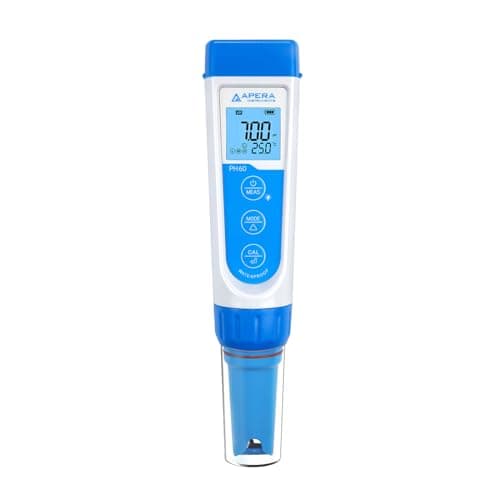
The only meter here whose published accuracy — ±0.01 pH — is finer than the decision you are using it to make, with a probe you can replace instead of the whole instrument.
Who it is for. Someone brewing continuously, tracking a number over time, or pushing a batch toward vinegar and wanting to know exactly where it is.
Published specifications
Model
PH60, SKU AI311
Range
“-2.00 to 16.00 pH”
Accuracy
“±0.01 pH ±1 digit”
Resolution
“0.01/0.1 pH”
Temperature compensation
“Auto Temperature Compensation 0 to 50°C (32 to 122°F)”
“TWO YEARS for the instrument and SIX MONTHS for the probe”
Source: Apera Instruments published PH60 product specification (model/SKU, range, accuracy, resolution, ATC range, calibration points and recognized buffers, replaceable PH60-E probe, IP67 rating, battery type and 2000-hour life, kit contents, warranty terms), aperainst.com, retrieved 2026-09-06
Rubric — 8.4 / 10
Materials9/10 · weight 28%
Documentation10/10 · weight 22%
Capacity fit9/10 · weight 16%
Cleaning7/10 · weight 18%
Value6/10 · weight 16%
What it gets right
±0.01 pH published accuracy against a decision line at 4.2 — the instrument is an order of magnitude finer than the question, which is the right way round
Three-point automatic calibration with buffers in the box, so it arrives ready to be made trustworthy rather than merely switched on
The probe is a replaceable part with its own model number, so a dead electrode is a component failure and not a landfill event
IP67 and floatable, which is a sensible specification for a device used over an open jar
What it costs you
The published probe warranty is six months against two years for the instrument, which tells you honestly where the wear is
It needs storage solution and periodic recalibration. A meter left dry in a drawer for a year reads confidently and wrongly
It costs many times a vial of strips to answer a question strips already answer well enough for most brewers
Four AAA batteries and a case make it a thing you own, not a thing you keep next to the jar
Skip it if. You test once a batch to confirm the ferment is under 4.2. Strips do that for a fraction of the money and never need calibrating.
The only cheap thing on this page that deals with chloramine as well as chlorine, at a published dose of one 500 mg tablet per 20 gallons, acting essentially on contact.
Who it is for. Anyone on a chloramine system who wants the problem solved for the price of a coffee, without a filter housing under the sink.
Published specifications
Active ingredient
Potassium metabisulfite
Count
25 tablets
Published dose
“500mg of potassium metabisulfite is enough to treat up to 20 gallons of water with up to 3 ppm of chlorine or chloramine”
Speed
Published as working “instantaneously”
Preparation
“Crush the required number of tablets before use.” “Dissolve or stir thoroughly into the liquid being treated.”
Storage
A 12 month shelf life is recommended by one retailer
Kombucha-specific guidance
None published. The dosing above is stated for brewing water
Source: Campden tablet specification and dosing as published by homebrew retailers: The Electric Brewery (500 mg potassium metabisulfite treats up to 20 gallons at up to 3 ppm chlorine or chloramine, works instantaneously, 12 month shelf life) and Homebrewers Mercantile (25 tablet count, active ingredient, crush-and-dissolve instructions), retrieved 2026-09-09
Rubric — 8.3 / 10
Materials7/10 · weight 28%
Documentation7/10 · weight 22%
Capacity fit9/10 · weight 16%
Cleaning10/10 · weight 18%
Value10/10 · weight 16%
What it gets right
It handles chloramine, which is the one thing boiling, standing overnight and an ordinary carbon filter at normal flow all fail to do
The published dose is one tablet per 20 gallons — a gallon batch needs a crumb of one, so a pack of 25 is effectively a lifetime supply
It works on contact rather than needing a wait, so it fits into the brew day you already have rather than adding a step the night before
It costs almost nothing and needs no plumbing, no housing and no replacement cartridge
What it costs you
No maker publishes a kombucha-specific dose. The figures here are stated for brewing water generally, and we are not going to pretend otherwise
Dosing a gallon accurately from a tablet sized for twenty means crushing and splitting, which is fiddly and hard to get exact at the small end
It is a sulfite. People with a sulfite sensitivity have a reason to prefer a filter or bottled water instead
It does nothing about anything else in the water — minerals, sediment or taste are all untouched
Skip it if. Your utility uses free chlorine rather than chloramine. Standing the water overnight or boiling it costs nothing and does the same job.
#ad No live price feed yet, so no number is shown rather than a stale one. How this is funded.
FAQ
Questions people actually ask
What temperature should kombucha be brewed at?+
Between about 75 and 85 F. Below roughly 70 F the yeast slows and the batch stalls; above about 85 F it ferments fast and thin and turns sour quickly.
What pH should kombucha be?+
Finished kombucha typically lands between 2.5 and 3.5. A new batch should drop below about 4.2 within the first couple of days, which is the point at which it has built its own acid protection.
Do I need pH strips to brew kombucha?+
You can brew without them, and people do. But they are the only instrument that tells you whether the batch has acidified enough to be safe, they cost very little, and one vial lasts for years of home brewing.
Can I use a seedling heat mat for kombucha?+
Yes, and it is the usual choice, but it needs a thermostat. VIVOSUN publishes that its mat reaches around 104 F from a 68 to 77 F ambient, which is well above kombucha's 75 to 85 F band. A controller holds the setpoint instead.
Where should I put the temperature strip?+
On the outside of the vessel, roughly at the level of the liquid, away from direct sun. It reads through the glass, which is the point: it tells you what the kombucha is at rather than what the room is at.
Chlorine versus chloramine, what boiling and standing overnight actually remove, and the published flow rate a carbon filter needs to handle chloramine.
Top pick · Hach Free & Total Chlorine Test Strips, 0-10 mg/L (2745050)