This site has told you a dozen times to use filtered water without once saying what that means. Two different chemicals are involved, and only one of them goes away on its own.
Sometimes. Municipal water is disinfected with either free chlorine or chloramine, and they behave completely differently: free chlorine dissipates from water left standing and is driven off by boiling, while chloramine is far more stable and does neither. Find out which one your utility uses — its annual water quality report says so, free — then treat accordingly.
Why the water is a variable at all
Chlorine and chloramine are added to municipal supplies for one purpose: to suppress microbial life all the way from the treatment plant to your tap. Kombucha is microbial life. That is the entire problem in one sentence, and it is why every page on this site that touches a culture eventually says “filtered water” and moves on.
The effect is rarely dramatic. A batch made with treated water does not die visibly; it goes slow. The culture takes longer to acidify, the batch spends longer in the window above pH 4.2 where it is not yet defending itself, and the brewer concludes the culture was weak. It usually was not. Water kefir grains show it fastest, because their whole cycle is 24 to 48 hours and there is nowhere for a delay to hide, which is why the published guidance for those is unchlorinated water rather than a suggestion.
None of which means tap water is automatically a problem. Plenty of people brew good kombucha straight from the tap for years. Whether you can depends on which chemical your utility uses and how much of it is left by the time it reaches you — and both of those are knowable rather than guessable.
Chlorine and chloramine are not the same problem
This is the distinction the internet consistently collapses, and it is the one that decides which fix you need.
How the two common municipal disinfectants behave. This is why one folk remedy works and the other does not.
Free chlorine
Chloramine
What it is
Dissolved chlorine gas / hypochlorite
Chlorine bonded to ammonia
Standing uncovered overnight
Dissipates
Does not meaningfully dissipate
Boiling
Driven off
Far more stable; not a reliable removal
Ordinary carbon filter at tap flow
Removed
Not reliably — needs long contact time
Campden tablet
Removed
Removed
Why utilities use it
Cheap, effective, dissipates fast
Persists further into the network
Read the second and third rows together and the folk advice makes sense at last. “Leave it out overnight” and “you boil the water for the tea anyway” are both perfectly good answers — if your utility uses free chlorine. On a chloramine system they are simply wrong, and the person repeating them is not lying, they are on a different water supply.
Step one costs nothing
Before buying anything, find out which one you have. Every community water system in the United States publishes an annual water quality report — the Consumer Confidence Report — and it states the disinfectant in use. It is free, it is specific to your supply, and it is more authoritative than any test you can run at home.
If you cannot find it, or you are on a supply that has changed treatment recently, the home version is a free-and-total chlorine strip. Free chlorine is the unreacted kind; total chlorine is everything. The gap between the two readings is combined chlorine, which on a municipal supply is essentially your chloramine. That is a genuinely useful measurement and almost nobody knows a single strip gives it to you.
The same logic runs through this whole site. A number you took yourself beats an argument you read, which is exactly why a vial of pH strips is the cheapest useful thing in the cupboard.
The picks
Find out, then fix it
One strip that tells you which chemical you are dealing with, the cheap treatment that handles both, and the plumbed option for anyone filtering water by the gallon.
Score8.2no photo yet
Hach
Free & Total Chlorine Test Strips, 0-10 mg/L (2745050)
The only product here that answers the question before you spend anything else — it reads free and total chlorine on the same strip, and the gap between those two numbers is your chloramine.
The only cheap thing on this page that deals with chloramine as well as chlorine, at a published dose of one 500 mg tablet per 20 gallons, acting essentially on contact.
#ad No live price feed yet, so no number is shown rather than a stale one. How this is funded.
Score7.5no photo yet
MoreBeer
Water Filter Kit, 10 in.
A complete carbon-block setup rather than a bare cartridge — and the only product here whose seller publishes the flow rate chloramine removal actually requires.
#ad No live price feed yet, so no number is shown rather than a stale one. How this is funded.
What each fix actually does
Standing overnight. Free chlorine only, and it needs the container uncovered and a wide surface. Free, slow, and useless against chloramine.
Boiling. Drives off free chlorine and you are boiling for the tea regardless, so it is free. Chloramine is far more stable and boiling is not a reliable removal for it.
A campden tablet. Potassium metabisulfite, published at 500 mg treating up to 20 gallons at up to 3 ppm of chlorine or chloramine, acting instantaneously. This is the cheap answer that works on both.
Carbon filtration. Removes chlorine easily. For chloramine it needs contact time — MoreBeer publishes a recommended fill rate of under 1 gallon per minute specifically to remove chloramines, which is far slower than a tap runs.
Bottled spring water. Works, costs the most per batch, and creates a recurring errand. Reasonable as a one-off test to see whether water was the problem.
Reverse osmosis or distilled water. Removes the disinfectant and also strips the trace minerals a culture uses. Not a straightforward upgrade — this is the one place where cleaner is not automatically better.
Dosing a tablet for one gallon
The published dose is one 500 mg tablet per 20 gallons. A kombucha batch is one gallon. That arithmetic is awkward and it is the honest weak point of an otherwise ideal product: you are crushing a tablet and using a fraction of the powder, which is not a precise operation in a home kitchen.
In practice brewers crush a tablet, dissolve it into a measured volume of water, and dose from that — or simply accept that a generous crumb in a gallon is still a very small quantity of sulfite that is largely consumed reacting with the chlorine it was added to remove. Neither approach is published as a kombucha method by anybody, and this page is not going to invent one. What is published is the brewing-water dose above, and the fact that it acts on contact rather than needing a wait.
Two things worth saying plainly. Sulfites are a genuine sensitivity for some people, and anyone avoiding them should filter or buy water instead. And a tablet does nothing about minerals, sediment or taste — it addresses one thing precisely, which is also why it is cheap.
When a filter is worth the hardware
A carbon block setup is the most expensive answer on this page to a problem a crushed tablet solves, and for a gallon a week it is hard to justify. It earns its place at volume: a continuous brew being topped up weekly, several ferments running at once, or a household brewing beer alongside kombucha.
The specification that matters is the one almost nobody publishes. MoreBeer states that chloramines can be removed by carbon filtration given long contact time, and recommends a fill rate under 1 gallon per minute to achieve it. That single sentence is the difference between a filter that solves your problem and one that quietly does not — and it means a filter run at normal tap pressure is a chlorine filter regardless of what the box says.
The rest of the arithmetic is straightforward: a cartridge published at 750 gallons, replaced at roughly 800 gallons or one year, whichever comes first. At a gallon of kombucha a week that is a cartridge a year on the clock rather than on the volume, which is the honest running cost.
Diagnosing a batch you think the water ruined
Water is a fashionable thing to blame and usually not the culprit. Before you re-plumb the kitchen, rule out the two variables that cause far more stalled batches.
What a slow batch usually is, in order of likelihood.
Symptom
Most likely cause
Check
Still sweet at day 10, no sourness
Temperature
Strip thermometer on the glass, not the room
pH still above 4.2 at day 3
Too little starter tea, or cold
Measure the starter at ten percent of batch volume
Slow, batch after batch, everything else right
Water
Free and total chlorine strip, or the utility report
Was fine, suddenly slow, nothing changed
Water — the utility may have switched treatment
Utility report; many switch seasonally
That last row is the genuinely interesting one. Some utilities alternate between free chlorine and chloramine at different times of year, which produces exactly the story brewers find baffling: a setup that worked for a year suddenly running slow with no change at your end. Batches that go too far and batches that stall are both timing problems, and water is one of the inputs that quietly moves the timing.
The other water in the process
Two places the same rule applies and people forget.
The first is rinsing. Never rinse a pellicle or a culture under the tap — you are running the exact chemical you have been avoiding straight over the organisms. The cleaning routine covers using a little of the batch's own kombucha instead.
The second is the sweet tea itself. If you are treating water, treat the water you brew the tea with, not just the water you top up with — the tea is most of the batch volume. Tea and sugar for kombucha covers the rest of the feedstock, and water is the ingredient on that page that gets one line and deserves this one.
Heads up: some links on this page are affiliate links. If you buy through one we may earn a commission at no extra cost to you. It never changes a ranking, and we take no payment for placement. The full version.
The short answer
Quick picks
Ranked on the published rubric. Every row jumps to that product's full write-up below; the button goes straight to Amazon.
#
Product
Best for
Score
Price
1
Score8.2
Hach
Free & Total Chlorine Test Strips, 0-10 mg/L (2745050)
The only product here that answers the question before you spend anything else — it reads free and total chlorine on the same strip, and the gap between those two numbers is your chloramine.
The only cheap thing on this page that deals with chloramine as well as chlorine, at a published dose of one 500 mg tablet per 20 gallons, acting essentially on contact.
A complete carbon-block setup rather than a bare cartridge — and the only product here whose seller publishes the flow rate chloramine removal actually requires.
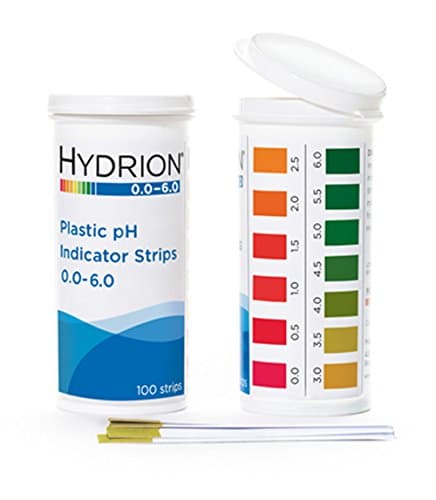
A 0.0 to 6.0 range in 0.5 steps, which puts four separate color matches inside the 2.5 to 3.5 window kombucha lives in — a 1-to-14 strip gives you one.
Hach Free & Total Chlorine Test Strips, 0-10 mg/L (2745050)
The only product here that answers the question before you spend anything else — it reads free and total chlorine on the same strip, and the gap between those two numbers is your chloramine.
Who it is for. Anyone whose culture keeps stalling for no visible reason, and anyone who wants to know whether the cheap fix or the expensive one is the right one.
Published specifications
Catalog number
2745050
Range
“0 - 10 mg/L Cl₂”
Graduations
“0, 0.5, 1, 2, 4, 10”
Measures
Free chlorine and total chlorine, simultaneously
Tests per package
50 tests. Also sold in 100, and 250 individually wrapped
Method
Dip and read against the printed scale
Read time
Not published
Shelf life
Not published
Source: Hach published product specification for Free & Total Chlorine Test Strips, 0-10 mg/L, catalog 2745050 (range, graduation steps, parameters measured, pack sizes, dip-and-read method), hach.com and ca.hach.com product detail pages, retrieved 2026-09-09
Rubric — 8.2 / 10
Materials8/10 · weight 28%
Documentation8/10 · weight 22%
Capacity fit7/10 · weight 16%
Cleaning10/10 · weight 18%
Value8/10 · weight 16%
What it gets right
Free and total on one strip is the whole point: subtract one from the other and you have your combined chlorine, which is the chloramine number nobody sells a home test for directly
It turns the entire water question from a forum argument into a reading you took yourself, which is exactly what pH strips did for the acidity question
Fifty tests is decades of use for a home brewer — you test when you move house or when the utility changes treatment, not every batch
Hach is a water-analysis company and publishes the range and the graduations rather than a marketing claim
What it costs you
The graduations run 0, 0.5, 1, 2, 4, 10, so the top of the scale is very coarse — fine for typical municipal residuals, useless for precision
Neither read time nor shelf life is published for this product, which is a gap on a strip that relies on a timed color development
It tells you what is in the water and nothing about how to remove it. This is a diagnostic, not a fix
Fifty tests is far more than a home brewer will ever use, and there is no smaller pack
Skip it if. Your utility’s annual water quality report already states which disinfectant it uses. That document is free, and it answers the same question without a purchase.
The only cheap thing on this page that deals with chloramine as well as chlorine, at a published dose of one 500 mg tablet per 20 gallons, acting essentially on contact.
Who it is for. Anyone on a chloramine system who wants the problem solved for the price of a coffee, without a filter housing under the sink.
Published specifications
Active ingredient
Potassium metabisulfite
Count
25 tablets
Published dose
“500mg of potassium metabisulfite is enough to treat up to 20 gallons of water with up to 3 ppm of chlorine or chloramine”
Speed
Published as working “instantaneously”
Preparation
“Crush the required number of tablets before use.” “Dissolve or stir thoroughly into the liquid being treated.”
Storage
A 12 month shelf life is recommended by one retailer
Kombucha-specific guidance
None published. The dosing above is stated for brewing water
Source: Campden tablet specification and dosing as published by homebrew retailers: The Electric Brewery (500 mg potassium metabisulfite treats up to 20 gallons at up to 3 ppm chlorine or chloramine, works instantaneously, 12 month shelf life) and Homebrewers Mercantile (25 tablet count, active ingredient, crush-and-dissolve instructions), retrieved 2026-09-09
Rubric — 8.3 / 10
Materials7/10 · weight 28%
Documentation7/10 · weight 22%
Capacity fit9/10 · weight 16%
Cleaning10/10 · weight 18%
Value10/10 · weight 16%
What it gets right
It handles chloramine, which is the one thing boiling, standing overnight and an ordinary carbon filter at normal flow all fail to do
The published dose is one tablet per 20 gallons — a gallon batch needs a crumb of one, so a pack of 25 is effectively a lifetime supply
It works on contact rather than needing a wait, so it fits into the brew day you already have rather than adding a step the night before
It costs almost nothing and needs no plumbing, no housing and no replacement cartridge
What it costs you
No maker publishes a kombucha-specific dose. The figures here are stated for brewing water generally, and we are not going to pretend otherwise
Dosing a gallon accurately from a tablet sized for twenty means crushing and splitting, which is fiddly and hard to get exact at the small end
It is a sulfite. People with a sulfite sensitivity have a reason to prefer a filter or bottled water instead
It does nothing about anything else in the water — minerals, sediment or taste are all untouched
Skip it if. Your utility uses free chlorine rather than chloramine. Standing the water overnight or boiling it costs nothing and does the same job.
#ad No live price feed yet, so no number is shown rather than a stale one. How this is funded.
Score7.5no photo yet
#3 · Filtered water at the tap, every time
MoreBeer Water Filter Kit, 10 in.
A complete carbon-block setup rather than a bare cartridge — and the only product here whose seller publishes the flow rate chloramine removal actually requires.
Who it is for. Someone running a continuous brew, several ferments at once, or brewing beer alongside kombucha — where filtered water by the gallon is a standing requirement rather than an occasional one.
Published specifications
In the kit
10 in housing, one carbon block filter, garden hose attachment, barbed fittings, and 6 ft of 3/8 in vinyl tubing
Filter
10 in carbon block, 10 micron
Removes
“removes all chlorine and organic flavor”; the cartridge listing adds sediment
Cartridge capacity
“Good for 750 gallons”
Replacement interval
“The carbon block should be replaced after filtering approximately 800 gallons of water or after 1 year of use, whichever comes first”
Chloramine
“Chloramines can be removed by carbon filtration if the water has a long contact time with the carbon. It is recommended to use at a fill rate of less than 1 gallon per minute in order to remove chloramines.”
Temperature
Cold water only. Not for hot water applications
Source: MoreBeer published specifications for the Water Filter Kit - 10 in. (kit contents, what it removes, 800 gallon or 1 year replacement interval, cold water only) and for the matching Carbon Block Water Filter - 10 in. (10 micron rating, 750 gallon capacity, and the published chloramine contact-time and sub-1-gallon-per-minute fill rate statement), morebeer.com, retrieved 2026-09-09
Rubric — 7.5 / 10
Materials8/10 · weight 28%
Documentation9/10 · weight 22%
Capacity fit9/10 · weight 16%
Cleaning6/10 · weight 18%
Value5/10 · weight 16%
What it gets right
It is the complete thing — housing, cartridge, hose fitting and tubing — rather than a cartridge that turns out to need a housing you have not bought
The seller publishes the flow rate chloramine removal requires, under 1 gallon per minute, which almost nobody in this category states and which is the difference between a filter that works on chloramine and one that does not
750 to 800 gallons is years of kombucha at a gallon a week, so the running cost is one cartridge a year at most
Filtered water is filtered water: unlike a chemical treatment it also takes out sediment and off-flavors you were not thinking about
What it costs you
It is by far the most expensive answer on this page to a problem a crushed tablet solves, and for one gallon a week that is hard to justify
The published chloramine removal depends entirely on running it slowly. At a normal tap flow it is a chlorine filter, not a chloramine filter
It attaches by garden hose fitting, which suits a laundry tap or an outdoor spigot and is awkward at a kitchen sink
Cold water only, and the cartridge is a consumable on a 1 year clock whether you use 800 gallons or 80
Skip it if. You brew a gallon a week. The volume does not justify the hardware, and a tablet or a jug of spring water covers it for a fraction of the cost.
A 0.0 to 6.0 range in 0.5 steps, which puts four separate color matches inside the 2.5 to 3.5 window kombucha lives in — a 1-to-14 strip gives you one.
Who it is for. Every kombucha brewer. This is the cheapest instrument on the site and the one that answers the safety question.
#ad No live price feed yet, so no number is shown rather than a stale one. How this is funded.
FAQ
Questions people actually ask
Can I use tap water for kombucha?+
Often yes, but it depends on how your water is treated. Free chlorine dissipates from water left standing and is driven off by boiling, so it is easy to deal with. Chloramine is far more stable and does neither, so it needs a campden tablet or slow carbon filtration. Your utility's annual water quality report states which one you have.
Does boiling water remove chlorine for kombucha?+
It removes free chlorine, and since you boil water for the tea anyway that is a free fix. It is not a reliable removal for chloramine, which is chlorine bonded to ammonia and much more stable. If your utility uses chloramine, boiling does not solve it.
How do I know if my water has chloramine?+
Read your community water system's annual water quality report, which names the disinfectant in use. To test at home, use a free-and-total chlorine strip: total chlorine minus free chlorine gives you combined chlorine, which on a municipal supply is essentially the chloramine.
Will a Brita or pitcher filter remove chloramine?+
Not reliably. Carbon removes chlorine easily but chloramine needs long contact with the carbon — MoreBeer publishes a recommended fill rate under 1 gallon per minute to remove chloramines, which is far slower than water passes through a pitcher or a tap. Certification is contaminant-specific too, so a filter listed for chlorine is not automatically listed for chloramine.
How much campden tablet do I use for a gallon of kombucha?+
No maker publishes a kombucha-specific dose. The published brewing-water figure is 500 mg — one tablet — treating up to 20 gallons at up to 3 ppm of chlorine or chloramine, so a gallon needs a small fraction of one, crushed and stirred in thoroughly. Anyone avoiding sulfites should filter or use bottled water instead.
Sources
Every specification cited on this page came from one of these documents, retrieved on the date shown against the product it belongs to.