Two ingredients, and both of them have a right answer that is cheaper than the wrong one.
By Scooter M.·Published September 1, 2026 · Updated September 13, 2026
The short answer
True tea from Camellia sinensis — black, green, white or oolong — and plain white granulated cane sugar. Herbal infusions are not tea and do not feed the culture. Avoid heavily oiled flavored teas — bergamot blends above all — for repeated batches, because the oils accumulate on the culture.
Which teas work
For the first fermentation. Flavoring happens later, in the bottle.
Tea
Works?
Notes
Black
Yes — the default
Most nutrients for the culture, most robust flavor.
Green
Yes
Lighter and faster. Slightly less to feed on than black.
Oolong
Yes
Between the two. The Kombucha Shop ships a black and oolong blend.
White
Yes
Very delicate. Best blended with black rather than used alone.
Bergamot blends and other oiled teas
Occasionally
Added oils accumulate on the culture over repeated batches.
Herbal infusion — rooibos, chamomile, mint
No
Not tea. Does not contain what the culture needs.
Decaffeinated tea
Poorly
Decaffeination strips more than caffeine. Cultures decline on it.
The reason herbal infusions fail is straightforward: kombucha cultures are adapted to compounds present in Camellia sinensis, and a chamomile infusion is a completely different plant with a different chemistry. It is not a matter of strength or steeping time.
A blend is usually the best answer
Black tea gives the culture the most to work with and produces the most robust result. Green tea produces a lighter, brighter drink and ferments a little faster. A blend gets both, which is why several kits ship one — The Kombucha Shop publishes organic loose leaf black and oolong in its kit contents.
A common working ratio is two-thirds black to one-third green. There is nothing precise about it; adjust to taste and watch the culture, which will tell you over a few batches whether it is thriving.
Sugar, and why plain white wins
The culture eats the sugar. That is the whole role, and it is why substitutions do not work the way people hope.
Plain white granulated cane sugar. The default, the cheapest, and what cultures are adapted to. It is fully consumed, which is why finished kombucha is far less sweet than the tea it started as.
Raw and unrefined sugars. Work, ferment slightly differently, and carry more minerals. Some brewers prefer them. Not an upgrade so much as a variation.
Honey. Not for kombucha. Raw honey carries its own antimicrobial activity, and the honey ferment is a different drink with a different culture: jun.
Zero-calorie sweeteners. Not food. Stevia, erythritol and sucralose are not metabolized by the culture, so the batch simply does not ferment.
Coconut sugar, maple syrup, agave. All ferment to some extent and all change the result. Fine to experiment with; not a good idea for the culture you rely on.
The picks
Kits that publish what tea and sugar they ship
Useful for a first batch precisely because they remove the variable. After that, plain supermarket tea and sugar cost a fraction of a kit sachet and work identically.
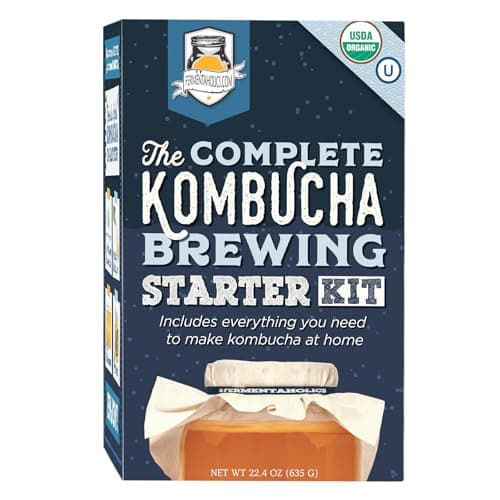
Fermentaholics
Complete Kombucha Brewing Starter Kit (1 Gallon)
Twelve fluid ounces of mature starter tea with the pellicle, measured against the maker’s own published ten percent rule — the fullest kit of the group.
The only kit here that ships pH strips, a pipette and a temperature gauge in the box, which is the difference between brewing kombucha and guessing at it.
#ad No live price feed yet, so no number is shown rather than a stale one. How this is funded.
Ratios and method for a gallon
One cup of sugar and eight tea bags — or about two tablespoons of loose tea — to roughly fourteen cups of water. Steep the tea in about four cups of just-boiled water for ten to fifteen minutes, remove it, dissolve the sugar into the hot tea, then top up with cold water.
Dissolving the sugar while the tea is hot matters. Sugar that has not dissolved sits at the bottom of the jar unavailable to the culture, and it is a surprisingly common reason a batch ferments more slowly than expected.
The water is an ingredient too
Chlorine and chloramine are added to municipal water to suppress microbial life, which is precisely what a kombucha culture is. Filtered water is the simplest answer. Tap water left standing uncovered overnight loses free chlorine, though not chloramine, which many utilities now use instead.
If a culture is persistently sluggish and the temperature is fine, the water is the next thing to change. The same applies more sharply to water kefir, where Cultures for Health specifies unchlorinated, unfluoridated water outright.
The leaf you choose also decides the one thing people ask about most after taste. Published dry-leaf caffeine runs from 34.86 mg/g for green down to 19.67 for oolong, and fermentation removes some of it — does kombucha have caffeine has the figures and is honest about where the studies disagree.
Water gets one line above and deserves more, because two different chemicals are involved and only one of them goes away on its own. Free chlorine leaves water left standing and is driven off when you boil for the tea; chloramine does neither, which is why half the advice on this subject works and half of it does not. Can you use tap water for kombucha? covers how to find out which one your utility uses, free, before buying anything.
This page settles which leaf works. It does not tell you which bag to order, and the bags are not comparable on weight — the best tea for kombucha compares them on published gallons per pouch, which is the only figure that makes the category comparable.
Heads up: some links on this page are affiliate links. If you buy through one we may earn a commission at no extra cost to you. It never changes a ranking, and we take no payment for placement. The full version.
The short answer
Quick picks
Ranked on the published rubric. Every row jumps to that product's full write-up below; the button goes straight to Amazon.
#
Product
Best for
Score
Price
1
Fermentaholics
Complete Kombucha Brewing Starter Kit (1 Gallon)
Twelve fluid ounces of mature starter tea with the pellicle, measured against the maker’s own published ten percent rule — the fullest kit of the group.
The only kit here that ships pH strips, a pipette and a temperature gauge in the box, which is the difference between brewing kombucha and guessing at it.
Twelve fluid ounces of mature starter tea with the pellicle, measured against the maker’s own published ten percent rule — the fullest kit of the group.
Who it is for. Someone who wants the culture to be the strongest part of the kit rather than the jar.
Published specifications
Batch size
1 gallon
Culture
Kombucha starter culture: pellicle plus 12 fl oz of mature starter tea, measured for a 1-gallon batch
Jar
1-gallon brew jar
Tea and sugar
Tea blend, organic cane sugar, reusable cotton tea bag
Measurement gear
Adhesive thermometer, pH strips, pipette
Cover
Cotton cloth cover and rubber band
Certification
USDA Certified Organic; also stated Kosher, Non-GMO and vegan
Starter tea ingredients
Organic cane sugar, filtered water, organic black tea, live cultures
Documentation
Detailed instructions and a flavoring guide
Source: Fermentaholics published kit contents and culture specification, fermentaholics.com/product/the-complete-kombucha-brewing-starter-kit/, retrieved 2026-09-01
Rubric — 8.0 / 10
Materials8/10 · weight 28%
Documentation9/10 · weight 22%
Capacity fit8/10 · weight 16%
Cleaning7/10 · weight 18%
Value8/10 · weight 16%
What it gets right
12 fl oz against a 128 oz gallon is 9.4 percent, within a rounding error of the maker’s own 10 percent rule — the quantity matches the instruction
Both instruments a first batch needs, thermometer and pH strips, are in the box
The starter tea’s ingredients are published, which almost no culture seller does
USDA Organic, Kosher, Non-GMO and vegan claims are all stated together rather than implied
What it costs you
No jar dimensions published
The jar is plain glass with no volume markers, so the 10 percent reserve is a judgment call
Nothing in the kit addresses bottling — you finish the batch with nowhere to put it
Skip it if. You want to bottle at the end of week one. Nothing here holds pressure; budget for swing-top bottles at the same time.
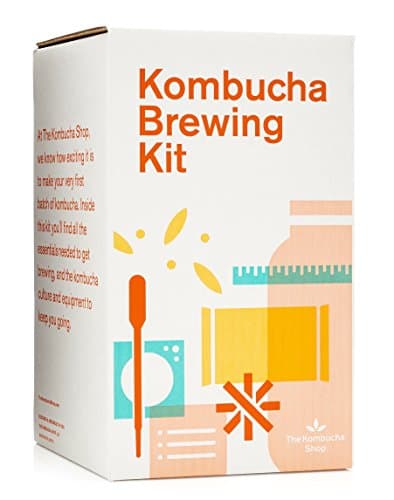
The only kit here that ships pH strips, a pipette and a temperature gauge in the box, which is the difference between brewing kombucha and guessing at it.
Who it is for. Someone brewing their first batch who wants the measurement gear included rather than ordered separately three days in.
Published specifications
Batch size
1 gallon
Jar
One Gallon Brew Jar with plastic lid, thick American glass, screen-printed Brew Notes on the side
Culture
Organic kombucha culture plus 1 cup liquid starter
Culture aging
Stated to ferment for a minimum of 6 weeks before shipping
Tea
Organic loose leaf black and oolong, with a reusable cotton tea bag
Measurement gear
pH test strips, pipette, temperature gauge, wet-erase marker
Cover
Cotton cover and rubber band
Certification
USDA Organic Certified
Spigot
None. The jar takes a plastic lid, not a tap.
Source: The Kombucha Shop published kit contents and product description, thekombuchashop.com/products/kombucha-brewing-kit, fetched 2026-09-01
Rubric — 7.4 / 10
Materials8/10 · weight 28%
Documentation7/10 · weight 22%
Capacity fit8/10 · weight 16%
Cleaning7/10 · weight 18%
Value7/10 · weight 16%
What it gets right
pH strips and a pipette in the box mean you can answer “is this safe yet” on day three instead of guessing
The culture is stated to ferment a minimum of six weeks before it ships, which is a long lead time and shows in how fast a first batch takes off
Brew Notes screen-printed on the glass keep the start date on the jar rather than on a sticky note
USDA Organic certification covers the tea, sugar and culture together
What it costs you
No jar dimensions are published anywhere, so you cannot check it against a shelf before ordering
No spigot, so bottling means lifting a full gallon and siphoning or pouring
The most expensive of the four kits here, and some of that is the marker
Skip it if. You already own a gallon jar. You are paying for glass you have, and a culture-plus-ingredients pack costs far less.
#ad No live price feed yet, so no number is shown rather than a stale one. How this is funded.
FAQ
Questions people actually ask
What is the best tea for kombucha?+
Black tea is the default and gives the culture the most to work with. Green, white and oolong all work, and a blend of black and green is a common choice. What matters is that it is true tea from Camellia sinensis.
Can I use herbal tea for kombucha?+
Not for the fermentation. Rooibos, chamomile, mint and similar are infusions of other plants and do not contain what a kombucha culture needs. Use them for flavoring in the second fermentation instead.
What sugar should I use for kombucha?+
Plain white granulated cane sugar. The culture eats it, which is why substitutions matter: zero-calorie sweeteners are not metabolized at all and the batch simply will not ferment.
Can I use honey in kombucha?+
Not for kombucha. Raw honey has its own antimicrobial activity and a kombucha culture tends to weaken on it. The honey ferment is jun, which uses green tea and a different culture entirely.
Can I use bergamot or other flavored tea?+
Occasionally, but not as your standing tea. Bergamot and other added oils accumulate on the culture over repeated batches. Use plain tea for fermenting and add flavor in the bottle instead.
Sources
Every specification cited on this page came from one of these documents, retrieved on the date shown against the product it belongs to.
Chlorine versus chloramine, what boiling and standing overnight actually remove, and the published flow rate a carbon filter needs to handle chloramine.