Buy a culture from a supplier who publishes how much starter tea comes with it, and match that volume to your batch: roughly ten percent of the batch size. A pellicle arriving in a splash of liquid is a much weaker start than a pellicle arriving in a measured cup of mature, acidic starter tea.
What a SCOBY actually is
SCOBY stands for symbiotic culture of bacteria and yeast. In everyday use people point at the rubbery disc floating on top and call that the SCOBY, and that is a slight misnomer worth clearing up because it changes what you buy. The disc — properly, the pellicle — is a cellulose mat the bacteria build. The actual community of yeast and acetic acid bacteria is suspended throughout the liquid.
This is why the starter tea matters more than the pellicle. It carries the organisms, and it carries the acidity that protects a fresh sweet batch during the first days, before the new culture has produced enough acid of its own to defend itself. The full SCOBY guide covers growing one from a bottle of shop kombucha, how long that takes, and what a healthy one looks like.
How much starter tea you need
Ten percent of the batch volume is the working rule, and Fermentaholics publishes it in those words. The arithmetic is simple and worth doing before you order:
Starter tea at the published 10 percent rule.
Batch
Volume
Starter tea at 10%
Common product size
Half gallon
64 oz
6.4 oz
0.75 cups (6 fl oz)
1 gallon
128 oz
12.8 oz
12 fl oz
2 gallons
256 oz
25.6 oz
Two 12 fl oz packs
Buying a half-gallon culture for a gallon batch is the commonest ordering mistake. It works, but the batch spends longer in the vulnerable window, which is precisely when mold gets a foothold.
Five drink ferments, five different organisms
Kombucha is one of several drink ferments that look similar in a jar and behave nothing alike. They are not interchangeable, and you cannot convert one into another by changing what you feed it.
Kombucha. Black or green tea plus cane sugar. Seven to fourteen days. Sour, tea-forward.
Jun. Green tea plus honey, a genuinely different culture, and it runs cooler and faster. Jun vs kombucha compares them properly.
Water kefir. Sugar water plus grains, no tea, no caffeine, and a 24-to-48-hour cycle rather than a fortnight. Kombucha vs water kefir.
Milk kefir. Dairy rather than tea or sugar water, and the fastest of the lot — a batch finishes overnight, every night, which is the whole commitment. Milk kefir grains, and what to buy.
Ginger bug. Not a purchased culture at all — you build one from fresh ginger, sugar and water in about a week. How to make a ginger bug.
Buying a live culture, and what can go wrong
A live culture is a live thing in a box, and that is the honest risk. It travels through unheated and overheated spaces, it can sit in a depot over a weekend, and none of that is under the seller's control once it ships. The things that are under their control, and that you can check before ordering:
The volume of starter tea, stated in fluid ounces or cups rather than described as 'plenty'.
What the starter tea is made of. Fermentaholics publishes its ingredients — organic cane sugar, filtered water, organic black tea, live cultures — which is rare and lets you check there is nothing in it you did not want.
How long the culture was grown before shipping. The Kombucha Shop states a minimum of six weeks.
Certification, where it matters to you. USDA Organic, Kosher and Non-GMO are all stated by the sellers on this site.
One more thing worth knowing before you buy anything: a kombucha culture and a vinegar mother are close relatives, and a kombucha batch left long enough ends up somewhere very near vinegar on its own. Kombucha vs apple cider vinegar sets out what separates them, including the one that has a legal definition.
And if the culture you are after is jun rather than kombucha, buy it as jun. It is a distinct organism community, not a SCOBY fed honey, and feeding a kombucha culture honey weakens it rather than converting it. Buying a jun SCOBY covers what ships in the box and how much starter tea should come with it. For the kefir cultures, our review of what Cultures for Health publishes compares their three starters on documentation rather than marketing.
The kombucha side gets the same treatment. Our Fermentaholics review checks the starter tea volumes that culture house publishes against its own ten percent rule at every batch size, and records the figures it leaves out.
Two more routes into a culture are worth knowing. Growing a SCOBY from a bottle covers the free alternative to buying one — which bottle can work, how long it really takes, and when ordering a culture is simply the better call. And the Yogourmet kefir starter review looks at the powdered route for anyone who wants kefir without keeping something alive.
Heads up: some links on this page are affiliate links. If you buy through one we may earn a commission at no extra cost to you. It never changes a ranking, and we take no payment for placement. The full version.
The short answer
Quick picks
Ranked on the published rubric. Every row jumps to that product's full write-up below; the button goes straight to Amazon.
#
Product
Best for
Score
Price
1
Fermentaholics
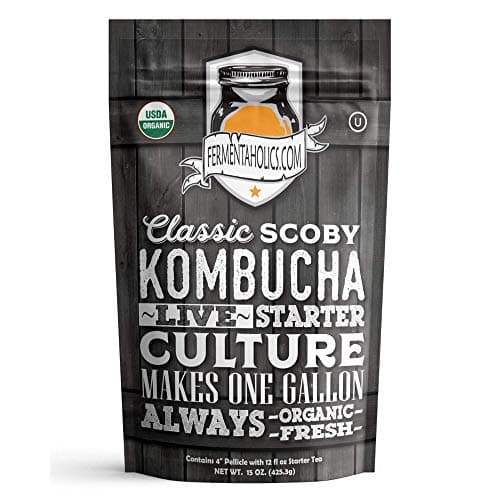
Organic Kombucha SCOBY with 12 fl oz Starter Tea
A hand-selected pellicle with twelve fluid ounces of mature starter tea, measured against the maker’s own published ten percent rule for a gallon.
Two teaspoons of dehydrated grains that rehydrate to three or four tablespoons and then turn out two to three quarts every 24 to 48 hours, indefinitely.
The same organic culture line dosed for half a gallon — three quarters of a cup of starter tea with a pellicle, which is the right amount for a smaller jar.
The only milk kefir culture here that publishes its whole life cycle — activation schedule, working ratio, culturing window and when the grains start multiplying.
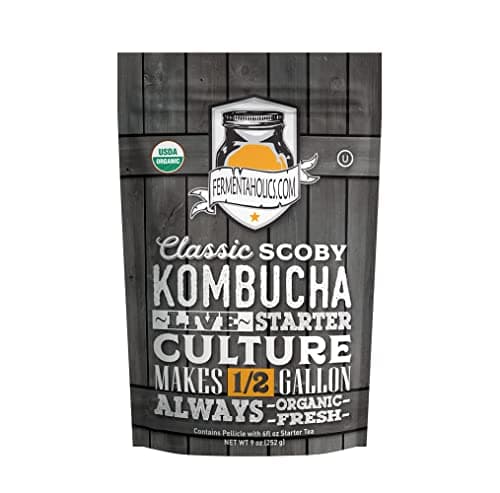
Fermentaholics Organic Kombucha SCOBY with 12 fl oz Starter Tea
A hand-selected pellicle with twelve fluid ounces of mature starter tea, measured against the maker’s own published ten percent rule for a gallon.
Who it is for. Anyone starting a standard one-gallon batch who wants the starter tea measured for them.
Published specifications
Batch size
One gallon
Starter tea volume
12 fl oz of mature, active starter tea
Pellicle
Hand-selected
Starter tea ingredients
Organic cane sugar, filtered water, organic black tea, live cultures
Certification
USDA Certified Organic, Kosher, Non-GMO, vegan
Production
Grown in the maker’s licensed lab
Maker’s dosing rule
“the rule of thumb is to use 10% starter tea per batch size”
Source: Fermentaholics published SCOBY specification (12 fl oz starter tea, 1-gallon dosing, ingredients, certifications) and its published 10 percent starter rule, retrieved 2026-09-01
Rubric — 8.5 / 10
Materials9/10 · weight 28%
Documentation9/10 · weight 22%
Capacity fit8/10 · weight 16%
Cleaning8/10 · weight 18%
Value8/10 · weight 16%
What it gets right
12 fl oz against a 128 oz gallon is 9.4 percent, within a rounding error of the maker’s own 10 percent rule — the quantity matches the instruction
Starter tea is the part that actually acidifies a new batch and protects it from mold; the pellicle is mostly a raft
Ingredients of the starter tea are published, which almost no culture seller does
Certified organic, kosher, non-GMO and vegan are stated together
What it costs you
A live culture in transit is a live culture in transit — heat and delay are real risks nobody controls
No stated shelf life once it arrives
You still need tea, sugar and a jar
Skip it if. You are brewing half a gallon. Buy the half-gallon version instead; a gallon’s worth of starter in a half-gallon batch drives the acidity too far, too fast.
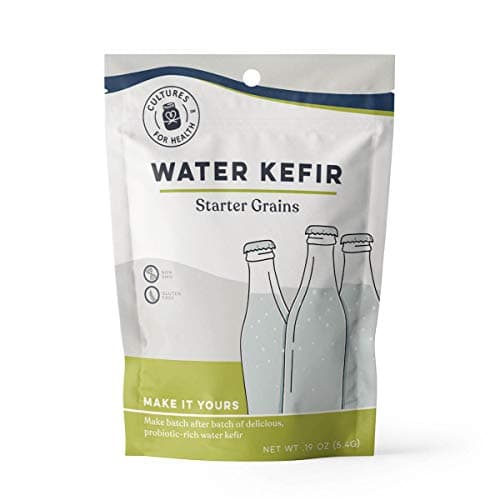
Cultures for Health Water Kefir Grains (Dehydrated)
Two teaspoons of dehydrated grains that rehydrate to three or four tablespoons and then turn out two to three quarts every 24 to 48 hours, indefinitely.
Who it is for. Someone who wants a fizzy home ferment on a two-day cycle, with no tea and no caffeine.
Published specifications
Shipped form
Dehydrated. Each packet contains 2 teaspoons of live active grains
Rehydration time
3-4 days; may take up to 7 days
Rehydration water
Unchlorinated, unfluoridated water with cane sugar
Activation sugar
1/4 cup cane sugar to 3-4 cups water
Rehydrated volume
3-4 tablespoons of grains
Output
2-3 quarts every 24-48 hours once established
Working ratio
1-2 teaspoons of grains per 4 cups of liquid
Culture temperature
68-85 F
Shelf life, room temperature
12-18 months at 68-78 F
Shelf life, refrigerated
18+ months at 40-45 F
Source: Cultures for Health published water kefir grain specifications (packet volume, rehydration, ratios, storage temperatures and shelf life), culturesforhealth.com water kefir FAQ and starter culture instructions, retrieved 2026-09-01
Rubric — 8.9 / 10
Materials9/10 · weight 28%
Documentation10/10 · weight 22%
Capacity fit8/10 · weight 16%
Cleaning8/10 · weight 18%
Value9/10 · weight 16%
What it gets right
A 24-to-48-hour cycle against kombucha’s 7 to 14 days — this is the ferment for someone impatient
Dehydrated grains have a published 12-to-18-month room-temperature shelf life, so the packet can sit in a drawer until you are ready
Every number a beginner needs is published: activation ratio, working ratio, temperature band, output volume
No tea and no caffeine, so it suits households that will not drink kombucha
What it costs you
Three to seven days of rehydration before the first real batch, which is longer than a kombucha SCOBY takes to get going
Chlorinated tap water will stall or kill the grains, so filtered water is not optional
Grains multiply, and you will be giving them away or throwing them out within a month
Skip it if. You want the sour, tea-driven flavor of kombucha. Water kefir is lighter, sweeter and closer to a soda; it is a different drink, not a faster kombucha.
Fermentaholics Organic Live Kombucha SCOBY, Half-Gallon Batch
The same organic culture line dosed for half a gallon — three quarters of a cup of starter tea with a pellicle, which is the right amount for a smaller jar.
Who it is for. A cautious first-timer, or anyone testing whether they will actually drink the stuff before committing a gallon of tea.
Fermentaholics Organic Dehydrated Water Kefir Grains
The same dehydrated-grain format with USDA Organic certification and the maker’s own published rehydration method.
Who it is for. Someone already buying kombucha cultures from the same maker who wants water kefir certified organic too.
Published specifications
Shipped form
Dehydrated grains
Certification
USDA Certified Organic
Rehydration
Maker publishes a step-by-step rehydration method for dehydrated grains
Feedstock
Cane sugar in unchlorinated water
Grain weight
Not published
Source: Fermentaholics published organic dehydrated water kefir grain listing and rehydration guide, fermentaholics.com/how-to-rehydrate-water-kefir-grains/, retrieved 2026-09-01
Rubric — 7.9 / 10
Materials9/10 · weight 28%
Documentation7/10 · weight 22%
Capacity fit7/10 · weight 16%
Cleaning8/10 · weight 18%
Value8/10 · weight 16%
What it gets right
Certified organic, which matters more here than usual because the grains live in the sugar you feed them
The maker publishes its own rehydration walkthrough rather than leaving you to a forum
Dehydrated grains ship without the timing pressure of a live culture
Same maker as the kombucha cultures, so one order can cover both ferments
What it costs you
Grain weight or volume is not published, so you cannot compare the packet size against alternatives
Rehydration is still days of feeding before a first real batch
No published shelf life
Skip it if. You want the exact packet quantity before you order. It is not published here; the Cultures for Health packet states two teaspoons.
#ad No live price feed yet, so no number is shown rather than a stale one. How this is funded.
#5 · A reusable culture you keep forever
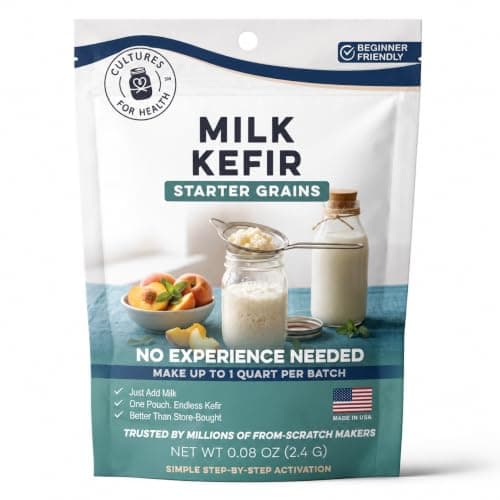
Cultures for Health Milk Kefir Grains (Dehydrated)
The only milk kefir culture here that publishes its whole life cycle — activation schedule, working ratio, culturing window and when the grains start multiplying.
Who it is for. Someone who wants a permanent culture — buy once, strain daily, and never order a starter again.
Published specifications
Shipped form
“1 packet of dehydrated traditional, heirloom-style milk kefir grains”
Activation starting volume
1 cup fresh, cold pasteurized milk
Activation schedule
Between hours 8 and 24, check hourly; at the first change in texture, strain and re-milk, increasing the milk by 1/2 cup
Activation period
3 to 7 days, feeding increasing amounts of milk from 1 cup up to 4 cups
Activation endpoint
“Your grains are activated when they are reliably thickening milk in about 24 hours”
Working ratio
1-2 teaspoons of grains per up to 4 cups of milk
Culture temperature
68-85 F
Culturing time
12 to 24 hours; never leave grains in milk beyond 48 hours
Multiplication
“Generally kefir grains take 6 to 8 weeks following rehydration to begin multiplying”
Milk requirement
Pasteurized whole milk, not UHT or ultra-pasteurized. Raw milk after a transition
Straining
“Stainless steel is acceptable. Avoid all other types of metal.”
Certification
Non-GMO, gluten free
Shelf life
“Use the starter culture by the date on the bag”
Source: Cultures for Health published milk kefir grain product specification, its activation instructions for dehydrated milk kefir grains, and its milk kefir FAQ (working ratio, temperature, culturing time, multiplication, milk types and straining metals), culturesforhealth.com, retrieved 2026-09-04
Rubric — 8.7 / 10
Materials9/10 · weight 28%
Documentation10/10 · weight 22%
Capacity fit8/10 · weight 16%
Cleaning7/10 · weight 18%
Value9/10 · weight 16%
What it gets right
Every number the first month needs is published: the 1-cup start, the half-cup step up, the 3-to-7-day window, the 1-2 teaspoons per 4 cups working ratio and the 12-to-24-hour culturing time
It is reusable indefinitely, so the culture is a one-time purchase rather than a subscription — unlike every powdered starter on this page
Dehydrated grains ship without the timing pressure of a live culture in a hot van
The maker states which metals are safe to strain with, which is the one hardware question this ferment raises and almost nobody answers
What it costs you
The packet weight or volume is not published, so you cannot compare the quantity against another seller before ordering
Three to seven days of daily feeding before the first drinkable batch, then a further 6 to 8 weeks before the grains multiply
It is a daily obligation. Grains left in milk past 48 hours starve, and there is no published pause longer than that
Ultra-pasteurized milk will not work, and in some US markets that is most of the shelf
Skip it if. You travel often or want a ferment you can walk away from for a fortnight. Grains need feeding on a 12-to-24-hour cycle; a powdered direct-set starter is the honest answer for an intermittent brewer.
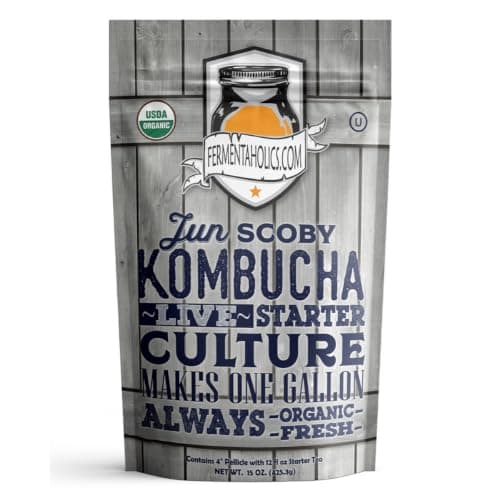
Fermentaholics Jun Kombucha Starter Culture, 12 fl oz
A jun pellicle with twelve fluid ounces of pre-measured mature starter tea — the culture on its own, for anyone who already owns a gallon jar.
Who it is for. A kombucha brewer with a spare jar who wants to try jun without buying a second set of hardware.
Published specifications
Culture
USDA Certified Organic jun SCOBY
Starter tea volume
12 fl oz
Batch size
“Makes 1 Gallon”
What ships
“pre-measured strong, mature liquid starter tea packaged with a starter pellicle”
Feedstock
Green tea and honey, not black tea and cane sugar
Certification
USDA Certified Organic, Kosher
Production
“grown in our fully licensed lab”
Shipped weight
0.5 lb
Jar
None. This is the culture only
Source: Fermentaholics published Jun Kombucha Starter Culture listing (organic jun SCOBY, 12 fl oz pre-measured mature starter tea with a starter pellicle, makes 1 gallon, green tea and honey feedstock, USDA Organic and Kosher, licensed lab, 0.5 lb shipped weight), Amazon B01NADMSEJ, retrieved 2026-09-13
Rubric — 8.4 / 10
Materials9/10 · weight 28%
Documentation8/10 · weight 22%
Capacity fit8/10 · weight 16%
Cleaning8/10 · weight 18%
Value9/10 · weight 16%
What it gets right
Twelve fluid ounces against a 128 oz gallon is 9.4 percent, which lands on the same ten percent starter rule the maker publishes for its kombucha cultures
It is the culture on its own, so it costs a fraction of the jun kit if you already own a gallon jar
A jun culture bought as a jun culture is the only reliable way to get one — feeding a kombucha SCOBY honey weakens it rather than converting it
Same licensed lab and the same organic and kosher certification as the maker’s kombucha line
What it costs you
You still need a jar, a cover, a band, green tea and honey before anything ferments
Honey is meaningfully more expensive per batch than cane sugar, and jun wants a lot of it
A live culture in transit is a live culture in transit — heat and delay are risks nobody controls
No shelf life is published once it arrives
Skip it if. You own no gallon jar. The Essentials jun kit bundles the same culture with the jar, cover and band for not much more.
From a dedicated culture supplier, from a general marketplace listing, or free from another brewer — every healthy batch grows a new pellicle, so brewers usually have spares. Buy from whoever publishes the volume of starter tea included, because that number is what protects your first batch.
How much starter tea do I need for one gallon?+
Roughly 10 percent of the batch, which is about 12 to 13 fluid ounces for a one-gallon batch. Fermentaholics publishes the 10 percent rule and ships 12 fl oz with its gallon culture, which is 9.4 percent.
Can I grow my own SCOBY from a bottle of kombucha?+
Yes, from a raw, unpasteurized, unflavored bottle plus sweet tea, left covered in a warm spot. It takes a couple of weeks and it depends entirely on the bottle being genuinely live. It is slower and less reliable than buying a culture, but it costs almost nothing.
Is a jun culture just a kombucha SCOBY fed honey?+
No. Jun is a distinct culture community adapted to honey and green tea. Feeding a kombucha SCOBY honey tends to weaken it rather than convert it, which is why jun is sold as its own culture.
How long does a kombucha culture last?+
Indefinitely with regular feeding. Cultures are reused batch after batch and grow a fresh pellicle every time. Between batches they are kept in a SCOBY hotel — a jar of strong finished kombucha that keeps them fed and acidic.
Grains or powder, what each maker actually publishes, the activation month in real numbers, and the jar-and-strainer question every daily brewer runs into.
Top pick · Cultures for Health Milk Kefir Grains (Dehydrated)
Three starters from one maker, compared on published activation windows, ratios and shelf life — and an honest account of where the documentation ends.
Top pick · Cultures for Health Water Kefir Grains (Dehydrated)