A ginger bug is a wild-yeast starter you build from fresh unpeeled ginger, sugar and unchlorinated water, fed daily for about a week until it fizzes. You then use it to carbonate homemade sodas. There is nothing to buy — the culture arrives on the ginger.
What a ginger bug actually is
Wild yeasts and lactic acid bacteria living on the skin of fresh ginger, cultivated deliberately in sugar water. Unlike a kombucha SCOBY or water kefir grains, there is no organism to acquire from anyone: it is already on the root, and the process is about giving it enough sugar and time to become dominant.
That makes it the cheapest ferment on this site by a wide margin, and the least reliable. Some bugs take off in four days; some sulk for two weeks and never really get going. Ginger varies, kitchens vary, and there is no supplier to complain to.
The method
A pint jar, unchlorinated water, plain sugar, and fresh ginger that has not been peeled — the skin is where the culture lives. Organic is genuinely preferable here, not as a principle but because some conventional ginger is treated in ways that suppress exactly the organisms you want.
Start with about two cups of unchlorinated water, two tablespoons of grated or finely chopped unpeeled ginger, and two tablespoons of plain sugar. Stir.
Cover with cloth and a band. Keep it at room temperature, somewhere warm.
Feed daily: another tablespoon of ginger and another of sugar, stirred in.
Within four to seven days it should be visibly bubbling, smelling yeasty and slightly gingery-sour, and fizzing when stirred.
That is a working bug. Strain off the liquid to use, and keep feeding what remains.
What working looks like, and what stalling looks like
Reading a ginger bug.
What you see
What it means
Bubbles rising when you stir it
Working. This is the signal to look for.
A yeasty, bready smell with a ginger edge
Normal and good.
Cloudy liquid with sediment at the bottom
Normal. That is the yeast.
Nothing at all after 7 days in a warm room
Stalled. Usually chlorinated water or treated ginger.
A sharp acetone or nail-polish smell
Stressed. Feed it more often and keep it warmer.
Fuzzy growth on the surface
Mold. Start again with a clean jar.
Using it
A ginger bug is a carbonating starter, not a drink. You strain off some of the liquid — roughly a quarter to half a cup per quart — into sweetened fruit juice or herbal infusion, bottle it, and let the yeast carbonate it over a few days.
Which means the bottle question is the same as everywhere else on this site, and if anything more acute: ginger bug sodas can carbonate hard and fast, and there is no published pressure rating for anything you are making at home. Use bottles built to hold pressure, burp them daily, and refrigerate as soon as they are fizzy.
The picks
What a ginger bug actually needs bought
Almost nothing. Pressure-rated bottles, because ginger bug sodas carbonate hard, and a way to know whether the room is warm enough for the bug to get going at all.
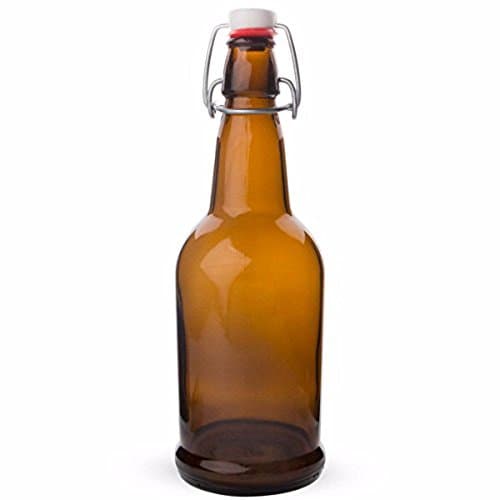
EZ Cap
Swing Top Bottles, Amber Glass, 16 oz (Case of 12)
The only bottle here with a published pressure rating — 100 PSI — in amber glass, which is the combination a second ferment actually asks for.
A gallon jar that arrives with the muslin cover, the band and a temperature strip already in the box, which is the whole non-culture half of a first batch.
#ad No live price feed yet, so no number is shown rather than a stale one. How this is funded.
How it differs from a kombucha culture
You build it rather than buy it. No supplier, no shipping, no starter tea.
It is not acid protected. A kombucha batch defends itself with pH. A ginger bug relies on the yeast establishing dominance quickly, which is why it is fed daily and why it molds more readily than kombucha.
It is a carbonating agent, not a drink. Nobody drinks the bug. It goes into something else.
It needs daily attention while establishing. Kombucha wants to be left alone; a ginger bug wants feeding every day for a week.
Heads up: some links on this page are affiliate links. If you buy through one we may earn a commission at no extra cost to you. It never changes a ranking, and we take no payment for placement. The full version.
The short answer
Quick picks
Ranked on the published rubric. Every row jumps to that product's full write-up below; the button goes straight to Amazon.
#
Product
Best for
Score
Price
1
EZ Cap
Swing Top Bottles, Amber Glass, 16 oz (Case of 12)
The only bottle here with a published pressure rating — 100 PSI — in amber glass, which is the combination a second ferment actually asks for.
A gallon jar that arrives with the muslin cover, the band and a temperature strip already in the box, which is the whole non-culture half of a first batch.
EZ Cap Swing Top Bottles, Amber Glass, 16 oz (Case of 12)
The only bottle here with a published pressure rating — 100 PSI — in amber glass, which is the combination a second ferment actually asks for.
Who it is for. Anyone doing a second ferment who wants a bottle with a number behind it rather than a shape that looks strong.
Published specifications
Capacity
16 oz
Glass color
Amber
Pressure rating
“Pressure rated to 100 PSI which means they can easily handle the carbonation of soda pop and hard seltzer”
Case quantity
12 bottles, includes 12 swing tops
Closure
Reusable swing top; also accepts a 26 mm pry-off crown cap
Maker’s note
“These swing tops are designed to be primarily sealed with a crown cap closure for long term storage.”
Dimensions
Not published
Source: MoreBeer published EZ Cap product specification (capacity, pressure rating, case contents, crown cap compatibility), morebeer.com/products/ez-cap-swing-top-bottles-amber-glass-16-oz-case-12, fetched 2026-09-01
Rubric — 8.3 / 10
Materials9/10 · weight 28%
Documentation9/10 · weight 22%
Capacity fit8/10 · weight 16%
Cleaning7/10 · weight 18%
Value8/10 · weight 16%
What it gets right
A published 100 PSI rating is the single most useful number in this whole category, and almost nobody publishes one
Amber glass blocks the light that degrades a bottle sitting out on a counter through a second ferment
The dual finish means you can crown-cap a batch you want to leave for months and swing-top the ones you will drink this week
16 oz is one serving, so a bottle gets opened once and drunk rather than losing its carbonation over three days
What it costs you
Swing-top gaskets perish, and a tired gasket is the commonest cause of a flat second ferment
No dimensions published, so fitting twelve of them on a fridge shelf is a measuring job when they arrive
Crown caps are sold separately if you want the long-storage option the maker recommends
Skip it if. You want to see the color of the finished drink. Amber hides it; the clear version of the same bottle does not.
A gallon jar that arrives with the muslin cover, the band and a temperature strip already in the box, which is the whole non-culture half of a first batch.
Who it is for. A first-time brewer, or anyone who has learned that the fewer parts a fermentation vessel has, the fewer places a batch can go wrong.
Published specifications
Capacity
1 gallon
Material
Glass
Included
Muslin cover, rubber band, temperature strip
Spigot
None
Dimensions
Not published
Mouth diameter
Not published
Source: Fermentaholics published jar listing contents, fermentaholics.com/product/printed-gallon-kombucha-glass-jar-2-pack/, retrieved 2026-09-01
Rubric — 7.7 / 10
Materials8/10 · weight 28%
Documentation5/10 · weight 22%
Capacity fit8/10 · weight 16%
Cleaning9/10 · weight 18%
Value9/10 · weight 16%
What it gets right
The temperature strip in the box means the jar tells you its own temperature from day one
Muslin breathes and blocks fruit flies, which is exactly what a kombucha cover has to do and what a solid lid does not
No spigot means no seal, no gasket and nothing to disassemble — the easiest vessel here to actually clean
The cheapest way into a proper gallon vessel
What it costs you
No published dimensions at all
No volume markers, so the starter reserve is eyeballed
No tap, so tasting means dipping and bottling means lifting
Skip it if. You want to draw a sample without opening the jar. A plain jar has to be opened every time you taste it.
#ad No live price feed yet, so no number is shown rather than a stale one. How this is funded.
#3 · Reading the jar, not the room
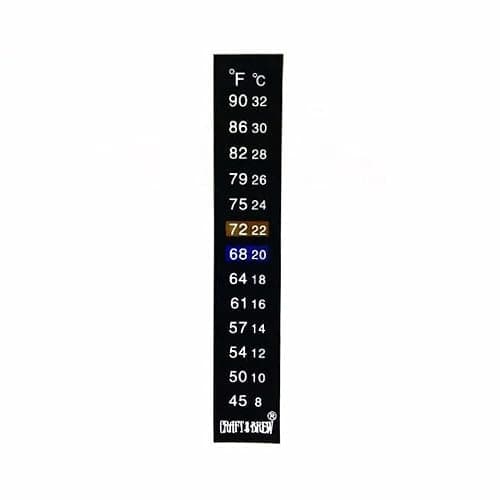
Craft a Brew Fermometer Adhesive Strip Thermometer
A four-inch liquid crystal strip that sticks to the glass and reads the liquid rather than the air, which is the distinction that matters.
Who it is for. Every brewer. This is the cheapest way to stop guessing what temperature the batch is at.
Published specifications
Size
Approximately 0.75 x 4 in
Reads
Fahrenheit and Celsius
Application
External fermenter surface
Compatible surfaces
Glass, plastic and stainless steel fermenters
How it works
“changes color to display the current temperature of the fermenting liquid inside the vessel”
Temperature range
Not published by this maker. Comparable fermentation strips are sold in bands such as 46-82 F, 57-90 F and 46-93 F.
Accuracy
Not published
Sold as
A 5 pack on the Amazon listing; the maker's own store lists it as a single strip
Source: Craft a Brew published Fermometer specification (size, display units, compatible surfaces, operating principle), craftabrew.com/products/fermometer-adhesive-strip-thermometer, fetched 2026-09-01. Comparable-strip ranges from retailer listings, cited as comparisons only.
Rubric — 7.4 / 10
Materials7/10 · weight 28%
Documentation5/10 · weight 22%
Capacity fit8/10 · weight 16%
Cleaning8/10 · weight 18%
Value10/10 · weight 16%
What it gets right
It reads through the glass, so it tells you what the kombucha is at rather than what the shelf is at — those differ by several degrees on a sunny afternoon
It costs less than a cup of coffee and never needs a battery
It sticks to glass, plastic and stainless, so it moves with you if you change vessels
Always visible, which means you actually look at it
What it costs you
Neither range nor accuracy is published for this specific strip
Liquid crystal strips read in bands, so you get “about 76” rather than 76.2
The two listings disagree on whether it is reusable — the Amazon listing calls it reusable, the maker's own spec page says nothing about removing or reapplying it
Skip it if. You want a logged, numeric record. A strip is a glance, not a measurement you can write down with confidence.
A wild-yeast starter built from fresh unpeeled ginger, sugar and unchlorinated water, fed daily for about a week. It is used to carbonate homemade sodas. Unlike kombucha or water kefir there is no culture to buy — the organisms live on the ginger skin.
How long does a ginger bug take to get going?+
Usually four to seven days of daily feeding in a warm room. The signal is bubbles rising when you stir it. If nothing has happened after a week, the usual causes are chlorinated water or ginger treated in a way that suppressed the surface organisms.
Do I need to peel the ginger?+
No — do not. The wild yeasts and bacteria you are cultivating live on the skin. Peeling removes the culture. Wash the ginger lightly if you want, but leave the skin on, and organic ginger is genuinely preferable here.
Why is my ginger bug not bubbling?+
Most often the water: chlorine and chloramine suppress the organisms. After that, ginger that has been treated, a room that is too cold, or simply not enough feeding. Try filtered water, fresh organic ginger and a warmer spot.
Can I drink the ginger bug itself?+
It is not what it is for. A bug is a carbonating starter that goes into sweetened juice or an infusion, which then carbonates in a sealed bottle. The bug liquid itself is strongly yeasty and not pleasant on its own.
Sources
Every specification cited on this page came from one of these documents, retrieved on the date shown against the product it belongs to.