Both are fizzy home ferments in a jar. They run on completely different schedules, and that is the difference that decides which one suits you.
By Scooter M.·Published September 1, 2026 · Updated September 4, 2026
The short answer
Brew kombucha if you want a sour, tea-driven drink and do not mind a fortnight per batch. Brew water kefir if you want something lighter and sweeter on a 24-to-48-hour cycle, with no tea and no caffeine. They are different drinks, not fast and slow versions of the same one.
Side by side, with published figures
Water kefir figures are Cultures for Health's published specifications; kombucha figures are the working ranges used throughout this site.
Kombucha
Water kefir
Feedstock
Sweetened black or green tea
Sugar water — no tea
Culture
Pellicle plus starter tea
Grains — translucent clusters
First ferment
7-14 days
24-48 hours
Working temperature
75-85 F
68-85 F
Working ratio
~10% starter tea per batch
1-2 tsp grains per 4 cups liquid
Caffeine
Yes, from the tea
None
Flavor
Sour, tea-forward, robust
Light, sweet, closer to a soda
Culture multiplies?
New pellicle each batch
Grains multiply and need giving away
The cycle time is the whole argument
Kombucha is a fortnightly commitment. You brew tea, wait one to two weeks, bottle, condition for a few days, and start again. It rewards planning and punishes impatience.
Water kefir turns over in a day or two. Cultures for Health publishes that established grains yield two to three quarts every 24 to 48 hours. That is a completely different rhythm: it is a daily kitchen task rather than a fortnightly project, and it produces a great deal more drink per week from the same counter space.
Which suits you is largely a temperament question. Some people find a fortnight restful and a daily task tiresome; plenty find the opposite.
Getting started, honestly compared
Kombucha starts faster. A live culture goes into sweet tea the day it arrives and is working immediately.
Water kefir starts slower. Dehydrated grains need three to four days of rehydration, extending to seven, before the first real batch. Cultures for Health publishes an activation ratio of a quarter cup of cane sugar to three or four cups of water for that stage.
Water kefir stores far better before you start. Cultures for Health publishes a 12-to-18-month shelf life at 68 to 78 F for dehydrated grains, and 18 months or more refrigerated. A live kombucha culture has no such latitude.
Water kefir needs filtered water. Chlorinated tap water stalls or kills the grains. Cultures for Health specifies unchlorinated, unfluoridated water for rehydration.
The picks
One of each, so you can decide by doing
Two dehydrated grain products with published ratios, and a kombucha culture with published starter tea. Between them, that is both ferments covered.
Cultures for Health
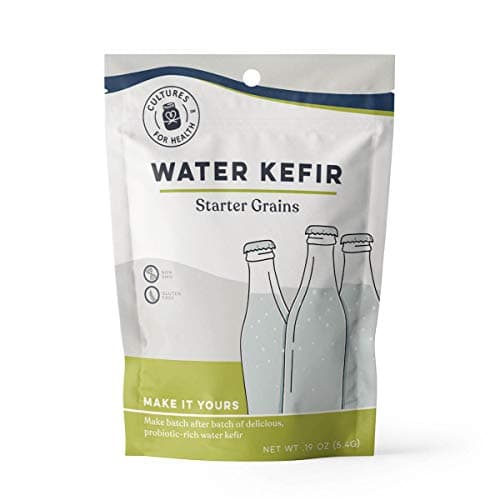
Water Kefir Grains (Dehydrated)
Two teaspoons of dehydrated grains that rehydrate to three or four tablespoons and then turn out two to three quarts every 24 to 48 hours, indefinitely.
Kombucha is sour and unmistakably made of tea. There is tannin in it, there is vinegar-adjacent sharpness, and the flavor is assertive whether or not you like it.
Water kefir is light, mildly sweet and much closer to a soft drink. It carbonates readily, takes fruit flavoring extremely well in a second ferment, and it is the far easier sell to a household that has already decided it does not like kombucha.
Both bottle the same way, in the same pressure-rated bottles. Water kefir often carbonates harder and faster, so if anything the pressure rating matters more.
The multiplying problem
Water kefir grains reproduce. Cultures for Health publishes that a packet of two teaspoons rehydrates to three or four tablespoons, and from there they keep going. Within a month or two you have more grains than batches, and you will be giving them away, composting them, or scaling up.
Kombucha does the same thing in a different form — a new pellicle every batch — but a SCOBY hotel absorbs it neatly, and pellicles stack. Grains take up volume in a way that is harder to ignore.
Heads up: some links on this page are affiliate links. If you buy through one we may earn a commission at no extra cost to you. It never changes a ranking, and we take no payment for placement. The full version.
The short answer
Quick picks
Ranked on the published rubric. Every row jumps to that product's full write-up below; the button goes straight to Amazon.
#
Product
Best for
Score
Price
1
Cultures for Health
Water Kefir Grains (Dehydrated)
Two teaspoons of dehydrated grains that rehydrate to three or four tablespoons and then turn out two to three quarts every 24 to 48 hours, indefinitely.
Cultures for Health Water Kefir Grains (Dehydrated)
Two teaspoons of dehydrated grains that rehydrate to three or four tablespoons and then turn out two to three quarts every 24 to 48 hours, indefinitely.
Who it is for. Someone who wants a fizzy home ferment on a two-day cycle, with no tea and no caffeine.
Published specifications
Shipped form
Dehydrated. Each packet contains 2 teaspoons of live active grains
Rehydration time
3-4 days; may take up to 7 days
Rehydration water
Unchlorinated, unfluoridated water with cane sugar
Activation sugar
1/4 cup cane sugar to 3-4 cups water
Rehydrated volume
3-4 tablespoons of grains
Output
2-3 quarts every 24-48 hours once established
Working ratio
1-2 teaspoons of grains per 4 cups of liquid
Culture temperature
68-85 F
Shelf life, room temperature
12-18 months at 68-78 F
Shelf life, refrigerated
18+ months at 40-45 F
Source: Cultures for Health published water kefir grain specifications (packet volume, rehydration, ratios, storage temperatures and shelf life), culturesforhealth.com water kefir FAQ and starter culture instructions, retrieved 2026-09-01
Rubric — 8.9 / 10
Materials9/10 · weight 28%
Documentation10/10 · weight 22%
Capacity fit8/10 · weight 16%
Cleaning8/10 · weight 18%
Value9/10 · weight 16%
What it gets right
A 24-to-48-hour cycle against kombucha’s 7 to 14 days — this is the ferment for someone impatient
Dehydrated grains have a published 12-to-18-month room-temperature shelf life, so the packet can sit in a drawer until you are ready
Every number a beginner needs is published: activation ratio, working ratio, temperature band, output volume
No tea and no caffeine, so it suits households that will not drink kombucha
What it costs you
Three to seven days of rehydration before the first real batch, which is longer than a kombucha SCOBY takes to get going
Chlorinated tap water will stall or kill the grains, so filtered water is not optional
Grains multiply, and you will be giving them away or throwing them out within a month
Skip it if. You want the sour, tea-driven flavor of kombucha. Water kefir is lighter, sweeter and closer to a soda; it is a different drink, not a faster kombucha.
Fermentaholics Organic Dehydrated Water Kefir Grains
The same dehydrated-grain format with USDA Organic certification and the maker’s own published rehydration method.
Who it is for. Someone already buying kombucha cultures from the same maker who wants water kefir certified organic too.
Published specifications
Shipped form
Dehydrated grains
Certification
USDA Certified Organic
Rehydration
Maker publishes a step-by-step rehydration method for dehydrated grains
Feedstock
Cane sugar in unchlorinated water
Grain weight
Not published
Source: Fermentaholics published organic dehydrated water kefir grain listing and rehydration guide, fermentaholics.com/how-to-rehydrate-water-kefir-grains/, retrieved 2026-09-01
Rubric — 7.9 / 10
Materials9/10 · weight 28%
Documentation7/10 · weight 22%
Capacity fit7/10 · weight 16%
Cleaning8/10 · weight 18%
Value8/10 · weight 16%
What it gets right
Certified organic, which matters more here than usual because the grains live in the sugar you feed them
The maker publishes its own rehydration walkthrough rather than leaving you to a forum
Dehydrated grains ship without the timing pressure of a live culture
Same maker as the kombucha cultures, so one order can cover both ferments
What it costs you
Grain weight or volume is not published, so you cannot compare the packet size against alternatives
Rehydration is still days of feeding before a first real batch
No published shelf life
Skip it if. You want the exact packet quantity before you order. It is not published here; the Cultures for Health packet states two teaspoons.
#ad No live price feed yet, so no number is shown rather than a stale one. How this is funded.
#3 · A one-gallon first batch
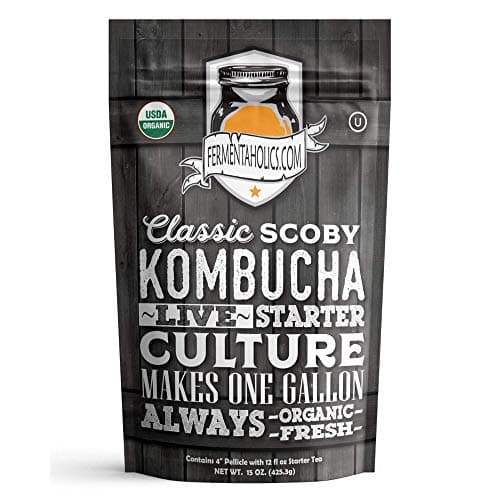
Fermentaholics Organic Kombucha SCOBY with 12 fl oz Starter Tea
A hand-selected pellicle with twelve fluid ounces of mature starter tea, measured against the maker’s own published ten percent rule for a gallon.
Who it is for. Anyone starting a standard one-gallon batch who wants the starter tea measured for them.
Published specifications
Batch size
One gallon
Starter tea volume
12 fl oz of mature, active starter tea
Pellicle
Hand-selected
Starter tea ingredients
Organic cane sugar, filtered water, organic black tea, live cultures
Certification
USDA Certified Organic, Kosher, Non-GMO, vegan
Production
Grown in the maker’s licensed lab
Maker’s dosing rule
“the rule of thumb is to use 10% starter tea per batch size”
Source: Fermentaholics published SCOBY specification (12 fl oz starter tea, 1-gallon dosing, ingredients, certifications) and its published 10 percent starter rule, retrieved 2026-09-01
Rubric — 8.5 / 10
Materials9/10 · weight 28%
Documentation9/10 · weight 22%
Capacity fit8/10 · weight 16%
Cleaning8/10 · weight 18%
Value8/10 · weight 16%
What it gets right
12 fl oz against a 128 oz gallon is 9.4 percent, within a rounding error of the maker’s own 10 percent rule — the quantity matches the instruction
Starter tea is the part that actually acidifies a new batch and protects it from mold; the pellicle is mostly a raft
Ingredients of the starter tea are published, which almost no culture seller does
Certified organic, kosher, non-GMO and vegan are stated together
What it costs you
A live culture in transit is a live culture in transit — heat and delay are real risks nobody controls
No stated shelf life once it arrives
You still need tea, sugar and a jar
Skip it if. You are brewing half a gallon. Buy the half-gallon version instead; a gallon’s worth of starter in a half-gallon batch drives the acidity too far, too fast.
#ad No live price feed yet, so no number is shown rather than a stale one. How this is funded.
FAQ
Questions people actually ask
What is the difference between kombucha and water kefir?+
Kombucha ferments sweetened tea with a pellicle and starter tea over 7 to 14 days and tastes sour and tea-forward. Water kefir ferments plain sugar water with grains in 24 to 48 hours, contains no tea or caffeine, and tastes lighter and closer to a soft drink.
Which is easier to make, kombucha or water kefir?+
Water kefir has the shorter cycle and no tea to brew, but it needs unchlorinated water and several days of rehydration before the first batch. Kombucha starts working the day the culture arrives but then takes a fortnight. Neither is difficult; they demand attention on different schedules.
How long do water kefir grains take to rehydrate?+
Three to four days, and up to seven. Cultures for Health publishes that window and specifies unchlorinated, unfluoridated water with cane sugar for activation, at a quarter cup of sugar to three or four cups of water.
How much water kefir can one packet of grains make?+
Cultures for Health publishes that a two-teaspoon packet rehydrates to three or four tablespoons of grains and then yields two to three quarts every 24 to 48 hours, indefinitely, as the grains continue to multiply.
Can I brew kombucha and water kefir at the same time?+
Yes. They use different vessels, different feedstock and different schedules, so there is no practical conflict. Keep the cultures in separate jars and label them, because a mixed culture cannot be separated again.
Sources
Every specification cited on this page came from one of these documents, retrieved on the date shown against the product it belongs to.
Grains or powder, what each maker actually publishes, the activation month in real numbers, and the jar-and-strainer question every daily brewer runs into.
Chlorine versus chloramine, what boiling and standing overnight actually remove, and the published flow rate a carbon filter needs to handle chloramine.