This is the one ferment on the site that asks something of you every day. Which culture you buy decides whether that is a habit or a chore.
By Scooter M.·Published September 4, 2026 · Updated September 27, 2026
The short answer
Buy dehydrated grains if you want a culture you keep forever, and a powdered direct-set starter if you want kefir this week with nothing to maintain. Grains take three to seven days to activate and then need straining every 12 to 24 hours; a direct-set packet makes a quart in 12 to 18 hours and recultures two to seven times before it is finished. Both need pasteurized milk that is not ultra-pasteurized.
What actually separates one milk kefir culture from another
Milk kefir is unusual among the ferments on this site because the product you buy is not really the interesting variable — the routine it commits you to is. Kombucha asks for your attention roughly once a fortnight. Water kefir asks every day or two. Milk kefir grains ask every single day, forever, and a culture that fits your week is worth more than a culture with a better label.
So the criteria below are ordered by how much they change daily life with the thing, not by how impressive they look on a listing. Every product further down this page was judged against them in the same order.
Reusable or finite. Grains are a one-time purchase that lasts indefinitely. A powdered starter is a consumable with a published number of recultures. This single distinction decides the cost of the drink over any horizon longer than a month, and it decides whether you can stop for a week.
What the maker publishes about the first month. Activation is the part beginners abandon, because a dehydrated culture does almost nothing visible for several days. A maker that publishes the starting volume, the feeding schedule and the endpoint has removed the reason most people give up.
The working ratio and the culturing window. Grains to milk, and hours to finish. Without both numbers you are looking at a jar and guessing, and the failure modes in either direction — starved grains, separated whey — look the same to a beginner.
Milk compatibility, stated explicitly. Ultra-pasteurized milk is a genuine dead end and it dominates some US dairy aisles. A culture whose maker says so plainly saves you a wasted week.
The hardware it forces on you. Every milk kefir culture needs something to ferment in and something to strain with, and some makers publish which metals are safe against the finished kefir. That is a real purchase decision hiding inside a culture purchase.
Nothing here was tested in a kitchen we own. Every figure below is a number its maker published, cited on the product it belongs to, and the scoring weights are on the methodology page so you can recompute any total on this page with a calculator.
Four routes to a jar of kefir
Two of the products below are cultures you keep and two are cultures you use up. They are not competing on quality so much as on commitment, which is why the table compares them on time and obligation rather than on features.
Published figures for each culture, compiled 2026-09-04. A blank means the maker publishes nothing on the subject.
Culture
Reusable?
Time to first real batch
Published culturing window
Cultures for Health milk kefir grains
Yes, indefinitely
3-7 days of activation
12-24 hours at 68-85 F
Cultures for Health kefir starter powder
2-7 recultures per packet
12-18 hours
12-18 hours at 72-74 F
Yogourmet kefir starter
Sold as single-use
About 24 hours
About 24 hours at 73-77 F
Kefirko fermenter
Hardware, not a culture
—
—
The column that matters most is the second one. A packet of powder is the fastest way to find out whether your household drinks kefir at all, and it is the most expensive way to keep drinking it. Grains are the reverse: slow to start, then free forever.
Grains or powder: the decision everything else follows from
Milk kefir grains are not grains. They are soft, cauliflower-looking clusters of bacteria and yeast bound in a protein and polysaccharide matrix, and they are alive in the same way a kombucha culture is alive. You put them in milk, they eat the lactose, and in 12 to 24 hours you strain them out and put them in fresh milk. Do that daily and they last indefinitely. Cultures for Health publishes that they generally take six to eight weeks after rehydration to begin multiplying, which is worth knowing so you do not conclude in week three that yours are failing.
A direct-set starter is a freeze-dried powder of selected organisms. You add it to milk, it cultures once, and then either you are done or you use a spoonful of the finished kefir to seed the next batch — which Cultures for Health publishes as working two to seven times before the culture drifts too far to be worth continuing. There is no live thing in your fridge between batches, and that is the whole appeal.
The honest disadvantage of grains is that they are a daily obligation with no published pause. The maker's guidance is not to leave them in milk beyond 48 hours, and the same FAQ warns that routine refrigeration is hard on them. There is no clean answer for a two-week vacation, and anyone who tells you otherwise is describing a workaround, not a published method.
The honest disadvantage of powder is arithmetic. Six sachets is six batches. Four packets recultured a few times each is maybe a couple of months. Grains bought once are still going in year three, and past the first month the cost per quart is not close.
The picks
Where we would start
Grains for anyone who wants the culture permanently, a direct-set powder for anyone who wants the drink without the daily obligation, and the one piece of hardware that genuinely changes the routine.
Cultures for Health
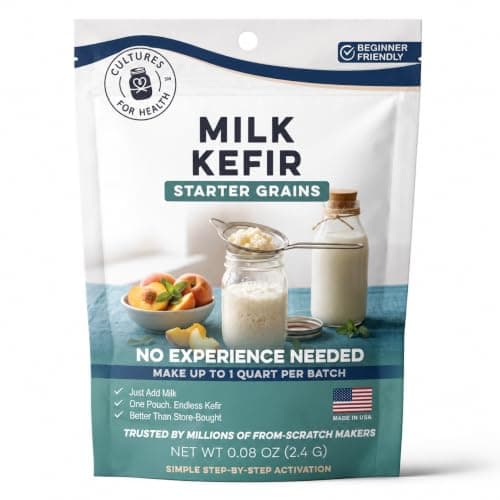
Milk Kefir Grains (Dehydrated)
The only milk kefir culture here that publishes its whole life cycle — activation schedule, working ratio, culturing window and when the grains start multiplying.
A direct-set powder that makes a quart at a time and can be recultured a handful of times, for anyone who wants the drink without keeping a culture alive.
#ad No live price feed yet, so no number is shown rather than a stale one. How this is funded.
Activation, in the maker's own numbers
Dehydrated grains do not work on day one, and the first week is where most people quit. Cultures for Health publishes the whole schedule, which is the single strongest reason its grains lead this page. The sequence is specific enough to follow without interpretation:
Cultures for Health's published activation method for dehydrated milk kefir grains.
Stage
Published instruction
Starting volume
The whole packet into 1 cup fresh, cold pasteurized milk
Milk to avoid during activation
Raw milk. Use pasteurized until the grains are established
Cover and place
Coffee filter or cloth secured with a band, in a warm spot at 68-85 F
Hours 8-24
Check the milk hourly
On the first texture change
Strain the grains out, re-milk, and increase the milk by 1/2 cup
At 24 hours with no change
Strain and re-milk at the same volume. Never decrease the milk
Overall period
3 to 7 days, working up from 1 cup to 4 cups
Endpoint
Reliably thickening milk in about 24 hours
Two details in that table are easy to skim past and expensive to miss. The first is never decreasing the volume of milk: a hungry culture recovers, an overfed one is only slow. The second is that the milk from these early cycles is not the product. It is feed. Judge the grains on whether they thicken the milk, not on how the liquid tastes.
The daily routine, and where it goes wrong
Once activated, the routine takes about ninety seconds. One to two teaspoons of grains per up to four cups of milk, covered, at 68 to 85 F, for 12 to 24 hours. Strain, drop the grains into fresh milk, refrigerate the kefir. That is the entire practice.
Three things reliably break it. The first is leaving the grains in past 48 hours, which the maker explicitly warns against — beyond that they are starving rather than fermenting. The second is a cold kitchen, which stretches a 12-hour ferment into something much longer and makes it very hard to tell a slow batch from a failing one. The third is a batch that separates into curds and a clear yellow-green liquid. That liquid is whey and the batch is over-fermented rather than spoiled; it is drinkable, and it is a signal to shorten the next cycle or use more milk.
One hardware note that belongs here rather than in a gear section: Cultures for Health states that for straining, “stainless steel is acceptable. Avoid all other types of metal.” Finished kefir is acidic, and reactive metals and acid are a bad combination for the same reason they are on a brewing vessel's spigot. A nylon sieve or a stainless one is fine; an aluminum one is not.
Milk that works, and milk that does not
This is the question that wastes the most beginner time, because the failure is silent: the milk simply never thickens, and you cannot tell whether the culture or the carton is at fault.
Works. Pasteurized dairy milk, goat milk, non-homogenized milk, quality powdered milk, and coconut milk. Raw milk works once the grains are established and transitioned onto it, but not during activation.
Does not work. Ultra-pasteurized and UHT milk. Cultures for Health publishes this for both its grains and its powder, and it is the commonest cause of a first batch that never sets. Read the carton, not the shelf label.
Not recommended. Almond milk — the maker states plainly that it has not found any of its kefir cultures to work well with it. Lactose-free milk is listed as no guarantee of success, which makes sense given lactose is the feedstock.
If you are culturing a non-dairy liquid regularly, the direct-set powder is the more honest purchase: Cultures for Health lists juice, coconut milk and coconut water as intended liquids for that product, where grains kept permanently in a non-dairy liquid need periodic dairy rests to stay healthy.
Temperature is the variable you cannot see
Every published window on this page is a temperature-and-time pair, and the temperature half is the one nobody measures. The grains run at 68 to 85 F. The Cultures for Health powder wants a much tighter 72 to 74 F for 12 to 18 hours. Yogourmet publishes 23 to 25 C — 73 to 77 F — for about 24 hours.
Those are narrow enough that a kitchen counter in February and the same counter in July are effectively two different appliances. An adhesive strip thermometer on the jar costs almost nothing and turns “it seems slow” into a number you can act on. The same reasoning, and the same hardware, applies across brewing temperature generally and to the thermometers worth sticking on a jar.
The jar and strainer question
Milk kefir needs a vessel and a sieve, and you use both every day. A quart mason jar, a square of cloth and a nylon sieve will do the entire job for the price of a sandwich, and the grains cannot tell the difference. Anyone telling you a dedicated fermenter is necessary is selling one.
What a dedicated fermenter buys is friction. The Kefirko fermenter's lid is the strainer, so the daily step becomes turning the jar over rather than finding a sieve, straining, and washing the sieve. On a ferment you perform 365 times a year, that is a real argument — and a real reason people keep the habit past month two. It is still a convenience purchase, its maker publishes “bioplastic” without naming the resin, and US listings still describe the smaller jar at 848 ml where the maker now publishes 900 ml. Check the size on the listing in front of you.
Whatever you use, it comes apart and gets cleaned daily. Milk residue is a harder cleaning problem than sweet tea, so the cleaning routine for fermentation gear matters more here than anywhere else on this site.
How milk kefir sits against the other ferments here
It is the fastest of the drink ferments and the most demanding. A batch finishes overnight where kombucha takes one to two weeks, and the price of that speed is that there is no version of the routine where you skip three days.
It is also a genuinely different drink from water kefir, despite sharing a name and a granule-shaped culture. Water kefir grains eat sugar in water and make something light and soda-like on a 24-to-48-hour cycle; milk kefir grains eat lactose and make something thick and tart, closer to a drinking yogurt. The two cultures are not interchangeable and neither can be converted into the other. If you are weighing the tea-based route against a kefir, kombucha vs kefir works through that comparison properly.
The powdered route has its own page now. The Yogourmet kefir starter review goes through the published organism list, the heat-and-cool method it asks for, and the single-use limit that decides it against grains.
Heads up: some links on this page are affiliate links. If you buy through one we may earn a commission at no extra cost to you. It never changes a ranking, and we take no payment for placement. The full version.
The short answer
Quick picks
Ranked on the published rubric. Every row jumps to that product's full write-up below; the button goes straight to Amazon.
#
Product
Best for
Score
Price
1
Cultures for Health
Milk Kefir Grains (Dehydrated)
The only milk kefir culture here that publishes its whole life cycle — activation schedule, working ratio, culturing window and when the grains start multiplying.
A direct-set powder that makes a quart at a time and can be recultured a handful of times, for anyone who wants the drink without keeping a culture alive.
Six 3-gram freeze-dried sachets, one per liter of milk, with the full organism list printed on the box — the most transparent label of any culture here.
Cultures for Health Milk Kefir Grains (Dehydrated)
The only milk kefir culture here that publishes its whole life cycle — activation schedule, working ratio, culturing window and when the grains start multiplying.
Who it is for. Someone who wants a permanent culture — buy once, strain daily, and never order a starter again.
Published specifications
Shipped form
“1 packet of dehydrated traditional, heirloom-style milk kefir grains”
Activation starting volume
1 cup fresh, cold pasteurized milk
Activation schedule
Between hours 8 and 24, check hourly; at the first change in texture, strain and re-milk, increasing the milk by 1/2 cup
Activation period
3 to 7 days, feeding increasing amounts of milk from 1 cup up to 4 cups
Activation endpoint
“Your grains are activated when they are reliably thickening milk in about 24 hours”
Working ratio
1-2 teaspoons of grains per up to 4 cups of milk
Culture temperature
68-85 F
Culturing time
12 to 24 hours; never leave grains in milk beyond 48 hours
Multiplication
“Generally kefir grains take 6 to 8 weeks following rehydration to begin multiplying”
Milk requirement
Pasteurized whole milk, not UHT or ultra-pasteurized. Raw milk after a transition
Straining
“Stainless steel is acceptable. Avoid all other types of metal.”
Certification
Non-GMO, gluten free
Shelf life
“Use the starter culture by the date on the bag”
Source: Cultures for Health published milk kefir grain product specification, its activation instructions for dehydrated milk kefir grains, and its milk kefir FAQ (working ratio, temperature, culturing time, multiplication, milk types and straining metals), culturesforhealth.com, retrieved 2026-09-04
Rubric — 8.7 / 10
Materials9/10 · weight 28%
Documentation10/10 · weight 22%
Capacity fit8/10 · weight 16%
Cleaning7/10 · weight 18%
Value9/10 · weight 16%
What it gets right
Every number the first month needs is published: the 1-cup start, the half-cup step up, the 3-to-7-day window, the 1-2 teaspoons per 4 cups working ratio and the 12-to-24-hour culturing time
It is reusable indefinitely, so the culture is a one-time purchase rather than a subscription — unlike every powdered starter on this page
Dehydrated grains ship without the timing pressure of a live culture in a hot van
The maker states which metals are safe to strain with, which is the one hardware question this ferment raises and almost nobody answers
What it costs you
The packet weight or volume is not published, so you cannot compare the quantity against another seller before ordering
Three to seven days of daily feeding before the first drinkable batch, then a further 6 to 8 weeks before the grains multiply
It is a daily obligation. Grains left in milk past 48 hours starve, and there is no published pause longer than that
Ultra-pasteurized milk will not work, and in some US markets that is most of the shelf
Skip it if. You travel often or want a ferment you can walk away from for a fortnight. Grains need feeding on a 12-to-24-hour cycle; a powdered direct-set starter is the honest answer for an intermittent brewer.
Not published. The maker says “bioplastic” and stops there
Dishwasher rating
Not published on the maker’s product page
Source: Kefirko published kefir fermenter product page (sizes in ml and oz, box contents, materials, dimensions and weights for both sizes), kefirko.com/product/kefir-fermenter/, retrieved 2026-09-04. The 848 ml figure is from US retail listings, cited as a size discrepancy only.
Rubric — 7.5 / 10
Materials7/10 · weight 28%
Documentation7/10 · weight 22%
Capacity fit9/10 · weight 16%
Cleaning9/10 · weight 18%
Value6/10 · weight 16%
What it gets right
The strainer is built into the lid, so the daily task becomes “turn it over” instead of “find the sieve, strain, wash the sieve”
Height, diameter and weight are all published for both sizes, so you can check it against a shelf before ordering
1400 ml holds a full quart of milk with headroom, and the 900 ml suits a smaller household
It comes apart into a handful of pieces with no crevices, which is what makes a daily ferment sustainable
What it costs you
“Bioplastic” is not a specification. The maker does not publish the resin, so you cannot check it against anything
No dishwasher rating on the maker’s own page, despite retailers stating one
It costs many times what a mason jar and a nylon sieve cost, and those do the same job
US retail listings still describe the smaller jar as 848 ml while the maker now publishes 900 ml — check the size on the listing you are buying
Skip it if. You already own a quart jar and a plastic sieve. This buys convenience, not capability, and the grains cannot tell the difference.
#ad No live price feed yet, so no number is shown rather than a stale one. How this is funded.
#3 · Kefir without a daily obligation
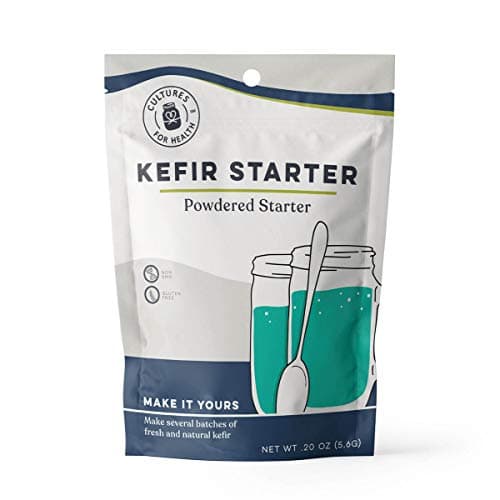
Cultures for Health Kefir Starter Culture Powder (4 Packets)
A direct-set powder that makes a quart at a time and can be recultured a handful of times, for anyone who wants the drink without keeping a culture alive.
Who it is for. An intermittent brewer, or anyone testing the drink before taking on a culture that has to be fed daily.
Published specifications
Packets per box
4 packets
Form
Powdered, direct-set starter culture
Yield per packet
1 quart of liquid per packet
Culture temperature
72-74 F
Culturing time
12 to 18 hours
Reculturing
“Kefir made with a direct-set style starter culture can often be recultured anywhere from 2 to 7 times”
Liquids
Pasteurized whole milk (not UHT/ultra-pasteurized), juice, coconut milk, or coconut water
Certification
Non-GMO, gluten free
Storage
“Store the starter in the refrigerator until you’re ready to activate it”
Source: Cultures for Health published Kefir Starter Culture Powder product page (packet count, liquids, certifications, storage) and its direct-set kefir instructions (1 packet per quart, 72-74 F, 12-18 hours, 2-7 recultures), culturesforhealth.com, retrieved 2026-09-04
Rubric — 8.1 / 10
Materials8/10 · weight 28%
Documentation9/10 · weight 22%
Capacity fit7/10 · weight 16%
Cleaning10/10 · weight 18%
Value6/10 · weight 16%
What it gets right
Nothing to maintain between batches — you open a packet when you want kefir and there is no culture in the fridge waiting to be fed
The temperature and time are tight and published: 72 to 74 F for 12 to 18 hours, which is a much narrower target than “68 to 85 F, 12 to 24 hours”
It cultures juice, coconut milk and coconut water as well as dairy, which grains do not do reliably
Four packets is enough to find out whether you actually drink the stuff before committing to grains
What it costs you
It runs out. Reculturing is published as 2 to 7 times, so the box is finite in a way grains never are
“A few times” and “2 to 7 times” are the only published numbers on reculturing — how far a given packet stretches is not knowable in advance
The 72-74 F window is narrower than most kitchens hold without help
Cost per quart is higher than grains once you get past the first month
Skip it if. You already know you want kefir every day. Grains cost less over any horizon longer than a few weeks and never need reordering.
Six 3-gram freeze-dried sachets, one per liter of milk, with the full organism list printed on the box — the most transparent label of any culture here.
Who it is for. Someone who wants to taste real kefir this week, from a box they can buy in a grocery aisle, before deciding whether to keep a culture.
Published specifications
Box contents
6 packets of 3 g
Yield
One packet per liter (about one quart) of milk; 6 in the box
Form
Freeze-dried (lyophilized) powder
Organisms
Lactococcus lactis, Lactococcus cremoris, Lactococcus diacetylactis, Lactobacillus acidophilus, Saccharomyces cerevisiae, Kluyveromyces lactis, plus kefir grains and maltodextrin
Milk preparation
Heat to 82 C / 180 F, then cool to 23-25 C / 73-77 F
Incubation
Room temperature, 23-25 C / 73-77 F, about 24 hours
Stopping the ferment
Refrigerate about 8 hours
Certification
Without preservatives, GMOs or gluten. Certified kosher and halal
Keeping time, finished kefir
“2 to 3 weeks in the refrigerator”
Reuse
Sold as single-use; the distributor points reusers to grains instead
Source: Yogourmet Kefir Starter published specification and instructions as listed by authorized distributor Revolution Fermentation (packet count and weight, yield, organism list, incubation temperature and time, certifications, keeping time), shop.revolutionfermentation.com, retrieved 2026-09-04
Rubric — 8.2 / 10
Materials8/10 · weight 28%
Documentation9/10 · weight 22%
Capacity fit8/10 · weight 16%
Cleaning9/10 · weight 18%
Value7/10 · weight 16%
What it gets right
The full organism list is published by name, which no other culture on this page does — useful if you are avoiding a specific yeast or bacterium
Kosher and halal certification are both stated, which is rare in home fermentation supplies
The gram weight and the per-packet yield are both published, so you can compare it against anything else on a cost-per-quart basis
Widely stocked in ordinary grocery channels, so a resupply is not a specialist order
What it costs you
The method requires heating the milk to 180 F and cooling it again, which is a pot to wash and an hour of attention that grains do not ask for
Sold as single-use, so six sachets is six batches and then you reorder
The incubation window is fixed at roughly 24 hours at 73-77 F, with no published guidance for a cooler kitchen
Maltodextrin is in the ingredient list, which some buyers will not want
Skip it if. You want a culture that pays for itself. Six batches is where this box stops; grains do not stop.
#ad No live price feed yet, so no number is shown rather than a stale one. How this is funded.
#5 · Reading the jar, not the room
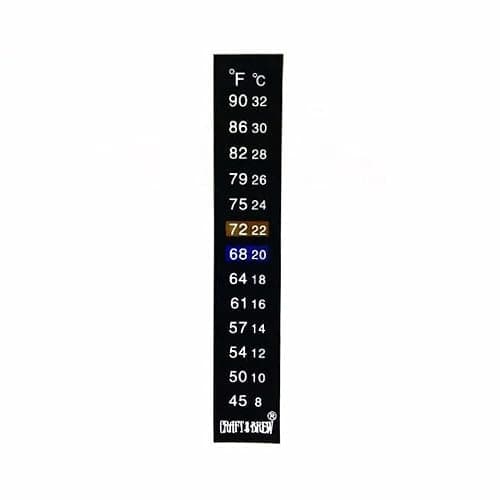
Craft a Brew Fermometer Adhesive Strip Thermometer
A four-inch liquid crystal strip that sticks to the glass and reads the liquid rather than the air, which is the distinction that matters.
Who it is for. Every brewer. This is the cheapest way to stop guessing what temperature the batch is at.
Published specifications
Size
Approximately 0.75 x 4 in
Reads
Fahrenheit and Celsius
Application
External fermenter surface
Compatible surfaces
Glass, plastic and stainless steel fermenters
How it works
“changes color to display the current temperature of the fermenting liquid inside the vessel”
Temperature range
Not published by this maker. Comparable fermentation strips are sold in bands such as 46-82 F, 57-90 F and 46-93 F.
Accuracy
Not published
Sold as
A 5 pack on the Amazon listing; the maker's own store lists it as a single strip
Source: Craft a Brew published Fermometer specification (size, display units, compatible surfaces, operating principle), craftabrew.com/products/fermometer-adhesive-strip-thermometer, fetched 2026-09-01. Comparable-strip ranges from retailer listings, cited as comparisons only.
Rubric — 7.4 / 10
Materials7/10 · weight 28%
Documentation5/10 · weight 22%
Capacity fit8/10 · weight 16%
Cleaning8/10 · weight 18%
Value10/10 · weight 16%
What it gets right
It reads through the glass, so it tells you what the kombucha is at rather than what the shelf is at — those differ by several degrees on a sunny afternoon
It costs less than a cup of coffee and never needs a battery
It sticks to glass, plastic and stainless, so it moves with you if you change vessels
Always visible, which means you actually look at it
What it costs you
Neither range nor accuracy is published for this specific strip
Liquid crystal strips read in bands, so you get “about 76” rather than 76.2
The two listings disagree on whether it is reusable — the Amazon listing calls it reusable, the maker's own spec page says nothing about removing or reapplying it
Skip it if. You want a logged, numeric record. A strip is a glance, not a measurement you can write down with confidence.
How long do dehydrated milk kefir grains take to activate?+
Three to seven days. Cultures for Health publishes starting the whole packet in 1 cup of fresh cold pasteurized milk, checking hourly between hours 8 and 24, and increasing the milk by half a cup each time the texture changes, working up to 4 cups. The grains are activated when they reliably thicken milk in about 24 hours.
How many milk kefir grains do I need per batch?+
One to two teaspoons of grains for up to 4 cups of milk, per Cultures for Health's published working ratio. Culture for 12 to 24 hours at 68 to 85 F, and do not leave the grains in milk beyond 48 hours.
Can I make milk kefir with ultra-pasteurized milk?+
No. Cultures for Health lists ultra-pasteurized and UHT milk as milk that does not work, for both its grains and its powdered starter. Pasteurized whole milk, goat milk, non-homogenized milk and coconut milk are listed as working; almond milk is not recommended.
Should I buy milk kefir grains or a powdered kefir starter?+
Grains if you want kefir regularly — they are reusable indefinitely and cost nothing after the first purchase. A direct-set powder if you want it occasionally: Cultures for Health publishes 2 to 7 recultures per packet, and Yogourmet's six 3-gram sachets are sold as single-use, so both are consumables.
Why are my milk kefir grains not multiplying?+
Often because it is too early. Cultures for Health publishes that grains generally take 6 to 8 weeks following rehydration to begin multiplying. Beyond that, the usual causes are a room below the 68 to 85 F band, ultra-pasteurized milk, or leaving the grains in one batch past 48 hours.
Can I strain milk kefir with a metal sieve?+
Stainless steel only. Cultures for Health's published guidance is that stainless steel is acceptable and all other types of metal should be avoided. A nylon sieve is the other safe option, and finished kefir is acidic enough that this is worth respecting.
Sources
Every specification cited on this page came from one of these documents, retrieved on the date shown against the product it belongs to.
Chlorine versus chloramine, what boiling and standing overnight actually remove, and the published flow rate a carbon filter needs to handle chloramine.
Three starters from one maker, compared on published activation windows, ratios and shelf life — and an honest account of where the documentation ends.