Every other drink ferment in this cupboard runs on a different schedule to kombucha. Picking one is mostly a question of how often you want to be in the kitchen.
By Scooter M.·Published September 6, 2026 · Updated September 14, 2026
The short answer
Pick by schedule, not by flavor. Jun runs like kombucha but cooler and faster — days, not a fortnight. Water kefir turns over every 24 to 48 hours. Milk kefir needs straining every 12 to 24 hours, forever. A jun kit is the smallest step from kombucha; dehydrated kefir grains are the cheapest long-run culture; a powdered kefir starter is the only one you can walk away from.
Why anyone leaves kombucha
Almost everyone on this site started with kombucha, and most people stay. The reasons for adding a second ferment are consistent and worth naming honestly, because they determine which kit is right.
The house is too cold. Kombucha wants roughly 75 to 85 F. Jun and water kefir both work in the high sixties, which makes them the realistic option in a flat that never gets warm. The temperature guide covers what a cold room actually does to a batch.
Nobody in the house drinks tea. Water kefir has no tea and no caffeine at all, which converts households that have already tried and rejected kombucha.
A fortnight is too slow. Water kefir yields two to three quarts every 24 to 48 hours once established. That is a completely different rhythm.
You want something thicker. Milk kefir is not a soft drink. It is closer to a drinking yogurt, and it is the only ferment here that is a food as much as a beverage.
What each one asks of you
The most useful comparison is not taste, which is subjective, but obligation, which is published. These figures come from the makers' own documentation.
Published figures for each culture, compiled 2026-09-06. Kombucha is included as the reference point.
Ferment
Feedstock
Cycle
Time to first real batch
Kombucha (reference)
Sweet black or green tea
7-14 days
Immediately, with a live culture
Jun
Green tea and honey
Days, and it runs cooler
Immediately, with a live culture
Water kefir
Sugar water, no tea
24-48 hours
3-4 days rehydration, up to 7
Milk kefir
Pasteurized whole milk
12-24 hours
3-7 days activation
Kefir from powder
Milk, juice or coconut
12-18 hours at 72-74 F
12-18 hours
Read the last column before the third. Every dehydrated culture on this page costs you most of a week before the first drinkable batch, which is the single commonest reason a new ferment gets abandoned — people expect the kombucha experience, where a live culture goes into sweet tea and starts working the same afternoon.
Jun: the smallest step from kombucha
Jun is the one that feels familiar. Same shape of process, same jar, same cloth cover, same second ferment in bottles. Green tea and honey instead of black tea and cane sugar, a cooler working temperature and a shorter cycle.
The thing that catches people out is that jun is a genuinely distinct culture. You cannot make one by feeding a kombucha SCOBY honey — that is a well-known way to weaken a perfectly good culture rather than convert it, which is why jun is sold as its own culture and why the kit exists at all.
The honest cost is honey. Jun wants a lot of it and honey is meaningfully more expensive per batch than cane sugar, so a jun habit costs more per gallon than a kombucha habit even though the equipment is identical.
The picks
One kit per ferment
A jun kit with the jar and cover included, and the two dehydrated grain cultures whose makers publish their whole activation method rather than leaving you to a forum.
Fermentaholics
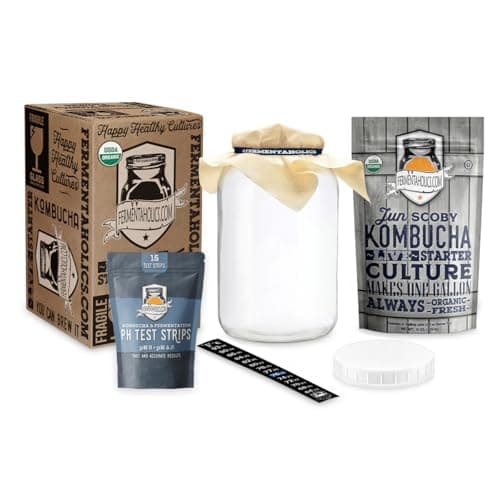
Essentials Jun Kombucha Brewing Kit
A jun culture is a different organism community to a kombucha SCOBY, and it will not appear by feeding a kombucha culture honey — this is the way to start jun properly.
Two teaspoons of dehydrated grains that rehydrate to three or four tablespoons and then turn out two to three quarts every 24 to 48 hours, indefinitely.
The only milk kefir culture here that publishes its whole life cycle — activation schedule, working ratio, culturing window and when the grains start multiplying.
Water kefir and milk kefir are not the same product
They share a name and a granular-looking culture and almost nothing else. Water kefir grains eat sugar in water and make something light and soda-like; the water kefir guide has the published ratios. Milk kefir grains eat lactose and make something thick and tart, and the milk kefir guide has that method.
Neither culture can be converted into the other, and both are sold dehydrated by the same maker, which is why they end up in the same order and then confuse people. Label the jars.
The practical difference for a kit buyer is the obligation. Water kefir gives you a day or two of slack between batches. Milk kefir does not: the published guidance is to strain every 12 to 24 hours and never leave the grains in milk beyond 48. That is a daily commitment with no published pause, and it is the reason the powdered starter exists.
The kit for people who will not commit
A direct-set powdered kefir starter is the only option on this page you can genuinely walk away from. One packet, one quart, 12 to 18 hours at 72 to 74 F, and then nothing in your fridge waiting to be fed. The published reculturing range is two to seven times per packet before the culture drifts.
It is the most expensive route per quart and the cheapest route to finding out whether your household drinks kefir at all. For a first purchase, that is often the right trade — and if the answer turns out to be yes, grains cost almost nothing over any horizon longer than a month.
What you can reuse, and what you cannot
Reusable: the jar. Jun uses the same gallon vessel as kombucha. The kefirs want something smaller — a quart or a half gallon, which is where a wide-mouth mason jar earns its place.
Reusable: the bottles. Every one of these second-ferments in the same pressure-rated swing tops. Water kefir in particular carbonates hard and fast.
Reusable: the thermometer. Every published window on this page is a temperature-and-time pair, and the temperature half is the one nobody measures.
Not reusable: the culture, obviously — and the strainer. Milk kefir needs straining daily through nylon or stainless steel only; the maker rules out every other metal.
What each one actually tastes like
Nobody keeps a ferment they do not enjoy drinking, so it is worth being concrete about this before the equipment question. All four are sour; they are sour in quite different ways.
Kombucha. Assertively sour and unmistakably made of tea. There is tannin in it and a vinegar-adjacent sharpness. It is the most polarizing of the four and the one people either love immediately or never come round to.
Jun. Lighter and rounder than kombucha, with the honey and green tea showing through rather than being buried. People who find kombucha harsh often get on with jun, which is most of its appeal.
Water kefir. Mildly sweet, faintly yeasty, and much closer to a soft drink than to anything fermented. It takes fruit in a second ferment better than any of the others and it is the easiest sell to a household that has already said no to kombucha.
Milk kefir. Thick, tart and dairy — closer to a drinking yogurt than to a soda. It is a different category of drink and it is the one most likely to end up in cooking rather than in a glass.
What each one costs to keep running
The kit price is the smallest part of this. What decides whether a ferment survives past month two is what it consumes every week, and the four differ more than you would expect.
Ongoing inputs for each ferment. Prices are not shown anywhere on this site; this is what you are buying, not what it costs.
Ferment
Weekly inputs
Culture cost after the first purchase
Kombucha
Tea, cane sugar, water
None — the culture is permanent
Jun
Green tea, honey, water
None — the culture is permanent
Water kefir
Cane sugar, unchlorinated water, trace minerals
None — grains multiply
Milk kefir
Pasteurized whole milk, daily
None — the grains are permanent
Kefir from powder
Milk plus a new packet every few batches
Recurring — 2 to 7 recultures per packet
Two things stand out. Honey is the expensive input on this page, which makes jun the costliest of the reusable-culture ferments per gallon even though its equipment is identical to kombucha's. And the powdered starter is the only row with a recurring culture cost, which is the trade for having nothing to maintain.
Milk is the input people underestimate. A milk kefir habit at the published working ratio consumes up to four cups a day if you run it continuously, which is a grocery decision as much as a fermentation one.
They all second-ferment, except one
Jun and water kefir both take a second fermentation exactly as kombucha does: into a sealed pressure-rated bottle with a little fruit or juice, left at room temperature for a day or two, then refrigerated. Water kefir in particular carbonates hard and fast, so the published pressure rating on a bottle matters at least as much there as it does for kombucha.
Milk kefir is the exception. It does get a second stage — usually left at room temperature for a further 12 to 24 hours after straining, sometimes with fruit — but the point is flavor and texture rather than carbonation, and it is done in a jar rather than in a sealed bottle. A dairy ferment under pressure is a mess nobody needs.
Practically, that means one set of bottles covers three of the four ferments here, which is worth knowing before you buy a second set of anything.
Of the four, jun is the one whose method genuinely differs from kombucha rather than just its schedule — honey behaves nothing like cane sugar in a jar. How to make jun covers the full batch before you decide which kit to buy.
Heads up: some links on this page are affiliate links. If you buy through one we may earn a commission at no extra cost to you. It never changes a ranking, and we take no payment for placement. The full version.
The short answer
Quick picks
Ranked on the published rubric. Every row jumps to that product's full write-up below; the button goes straight to Amazon.
#
Product
Best for
Score
Price
1
Fermentaholics
Essentials Jun Kombucha Brewing Kit
A jun culture is a different organism community to a kombucha SCOBY, and it will not appear by feeding a kombucha culture honey — this is the way to start jun properly.
Two teaspoons of dehydrated grains that rehydrate to three or four tablespoons and then turn out two to three quarts every 24 to 48 hours, indefinitely.
The only milk kefir culture here that publishes its whole life cycle — activation schedule, working ratio, culturing window and when the grains start multiplying.
A direct-set powder that makes a quart at a time and can be recultured a handful of times, for anyone who wants the drink without keeping a culture alive.
Fermentaholics Essentials Jun Kombucha Brewing Kit
A jun culture is a different organism community to a kombucha SCOBY, and it will not appear by feeding a kombucha culture honey — this is the way to start jun properly.
Who it is for. Someone who has read that jun is lighter and faster, and wants the culture that actually does that.
Published specifications
Culture
USDA Certified Organic jun culture
Feedstock
Green tea and honey, not black tea and sugar
Kit type
Essentials — jar, cover, band, culture
Certification
USDA Certified Organic
Source: Fermentaholics published Jun kit listing, fermentaholics.com/product/essentials-jun-kombucha-brewing-kit/, retrieved 2026-09-01
Rubric — 7.2 / 10
Materials8/10 · weight 28%
Documentation6/10 · weight 22%
Capacity fit7/10 · weight 16%
Cleaning8/10 · weight 18%
Value7/10 · weight 16%
What it gets right
A jun culture bought as a jun culture is the only reliable way to get one — converting a kombucha SCOBY to honey is a well-known way to weaken it
Same Essentials structure as the kombucha kit, so the jar and cover are the parts you already understand
Jun ferments cooler and faster than kombucha, which suits a house that never gets to 78F
What it costs you
Honey is meaningfully more expensive per batch than cane sugar, and jun wants a lot of it
Fewer published details than the kombucha kits from the same maker
No tea, sugar, honey or pH strips included
Skip it if. You have not brewed kombucha yet. Jun is less forgiving of a cold room and a weak starter; the ordinary kombucha route teaches the same skills more cheaply.
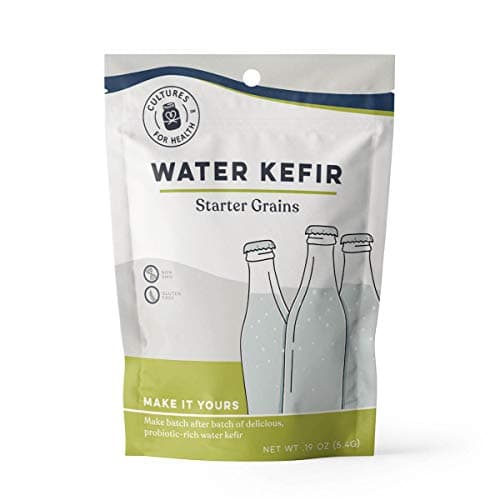
Cultures for Health Water Kefir Grains (Dehydrated)
Two teaspoons of dehydrated grains that rehydrate to three or four tablespoons and then turn out two to three quarts every 24 to 48 hours, indefinitely.
Who it is for. Someone who wants a fizzy home ferment on a two-day cycle, with no tea and no caffeine.
Published specifications
Shipped form
Dehydrated. Each packet contains 2 teaspoons of live active grains
Rehydration time
3-4 days; may take up to 7 days
Rehydration water
Unchlorinated, unfluoridated water with cane sugar
Activation sugar
1/4 cup cane sugar to 3-4 cups water
Rehydrated volume
3-4 tablespoons of grains
Output
2-3 quarts every 24-48 hours once established
Working ratio
1-2 teaspoons of grains per 4 cups of liquid
Culture temperature
68-85 F
Shelf life, room temperature
12-18 months at 68-78 F
Shelf life, refrigerated
18+ months at 40-45 F
Source: Cultures for Health published water kefir grain specifications (packet volume, rehydration, ratios, storage temperatures and shelf life), culturesforhealth.com water kefir FAQ and starter culture instructions, retrieved 2026-09-01
Rubric — 8.9 / 10
Materials9/10 · weight 28%
Documentation10/10 · weight 22%
Capacity fit8/10 · weight 16%
Cleaning8/10 · weight 18%
Value9/10 · weight 16%
What it gets right
A 24-to-48-hour cycle against kombucha’s 7 to 14 days — this is the ferment for someone impatient
Dehydrated grains have a published 12-to-18-month room-temperature shelf life, so the packet can sit in a drawer until you are ready
Every number a beginner needs is published: activation ratio, working ratio, temperature band, output volume
No tea and no caffeine, so it suits households that will not drink kombucha
What it costs you
Three to seven days of rehydration before the first real batch, which is longer than a kombucha SCOBY takes to get going
Chlorinated tap water will stall or kill the grains, so filtered water is not optional
Grains multiply, and you will be giving them away or throwing them out within a month
Skip it if. You want the sour, tea-driven flavor of kombucha. Water kefir is lighter, sweeter and closer to a soda; it is a different drink, not a faster kombucha.
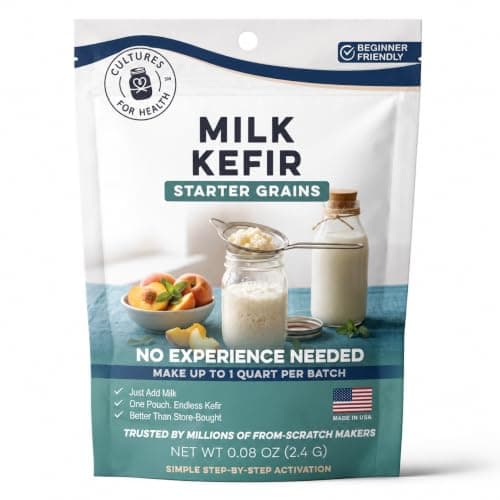
Cultures for Health Milk Kefir Grains (Dehydrated)
The only milk kefir culture here that publishes its whole life cycle — activation schedule, working ratio, culturing window and when the grains start multiplying.
Who it is for. Someone who wants a permanent culture — buy once, strain daily, and never order a starter again.
Published specifications
Shipped form
“1 packet of dehydrated traditional, heirloom-style milk kefir grains”
Activation starting volume
1 cup fresh, cold pasteurized milk
Activation schedule
Between hours 8 and 24, check hourly; at the first change in texture, strain and re-milk, increasing the milk by 1/2 cup
Activation period
3 to 7 days, feeding increasing amounts of milk from 1 cup up to 4 cups
Activation endpoint
“Your grains are activated when they are reliably thickening milk in about 24 hours”
Working ratio
1-2 teaspoons of grains per up to 4 cups of milk
Culture temperature
68-85 F
Culturing time
12 to 24 hours; never leave grains in milk beyond 48 hours
Multiplication
“Generally kefir grains take 6 to 8 weeks following rehydration to begin multiplying”
Milk requirement
Pasteurized whole milk, not UHT or ultra-pasteurized. Raw milk after a transition
Straining
“Stainless steel is acceptable. Avoid all other types of metal.”
Certification
Non-GMO, gluten free
Shelf life
“Use the starter culture by the date on the bag”
Source: Cultures for Health published milk kefir grain product specification, its activation instructions for dehydrated milk kefir grains, and its milk kefir FAQ (working ratio, temperature, culturing time, multiplication, milk types and straining metals), culturesforhealth.com, retrieved 2026-09-04
Rubric — 8.7 / 10
Materials9/10 · weight 28%
Documentation10/10 · weight 22%
Capacity fit8/10 · weight 16%
Cleaning7/10 · weight 18%
Value9/10 · weight 16%
What it gets right
Every number the first month needs is published: the 1-cup start, the half-cup step up, the 3-to-7-day window, the 1-2 teaspoons per 4 cups working ratio and the 12-to-24-hour culturing time
It is reusable indefinitely, so the culture is a one-time purchase rather than a subscription — unlike every powdered starter on this page
Dehydrated grains ship without the timing pressure of a live culture in a hot van
The maker states which metals are safe to strain with, which is the one hardware question this ferment raises and almost nobody answers
What it costs you
The packet weight or volume is not published, so you cannot compare the quantity against another seller before ordering
Three to seven days of daily feeding before the first drinkable batch, then a further 6 to 8 weeks before the grains multiply
It is a daily obligation. Grains left in milk past 48 hours starve, and there is no published pause longer than that
Ultra-pasteurized milk will not work, and in some US markets that is most of the shelf
Skip it if. You travel often or want a ferment you can walk away from for a fortnight. Grains need feeding on a 12-to-24-hour cycle; a powdered direct-set starter is the honest answer for an intermittent brewer.
Not published. The maker says “bioplastic” and stops there
Dishwasher rating
Not published on the maker’s product page
Source: Kefirko published kefir fermenter product page (sizes in ml and oz, box contents, materials, dimensions and weights for both sizes), kefirko.com/product/kefir-fermenter/, retrieved 2026-09-04. The 848 ml figure is from US retail listings, cited as a size discrepancy only.
Rubric — 7.5 / 10
Materials7/10 · weight 28%
Documentation7/10 · weight 22%
Capacity fit9/10 · weight 16%
Cleaning9/10 · weight 18%
Value6/10 · weight 16%
What it gets right
The strainer is built into the lid, so the daily task becomes “turn it over” instead of “find the sieve, strain, wash the sieve”
Height, diameter and weight are all published for both sizes, so you can check it against a shelf before ordering
1400 ml holds a full quart of milk with headroom, and the 900 ml suits a smaller household
It comes apart into a handful of pieces with no crevices, which is what makes a daily ferment sustainable
What it costs you
“Bioplastic” is not a specification. The maker does not publish the resin, so you cannot check it against anything
No dishwasher rating on the maker’s own page, despite retailers stating one
It costs many times what a mason jar and a nylon sieve cost, and those do the same job
US retail listings still describe the smaller jar as 848 ml while the maker now publishes 900 ml — check the size on the listing you are buying
Skip it if. You already own a quart jar and a plastic sieve. This buys convenience, not capability, and the grains cannot tell the difference.
#ad No live price feed yet, so no number is shown rather than a stale one. How this is funded.
#5 · Kefir without a daily obligation
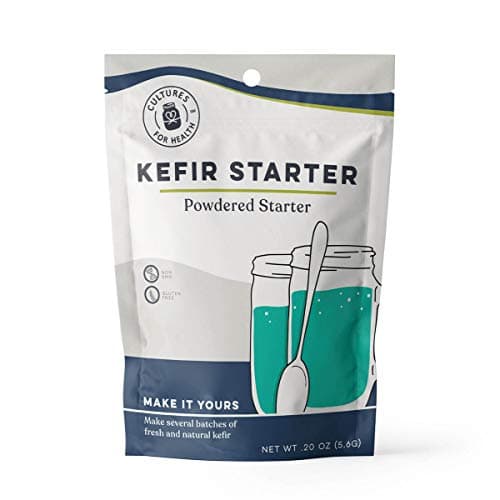
Cultures for Health Kefir Starter Culture Powder (4 Packets)
A direct-set powder that makes a quart at a time and can be recultured a handful of times, for anyone who wants the drink without keeping a culture alive.
Who it is for. An intermittent brewer, or anyone testing the drink before taking on a culture that has to be fed daily.
Published specifications
Packets per box
4 packets
Form
Powdered, direct-set starter culture
Yield per packet
1 quart of liquid per packet
Culture temperature
72-74 F
Culturing time
12 to 18 hours
Reculturing
“Kefir made with a direct-set style starter culture can often be recultured anywhere from 2 to 7 times”
Liquids
Pasteurized whole milk (not UHT/ultra-pasteurized), juice, coconut milk, or coconut water
Certification
Non-GMO, gluten free
Storage
“Store the starter in the refrigerator until you’re ready to activate it”
Source: Cultures for Health published Kefir Starter Culture Powder product page (packet count, liquids, certifications, storage) and its direct-set kefir instructions (1 packet per quart, 72-74 F, 12-18 hours, 2-7 recultures), culturesforhealth.com, retrieved 2026-09-04
Rubric — 8.1 / 10
Materials8/10 · weight 28%
Documentation9/10 · weight 22%
Capacity fit7/10 · weight 16%
Cleaning10/10 · weight 18%
Value6/10 · weight 16%
What it gets right
Nothing to maintain between batches — you open a packet when you want kefir and there is no culture in the fridge waiting to be fed
The temperature and time are tight and published: 72 to 74 F for 12 to 18 hours, which is a much narrower target than “68 to 85 F, 12 to 24 hours”
It cultures juice, coconut milk and coconut water as well as dairy, which grains do not do reliably
Four packets is enough to find out whether you actually drink the stuff before committing to grains
What it costs you
It runs out. Reculturing is published as 2 to 7 times, so the box is finite in a way grains never are
“A few times” and “2 to 7 times” are the only published numbers on reculturing — how far a given packet stretches is not knowable in advance
The 72-74 F window is narrower than most kitchens hold without help
Cost per quart is higher than grains once you get past the first month
Skip it if. You already know you want kefir every day. Grains cost less over any horizon longer than a few weeks and never need reordering.
What is the easiest ferment to start after kombucha?+
Jun, if your kitchen is cool — it uses the same jar, cover and method, just green tea and honey instead of black tea and sugar, at a lower temperature and a shorter cycle. Water kefir is the easiest if you want to leave tea behind entirely, though its dehydrated grains need three to four days of rehydration first.
Can I turn my kombucha SCOBY into a jun culture?+
No. Jun is a distinct culture community adapted to honey and green tea. Feeding a kombucha SCOBY honey tends to weaken it rather than convert it, which is why jun is sold as its own culture and why a jun kit exists.
Is a jun kit different from a kombucha kit?+
Only in the culture. The Fermentaholics jun kit follows the same Essentials structure — jar, cover, band and culture — so the equipment is identical. The running cost is different, because jun is fed honey and honey is meaningfully more expensive per batch than cane sugar.
Do water kefir and milk kefir use the same grains?+
No. They are unrelated cultures that share a name and a granular appearance. Water kefir grains ferment sugar water on a 24-to-48-hour cycle; milk kefir grains ferment lactose on a 12-to-24-hour cycle. Neither can be converted into the other.
Which ferment needs the least attention?+
A powdered direct-set kefir starter, because there is no living culture to maintain between batches — you open a packet when you want kefir. Of the reusable cultures, jun asks the least often, since it runs on days rather than the daily straining milk kefir grains require.
Sources
Every specification cited on this page came from one of these documents, retrieved on the date shown against the product it belongs to.
Grains or powder, what each maker actually publishes, the activation month in real numbers, and the jar-and-strainer question every daily brewer runs into.
Three starters from one maker, compared on published activation windows, ratios and shelf life — and an honest account of where the documentation ends.