Cultures for Health, reviewed on what they publish
We have not cultured anything in a lab. What we can do is read every number this maker publishes, check it against its own instructions, and say where the paperwork stops.
By Scooter M.·Published September 13, 2026 · Updated September 27, 2026
The short answer
Cultures for Health publishes more usable detail than any other culture seller this site has sourced from — activation schedules, working ratios, temperature bands, shelf lives, even which metals are safe to strain with. Buy the dehydrated grains if you want a permanent culture; buy the powdered starter if you want kefir with nothing to maintain. The gaps are in packet weights and in anything kombucha-specific.
How this review works, and what it is not
This site has no test lab and does not claim one. We have not cultured these grains, timed their activation or measured anything. What this page does instead is the thing a buyer cannot easily do for themselves: read everything the maker publishes across its product pages, instructions and FAQs, check the figures against each other, and report where the documentation is strong and where it stops.
That is a genuinely useful review for this category, because live cultures are almost impossible to compare any other way. You cannot inspect one before buying, photographs tell you nothing, and every seller's marketing sounds identical. Documentation is the one thing that differs, and it is checkable. The rubric is published with its weights, and documentation carries the second-heaviest of them for exactly this reason.
The documentation is the product
Start with what makes this maker unusual. For its water kefir grains it publishes the packet contents, the rehydration window, the activation ratio, the rehydrated volume, the working ratio, the culturing temperature band and two separate shelf lives.
Published figures across the three cultures, compiled from the maker's product pages, instructions and FAQs.
Water kefir grains
Milk kefir grains
Kefir starter powder
Form
Dehydrated
Dehydrated
Freeze-dried powder
Activation
3-4 days, up to 7
3-7 days, 1 cup up to 4
None — use immediately
Working ratio
1-2 tsp per 4 cups
1-2 tsp per up to 4 cups
1 packet per 1 quart
Temperature
68-85 F
68-85 F
72-74 F
Cycle
24-48 hours
12-24 hours
12-18 hours
Reusable
Yes, indefinitely
Yes, indefinitely
2 to 7 recultures per packet
Shelf life
12-18 months room temp
“Use by the date on the bag”
“Use by the date on the bag”
Almost nothing else in home fermentation publishes a table like that. The water kefir column in particular is the most complete specification for a live culture anywhere on this site, and it is a large part of why those grains are a good first ferment — every number a beginner needs is stated before they buy.
Where the paperwork runs out
Being fair means being specific about the gaps, and there are three.
Packet weights are inconsistent. The water kefir packet publishes two teaspoons of dehydrated grains. The milk kefir packet publishes no weight or volume at all — just “1 packet”. You cannot compare the milk grains against another seller's packet on quantity, which is the one comparison a buyer most wants.
Shelf life is published for one product and not the others. Twelve to eighteen months at room temperature is a genuinely useful figure for the water kefir grains. For the milk grains and the powder it is “use by the date on the bag”, which tells you nothing before the bag arrives.
Nothing is kombucha-specific. This maker sells cultures for kefir, yogurt, cheese and more; none of the published guidance addresses kombucha at all. On a kombucha site that is worth saying plainly — these are excellent products for the other drink ferments and irrelevant to a SCOBY.
The picks
Which of the three to buy
Water kefir for the fastest, best-documented first ferment. Milk kefir if you want a thick, tart daily drink. The powder if you want kefir with nothing living in your fridge.
Cultures for Health
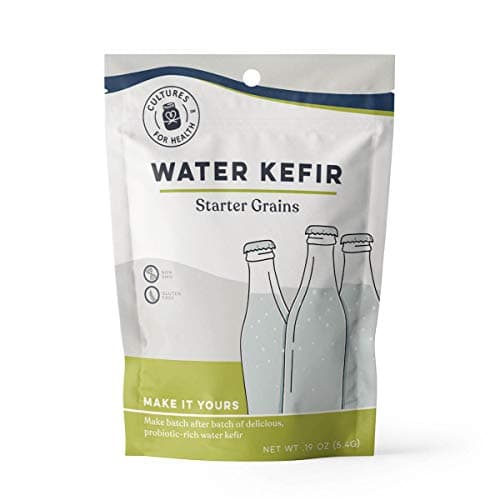
Water Kefir Grains (Dehydrated)
Two teaspoons of dehydrated grains that rehydrate to three or four tablespoons and then turn out two to three quarts every 24 to 48 hours, indefinitely.
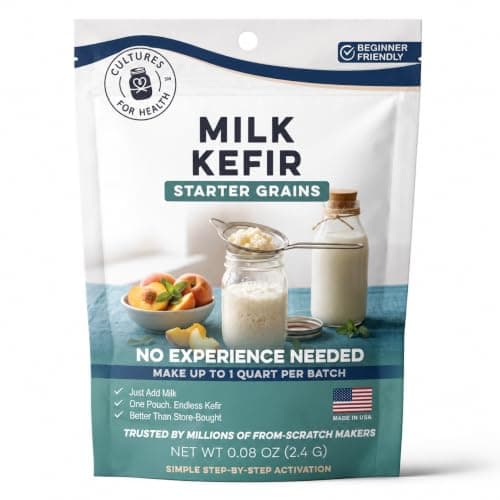
The only milk kefir culture here that publishes its whole life cycle — activation schedule, working ratio, culturing window and when the grains start multiplying.
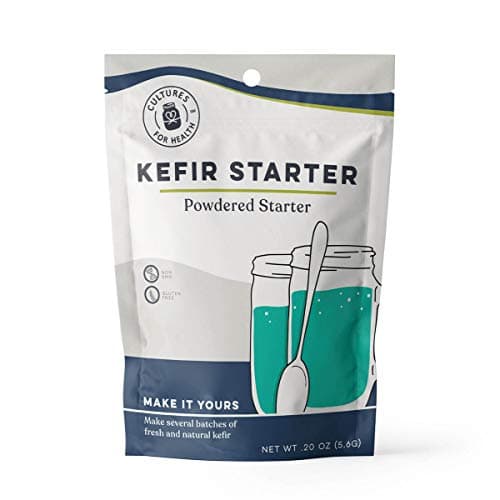
A direct-set powder that makes a quart at a time and can be recultured a handful of times, for anyone who wants the drink without keeping a culture alive.
They are not competing products so much as three different commitments, and the honest way to choose is by how often you want to be in the kitchen.
Water kefir grains are the easiest entry. A 24-to-48-hour cycle, no tea, no caffeine, a published 68 to 85 F band, and dehydrated grains with a published 12-to-18-month room-temperature shelf life so the packet can sit in a drawer until you are ready. The water kefir guide has the full method.
Milk kefir grains are the biggest commitment on this page: strain every 12 to 24 hours, never leave them beyond 48, and expect six to eight weeks after rehydration before they begin multiplying. The milk kefir guide covers the activation month in the maker's own numbers.
The powdered starter is the only one you can walk away from. One packet per quart, 12 to 18 hours at a tight 72 to 74 F, and a published two to seven recultures before it drifts. It is the most expensive per quart and the cheapest way to find out whether your household drinks kefir at all.
The detail that earns the most trust
One published line does more for this maker's credibility than the rest of the marketing combined: for straining milk kefir, “stainless steel is acceptable. Avoid all other types of metal.”
That is a specific, actionable, slightly inconvenient instruction — the kind a seller includes because it is true rather than because it sells anything. It also happens to be the same guidance this site gives about metal and acid, arrived at independently, which is a reasonable cross-check on whether a maker knows what it is talking about.
The counterpart is the honest warning against routine refrigeration of milk kefir grains — described as very hard on them — where a less careful seller would simply say “store in the fridge” and let the customer discover the problem. Sellers who publish the inconvenient thing are the ones worth buying live cultures from.
How they compare with the other sellers here
A review in isolation is not much use. This site sources from several culture houses, and the fair way to place this one is against the others on the same measure: what they are willing to write down.
What each culture seller on this site publishes, compared on documentation rather than marketing.
Seller
Quantities published
Method published
Gaps
Cultures for Health
Partly — water kefir yes, milk kefir no
Extensively: ratios, temperatures, cycles, shelf life
Packet weights; nothing kombucha-specific
Fermentaholics
Yes — starter tea in fl oz, dosing rule
Partly: rehydration guides, the 10 percent rule
Grain weights; fewer figures overall
The Kombucha Shop
Yes — starter tea in cups, kit contents
Partly: kit instructions
No jar dimensions anywhere
The pattern is that Fermentaholics publishes the best quantities — a starter tea volume in fluid ounces against a stated ten percent rule is the most checkable claim any culture seller on this site makes — while Cultures for Health publishes the best method. Activation schedules, working ratios, temperature bands and two separate shelf lives is a depth of instruction nobody else here approaches.
The quantities side has its own write-up. Fermentaholics, reviewed on what it publishes checks those starter tea volumes against the ten percent rule at every batch size, and lists the figures that seller leaves out.
For a buyer that resolves cleanly. If you are starting kombucha or jun, the seller who publishes the starter tea volume is the one to buy from — where to buy a SCOBY works through that. If you are starting kefir, buy from the seller who publishes the method, because kefir is the ferment where the first month is where people give up.
The other powdered starter on this site is reviewed the same way. The Yogourmet kefir starter review sets its published sachet weights, shelf life and organism list against this maker's.
Heads up: some links on this page are affiliate links. If you buy through one we may earn a commission at no extra cost to you. It never changes a ranking, and we take no payment for placement. The full version.
The short answer
Quick picks
Ranked on the published rubric. Every row jumps to that product's full write-up below; the button goes straight to Amazon.
#
Product
Best for
Score
Price
1
Cultures for Health
Water Kefir Grains (Dehydrated)
Two teaspoons of dehydrated grains that rehydrate to three or four tablespoons and then turn out two to three quarts every 24 to 48 hours, indefinitely.
The only milk kefir culture here that publishes its whole life cycle — activation schedule, working ratio, culturing window and when the grains start multiplying.
A direct-set powder that makes a quart at a time and can be recultured a handful of times, for anyone who wants the drink without keeping a culture alive.
Cultures for Health Water Kefir Grains (Dehydrated)
Two teaspoons of dehydrated grains that rehydrate to three or four tablespoons and then turn out two to three quarts every 24 to 48 hours, indefinitely.
Who it is for. Someone who wants a fizzy home ferment on a two-day cycle, with no tea and no caffeine.
Published specifications
Shipped form
Dehydrated. Each packet contains 2 teaspoons of live active grains
Rehydration time
3-4 days; may take up to 7 days
Rehydration water
Unchlorinated, unfluoridated water with cane sugar
Activation sugar
1/4 cup cane sugar to 3-4 cups water
Rehydrated volume
3-4 tablespoons of grains
Output
2-3 quarts every 24-48 hours once established
Working ratio
1-2 teaspoons of grains per 4 cups of liquid
Culture temperature
68-85 F
Shelf life, room temperature
12-18 months at 68-78 F
Shelf life, refrigerated
18+ months at 40-45 F
Source: Cultures for Health published water kefir grain specifications (packet volume, rehydration, ratios, storage temperatures and shelf life), culturesforhealth.com water kefir FAQ and starter culture instructions, retrieved 2026-09-01
Rubric — 8.9 / 10
Materials9/10 · weight 28%
Documentation10/10 · weight 22%
Capacity fit8/10 · weight 16%
Cleaning8/10 · weight 18%
Value9/10 · weight 16%
What it gets right
A 24-to-48-hour cycle against kombucha’s 7 to 14 days — this is the ferment for someone impatient
Dehydrated grains have a published 12-to-18-month room-temperature shelf life, so the packet can sit in a drawer until you are ready
Every number a beginner needs is published: activation ratio, working ratio, temperature band, output volume
No tea and no caffeine, so it suits households that will not drink kombucha
What it costs you
Three to seven days of rehydration before the first real batch, which is longer than a kombucha SCOBY takes to get going
Chlorinated tap water will stall or kill the grains, so filtered water is not optional
Grains multiply, and you will be giving them away or throwing them out within a month
Skip it if. You want the sour, tea-driven flavor of kombucha. Water kefir is lighter, sweeter and closer to a soda; it is a different drink, not a faster kombucha.
Cultures for Health Milk Kefir Grains (Dehydrated)
The only milk kefir culture here that publishes its whole life cycle — activation schedule, working ratio, culturing window and when the grains start multiplying.
Who it is for. Someone who wants a permanent culture — buy once, strain daily, and never order a starter again.
Published specifications
Shipped form
“1 packet of dehydrated traditional, heirloom-style milk kefir grains”
Activation starting volume
1 cup fresh, cold pasteurized milk
Activation schedule
Between hours 8 and 24, check hourly; at the first change in texture, strain and re-milk, increasing the milk by 1/2 cup
Activation period
3 to 7 days, feeding increasing amounts of milk from 1 cup up to 4 cups
Activation endpoint
“Your grains are activated when they are reliably thickening milk in about 24 hours”
Working ratio
1-2 teaspoons of grains per up to 4 cups of milk
Culture temperature
68-85 F
Culturing time
12 to 24 hours; never leave grains in milk beyond 48 hours
Multiplication
“Generally kefir grains take 6 to 8 weeks following rehydration to begin multiplying”
Milk requirement
Pasteurized whole milk, not UHT or ultra-pasteurized. Raw milk after a transition
Straining
“Stainless steel is acceptable. Avoid all other types of metal.”
Certification
Non-GMO, gluten free
Shelf life
“Use the starter culture by the date on the bag”
Source: Cultures for Health published milk kefir grain product specification, its activation instructions for dehydrated milk kefir grains, and its milk kefir FAQ (working ratio, temperature, culturing time, multiplication, milk types and straining metals), culturesforhealth.com, retrieved 2026-09-04
Rubric — 8.7 / 10
Materials9/10 · weight 28%
Documentation10/10 · weight 22%
Capacity fit8/10 · weight 16%
Cleaning7/10 · weight 18%
Value9/10 · weight 16%
What it gets right
Every number the first month needs is published: the 1-cup start, the half-cup step up, the 3-to-7-day window, the 1-2 teaspoons per 4 cups working ratio and the 12-to-24-hour culturing time
It is reusable indefinitely, so the culture is a one-time purchase rather than a subscription — unlike every powdered starter on this page
Dehydrated grains ship without the timing pressure of a live culture in a hot van
The maker states which metals are safe to strain with, which is the one hardware question this ferment raises and almost nobody answers
What it costs you
The packet weight or volume is not published, so you cannot compare the quantity against another seller before ordering
Three to seven days of daily feeding before the first drinkable batch, then a further 6 to 8 weeks before the grains multiply
It is a daily obligation. Grains left in milk past 48 hours starve, and there is no published pause longer than that
Ultra-pasteurized milk will not work, and in some US markets that is most of the shelf
Skip it if. You travel often or want a ferment you can walk away from for a fortnight. Grains need feeding on a 12-to-24-hour cycle; a powdered direct-set starter is the honest answer for an intermittent brewer.
Cultures for Health Kefir Starter Culture Powder (4 Packets)
A direct-set powder that makes a quart at a time and can be recultured a handful of times, for anyone who wants the drink without keeping a culture alive.
Who it is for. An intermittent brewer, or anyone testing the drink before taking on a culture that has to be fed daily.
Published specifications
Packets per box
4 packets
Form
Powdered, direct-set starter culture
Yield per packet
1 quart of liquid per packet
Culture temperature
72-74 F
Culturing time
12 to 18 hours
Reculturing
“Kefir made with a direct-set style starter culture can often be recultured anywhere from 2 to 7 times”
Liquids
Pasteurized whole milk (not UHT/ultra-pasteurized), juice, coconut milk, or coconut water
Certification
Non-GMO, gluten free
Storage
“Store the starter in the refrigerator until you’re ready to activate it”
Source: Cultures for Health published Kefir Starter Culture Powder product page (packet count, liquids, certifications, storage) and its direct-set kefir instructions (1 packet per quart, 72-74 F, 12-18 hours, 2-7 recultures), culturesforhealth.com, retrieved 2026-09-04
Rubric — 8.1 / 10
Materials8/10 · weight 28%
Documentation9/10 · weight 22%
Capacity fit7/10 · weight 16%
Cleaning10/10 · weight 18%
Value6/10 · weight 16%
What it gets right
Nothing to maintain between batches — you open a packet when you want kefir and there is no culture in the fridge waiting to be fed
The temperature and time are tight and published: 72 to 74 F for 12 to 18 hours, which is a much narrower target than “68 to 85 F, 12 to 24 hours”
It cultures juice, coconut milk and coconut water as well as dairy, which grains do not do reliably
Four packets is enough to find out whether you actually drink the stuff before committing to grains
What it costs you
It runs out. Reculturing is published as 2 to 7 times, so the box is finite in a way grains never are
“A few times” and “2 to 7 times” are the only published numbers on reculturing — how far a given packet stretches is not knowable in advance
The 72-74 F window is narrower than most kitchens hold without help
Cost per quart is higher than grains once you get past the first month
Skip it if. You already know you want kefir every day. Grains cost less over any horizon longer than a few weeks and never need reordering.
Judged on what they publish — which is the only way to compare live cultures before buying — they document more than any other seller this site has sourced from: activation schedules, working ratios, temperature bands, cycle times and shelf lives. This site has not cultured them and does not claim to have tested them.
Which Cultures for Health product should I start with?+
Water kefir grains. They have the most complete published specification, a 24-to-48-hour cycle, no tea and no caffeine, and a 12-to-18-month room-temperature shelf life so the packet can wait until you are ready. Milk kefir grains are a daily commitment; the powdered starter is for people who want nothing to maintain.
Do Cultures for Health sell a kombucha culture?+
Their published guidance covers kefir, yogurt and other cultures, and none of it addresses kombucha. The three products reviewed here are for the other drink ferments. For a kombucha SCOBY, see this site's separate page on where to buy one.
Is dehydrated culture worse than a live one?+
For a mail-order purchase it is generally better. A dehydrated culture has no timing pressure in transit and tolerates delays, and the water kefir grains publish a 12-to-18-month room-temperature shelf life. The trade-off is three to seven days of activation before the first real batch.
How long do Cultures for Health grains last?+
For the dehydrated water kefir grains the maker publishes 12 to 18 months at 68 to 78 F, and 18 months or more refrigerated at 40 to 45 F. For the milk kefir grains and the powdered starter, the only published guidance is to use them by the date printed on the bag.
Sources
Every specification cited on this page came from one of these documents, retrieved on the date shown against the product it belongs to.
Grains or powder, what each maker actually publishes, the activation month in real numbers, and the jar-and-strainer question every daily brewer runs into.