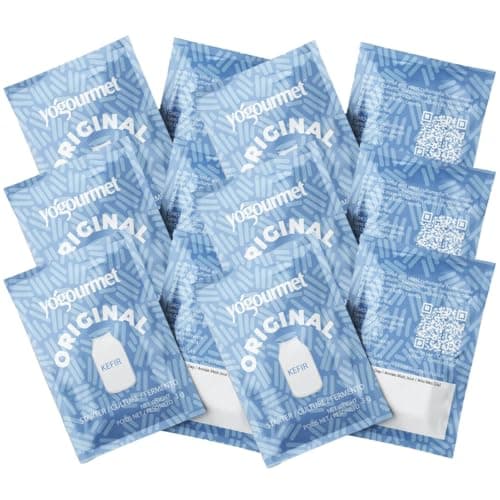
Buy it if you want kefir without a daily obligation. It is freeze-dried, shelf stable for a published two years, and each 3 gram sachet turns a quart of milk into kefir on its own. Buy grains instead if you intend to keep making it, because this box is single use: twelve sachets is twelve batches and then it is gone, while grains keep going indefinitely. That is the entire decision, and the rest is detail.
What this review is
This site has not cultured milk with this starter. What it can do is read everything Yogourmet and its distributors publish, hold it against the alternatives already documented here, and be clear about which claims are the maker's.
One practical note before the specification. Yogourmet sells this starter in a six-sachet box and a twelve-sachet bulk box. When this page was written, only the twelve-sachet version was purchasable — both six-sachet listings showed as not currently in stock — so the twelve is what is featured and priced here.
The published specification
Published figures for the Yogourmet kefir starter, from the live 12-pack listing and the distributor's published instructions.
Parameter
Published value
Contents
12 sachets of 3 g
Yield
One sachet per 1 L (about 1 quart) of milk
Form
Freeze-dried powder
Shelf life
24 months from the production date
Milk preparation
Heat to 82 C / 180 F, cool to 23-25 C / 73-77 F
Incubation
About 24 hours at 23-25 C / 73-77 F
Stopping the ferment
Refrigerate about 8 hours
Production standards
ISO 9001 and FSSC 22000, stated
Certification
Halal, kosher, gluten free, non-GMO; no preservatives or coloring
Reuse
Sold as single use
That is an unusually complete label for a home fermentation product. Most cultures publish a name and a promise; this one publishes a gram weight, a yield, two temperatures, a duration and a shelf life, which means you can compare it against anything else on a cost-per-quart basis before buying.
The six-sachet box goes further still: its packaging lists the organisms by name — several Lactococcus strains, Lactobacillus acidophilus, and the yeasts Saccharomyces cerevisiae and Kluyveromyces lactis, plus kefir grains and maltodextrin. No other culture on this site names its organisms. That list is published for the product line rather than repeated on the bulk listing, which is worth knowing if you are avoiding a specific organism.
The catch is in one row
Read the table again and stop at the last line. Sold as single use.
Milk kefir grains are a permanent culture: strain them out, drop them into fresh milk, and they do it again tomorrow and in five years. The grains page works through what that routine costs you — it is about ninety seconds a day and there is no version where you skip three days. A powdered starter is the opposite trade: nothing to maintain, and a box that empties.
Some powdered starters can be recultured a limited number of times by using a little finished kefir to start the next batch. Yogourmet is sold as single use, and its distributor points people who want to reculture toward grains instead. Treat the twelve sachets as twelve batches.
The three routes to kefir this site has sourced, on published figures.
Yogourmet 12-pack
Cultures for Health powder
Milk kefir grains
Form
Freeze-dried sachets
Freeze-dried packets
Live grains
Batches per box
12
4
Indefinite
Daily routine
None
None
Strain and refeed, most days
Milk heated first?
Yes, to 180 F
Yes, per its instructions
No
Organisms named
Yes, for the line
Partly
Not applicable
Runs out
Yes
Yes
No
The picks
The honest pair
The starter if you want kefir with no obligation, the grains if you want kefir permanently. Most people who stick with kefir end up on grains.
Yogourmet
Kefir Starter, 12 Sachets (Bulk)
The same freeze-dried starter as the six-sachet box in twice the quantity — twelve quarts of kefir, each from its own packet, with nothing to feed between batches.
The only milk kefir culture here that publishes its whole life cycle — activation schedule, working ratio, culturing window and when the grains start multiplying.
This is the part people underestimate, because "just add powder" sounds simpler than keeping grains.
You heat the milk to 180 F, cool it back to the mid-seventies, stir in a sachet, and leave it about twenty-four hours before refrigerating. The heating step is not optional in the published method — it is what gives a freeze-dried culture a clean field to work in — and it means a pot, a thermometer and an hour of waiting for milk to cool.
Grains, by contrast, go straight into cold milk from the carton. So the powder saves you a daily routine and costs you a longer session each time you brew. Which of those you would rather spend is a genuine preference, not a right answer.
Where the arithmetic crosses over
Both routes publish enough for a real comparison, so it is worth doing rather than asserting.
A box of twelve sachets makes twelve quarts and then stops. That gives a fixed, knowable cost per quart: box price divided by twelve, every time, forever. Nothing about it gets cheaper with use.
Grains have the opposite shape. They cost more up front than a box of starter, and then the cost per quart falls every week you keep them, because the culture is the same one and the only running cost is milk. A packet of grains that survives a year has produced something in the region of a hundred quarts, and it is still going.
So the crossover is not close. On pure cost per quart, grains overtake a powdered starter within the first box and keep pulling away. What the powder buys is not economy — it is the option to stop. You cannot abandon grains for a fortnight without consequence, and you can leave a box in the cupboard for two years, which is exactly what its published shelf life is for.
That is why this page does not frame the two as rivals on price. They answer different questions: one is the cheapest way to drink kefir indefinitely, the other is the cheapest way to drink kefir occasionally.
Who should buy it
Anyone testing whether they like kefir. Twelve quarts is a real trial, and nothing dies if you lose interest after three.
People who travel. A box in the cupboard does not need feeding while you are away. A jar of grains does.
Anyone avoiding a specific organism. The named organism list is the most transparent label in this category.
Not someone who wants kefir forever. On a cost-per-quart basis a culture that never runs out wins, and it wins quickly.
Not someone who wants the shortest possible session. Heating and cooling milk takes longer than straining grains.
The verdict
On documentation this is the best-labeled culture on the site: gram weights, yields, two temperatures, a duration, a shelf life, production standards, four dietary certifications and, for the line, a named organism list. Nothing here is hedged.
On fit it is a niche product sold well. It solves exactly one problem — wanting kefir without keeping something alive — and it solves it cleanly for twelve batches. If that is your problem, this is the right box. If you expect to still be making kefir next year, buy grains and accept the routine; the site's own comparison of the two is on the grains page, and the seller with the deepest published method is covered in the Cultures for Health review.
Heads up: some links on this page are affiliate links. If you buy through one we may earn a commission at no extra cost to you. It never changes a ranking, and we take no payment for placement. The full version.
The short answer
Quick picks
Ranked on the published rubric. Every row jumps to that product's full write-up below; the button goes straight to Amazon.
#
Product
Best for
Score
Price
1
Yogourmet
Kefir Starter, 12 Sachets (Bulk)
The same freeze-dried starter as the six-sachet box in twice the quantity — twelve quarts of kefir, each from its own packet, with nothing to feed between batches.
A direct-set powder that makes a quart at a time and can be recultured a handful of times, for anyone who wants the drink without keeping a culture alive.
The only milk kefir culture here that publishes its whole life cycle — activation schedule, working ratio, culturing window and when the grains start multiplying.
#1 · A year of kefir without keeping a culture alive
Yogourmet Kefir Starter, 12 Sachets (Bulk)
The same freeze-dried starter as the six-sachet box in twice the quantity — twelve quarts of kefir, each from its own packet, with nothing to feed between batches.
Who it is for. Someone who wants kefir regularly but refuses a daily routine, or anyone testing whether they like it before committing to grains.
Published specifications
Box contents
12 packets of 3 g
Yield
One 3 g sachet per 1 L (about 1 quart) of milk; 12 quarts per box
Form
Freeze-dried powder
Shelf life
“24 months from the production date”, per the maker
Production standards
Stated to be produced to ISO 9001 and FSSC 22000 standards
Certification
Stated halal, kosher, gluten free and non-GMO, with no preservatives or coloring agents
Method
Heat milk to 82 C / 180 F, cool to 23-25 C / 73-77 F, incubate about 24 hours, then refrigerate — published for this starter by its distributor
Reuse
Sold as single use. One sachet is one batch
Source: Yogourmet Kefir Starter 12 Pack published listing (12 sachets of 3 g, each making 1 L of kefir, 24-month shelf life, ISO 9001 and FSSC 22000 production standards, halal, kosher, gluten free and non-GMO with no preservatives or coloring agents), Amazon B0C9R7W1HY, retrieved 2026-09-27; preparation method as published for the Yogourmet kefir starter by authorized distributor Revolution Fermentation, retrieved 2026-09-04
Rubric — 8.3 / 10
Materials8/10 · weight 28%
Documentation8/10 · weight 22%
Capacity fit9/10 · weight 16%
Cleaning9/10 · weight 18%
Value8/10 · weight 16%
What it gets right
Twelve quarts from one shelf-stable box, with no daily straining and nothing to keep alive between batches
A published 24-month shelf life, so the box can sit in a cupboard until you want it
ISO 9001 and FSSC 22000 production standards and four dietary certifications are all stated on the listing
Per quart it is cheaper than the six-sachet box, which is the only reason to buy the larger size
What it costs you
Single use. Twelve sachets is twelve batches, and then you buy the box again — grains do not stop
The method needs milk heated to 180 F and cooled again, which is a pot to wash and an hour of attention
The organism list is published for the line but not repeated on this bulk listing
A fixed incubation window of about 24 hours at 73-77 F, with no published guidance for a cooler kitchen
Skip it if. You want a culture that pays for itself. Twelve batches is where this box stops, and milk kefir grains keep going indefinitely.
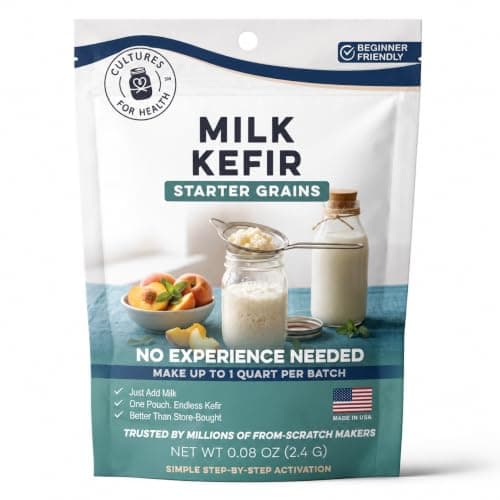
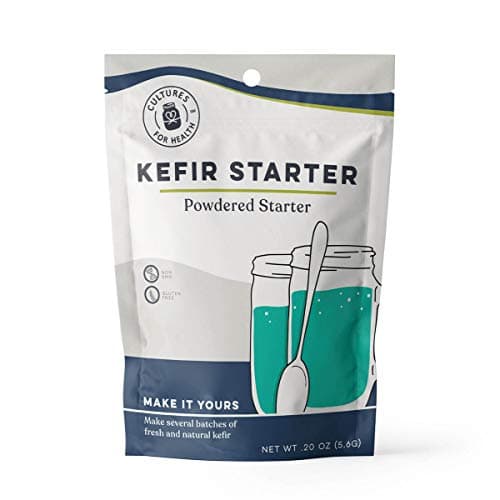
Cultures for Health Kefir Starter Culture Powder (4 Packets)
A direct-set powder that makes a quart at a time and can be recultured a handful of times, for anyone who wants the drink without keeping a culture alive.
Who it is for. An intermittent brewer, or anyone testing the drink before taking on a culture that has to be fed daily.
Published specifications
Packets per box
4 packets
Form
Powdered, direct-set starter culture
Yield per packet
1 quart of liquid per packet
Culture temperature
72-74 F
Culturing time
12 to 18 hours
Reculturing
“Kefir made with a direct-set style starter culture can often be recultured anywhere from 2 to 7 times”
Liquids
Pasteurized whole milk (not UHT/ultra-pasteurized), juice, coconut milk, or coconut water
Certification
Non-GMO, gluten free
Storage
“Store the starter in the refrigerator until you’re ready to activate it”
Source: Cultures for Health published Kefir Starter Culture Powder product page (packet count, liquids, certifications, storage) and its direct-set kefir instructions (1 packet per quart, 72-74 F, 12-18 hours, 2-7 recultures), culturesforhealth.com, retrieved 2026-09-04
Rubric — 8.1 / 10
Materials8/10 · weight 28%
Documentation9/10 · weight 22%
Capacity fit7/10 · weight 16%
Cleaning10/10 · weight 18%
Value6/10 · weight 16%
What it gets right
Nothing to maintain between batches — you open a packet when you want kefir and there is no culture in the fridge waiting to be fed
The temperature and time are tight and published: 72 to 74 F for 12 to 18 hours, which is a much narrower target than “68 to 85 F, 12 to 24 hours”
It cultures juice, coconut milk and coconut water as well as dairy, which grains do not do reliably
Four packets is enough to find out whether you actually drink the stuff before committing to grains
What it costs you
It runs out. Reculturing is published as 2 to 7 times, so the box is finite in a way grains never are
“A few times” and “2 to 7 times” are the only published numbers on reculturing — how far a given packet stretches is not knowable in advance
The 72-74 F window is narrower than most kitchens hold without help
Cost per quart is higher than grains once you get past the first month
Skip it if. You already know you want kefir every day. Grains cost less over any horizon longer than a few weeks and never need reordering.
Cultures for Health Milk Kefir Grains (Dehydrated)
The only milk kefir culture here that publishes its whole life cycle — activation schedule, working ratio, culturing window and when the grains start multiplying.
Who it is for. Someone who wants a permanent culture — buy once, strain daily, and never order a starter again.
Published specifications
Shipped form
“1 packet of dehydrated traditional, heirloom-style milk kefir grains”
Activation starting volume
1 cup fresh, cold pasteurized milk
Activation schedule
Between hours 8 and 24, check hourly; at the first change in texture, strain and re-milk, increasing the milk by 1/2 cup
Activation period
3 to 7 days, feeding increasing amounts of milk from 1 cup up to 4 cups
Activation endpoint
“Your grains are activated when they are reliably thickening milk in about 24 hours”
Working ratio
1-2 teaspoons of grains per up to 4 cups of milk
Culture temperature
68-85 F
Culturing time
12 to 24 hours; never leave grains in milk beyond 48 hours
Multiplication
“Generally kefir grains take 6 to 8 weeks following rehydration to begin multiplying”
Milk requirement
Pasteurized whole milk, not UHT or ultra-pasteurized. Raw milk after a transition
Straining
“Stainless steel is acceptable. Avoid all other types of metal.”
Certification
Non-GMO, gluten free
Shelf life
“Use the starter culture by the date on the bag”
Source: Cultures for Health published milk kefir grain product specification, its activation instructions for dehydrated milk kefir grains, and its milk kefir FAQ (working ratio, temperature, culturing time, multiplication, milk types and straining metals), culturesforhealth.com, retrieved 2026-09-04
Rubric — 8.7 / 10
Materials9/10 · weight 28%
Documentation10/10 · weight 22%
Capacity fit8/10 · weight 16%
Cleaning7/10 · weight 18%
Value9/10 · weight 16%
What it gets right
Every number the first month needs is published: the 1-cup start, the half-cup step up, the 3-to-7-day window, the 1-2 teaspoons per 4 cups working ratio and the 12-to-24-hour culturing time
It is reusable indefinitely, so the culture is a one-time purchase rather than a subscription — unlike every powdered starter on this page
Dehydrated grains ship without the timing pressure of a live culture in a hot van
The maker states which metals are safe to strain with, which is the one hardware question this ferment raises and almost nobody answers
What it costs you
The packet weight or volume is not published, so you cannot compare the quantity against another seller before ordering
Three to seven days of daily feeding before the first drinkable batch, then a further 6 to 8 weeks before the grains multiply
It is a daily obligation. Grains left in milk past 48 hours starve, and there is no published pause longer than that
Ultra-pasteurized milk will not work, and in some US markets that is most of the shelf
Skip it if. You travel often or want a ferment you can walk away from for a fortnight. Grains need feeding on a 12-to-24-hour cycle; a powdered direct-set starter is the honest answer for an intermittent brewer.
Judged on what it publishes, it is the best-labeled culture on this site: 3 gram sachets, one quart of milk each, a 24-month shelf life, published incubation temperatures and times, ISO 9001 and FSSC 22000 production standards, and — for the product line — a named organism list that no other culture here provides. This site has not cultured milk with it and makes no testing claim.
Can you reuse Yogourmet kefir starter?+
It is sold as single use, so plan on one sachet per batch. Some powdered starters tolerate a limited number of recultures from finished kefir, but Yogourmet does not publish that as a supported method and its distributor points people who want to reculture toward live grains instead.
Yogourmet kefir starter or milk kefir grains?+
Starter if you want kefir with no daily obligation or you are testing whether you like it; grains if you expect to keep making it. Grains never run out and go straight into cold milk, but need straining and refeeding most days. The starter needs no maintenance at all, and twelve sachets is twelve batches before you buy again.
Do you have to heat the milk for Yogourmet kefir starter?+
Yes, in the published method: heat to 82 C / 180 F, then cool to 23-25 C / 73-77 F before adding the sachet. That step gives a freeze-dried culture a clean field to work in. It also means the session is longer than a grains routine, where the milk goes in straight from the carton.
How long does Yogourmet kefir starter keep?+
The maker publishes 24 months from the production date, and states the sachets can still be used after that without health risk. That shelf life is the practical argument for the product: a box can sit in a cupboard until you want it, which is not true of a live culture.
How much kefir does one sachet make?+
One 3 gram sachet cultures 1 liter, about one quart, of milk. The twelve-pack therefore makes about twelve quarts in total. Publishing both the gram weight and the per-sachet yield is what lets you compare it against grains or another powder on a cost-per-quart basis before you buy.
Sources
Every specification cited on this page came from one of these documents, retrieved on the date shown against the product it belongs to.
Grains or powder, what each maker actually publishes, the activation month in real numbers, and the jar-and-strainer question every daily brewer runs into.
Three starters from one maker, compared on published activation windows, ratios and shelf life — and an honest account of where the documentation ends.