Kombucha sits at roughly pH 2.5 to 3.5 for weeks at a time. That is a genuinely hostile environment for hardware, and it is why the vessel decision is really a materials decision.
Our top pick in vessels & jars
Craft a Brew Kombucha Jar with Valve (1 Gallon)
The one gallon jar in this group whose valve grade is published — 304 stainless — which is the single specification that decides whether a spigot belongs anywhere near kombucha.
Glass is the default and the safest answer. If you want a spigot, the spigot must be 304-grade stainless or a named food-grade plastic — never brass, never an unlabeled metal, never a translucent white consumer tap. Buy one gallon for batch brewing and at least two gallons if you want continuous brew.
Materials, in order of how much they can go wrong
Kombucha is an acid bath that you drink. Anything it touches for two weeks is a surface the acid has two weeks to work on, and the failure mode is not dramatic — nothing cracks or dissolves. It is slow leaching you cannot taste, which is exactly why the material has to be decided on paper rather than by how the vessel looks.
Glass. Chemically inert, non-porous, and transparent so you can watch the pellicle form and catch mold on day three instead of day ten. This is the default for a reason.
Food-grade ceramic, stoneware and porcelain. Historically the fermentation vessel, and excellent at keeping light out. The caveat is lead: decorative glazes can contain it, and a decorative crock is not a food vessel. Kombucha Kamp's guidance is that food-safe pieces use lead-free glazes and that home lead tests can confirm a vessel is safe.
Stainless steel, 304 or 316. Non-corrosive at these pH levels and the standard in professional brewing. Opaque, and more expensive at home scale. Can you brew kombucha in stainless steel? covers what the grade numbers mean and why glass still wins at home.
Oak barrels. Possible, but they need constant filling, and Kombucha Kamp warns specifically about barrel suppliers fitting brass spigots — fine for beer, not for a pH-3 liquid.
Plastic. Only genuinely food-grade, acid-stable plastic, and even then it scratches, and scratches harbor what you cannot scrub out. Can you brew kombucha in plastic? goes through it properly.
The spigot is the part that fails
A tap is a genuine convenience: you can taste on day six without opening the vessel, and you can fill a bottle without lifting a gallon of liquid. It is also the only part of the vessel with moving components, hidden internal surfaces and a material that might not be glass.
Kombucha Kamp's published guidance names the safe list as stainless steel at 304 grade or better, professional-grade hard plastic, and wood — and names the unsafe elements as semi-hard plastic with a metallic coating that can erode, brass connections, consumer-grade translucent white plastic, and any spigot assembled with adhesives or epoxies. The other requirement is one people forget: it must come apart for cleaning. Kombucha spigot safety is the full version.
What size to buy
Working sizes for a home brewer. Yields assume roughly 10 percent of the batch is held back as starter tea for the next round.
Vessel
Batch
Roughly
Suits
Half gallon
64 oz
3 x 16 oz bottles
A trial batch
1 gallon
128 oz
6-7 x 16 oz bottles
One or two drinkers, batch brew
2 gallons
256 oz
13-14 x 16 oz bottles
A household, or continuous brew
2.5 gallons
320 oz
17-18 x 16 oz bottles
Continuous brew with a buffer
One gallon is the right first purchase for almost everyone. What size jar for kombucha works through the arithmetic, including why a continuous brew wants more headroom than you would expect.
The measurement nobody publishes
A pellicle grows to the full width of the liquid surface. Sooner or later you have to get it out — to separate a layer, to start a SCOBY hotel, or to clean the vessel properly. A narrow-necked carboy makes that a genuinely awkward job, and a jar whose mouth is narrower than its body means the pellicle has to be folded to come out.
Almost no maker publishes a mouth diameter. Of everything on this site, the Anchor Hocking Heritage Hill 2-gallon is the outlier: its 9 in top diameter is published, and it is the same as its body diameter. Where the number is missing, our product entries say "not published" rather than estimating — because a guess at the one measurement you need is worse than an honest gap.
There is one other exception, and it comes from outside the kombucha aisle entirely: a plain Ball wide-mouth canning jar publishes 3 in inner and 3.5 in outer. Mason jars for kombucha compares the sizes on that figure and on height, which is the other measurement a cupboard cares about.
Most of that decision collapses into one purchase for most people, because one gallon is the size cultures are dosed for and kits are built around. The best 1 gallon jar for kombucha compares the four on tap, published dimensions and what actually ships in the box.
Two vessel questions sit outside the standard gallon. Small batch kombucha covers brewing half a gallon for a household that cannot drink seven bottles, and the Heritage Hill jar review looks at a lidded storage jar that turns out to be the best SCOBY hotel vessel here.
The maker cited twice on this page now has a review of its own. Kombucha Kamp, reviewed on what it publishes puts its three continuous brewers side by side on capacity, height with the stand and spigot material — the best-documented vessels in this category — and is equally plain about the two places where its own pages disagree with themselves.
Heads up: some links on this page are affiliate links. If you buy through one we may earn a commission at no extra cost to you. It never changes a ranking, and we take no payment for placement. The full version.
The short answer
Quick picks
Ranked on the published rubric. Every row jumps to that product's full write-up below; the button goes straight to Amazon.
#
Product
Best for
Score
Price
1
Craft a Brew
Kombucha Jar with Valve (1 Gallon)
The one gallon jar in this group whose valve grade is published — 304 stainless — which is the single specification that decides whether a spigot belongs anywhere near kombucha.
Two gallons of glass whose diameter and height are both published to the eighth of an inch — the rare vessel you can check against a shelf before you buy it.
A gallon jar that arrives with the muslin cover, the band and a temperature strip already in the box, which is the whole non-culture half of a first batch.
About 2.2 gallons of glass on an acacia stand with a stainless spigot, and the only vessel here where you can see the pellicle, the yeast strands and the fill line at a glance.
The only jar on this site that publishes its mouth diameter — 3 inches inside — which is the one measurement a brewer with a pellicle to lift actually needs.
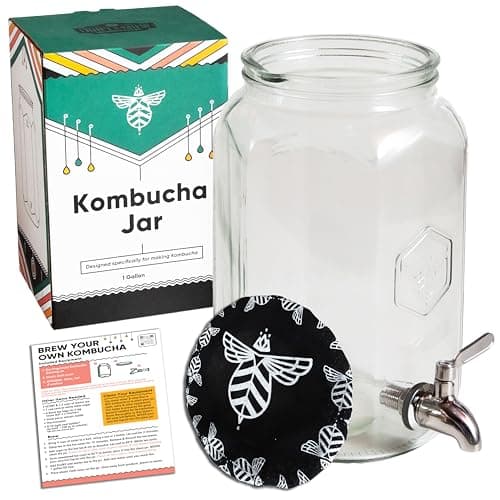
The one gallon jar in this group whose valve grade is published — 304 stainless — which is the single specification that decides whether a spigot belongs anywhere near kombucha.
Who it is for. A batch brewer who wants a tap for tasting and bottling, and who wants the spigot’s material in writing.
Published specifications
Capacity
1 gallon
Height
10 inches
Diameter
6 inches
Diameter including valve
7.75 inches
Valve material
304 grade stainless steel
Volume markers
1 gallon and 2 cup markers
Care
Hand wash only — not dishwasher safe
Mouth diameter
Not published
Source: Craft a Brew published dimensions, valve grade and care instructions, craftabrew.com/products/kombucha-jar-with-valve, fetched 2026-09-01
Rubric — 8.0 / 10
Materials9/10 · weight 28%
Documentation9/10 · weight 22%
Capacity fit7/10 · weight 16%
Cleaning6/10 · weight 18%
Value8/10 · weight 16%
What it gets right
304 grade is stated outright, so you are not inferring a spigot’s alloy from a photograph
10 in tall by 7.75 in across including the valve is a published footprint you can check against a counter and a cupboard
Volume markers at 1 gallon and 2 cups line up exactly with a batch and its starter reserve
A tap means you can taste on day six without lifting the jar or dropping anything into it
What it costs you
Hand wash only, and a spigot is the part that most wants a dishwasher
Mouth diameter is not published, which matters because a pellicle grows to the width of the vessel and has to come back out
At one gallon it is small for true continuous brewing — Kombucha Kamp is explicit that a 1-gallon jar is not a good continuous-brew choice
Skip it if. You want to run continuous brew. One gallon does not hold enough liquid to keep a stable culture while you draw off a bottle at a time; go to 2 gallons or more.
Anchor Hocking Heritage Hill 2 Gallon Glass Jar with Glass Lid
Two gallons of glass whose diameter and height are both published to the eighth of an inch — the rare vessel you can check against a shelf before you buy it.
Who it is for. Someone scaling past a gallon who would rather measure a shelf than guess, and who does not mind pouring.
Published specifications
Capacity
2 gallons (256 oz)
Top diameter
9 inches
Bottom diameter
9 inches
Maximum diameter
9 3/8 inches
Height
13 3/8 inches
Lid
Glass lid included
Spigot
None
Mouth
Wide-mouth opening; exact aperture not published separately from the 9 in top diameter
Source: Anchor Hocking 69372 published dimensions via foodservice distributor spec sheets (top, bottom and maximum diameter, height), retrieved 2026-09-01
Rubric — 9.1 / 10
Materials9/10 · weight 28%
Documentation10/10 · weight 22%
Capacity fit9/10 · weight 16%
Cleaning9/10 · weight 18%
Value8/10 · weight 16%
What it gets right
Every external dimension is published, which almost nothing else in this category manages
A 9 in top diameter is wide enough to get a full-width pellicle out without folding it
Two gallons is the smallest size Kombucha Kamp considers workable for continuous brew
The glass lid is for storage between batches; brewing still uses cloth, so the lid is a genuine bonus rather than the wrong tool
What it costs you
No spigot, and no factory route to fitting one — drilling tempered glass is not a home job
13 3/8 in tall will not fit under most upper cabinets with a cloth cover and band on top
Two gallons of finished kombucha weighs roughly 17 lb, and you will be lifting it to bottle
Skip it if. You want a tap. This jar has no spigot and no safe way to add one; buy a vessel built with a valve instead.
#ad No live price feed yet, so no number is shown rather than a stale one. How this is funded.
Score7.7no photo yet
#3 · A plain jar with the cover sorted
Fermentaholics Printed Gallon Kombucha Glass Jar
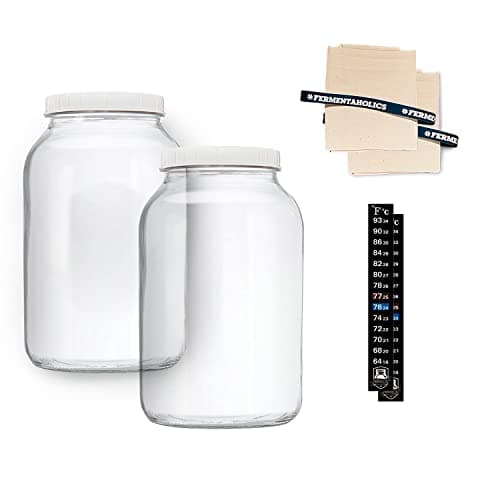
A gallon jar that arrives with the muslin cover, the band and a temperature strip already in the box, which is the whole non-culture half of a first batch.
Who it is for. A first-time brewer, or anyone who has learned that the fewer parts a fermentation vessel has, the fewer places a batch can go wrong.
Published specifications
Capacity
1 gallon
Material
Glass
Included
Muslin cover, rubber band, temperature strip
Spigot
None
Dimensions
Not published
Mouth diameter
Not published
Source: Fermentaholics published jar listing contents, fermentaholics.com/product/printed-gallon-kombucha-glass-jar-2-pack/, retrieved 2026-09-01
Rubric — 7.7 / 10
Materials8/10 · weight 28%
Documentation5/10 · weight 22%
Capacity fit8/10 · weight 16%
Cleaning9/10 · weight 18%
Value9/10 · weight 16%
What it gets right
The temperature strip in the box means the jar tells you its own temperature from day one
Muslin breathes and blocks fruit flies, which is exactly what a kombucha cover has to do and what a solid lid does not
No spigot means no seal, no gasket and nothing to disassemble — the easiest vessel here to actually clean
The cheapest way into a proper gallon vessel
What it costs you
No published dimensions at all
No volume markers, so the starter reserve is eyeballed
No tap, so tasting means dipping and bottling means lifting
Skip it if. You want to draw a sample without opening the jar. A plain jar has to be opened every time you taste it.
About 2.2 gallons of glass on an acacia stand with a stainless spigot, and the only vessel here where you can see the pellicle, the yeast strands and the fill line at a glance.
Who it is for. A continuous brewer who wants to see what is happening, and who has an open shelf or an island to put it on.
Published specifications
Capacity
Approximately 2.2 gallons
Vessel height
13 inches
Vessel width
9 inches
Height with stand
18 inches
Spigot
Stainless steel
Stand
Acacia wood
Material
Glass
Source: Kombucha Kamp published vessel specifications (capacity, vessel and stand heights, spigot material), kombuchakamp.com/glass-continuous-brewer.html, retrieved 2026-09-01
Rubric — 8.5 / 10
Materials9/10 · weight 28%
Documentation9/10 · weight 22%
Capacity fit9/10 · weight 16%
Cleaning8/10 · weight 18%
Value7/10 · weight 16%
What it gets right
Glass is chemically inert at kombucha’s pH and shows you the state of the culture without opening anything
A stainless spigot as standard rather than as an upgrade
18 in on the stand is published, so you can check the clearance to a cabinet before ordering
2.2 gallons sits inside the 2-to-5-gallon band Kombucha Kamp recommends for continuous brew
What it costs you
Light reaches the culture, and continuous brew is a long exposure — it needs a dark corner or a cloth over it
Glass at 2.2 gallons is heavy and unforgiving of a knock against a tap
18 in tall on the stand rules out most under-cabinet counters
Skip it if. Your only free counter is under a cabinet. At 18 in with the stand you will not get the cover off, let alone the pellicle out.
#ad No live price feed yet, so no number is shown rather than a stale one. How this is funded.
Score9.1no photo yet
#6 · A half-gallon batch you can get your hand into
Ball Wide Mouth Glass Canning Jars, 64 oz (Case of 6)
The only jar on this site that publishes its mouth diameter — 3 inches inside — which is the one measurement a brewer with a pellicle to lift actually needs.
Who it is for. A brewer running small or parallel batches, or anyone who wants a jar whose opening they can check against their own hand before ordering.
Published specifications
Capacity
64 oz (half gallon)
Mouth
Wide mouth. 3 in inner diameter, 3.5 in outer
Height
9.25 in without the lid, 9.375 in with it
Case quantity
6 jars
Included
Lids and bands, screwed onto the jars
Material
Glass. Stated FDA compliant and BPA free
Heat limit
Withstands temperatures up to 250 F
Thermal shock
“Withstands sudden 90° F temperature change”
Freezer
“Not freezer safe”
Markings
Graduated in cups, ounces and mL on the glass
Origin
Made in USA
Spigot
None. This is a jar, not a brewer.
Source: Ball Wide Mouth 64 oz glass canning jar specification as published by distributor Uline (item S-19404: capacity, 3 in inner and 3.5 in outer mouth diameter, 9.25 in and 9.375 in heights, case quantity, materials, 250 F limit, 90 F thermal shock, freezer guidance, graduated markings, origin), uline.com, retrieved 2026-09-06
Rubric — 9.1 / 10
Materials9/10 · weight 28%
Documentation10/10 · weight 22%
Capacity fit8/10 · weight 16%
Cleaning9/10 · weight 18%
Value9/10 · weight 16%
What it gets right
The 3-inch inner mouth is published, which almost no brewing jar states — it is the difference between lifting a pellicle out cleanly and fishing for it
Graduated markings on the glass mean the batch and the starter tea can be measured in the vessel rather than in a jug first
Six jars per case, so a SCOBY hotel, a half-gallon batch and a spare all arrive in one order
The published 90 F sudden-change tolerance is the number that matters when hot tea meets a cold jar
What it costs you
No spigot, so a half gallon has to be poured or siphoned, and pouring past a pellicle is awkward
Not freezer safe, per the published care guidance
A metal lid and band come with it, and neither belongs on a fermenting jar — you will use a cloth instead and store the lids
Half a gallon is a small batch. Two of these is more glass to clean than one gallon jar
Skip it if. You want a gallon or more per batch. Half-gallon jars multiply fast, and four of them is a worse experience than one two-gallon vessel.
#ad No live price feed yet, so no number is shown rather than a stale one. How this is funded.
FAQ
Questions people actually ask
What is the best vessel for brewing kombucha?+
A one-gallon glass jar with a wide mouth for batch brewing. If you want a tap, choose one whose spigot is published as 304-grade stainless steel. For continuous brewing, go to at least two gallons, in glass, food-grade lead-free ceramic, or 304 stainless.
Can I use a metal container for kombucha?+
Only 304 or 316 grade stainless steel, which is non-corrosive at kombucha's pH and is what commercial breweries use. Other metals, and brass in particular, are not safe with a liquid this acidic.
Why does the spigot material matter so much?+
Because it sits in an acidic liquid continuously, and because it is the only part of the vessel that is not glass. Low-grade materials can leach, metallic-coated plastic can erode, and brass is explicitly unsuitable at kombucha's pH. Stainless at 304 grade or better is the safe default.
Is a 1-gallon jar big enough for continuous brew?+
No. Kombucha Kamp states plainly that a 1-gallon jar such as a sun tea jar is not a good choice for continuous brewing, and recommends 2 to 5 gallons. A continuous brew has to hold enough liquid to stay stable while you keep drawing from it.
Do I need a lid on a kombucha jar?+
Not during fermentation. The culture needs air exchange, so the vessel is covered with a tight-weave cloth held with a band. A solid lid belongs on the jar only for storage between batches.
The three Kombucha Kamp continuous brewers on published capacity, dimensions and spigot material — and when a plain jar with a valve does the same job.
Top pick · Kombucha Kamp Glass Continuous Brewer with Stand