The cover is the cheapest part of the setup and the one people improvise worst. Two requirements, and they pull in opposite directions.
By Scooter M.·Published September 1, 2026 · Updated September 13, 2026
The short answer
Use a tight-weave cotton cloth held on with a rubber band. It has to breathe, because the first fermentation is aerobic, and the weave has to be close enough that a fruit fly cannot get through. A solid lid belongs on the jar only for storage between batches.
Two jobs, pulling opposite ways
A kombucha cover has to let air in and keep insects out, and those requirements fight each other. Too open and you get fruit flies, which lay eggs on the pellicle and ruin a batch. Too closed and you starve a culture that needs oxygen to work.
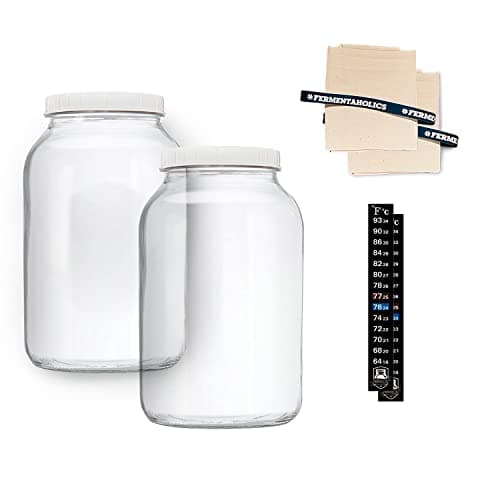
The winning material is ordinary tight-weave cotton. Muslin, a clean tea towel, a cotton handkerchief, or the cover that ships with most brewing jars. Fermentaholics includes a breathable muslin cloth cover, a rubber band and a temperature strip with each of its jars, which is the whole non-culture requirement in one box.
What does not work, and why
Common improvisations, and how each one fails.
Cover
Verdict
Why
Tight-weave cotton, muslin, tea towel
Correct
Breathes, and the weave stops fruit flies.
Single-layer cheesecloth
Usually too open
Fruit flies walk straight through the gaps. Fold it four times or use something else.
Coffee filter
Marginal
Breathes poorly when damp and tears at the band. Works in a pinch, not for a fortnight.
Paper towel
No
Goes limp and sags into the liquid the first time it gets condensation on it.
Solid lid, screwed down
No
Starves an aerobic ferment. Wrong tool.
Airlock
No
Correct for beer and wine, which are anaerobic. Kombucha's first ferment is not.
When a lid is right
Between batches. If a vessel is holding finished kombucha or a resting culture rather than actively fermenting, a solid lid is exactly right — it keeps dust out and stops evaporation. That is why the Anchor Hocking Heritage Hill jar ships with a glass lid and is still a good brewing vessel: the lid is for storage, and brewing uses cloth.
A SCOBY hotel is the same case. A hotel is not fermenting hard; it is a culture parked in strong kombucha. A loose lid or a cloth both work, and a cloth is still slightly safer because a sealed jar of live culture can build a surprising amount of pressure over months.
The band, and the detail that matters
A rubber band around the neck, tight enough that the cloth cannot lift. The failure people do not anticipate is the cloth sagging into the liquid: a cover touching the surface wicks kombucha up into the fabric, and a permanently damp cloth in contact with the ferment is an invitation to mold at the rim.
Keep the cloth taut, and keep the liquid level well below the rim. A jar filled to the brim has no gap for the cover to span.
The picks
Jars that arrive with the cover sorted
Each of these ships with a breathable muslin cover and a band, which removes the one component people most often improvise badly.
Score7.7no photo yet
Fermentaholics
Printed Gallon Kombucha Glass Jar
A gallon jar that arrives with the muslin cover, the band and a temperature strip already in the box, which is the whole non-culture half of a first batch.
#ad No live price feed yet, so no number is shown rather than a stale one. How this is funded.
Fruit flies specifically
They are attracted to exactly what a kombucha vessel smells like, and they are small enough to walk through an open weave. A few practical measures that cost nothing:
Keep the jar away from the fruit bowl and the bin. Proximity is most of the problem.
Fold cheesecloth to four layers if it is what you have, or use a tea towel instead.
Check the band seal after every top-up — a cover pulled slightly loose is the usual entry point.
Wipe the outside of the jar. Kombucha dripped down the glass is a signal broadcast to every fly in the room.
One more reason the cover is a separate decision: most jars arrive with a lid you must not use during fermentation. A canning jar ships with a flat metal disc and a band, and a coated steel disc over an acidic ferment for weeks is exactly what you are avoiding — mason jars for kombucha covers what to do with the lid instead.
The insect half of that sentence is the one people discover the hard way, usually in summer. A fermenting jar gives off acetic acid and carbon dioxide, which are exactly the signals a fruit fly hunts for — fruit flies and your kombucha jar covers the weave that actually stops them and what to do if they got in.
Heads up: some links on this page are affiliate links. If you buy through one we may earn a commission at no extra cost to you. It never changes a ranking, and we take no payment for placement. The full version.
The short answer
Quick picks
Ranked on the published rubric. Every row jumps to that product's full write-up below; the button goes straight to Amazon.
#
Product
Best for
Score
Price
1
Score7.7
Fermentaholics
Printed Gallon Kombucha Glass Jar
A gallon jar that arrives with the muslin cover, the band and a temperature strip already in the box, which is the whole non-culture half of a first batch.
A gallon jar that arrives with the muslin cover, the band and a temperature strip already in the box, which is the whole non-culture half of a first batch.
Who it is for. A first-time brewer, or anyone who has learned that the fewer parts a fermentation vessel has, the fewer places a batch can go wrong.
Published specifications
Capacity
1 gallon
Material
Glass
Included
Muslin cover, rubber band, temperature strip
Spigot
None
Dimensions
Not published
Mouth diameter
Not published
Source: Fermentaholics published jar listing contents, fermentaholics.com/product/printed-gallon-kombucha-glass-jar-2-pack/, retrieved 2026-09-01
Rubric — 7.7 / 10
Materials8/10 · weight 28%
Documentation5/10 · weight 22%
Capacity fit8/10 · weight 16%
Cleaning9/10 · weight 18%
Value9/10 · weight 16%
What it gets right
The temperature strip in the box means the jar tells you its own temperature from day one
Muslin breathes and blocks fruit flies, which is exactly what a kombucha cover has to do and what a solid lid does not
No spigot means no seal, no gasket and nothing to disassemble — the easiest vessel here to actually clean
The cheapest way into a proper gallon vessel
What it costs you
No published dimensions at all
No volume markers, so the starter reserve is eyeballed
No tap, so tasting means dipping and bottling means lifting
Skip it if. You want to draw a sample without opening the jar. A plain jar has to be opened every time you taste it.
#ad No live price feed yet, so no number is shown rather than a stale one. How this is funded.
FAQ
Questions people actually ask
What should I cover a kombucha jar with?+
A tight-weave cotton cloth held on with a rubber band. Muslin, a clean tea towel or a cotton handkerchief all work. It must breathe, because the first fermentation is aerobic, and the weave must be close enough to stop fruit flies.
Can I use cheesecloth to cover kombucha?+
Only folded several times. Single-layer cheesecloth has gaps a fruit fly walks straight through. Four layers works; a tea towel works better and costs nothing extra.
Why can't I use a lid during fermentation?+
Because kombucha's first fermentation is aerobic — the culture needs oxygen. A sealed lid starves it and traps carbon dioxide that should be escaping. A lid is correct only for storage between batches.
Should I use an airlock on a kombucha jar?+
No. Airlocks are for anaerobic ferments such as beer and wine, where you want to exclude air entirely. Using one on kombucha's first fermentation deprives the culture of the oxygen it needs.
My cover keeps getting damp. Is that a problem?+
Condensation under a cloth on a warm ferment is normal. It becomes a problem only when the cloth is soaking or touching the liquid, because a cover wicking kombucha up into the fabric is where mold at the rim tends to start. Lower the fill level or use a lighter cloth.
Sources
Every specification cited on this page came from one of these documents, retrieved on the date shown against the product it belongs to.