Cover the jar with a tight-woven cloth — a tea towel or purpose-made muslin, not a single layer of cheesecloth — held with a band that actually grips the rim. Fruit flies are drawn to the acetic acid a ferment gives off, so the jar is the attraction and the cover is the only defense. If flies laid eggs in a batch, discard it and the pellicle.
Why your jar is the most attractive thing in the kitchen
Fruit flies do not find your kombucha by luck. They are drawn to exactly what a ferment produces: acetic acid and carbon dioxide, the two signals that in nature mean rotting fruit. A gallon of actively fermenting sweet tea is, chemically, a very loud advertisement.
This is why the problem gets worse as a batch progresses rather than better, and why the jar you have had out for two weeks attracts more attention than the one you started yesterday. It is also why a cover that works in week one can fail in week two, when the smell is stronger and the flies are more motivated.
There is a second, larger source most people miss. The fruit bowl on the counter is usually where the population comes from in the first place. Dealing with the jar while leaving a bowl of ripening bananas three feet away is treating the symptom.
The cover is the whole defense
A first fermentation is open to the air by design — it needs the exchange, which is why a solid lid is the wrong answer. That leaves a woven cover as the only barrier, and not all of them are barriers.
Tight-woven cotton, or purpose-made muslin. The standard, and it works. Hold it up to a light: if you can see distinct holes, a fruit fly can find them.
A clean tea towel. Free, already in your kitchen, and denser than most things sold for the job. The only downside is bulk under the band.
Single-layer cheesecloth — the classic failure. It is sold for straining, not for excluding insects, and its weave is wide open. Fold it four times or use something else.
Paper towel or a coffee filter. They work and they breathe, but they sag, tear when damp and are a single spill from failing. Fine for a few days, poor for a fortnight.
The band matters as much as the cloth. A cover that is technically fine but gapes at one side of the rim is not a cover. A proper elastic or a doubled rubber band that pulls the cloth taut against the glass is the difference, and it is the part people skip.
The picks
Jars that arrive with the cover sorted
The cheapest fix is buying a vessel that ships with a breathable muslin cover and a band already sized to its rim, rather than improvising one.
Fermentaholics
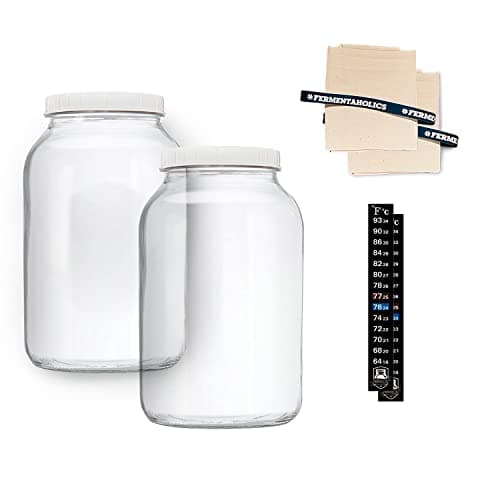
One Gallon Plain Glass Kombucha Jars, 2-Pack
Two identical gallon jars, each with its own cover, band and temperature strip — which is how you stop having a week with no kombucha in it.
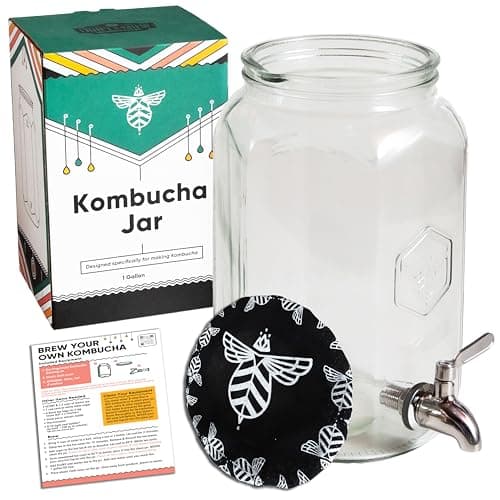
The one gallon jar in this group whose valve grade is published — 304 stainless — which is the single specification that decides whether a spigot belongs anywhere near kombucha.
A gallon jar that arrives with the muslin cover, the band and a temperature strip already in the box, which is the whole non-culture half of a first batch.
#ad No live price feed yet, so no number is shown rather than a stale one. How this is funded.
The second ferment is not the problem
Worth saying plainly, because it saves a lot of worry: once kombucha is in a sealed bottle, fruit flies are irrelevant. A swing top or a crown cap is an airtight closure and nothing gets in.
The vulnerable window is the bottling itself — the few minutes when the jar is open, the funnel is out and there is kombucha on the counter. That is when a fly that has been circling for a fortnight finally gets its chance. Bottle quickly, wipe spills as you go, and do not leave a half-filled bottle standing open while you answer the door.
Bottles themselves are worth keeping capped even when empty and clean, for the same reason. An open bottle on a drying rack is a small, dark, sweet-smelling cave.
If they got in
This is the question people actually arrive with, and the answer depends on what you are looking at.
What you found, and what to do about it.
What you see
What it means
What to do
Flies circling outside the cloth
Normal and harmless
Improve the cover; the batch is untouched
A fly drowned on the surface
It got in, briefly
Remove it. The batch is almost certainly fine
Several flies, over days
The cover is failing
Fix the cover now; inspect the surface closely
Small cream or white specks on the pellicle
Eggs or larvae
Discard the batch and the pellicle
Dry, fuzzy growth on the surface
Mold, not flies
Discard both — see the mold page
The line to be strict about is eggs. A single drowned fly in a pH-3 liquid is an unpleasant surprise and nothing more. Eggs or visible larvae mean the batch has been used as a nursery, and no amount of straining fixes that — the culture goes with it, because you cannot clean a pellicle you cannot see into.
Mold is a different failure with a different look, and people confuse the two constantly. Mold versus SCOBY is the page to read before throwing anything away, because a new pellicle and yeast strands both look alarming and neither is a problem.
Getting the population down
If flies are already established in the kitchen, the cover is a wall against a siege. Three things actually reduce the population.
Move the fruit. Ripening fruit on an open counter is almost always the source. Into the fridge, or into a closed bowl, for two weeks.
Clear the drain and the recycling. Damp residue in a sink drain and unrinsed bottles in a recycling bin are the two breeding sites people never think of. Rinse bottles the moment they are empty.
Set a trap, away from the jar. A glass of cider vinegar with a drop of dish soap, placed across the room, works on exactly the same attraction your jar uses — and pulls them away from it rather than toward it.
What not to do is spray anything near a fermenting vessel. Household insecticide and an open culture are a genuinely bad combination, and the cover does not protect against an aerosol.
Testing a weave before you trust it
“Tight-woven” is doing a lot of work in most advice, and it is not a measurement. Two tests take a few seconds and settle it.
The first is the light test. Hold the cloth up against a window or a lamp. You are not looking for whether light passes — all breathable fabric passes light — you are looking for whether you can resolve individual holes. Distinct points of light mean a distinct gap, and a fruit fly is smaller than most people assume.
The second is the stretch test, which is the one people skip. Pull the cloth taut the way a rubber band will pull it over a rim. Many fabrics that look dense relaxed open up noticeably under tension, and that is the state your cover will actually be in for the next fortnight. A weave that opens when stretched is not a cover, it is a filter.
Doubling is the cheap fix for both. Two layers of a marginal cloth beat one layer of a good one, the airflow penalty is negligible at this scale, and a first fermentation needs far less air exchange than people imagine.
Why this is a July problem
Almost nobody asks this question in February. Fruit fly populations rise sharply with temperature and with the availability of ripening fruit, which means the same setup that worked untroubled all winter can be overrun within a week of the first warm spell.
That matters practically, because it means a cover that has been fine is not evidence that it is good — it is evidence that nothing has tested it yet. The sensible move is to upgrade the cover at the start of summer rather than after the first incident, and to check the band, which perishes and loosens over months in a warm kitchen.
Warm weather compounds it in a second way. Higher temperatures also speed the ferment, so the jar is producing more of the acetic acid and carbon dioxide that draw flies in the first place, exactly when there are more of them about. The temperature page covers the brewing side of that; the fly side is simply that summer is when both curves peak together.
The band is the half nobody replaces
Covers get discussed endlessly and the band almost never does, which is odd given that a perfect cloth held on badly is not a cover at all.
Rubber perishes, and it perishes faster in a warm kitchen than anywhere else in the house. A band that has been holding a cover for six months has usually lost enough elasticity to sit loose against the glass, and a gap at one side of the rim is all a fruit fly needs. Check it by running a finger around the join: if the cloth lifts anywhere, replace the band.
A doubled band, or a purpose-made elastic cover with a sewn hem, solves this permanently and costs almost nothing. Several of the jars on this site ship with one, which is a genuine reason to prefer them over improvising with what is in the drawer.
Heads up: some links on this page are affiliate links. If you buy through one we may earn a commission at no extra cost to you. It never changes a ranking, and we take no payment for placement. The full version.
The short answer
Quick picks
Ranked on the published rubric. Every row jumps to that product's full write-up below; the button goes straight to Amazon.
#
Product
Best for
Score
Price
1
Fermentaholics
One Gallon Plain Glass Kombucha Jars, 2-Pack
Two identical gallon jars, each with its own cover, band and temperature strip — which is how you stop having a week with no kombucha in it.
The one gallon jar in this group whose valve grade is published — 304 stainless — which is the single specification that decides whether a spigot belongs anywhere near kombucha.
A gallon jar that arrives with the muslin cover, the band and a temperature strip already in the box, which is the whole non-culture half of a first batch.
The one gallon jar in this group whose valve grade is published — 304 stainless — which is the single specification that decides whether a spigot belongs anywhere near kombucha.
Who it is for. A batch brewer who wants a tap for tasting and bottling, and who wants the spigot’s material in writing.
Published specifications
Capacity
1 gallon
Height
10 inches
Diameter
6 inches
Diameter including valve
7.75 inches
Valve material
304 grade stainless steel
Volume markers
1 gallon and 2 cup markers
Care
Hand wash only — not dishwasher safe
Mouth diameter
Not published
Source: Craft a Brew published dimensions, valve grade and care instructions, craftabrew.com/products/kombucha-jar-with-valve, fetched 2026-09-01
Rubric — 8.0 / 10
Materials9/10 · weight 28%
Documentation9/10 · weight 22%
Capacity fit7/10 · weight 16%
Cleaning6/10 · weight 18%
Value8/10 · weight 16%
What it gets right
304 grade is stated outright, so you are not inferring a spigot’s alloy from a photograph
10 in tall by 7.75 in across including the valve is a published footprint you can check against a counter and a cupboard
Volume markers at 1 gallon and 2 cups line up exactly with a batch and its starter reserve
A tap means you can taste on day six without lifting the jar or dropping anything into it
What it costs you
Hand wash only, and a spigot is the part that most wants a dishwasher
Mouth diameter is not published, which matters because a pellicle grows to the width of the vessel and has to come back out
At one gallon it is small for true continuous brewing — Kombucha Kamp is explicit that a 1-gallon jar is not a good continuous-brew choice
Skip it if. You want to run continuous brew. One gallon does not hold enough liquid to keep a stable culture while you draw off a bottle at a time; go to 2 gallons or more.
A gallon jar that arrives with the muslin cover, the band and a temperature strip already in the box, which is the whole non-culture half of a first batch.
Who it is for. A first-time brewer, or anyone who has learned that the fewer parts a fermentation vessel has, the fewer places a batch can go wrong.
Published specifications
Capacity
1 gallon
Material
Glass
Included
Muslin cover, rubber band, temperature strip
Spigot
None
Dimensions
Not published
Mouth diameter
Not published
Source: Fermentaholics published jar listing contents, fermentaholics.com/product/printed-gallon-kombucha-glass-jar-2-pack/, retrieved 2026-09-01
Rubric — 7.7 / 10
Materials8/10 · weight 28%
Documentation5/10 · weight 22%
Capacity fit8/10 · weight 16%
Cleaning9/10 · weight 18%
Value9/10 · weight 16%
What it gets right
The temperature strip in the box means the jar tells you its own temperature from day one
Muslin breathes and blocks fruit flies, which is exactly what a kombucha cover has to do and what a solid lid does not
No spigot means no seal, no gasket and nothing to disassemble — the easiest vessel here to actually clean
The cheapest way into a proper gallon vessel
What it costs you
No published dimensions at all
No volume markers, so the starter reserve is eyeballed
No tap, so tasting means dipping and bottling means lifting
Skip it if. You want to draw a sample without opening the jar. A plain jar has to be opened every time you taste it.
#ad No live price feed yet, so no number is shown rather than a stale one. How this is funded.
#4 · Second ferment, one serving at a time
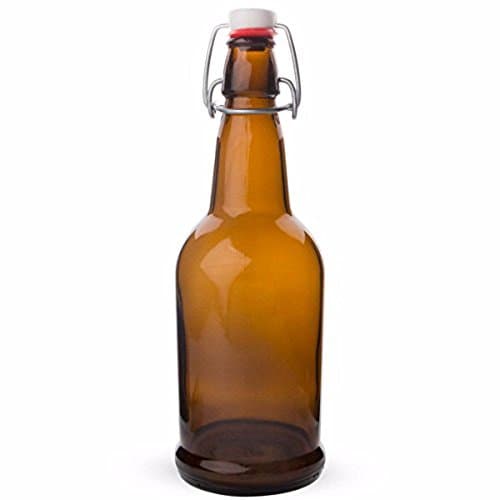
EZ Cap Swing Top Bottles, Amber Glass, 16 oz (Case of 12)
The only bottle here with a published pressure rating — 100 PSI — in amber glass, which is the combination a second ferment actually asks for.
Who it is for. Anyone doing a second ferment who wants a bottle with a number behind it rather than a shape that looks strong.
Published specifications
Capacity
16 oz
Glass color
Amber
Pressure rating
“Pressure rated to 100 PSI which means they can easily handle the carbonation of soda pop and hard seltzer”
Case quantity
12 bottles, includes 12 swing tops
Closure
Reusable swing top; also accepts a 26 mm pry-off crown cap
Maker’s note
“These swing tops are designed to be primarily sealed with a crown cap closure for long term storage.”
Dimensions
Not published
Source: MoreBeer published EZ Cap product specification (capacity, pressure rating, case contents, crown cap compatibility), morebeer.com/products/ez-cap-swing-top-bottles-amber-glass-16-oz-case-12, fetched 2026-09-01
Rubric — 8.3 / 10
Materials9/10 · weight 28%
Documentation9/10 · weight 22%
Capacity fit8/10 · weight 16%
Cleaning7/10 · weight 18%
Value8/10 · weight 16%
What it gets right
A published 100 PSI rating is the single most useful number in this whole category, and almost nobody publishes one
Amber glass blocks the light that degrades a bottle sitting out on a counter through a second ferment
The dual finish means you can crown-cap a batch you want to leave for months and swing-top the ones you will drink this week
16 oz is one serving, so a bottle gets opened once and drunk rather than losing its carbonation over three days
What it costs you
Swing-top gaskets perish, and a tired gasket is the commonest cause of a flat second ferment
No dimensions published, so fitting twelve of them on a fridge shelf is a measuring job when they arrive
Crown caps are sold separately if you want the long-storage option the maker recommends
Skip it if. You want to see the color of the finished drink. Amber hides it; the clear version of the same bottle does not.
Cover the jar with tight-woven cotton or purpose-made muslin — not single-layer cheesecloth — and secure it with a band that pulls the cloth taut against the rim with no gaps. Hold any cover up to a light first: if you can see distinct holes, a fruit fly can find them.
Can I still drink kombucha if a fruit fly got in it?+
A single drowned fly on the surface is unpleasant and not a safety problem in a liquid at roughly pH 3 — remove it and carry on. What you cannot salvage is a batch with eggs or larvae in it: those look like small cream or white specks on the pellicle, and the batch and the culture both have to go.
Why does my kombucha attract fruit flies?+
Because it is producing acetic acid and carbon dioxide, which are the same signals rotting fruit gives off. The attraction grows as the batch progresses, which is why a cover that held in week one can fail in week two.
Is cheesecloth good enough to cover kombucha?+
Not in a single layer. Cheesecloth is woven for straining, and its weave is open enough for a fruit fly to walk through. Fold it four or more times, or use tight-woven cotton, a clean tea towel or a purpose-made muslin cover instead.
Do I need to worry about fruit flies during the second fermentation?+
No. Once kombucha is in a sealed swing-top or crown-capped bottle, nothing gets in. The vulnerable moment is bottling itself, when the jar is open and there is kombucha on the counter — work quickly and wipe spills as you go.
Sources
Every specification cited on this page came from one of these documents, retrieved on the date shown against the product it belongs to.