One gallon is not an arbitrary size. It is the batch every culture is measured for, every kit is built around, and every recipe on this site assumes.
By Scooter M.·Published September 13, 2026 · Updated September 21, 2026
The short answer
Buy a gallon jar with a tap if you will brew regularly — drawing a taste without opening the vessel is the difference between knowing what a batch is doing and guessing. Buy a plain gallon jar if you want the cheapest vessel that works and do not mind pouring. Check published height against your shelf before either.
Why a gallon, specifically
A gallon looks like a round number someone picked. It is not. It is the size the whole category has standardized on, and that has practical consequences for what you can buy.
Cultures are dosed for it: the published ten percent starter tea rule works out at roughly 12 to 13 fluid ounces for a gallon, and that is exactly the volume culture sellers ship — the SCOBY page has the arithmetic. Kits are built around it. Recipes assume one cup of sugar and two tablespoons of loose leaf per gallon.
And it matches consumption. A gallon is 128 oz; hold back roughly a tenth as starter and you have about 115 oz to bottle, which is seven 16 oz bottles or a little over three 32 oz ones. For one or two people on a fortnightly cycle, that is close to right. The sizing guide works through when it is not.
What separates one gallon jar from another
Tap or no tap. The biggest single difference in how a vessel is lived with. A spigot means tasting without opening the jar and bottling without lifting a full gallon; it also means a part that must be a safe material and must be taken apart to clean.
Published dimensions. Height decides whether it fits under a cabinet; mouth diameter decides whether your hand and a pellicle come out together. Most makers publish neither, and the ones that do are worth preferring for that reason alone.
What ships in the box. A cloth cover and a band are cheap and annoying to source separately. A jar that arrives ready to use saves an order.
Volume markers. Printed markings on the glass mean the batch and the starter reserve get measured in the vessel rather than in a jug first, every single time.
What deliberately does not matter: looks. A jar you enjoy looking at is a genuine benefit and it is not something this site can score for you. The rubric is published with its weights and none of them is aesthetics.
The four, side by side
Published figures, compiled 2026-09-13. A blank means the maker publishes nothing on the subject.
Jar
Capacity
Tap
Ships with
Craft a Brew, valve
1 gallon
Yes, stainless valve
Cloth cover, volume markers, pour spout
Fermentaholics printed
1 gallon
No
Muslin cover, band, temperature strip
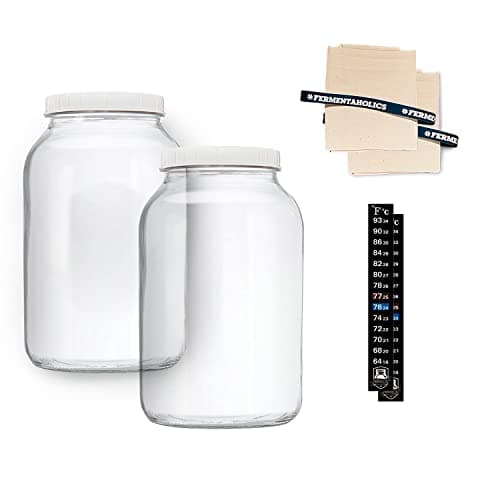
Fermentaholics plain, 2 pack
1 gallon each
No
Muslin covers and bands, two jars
Anchor Hocking Heritage Hill
2 gallons
No
Glass lid
The two-pack is the quiet value option and the one most people should look at twice. Two gallon jars means one brewing and one free — for a SCOBY hotel, for decanting into while you clean the first, or for a second batch on a staggered schedule. Almost everyone ends up owning two jars; buying them together is cheaper than discovering it.
The picks
A tap, a pair, or the cheapest that works
The valve jar for anyone brewing regularly, the two-pack because you will need a second jar anyway, and the printed jar if you want the cover and the temperature strip in the box.
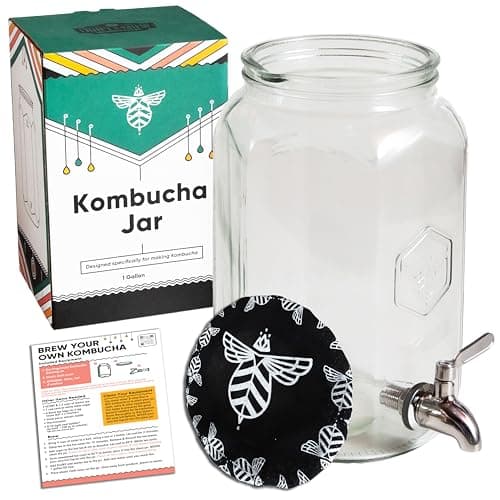
Craft a Brew
Kombucha Jar with Valve (1 Gallon)
The one gallon jar in this group whose valve grade is published — 304 stainless — which is the single specification that decides whether a spigot belongs anywhere near kombucha.
A gallon jar that arrives with the muslin cover, the band and a temperature strip already in the box, which is the whole non-culture half of a first batch.
#ad No live price feed yet, so no number is shown rather than a stale one. How this is funded.
The tap changes the routine more than the specification suggests
On paper a spigot is a convenience. In practice it changes what you know about your batch, which is a bigger deal.
Without a tap, tasting means opening the jar: lifting the cover, getting a clean implement past the pellicle, and closing it again. It is enough friction that most people do it once or twice a batch, which means they are brewing to a calendar rather than to taste. With a tap it is five seconds, so people actually do it from day five, which is how batches stop going too sour.
The costs are real and worth stating. A valve is a part that sits in an acidic liquid for weeks, so its material has to be published and right — the spigot safety page covers why brass keeps appearing and why it must not. It comes apart to clean, and things grow inside a spigot body you cannot see into. And it raises the jar, because a bottle has to fit underneath.
Measure the shelf before you order
The commonest returned purchase in this category is a jar that does not fit where it was meant to go, and it is entirely preventable.
A gallon jar with a tap needs clearance for a bottle underneath, which in practice means it lives on a counter rather than a shelf. A plain gallon jar is shorter but still tall enough that the average under-cabinet gap is worth measuring rather than eyeballing.
This is also where published figures earn their keep, and most of this category does not provide them. Of everything on this site, the outliers are the Anchor Hocking two-gallon, whose distributor publishes its dimensions, and a plain Ball wide-mouth canning jar, which publishes 3 in inner mouth diameter and 9.25 in height. Where a figure is missing, our entries say “not published” rather than estimating.
When a gallon is the wrong size
You want a continuous brew. A gallon is too small: the published replacement rule is 25 to 35 percent per draw, which on a gallon is a quart — barely two bottles. The published sizing for continuous brewing is 2 to 5 gallons, and the method page explains why.
You are testing whether you like it. A half gallon is a cheaper mistake, changes temperature faster so a cold room shows up sooner, and fits a jar many people already own.
You drink a lot. Two gallons at once beats two one-gallon jars: one cover, one thing to clean, one temperature to watch.
You are brewing something else. Milk and water kefir live in quart jars on a daily cycle, not gallons on a fortnightly one — see kits for the other ferments.
What a jar does not include
A vessel is glass. Everything that turns it into kombucha is a separate decision, and the list is short but non-negotiable.
A breathable cover and a band. Some jars ship these, some do not. The first fermentation is aerobic and must not be sealed — covers and cloths covers the weave, and the fruit fly page covers why it has to be a real one.
A culture with measured starter tea. The one part that cannot be improvised. Buy from whoever publishes the volume in fluid ounces.
Tea and sugar. True tea only, plain cane sugar — the tea guide compares the bags on published gallons per pouch.
Bottles. A jar has nowhere for finished kombucha to go. Order them with the jar, not two weeks later.
Two cheap instruments. A temperature strip on the glass and a vial of pH strips answer the only two questions a first batch raises.
Cleaning a gallon jar, and the part that hides things
A plain jar is the easiest vessel on this site to keep clean, and a jar with a tap is the hardest. That difference is worth understanding before choosing between them, because it recurs every few months for as long as you own it.
The jar itself needs very little: hot water, a cloth, and unscented soap only when something is genuinely stuck. Kombucha residue is acidic and does not bake on the way sugar syrup does. What matters far more is rinsing thoroughly, because detergent residue is a real risk to a culture where a smear of kombucha is not — the cleaning routine covers the order.
The spigot is the part that hides things. It comes apart, and it should, because yeast and cellulose accumulate inside a valve body where you cannot see them and a rinse does nothing. Strip it at every reset, and if flow ever slows to a trickle that is the diagnosis rather than a mystery.
One thing not to do to either: no abrasive pads. Scratched glass is mostly cosmetic, but a scratched plastic or coated component holds residue in a way a smooth surface does not, and scouring stainless removes the passive layer that makes it non-corrosive in the first place.
Where the jar ends up living
A gallon of liquid behind glass tracks the room it sits in, so the spot matters nearly as much as the vessel. An interior shelf away from the oven, the fridge exhaust and direct sun is more stable than a windowsill, and stability beats a slightly better average.
It also has to be somewhere you walk past. Clear glass is only an advantage if you look at it — a jar tucked in a cupboard is a jar you remember on day eighteen, which is how a good batch becomes something closer to vinegar.
One more pair of gallon jars is worth knowing about, though not as a fermenter. The Heritage Hill jar review covers a lidded storage set that suits a SCOBY hotel better than anything else here.
Heads up: some links on this page are affiliate links. If you buy through one we may earn a commission at no extra cost to you. It never changes a ranking, and we take no payment for placement. The full version.
The short answer
Quick picks
Ranked on the published rubric. Every row jumps to that product's full write-up below; the button goes straight to Amazon.
#
Product
Best for
Score
Price
1
Craft a Brew
Kombucha Jar with Valve (1 Gallon)
The one gallon jar in this group whose valve grade is published — 304 stainless — which is the single specification that decides whether a spigot belongs anywhere near kombucha.
A gallon jar that arrives with the muslin cover, the band and a temperature strip already in the box, which is the whole non-culture half of a first batch.
Two gallons of glass whose diameter and height are both published to the eighth of an inch — the rare vessel you can check against a shelf before you buy it.
The only jar on this site that publishes its mouth diameter — 3 inches inside — which is the one measurement a brewer with a pellicle to lift actually needs.
The one gallon jar in this group whose valve grade is published — 304 stainless — which is the single specification that decides whether a spigot belongs anywhere near kombucha.
Who it is for. A batch brewer who wants a tap for tasting and bottling, and who wants the spigot’s material in writing.
Published specifications
Capacity
1 gallon
Height
10 inches
Diameter
6 inches
Diameter including valve
7.75 inches
Valve material
304 grade stainless steel
Volume markers
1 gallon and 2 cup markers
Care
Hand wash only — not dishwasher safe
Mouth diameter
Not published
Source: Craft a Brew published dimensions, valve grade and care instructions, craftabrew.com/products/kombucha-jar-with-valve, fetched 2026-09-01
Rubric — 8.0 / 10
Materials9/10 · weight 28%
Documentation9/10 · weight 22%
Capacity fit7/10 · weight 16%
Cleaning6/10 · weight 18%
Value8/10 · weight 16%
What it gets right
304 grade is stated outright, so you are not inferring a spigot’s alloy from a photograph
10 in tall by 7.75 in across including the valve is a published footprint you can check against a counter and a cupboard
Volume markers at 1 gallon and 2 cups line up exactly with a batch and its starter reserve
A tap means you can taste on day six without lifting the jar or dropping anything into it
What it costs you
Hand wash only, and a spigot is the part that most wants a dishwasher
Mouth diameter is not published, which matters because a pellicle grows to the width of the vessel and has to come back out
At one gallon it is small for true continuous brewing — Kombucha Kamp is explicit that a 1-gallon jar is not a good continuous-brew choice
Skip it if. You want to run continuous brew. One gallon does not hold enough liquid to keep a stable culture while you draw off a bottle at a time; go to 2 gallons or more.
A gallon jar that arrives with the muslin cover, the band and a temperature strip already in the box, which is the whole non-culture half of a first batch.
Who it is for. A first-time brewer, or anyone who has learned that the fewer parts a fermentation vessel has, the fewer places a batch can go wrong.
Published specifications
Capacity
1 gallon
Material
Glass
Included
Muslin cover, rubber band, temperature strip
Spigot
None
Dimensions
Not published
Mouth diameter
Not published
Source: Fermentaholics published jar listing contents, fermentaholics.com/product/printed-gallon-kombucha-glass-jar-2-pack/, retrieved 2026-09-01
Rubric — 7.7 / 10
Materials8/10 · weight 28%
Documentation5/10 · weight 22%
Capacity fit8/10 · weight 16%
Cleaning9/10 · weight 18%
Value9/10 · weight 16%
What it gets right
The temperature strip in the box means the jar tells you its own temperature from day one
Muslin breathes and blocks fruit flies, which is exactly what a kombucha cover has to do and what a solid lid does not
No spigot means no seal, no gasket and nothing to disassemble — the easiest vessel here to actually clean
The cheapest way into a proper gallon vessel
What it costs you
No published dimensions at all
No volume markers, so the starter reserve is eyeballed
No tap, so tasting means dipping and bottling means lifting
Skip it if. You want to draw a sample without opening the jar. A plain jar has to be opened every time you taste it.
Anchor Hocking Heritage Hill 2 Gallon Glass Jar with Glass Lid
Two gallons of glass whose diameter and height are both published to the eighth of an inch — the rare vessel you can check against a shelf before you buy it.
Who it is for. Someone scaling past a gallon who would rather measure a shelf than guess, and who does not mind pouring.
Published specifications
Capacity
2 gallons (256 oz)
Top diameter
9 inches
Bottom diameter
9 inches
Maximum diameter
9 3/8 inches
Height
13 3/8 inches
Lid
Glass lid included
Spigot
None
Mouth
Wide-mouth opening; exact aperture not published separately from the 9 in top diameter
Source: Anchor Hocking 69372 published dimensions via foodservice distributor spec sheets (top, bottom and maximum diameter, height), retrieved 2026-09-01
Rubric — 9.1 / 10
Materials9/10 · weight 28%
Documentation10/10 · weight 22%
Capacity fit9/10 · weight 16%
Cleaning9/10 · weight 18%
Value8/10 · weight 16%
What it gets right
Every external dimension is published, which almost nothing else in this category manages
A 9 in top diameter is wide enough to get a full-width pellicle out without folding it
Two gallons is the smallest size Kombucha Kamp considers workable for continuous brew
The glass lid is for storage between batches; brewing still uses cloth, so the lid is a genuine bonus rather than the wrong tool
What it costs you
No spigot, and no factory route to fitting one — drilling tempered glass is not a home job
13 3/8 in tall will not fit under most upper cabinets with a cloth cover and band on top
Two gallons of finished kombucha weighs roughly 17 lb, and you will be lifting it to bottle
Skip it if. You want a tap. This jar has no spigot and no safe way to add one; buy a vessel built with a valve instead.
#ad No live price feed yet, so no number is shown rather than a stale one. How this is funded.
Score9.1no photo yet
#5 · A half-gallon batch you can get your hand into
Ball Wide Mouth Glass Canning Jars, 64 oz (Case of 6)
The only jar on this site that publishes its mouth diameter — 3 inches inside — which is the one measurement a brewer with a pellicle to lift actually needs.
Who it is for. A brewer running small or parallel batches, or anyone who wants a jar whose opening they can check against their own hand before ordering.
Published specifications
Capacity
64 oz (half gallon)
Mouth
Wide mouth. 3 in inner diameter, 3.5 in outer
Height
9.25 in without the lid, 9.375 in with it
Case quantity
6 jars
Included
Lids and bands, screwed onto the jars
Material
Glass. Stated FDA compliant and BPA free
Heat limit
Withstands temperatures up to 250 F
Thermal shock
“Withstands sudden 90° F temperature change”
Freezer
“Not freezer safe”
Markings
Graduated in cups, ounces and mL on the glass
Origin
Made in USA
Spigot
None. This is a jar, not a brewer.
Source: Ball Wide Mouth 64 oz glass canning jar specification as published by distributor Uline (item S-19404: capacity, 3 in inner and 3.5 in outer mouth diameter, 9.25 in and 9.375 in heights, case quantity, materials, 250 F limit, 90 F thermal shock, freezer guidance, graduated markings, origin), uline.com, retrieved 2026-09-06
Rubric — 9.1 / 10
Materials9/10 · weight 28%
Documentation10/10 · weight 22%
Capacity fit8/10 · weight 16%
Cleaning9/10 · weight 18%
Value9/10 · weight 16%
What it gets right
The 3-inch inner mouth is published, which almost no brewing jar states — it is the difference between lifting a pellicle out cleanly and fishing for it
Graduated markings on the glass mean the batch and the starter tea can be measured in the vessel rather than in a jug first
Six jars per case, so a SCOBY hotel, a half-gallon batch and a spare all arrive in one order
The published 90 F sudden-change tolerance is the number that matters when hot tea meets a cold jar
What it costs you
No spigot, so a half gallon has to be poured or siphoned, and pouring past a pellicle is awkward
Not freezer safe, per the published care guidance
A metal lid and band come with it, and neither belongs on a fermenting jar — you will use a cloth instead and store the lids
Half a gallon is a small batch. Two of these is more glass to clean than one gallon jar
Skip it if. You want a gallon or more per batch. Half-gallon jars multiply fast, and four of them is a worse experience than one two-gallon vessel.
#ad No live price feed yet, so no number is shown rather than a stale one. How this is funded.
FAQ
Questions people actually ask
What is the best 1 gallon jar for kombucha?+
For regular brewing, one with a tap whose valve material is published — drawing a taste without opening the vessel is what stops batches being brewed to a calendar instead of to taste. For the cheapest thing that works, a plain gallon jar with a muslin cover and band. Buying a two-pack is usually better value, because almost everyone ends up needing a second jar.
Why is one gallon the standard kombucha batch size?+
Because the whole category standardized on it. Cultures ship with roughly 12 fl oz of starter tea, which is the published ten percent of a 128 oz gallon; kits are built around gallon jars; and recipes assume a cup of sugar and two tablespoons of loose leaf per gallon. A gallon also yields about seven 16 oz bottles after the starter reserve.
Do I need a spigot on a kombucha jar?+
Not to brew, but it changes the routine. Without one, tasting means opening the jar and getting past the pellicle, so most people only do it once or twice a batch. With one it takes five seconds, so they taste from day five and stop overshooting. The cost is a part that sits in acid for weeks and has to be taken apart to clean.
Can I use a 1 gallon jar for continuous brew?+
Not well. The published replacement rule for continuous brewing is 25 to 35 percent of the vessel per draw, which on a gallon is only a quart — barely two bottles. The published sizing guidance for a continuous brew vessel is 2 to 5 gallons.
What lid should I use on a kombucha jar?+
None during the first fermentation. That stage is aerobic and must not build pressure, so it needs a tight-woven cloth or muslin cover held with a band. Keep any solid lid the jar ships with for storing finished kombucha in the fridge or capping a SCOBY hotel that is not actively fermenting.
Sources
Every specification cited on this page came from one of these documents, retrieved on the date shown against the product it belongs to.