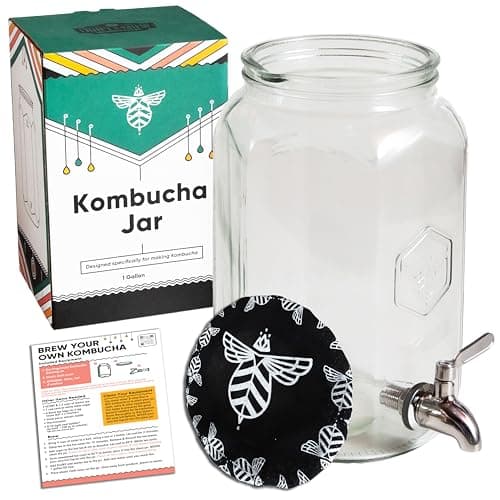
The tap is the best feature and the biggest liability on a brewing vessel. Everything turns on one specification most makers never publish.
By Scooter M.·Published September 1, 2026 · Updated September 7, 2026
The short answer
Buy a spigot jar only when the maker publishes the valve material. 304-grade stainless is the safe default; a named professional-grade plastic such as PP5 is acceptable; an unlabeled metal or a translucent white consumer tap is not. Of the vessels here, all four publish theirs, which is why they are the four on this page.
Why anyone wants a tap
Two genuine conveniences, both bigger than they sound. First, tasting: kombucha changes daily between day five and day twelve, and a tap lets you draw a mouthful without opening the vessel, disturbing the pellicle or dropping anything into the liquid. Second, bottling: a full gallon weighs roughly eight and a half pounds and a full two gallons about seventeen, and pouring from that height into a narrow bottle neck is how kombucha ends up on the floor.
Against that, a spigot is the only part of the vessel with moving components, hidden internal surfaces, a gasket, and a material that is not glass. Every one of those is a place something can go wrong.
304 stainless is the number to look for
Kombucha sits at roughly pH 2.5 to 3.5, continuously, for as long as the vessel is in use. That is an environment where the alloy genuinely matters. Kombucha Kamp's published guidance names stainless steel at 304 grade or better as safe, alongside professional-grade hard plastic and wood, and names the unsafe elements explicitly: semi-hard plastic with a metallic coating that can erode over time, brass connections, consumer-grade translucent white plastic, and any spigot assembled with adhesives or epoxies.
Brass deserves its own sentence, because it is the trap. Kombucha Kamp warns that barrel suppliers often fit brass spigots, which are "safe with higher pH beverages like beer, but not safe with the low pH of Kombucha". A tap that came off a homebrew shop shelf is not automatically a kombucha tap. Spigot safety is the full version.
What each vessel publishes
Published valve materials and dimensions, compiled 2026-09-01.
Vessel
Capacity
Valve material
Published height
Craft a Brew jar with valve
1 gal
304 grade stainless steel
10 in
Kombucha Kamp glass brewer
~2.2 gal
Stainless steel
13 in / 18 in on stand
Kombucha Kamp stoneware crock
~2.5 gal
Stainless steel
12-14 in
Kombucha Kamp porcelain brewer
~2.2 gal
PP5 plastic, stainless upgrade offered
10 in / 17 in on stand
The Craft a Brew jar is the outlier for a different reason: it is the only one of the four that names its grade rather than just its material. "Stainless steel" is a family, not a specification; "304 grade stainless steel" is a specification. Both are fine here, but the second one is checkable.
The picks
Three taps we would put on a counter
One gallon with a published 304 valve for batch brewing, and two continuous brewers with stainless taps as standard.
Craft a Brew
Kombucha Jar with Valve (1 Gallon)
The one gallon jar in this group whose valve grade is published — 304 stainless — which is the single specification that decides whether a spigot belongs anywhere near kombucha.
About 2.2 gallons of glass on an acacia stand with a stainless spigot, and the only vessel here where you can see the pellicle, the yeast strands and the fill line at a glance.
#ad No live price feed yet, so no number is shown rather than a stale one. How this is funded.
Score8.3no photo yet
Kombucha Kamp
USA Handmade Stoneware Continuous Brewer Crock
Roughly 2.5 gallons of US-made handmade stoneware with a stainless spigot, and the only vessel here whose dimensions are given as a range because each one is thrown by hand.
#ad No live price feed yet, so no number is shown rather than a stale one. How this is funded.
The cleaning problem nobody mentions in the listing
A spigot has to come apart. Kombucha throws yeast strands, and yeast strands find their way into the narrow bore of a tap and stay there. Kombucha Kamp lists "quickly and easily removed for cleaning" as a critical requirement, and it is the criterion most buyers never think about until the first time a tap runs slow.
This is why the Craft a Brew jar scores lower on our cleaning criterion than a plain jar with no tap at all: it is published as hand wash only, and the spigot is precisely the part that most wants a dishwasher. A tap is a convenience you pay for in maintenance, and knowing that in advance is the whole point.
When a spigot is the wrong choice
You are brewing your first batch. A plain jar has fewer failure points and teaches you what the culture does, and you can add a tapped vessel later once you know you will keep going.
You brew half a gallon at a time. The lifting problem a tap solves does not exist at that scale.
You want a vessel you can put through a dishwasher. Most spigot jars are hand wash only.
The listing does not state the valve material. That is not a jar to buy; it is a jar to skip.
A tap earns its keep twice over on bottling day. Push a spring-tip bottle filler onto the spigot and the vessel becomes a bottling station: flow starts when the wand touches the bottom of the bottle, stops the moment you lift it, and the volume the wand displaced becomes your headspace. Funnels, fillers and bottle brushes sets out the published fittings and dimensions.
Heads up: some links on this page are affiliate links. If you buy through one we may earn a commission at no extra cost to you. It never changes a ranking, and we take no payment for placement. The full version.
The short answer
Quick picks
Ranked on the published rubric. Every row jumps to that product's full write-up below; the button goes straight to Amazon.
#
Product
Best for
Score
Price
1
Craft a Brew
Kombucha Jar with Valve (1 Gallon)
The one gallon jar in this group whose valve grade is published — 304 stainless — which is the single specification that decides whether a spigot belongs anywhere near kombucha.
About 2.2 gallons of glass on an acacia stand with a stainless spigot, and the only vessel here where you can see the pellicle, the yeast strands and the fill line at a glance.
Roughly 2.5 gallons of US-made handmade stoneware with a stainless spigot, and the only vessel here whose dimensions are given as a range because each one is thrown by hand.
Certified lead-free porcelain at about 2.2 gallons, opaque so the culture sits in the dark, with a PP5 spigot as standard and a stainless upgrade offered.
The one gallon jar in this group whose valve grade is published — 304 stainless — which is the single specification that decides whether a spigot belongs anywhere near kombucha.
Who it is for. A batch brewer who wants a tap for tasting and bottling, and who wants the spigot’s material in writing.
Published specifications
Capacity
1 gallon
Height
10 inches
Diameter
6 inches
Diameter including valve
7.75 inches
Valve material
304 grade stainless steel
Volume markers
1 gallon and 2 cup markers
Care
Hand wash only — not dishwasher safe
Mouth diameter
Not published
Source: Craft a Brew published dimensions, valve grade and care instructions, craftabrew.com/products/kombucha-jar-with-valve, fetched 2026-09-01
Rubric — 8.0 / 10
Materials9/10 · weight 28%
Documentation9/10 · weight 22%
Capacity fit7/10 · weight 16%
Cleaning6/10 · weight 18%
Value8/10 · weight 16%
What it gets right
304 grade is stated outright, so you are not inferring a spigot’s alloy from a photograph
10 in tall by 7.75 in across including the valve is a published footprint you can check against a counter and a cupboard
Volume markers at 1 gallon and 2 cups line up exactly with a batch and its starter reserve
A tap means you can taste on day six without lifting the jar or dropping anything into it
What it costs you
Hand wash only, and a spigot is the part that most wants a dishwasher
Mouth diameter is not published, which matters because a pellicle grows to the width of the vessel and has to come back out
At one gallon it is small for true continuous brewing — Kombucha Kamp is explicit that a 1-gallon jar is not a good continuous-brew choice
Skip it if. You want to run continuous brew. One gallon does not hold enough liquid to keep a stable culture while you draw off a bottle at a time; go to 2 gallons or more.
About 2.2 gallons of glass on an acacia stand with a stainless spigot, and the only vessel here where you can see the pellicle, the yeast strands and the fill line at a glance.
Who it is for. A continuous brewer who wants to see what is happening, and who has an open shelf or an island to put it on.
Published specifications
Capacity
Approximately 2.2 gallons
Vessel height
13 inches
Vessel width
9 inches
Height with stand
18 inches
Spigot
Stainless steel
Stand
Acacia wood
Material
Glass
Source: Kombucha Kamp published vessel specifications (capacity, vessel and stand heights, spigot material), kombuchakamp.com/glass-continuous-brewer.html, retrieved 2026-09-01
Rubric — 8.5 / 10
Materials9/10 · weight 28%
Documentation9/10 · weight 22%
Capacity fit9/10 · weight 16%
Cleaning8/10 · weight 18%
Value7/10 · weight 16%
What it gets right
Glass is chemically inert at kombucha’s pH and shows you the state of the culture without opening anything
A stainless spigot as standard rather than as an upgrade
18 in on the stand is published, so you can check the clearance to a cabinet before ordering
2.2 gallons sits inside the 2-to-5-gallon band Kombucha Kamp recommends for continuous brew
What it costs you
Light reaches the culture, and continuous brew is a long exposure — it needs a dark corner or a cloth over it
Glass at 2.2 gallons is heavy and unforgiving of a knock against a tap
18 in tall on the stand rules out most under-cabinet counters
Skip it if. Your only free counter is under a cabinet. At 18 in with the stand you will not get the cover off, let alone the pellicle out.
#ad No live price feed yet, so no number is shown rather than a stale one. How this is funded.
Score8.3no photo yet
#3 · The largest published capacity
Kombucha Kamp USA Handmade Stoneware Continuous Brewer Crock
Roughly 2.5 gallons of US-made handmade stoneware with a stainless spigot, and the only vessel here whose dimensions are given as a range because each one is thrown by hand.
Who it is for. A committed continuous brewer with counter space, who wants the biggest published capacity and a stainless tap in the box.
Published specifications
Capacity
Approximately 2.5 gallons
Vessel height
12 to 14 inches
Vessel width
10 to 12 inches at the shoulders
Material
Stoneware, handmade in the USA
Spigot
Brew-safe stainless steel upgrade included
Dimension variance
Published as a range because each crock is individually made
Source: Kombucha Kamp published crock specifications (capacity, height and shoulder-width ranges, stainless spigot), kombuchakamp.com/usa-handmade-stoneware-continuous-brewer-crock.html, retrieved 2026-09-01
Rubric — 8.3 / 10
Materials9/10 · weight 28%
Documentation8/10 · weight 22%
Capacity fit10/10 · weight 16%
Cleaning7/10 · weight 18%
Value7/10 · weight 16%
What it gets right
2.5 gallons is the largest here and sits in the middle of the 2-to-5-gallon continuous brew band
Stainless spigot included rather than offered as an extra
Opaque stoneware keeps light off the ferment
Publishing dimensions as a range rather than a false precision is the honest way to spec a handmade vessel, and it tells you to leave clearance
What it costs you
Up to 14 in tall and 12 in wide at the shoulders — you have to plan for the top of the range, not the bottom
Handmade stoneware at 2.5 gallons is heavy before you fill it and very heavy after
No visibility into the vessel at all
Skip it if. You measure your shelf to the inch. A vessel whose height can be 12 in or 14 in is not the one to buy for a tight gap.
#ad No live price feed yet, so no number is shown rather than a stale one. How this is funded.
Score8.0no photo yet
#4 · Keeping light off a long ferment
Kombucha Kamp Modern Porcelain Continuous Brewer with Stand
Certified lead-free porcelain at about 2.2 gallons, opaque so the culture sits in the dark, with a PP5 spigot as standard and a stainless upgrade offered.
Who it is for. An established continuous brewer who has stopped needing to look, and wants the culture in the dark.
Published specifications
Capacity
Approximately 2.2 gallons
Vessel height
10 inches
Vessel width
10 inches
Height with stand
17 inches
Material
Certified lead-free porcelain, made in China
Spigot (standard)
PP5 plastic, described by the maker as “the highest quality plastic designed to be corrosion resistant”
Spigot (option)
Stainless steel upgrade offered
Stand
Fine-finish wood counter stand
Finishes
White, plus Black Knight, Forest Green and Blue Heaven
Source: Kombucha Kamp published vessel specifications (capacity, dimensions, porcelain and PP5 spigot materials, finishes), kombuchakamp.com/modern-porcelain-continuous-brewer-deluxe-package.html, retrieved 2026-09-01
Rubric — 8.0 / 10
Materials8/10 · weight 28%
Documentation9/10 · weight 22%
Capacity fit9/10 · weight 16%
Cleaning7/10 · weight 18%
Value7/10 · weight 16%
What it gets right
Opaque walls mean the culture never sees light, which is what you want across a months-long continuous ferment
Lead-free certification is stated, and lead in decorative glaze is the real hazard with ceramic fermentation vessels
10 in tall in the vessel and 17 in on the stand is the shortest of the three continuous brewers here
10 in wide gives a big surface area, which is where a pellicle wants to grow
What it costs you
You cannot see the liquid level, the pellicle or a mold bloom without lifting the lid
The standard spigot is plastic. PP5 is a genuinely acid-stable polypropylene and the maker names the grade, but stainless has the longer track record
Imported porcelain, so a chip in transit is a whole-vessel problem
Skip it if. You are new to kombucha. A beginner benefits enormously from seeing the pellicle form and from spotting mold early, and an opaque vessel takes that away.
#ad No live price feed yet, so no number is shown rather than a stale one. How this is funded.
FAQ
Questions people actually ask
What kind of spigot is safe for kombucha?+
304-grade stainless steel or better, a named professional-grade hard plastic such as PP5, or wood. Kombucha Kamp's published guidance names those as safe and specifically warns against brass, consumer-grade translucent white plastic, metallic-coated semi-hard plastic and any spigot assembled with adhesives or epoxies.
Can I add a spigot to a glass jar I already own?+
No, not safely. Drilling tempered glass at home is likely to crack the jar. Buy a vessel manufactured with a valve rather than modifying one that was not.
Do spigot jars leak?+
They can, and the usual cause is a gasket that has been reassembled slightly out of position after cleaning. Take the tap apart on a towel, keep the parts in order, and check the seal by filling the vessel with plain water before you commit a batch to it.
Is a 1-gallon spigot jar enough for continuous brew?+
No. Kombucha Kamp states plainly that a 1-gallon jar is not a good choice for continuous brewing and recommends 2 to 5 gallons. A one-gallon spigot jar is a good batch-brew vessel with a convenient tap.
How do I clean the inside of a spigot?+
Disassemble it. That is the only way, which is why the ability to take the tap apart quickly is a buying criterion rather than a detail. A small bottle brush and hot water handles the bore; avoid soaking gaskets in anything harsh.
Sources
Every specification cited on this page came from one of these documents, retrieved on the date shown against the product it belongs to.