One gallon is the right answer for most people. Here is the arithmetic behind that, and the two cases where it is wrong.
By Scooter M.·Published September 1, 2026 · Updated September 21, 2026
The short answer
One gallon for batch brewing, which yields six to seven 16 oz bottles after you hold back starter tea. Two gallons or more if you want continuous brew. Half a gallon only as a trial batch, because a smaller volume swings in temperature much faster.
Batch size, jar size, bottles filled
Yields assume 10 percent of the batch is held back as starter tea for the next round, which is the published rule.
Batch
Volume
Starter held back
To bottle
16 oz bottles
Half gallon
64 oz
6.4 oz
~58 oz
3-4
1 gallon
128 oz
12.8 oz
~115 oz
7
2 gallons
256 oz
25.6 oz
~230 oz
14
2.5 gallons
320 oz
32 oz
~288 oz
18
A gallon a fortnight is roughly half a 16 oz bottle a day for one person, or a bottle every other day for two. That is why one gallon has become the standard size: it matches how much kombucha a household actually drinks.
Headroom, and why the jar is bigger than the batch
A one-gallon batch does not go in a one-gallon jar. You need room above the liquid for the pellicle to sit and for air to move over the surface, which is what the culture needs. In practice a "one gallon" brewing jar holds slightly more than a gallon, and you fill it to about the gallon line rather than to the rim.
Vessels sold specifically for kombucha usually account for this — Craft a Brew's jar prints a 1 gallon line and a 2 cup line onto the glass, which is exactly the batch and the starter reserve. A generic jar does not, which is one small argument for a purpose-made one.
Shape matters as much as volume
Kombucha ferments at the surface, where the culture meets air. A wide, shallow vessel therefore ferments faster than a tall narrow one of the same volume, because it has more surface per gallon.
This has two practical consequences. A carboy or a demijohn — perfect for beer and wine — is the wrong shape here: narrow neck, small surface, and a pellicle that grows to the width of the body and then cannot come out through the neck. And a wide-mouthed jar is easier to clean, easier to get a hand into, and easier to lift a pellicle out of in one piece.
Mouth diameter is the measurement almost nobody publishes. Of everything on this site, the Anchor Hocking Heritage Hill 2-gallon is the exception: its 9 in top diameter is published and equals its body diameter, so nothing has to be folded to come out.
The picks
A jar for each of the three cases
One gallon for a standard batch, two gallons with every dimension published for scaling up, and a pair of gallon jars for running two batches a week apart.
Score7.7no photo yet
Fermentaholics
Printed Gallon Kombucha Glass Jar
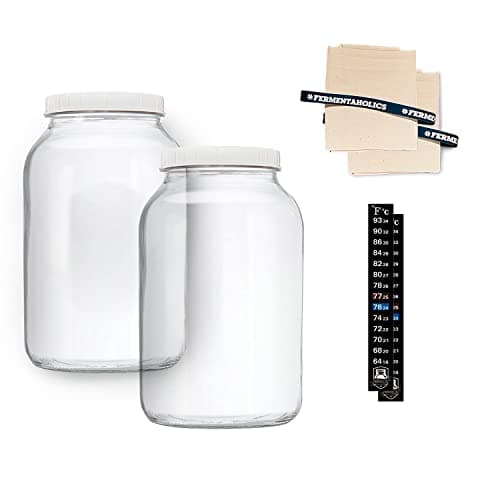
A gallon jar that arrives with the muslin cover, the band and a temperature strip already in the box, which is the whole non-culture half of a first batch.
#ad No live price feed yet, so no number is shown rather than a stale one. How this is funded.
Score9.1no photo yet
Anchor Hocking
Heritage Hill 2 Gallon Glass Jar with Glass Lid
Two gallons of glass whose diameter and height are both published to the eighth of an inch — the rare vessel you can check against a shelf before you buy it.
Two one-gallon jars offset by a week gives you a steady supply instead of a fortnightly flood, lets you run different teas or different ferment lengths side by side, and gives you somewhere to keep spare cultures. That last one is not optional for long: every healthy batch grows a new pellicle, and by month two you need a SCOBY hotel whether you planned for one or not.
Two gallons in two vessels also weighs half as much per lift as two gallons in one, which matters more than it sounds when you are bottling.
When half a gallon is right, and when it is not
A half-gallon batch is a good trial. It is a cheaper mistake, it needs less tea and sugar, and it fits in a half-gallon mason jar that many kitchens already contain.
Its drawback is thermal: a smaller volume of liquid changes temperature much faster than a larger one. A cold night moves a half gallon further than it moves a gallon, which makes a small batch more sensitive to exactly the variable that decides everything. Match the culture to the batch too — the half-gallon culture ships with 6 fl oz of starter tea against the gallon version's 12.
If a half gallon is where you want to start, the sizing question changes shape slightly, because the plain canning aisle is suddenly competitive and one jar there publishes the mouth diameter nobody else does. Mason jars for kombucha compares the half-gallon and gallon options on that figure and on height.
Once the size is settled, the choice narrows to a handful of vessels, and they differ more than the listings suggest — mainly on whether there is a tap. The best 1 gallon jar for kombucha compares them on published dimensions and on what actually arrives in the box.
If the honest answer is that a gallon is more kombucha than you drink, small batch kombucha covers brewing half a gallon instead — the jar, a culture dosed for the size, and the ratios that do not change when you scale down.
Heads up: some links on this page are affiliate links. If you buy through one we may earn a commission at no extra cost to you. It never changes a ranking, and we take no payment for placement. The full version.
The short answer
Quick picks
Ranked on the published rubric. Every row jumps to that product's full write-up below; the button goes straight to Amazon.
#
Product
Best for
Score
Price
1
Score7.7
Fermentaholics
Printed Gallon Kombucha Glass Jar
A gallon jar that arrives with the muslin cover, the band and a temperature strip already in the box, which is the whole non-culture half of a first batch.
Two gallons of glass whose diameter and height are both published to the eighth of an inch — the rare vessel you can check against a shelf before you buy it.
A gallon jar that arrives with the muslin cover, the band and a temperature strip already in the box, which is the whole non-culture half of a first batch.
Who it is for. A first-time brewer, or anyone who has learned that the fewer parts a fermentation vessel has, the fewer places a batch can go wrong.
Published specifications
Capacity
1 gallon
Material
Glass
Included
Muslin cover, rubber band, temperature strip
Spigot
None
Dimensions
Not published
Mouth diameter
Not published
Source: Fermentaholics published jar listing contents, fermentaholics.com/product/printed-gallon-kombucha-glass-jar-2-pack/, retrieved 2026-09-01
Rubric — 7.7 / 10
Materials8/10 · weight 28%
Documentation5/10 · weight 22%
Capacity fit8/10 · weight 16%
Cleaning9/10 · weight 18%
Value9/10 · weight 16%
What it gets right
The temperature strip in the box means the jar tells you its own temperature from day one
Muslin breathes and blocks fruit flies, which is exactly what a kombucha cover has to do and what a solid lid does not
No spigot means no seal, no gasket and nothing to disassemble — the easiest vessel here to actually clean
The cheapest way into a proper gallon vessel
What it costs you
No published dimensions at all
No volume markers, so the starter reserve is eyeballed
No tap, so tasting means dipping and bottling means lifting
Skip it if. You want to draw a sample without opening the jar. A plain jar has to be opened every time you taste it.
#ad No live price feed yet, so no number is shown rather than a stale one. How this is funded.
Score9.1no photo yet
#2 · Scaling up on published dimensions
Anchor Hocking Heritage Hill 2 Gallon Glass Jar with Glass Lid
Two gallons of glass whose diameter and height are both published to the eighth of an inch — the rare vessel you can check against a shelf before you buy it.
Who it is for. Someone scaling past a gallon who would rather measure a shelf than guess, and who does not mind pouring.
Published specifications
Capacity
2 gallons (256 oz)
Top diameter
9 inches
Bottom diameter
9 inches
Maximum diameter
9 3/8 inches
Height
13 3/8 inches
Lid
Glass lid included
Spigot
None
Mouth
Wide-mouth opening; exact aperture not published separately from the 9 in top diameter
Source: Anchor Hocking 69372 published dimensions via foodservice distributor spec sheets (top, bottom and maximum diameter, height), retrieved 2026-09-01
Rubric — 9.1 / 10
Materials9/10 · weight 28%
Documentation10/10 · weight 22%
Capacity fit9/10 · weight 16%
Cleaning9/10 · weight 18%
Value8/10 · weight 16%
What it gets right
Every external dimension is published, which almost nothing else in this category manages
A 9 in top diameter is wide enough to get a full-width pellicle out without folding it
Two gallons is the smallest size Kombucha Kamp considers workable for continuous brew
The glass lid is for storage between batches; brewing still uses cloth, so the lid is a genuine bonus rather than the wrong tool
What it costs you
No spigot, and no factory route to fitting one — drilling tempered glass is not a home job
13 3/8 in tall will not fit under most upper cabinets with a cloth cover and band on top
Two gallons of finished kombucha weighs roughly 17 lb, and you will be lifting it to bottle
Skip it if. You want a tap. This jar has no spigot and no safe way to add one; buy a vessel built with a valve instead.
One gallon for standard batch brewing. It yields six to seven 16 oz bottles once you hold back roughly 10 percent as starter tea, which matches what most households drink in a fortnight.
How much kombucha does a 1-gallon batch make?+
About 115 oz of drinkable kombucha, because roughly 13 oz is held back as starter tea for the next batch. That fills around seven 16 oz bottles or three and a half 32 oz bottles.
Can I brew kombucha in a half-gallon jar?+
Yes, and it is a sensible trial size. Just buy a culture dosed for a half gallon, and be aware that a smaller volume of liquid swings in temperature faster than a full gallon, which makes it more sensitive to a cold night.
Should I use a carboy or demijohn for kombucha?+
No. Kombucha ferments at the surface and needs air exchange, so a narrow-necked vessel gives too little surface area. The bigger problem is that the pellicle grows to the width of the body and then will not fit back out through the neck.
Is it better to have one big jar or two small ones?+
Two one-gallon jars offset by a week gives a steady supply rather than a fortnightly flood, halves the weight of each lift, and gives you a second vessel for a SCOBY hotel — which you will need by month two anyway.
Sources
Every specification cited on this page came from one of these documents, retrieved on the date shown against the product it belongs to.