The cheapest vessel that works, and the only category where a maker will actually tell you how wide the opening is before you buy.
By Scooter M.·Published September 6, 2026 · Updated September 21, 2026
The short answer
A wide-mouth half-gallon or gallon glass jar is all a first ferment needs. Buy on mouth diameter first — you have to get a hand and a pellicle through it — then on height against your shelf. Cover with cloth and a band, never the metal lid it ships with, and expect to pour or siphon because a mason jar has no spigot.
Four things to check, in this order
A mason jar is the least sophisticated vessel on this site and, for a first ferment, one of the best. There is nothing to leach, nothing to seize, nothing to replace. Which means the buying decision comes down to dimensions and one piece of hardware you will not use.
Mouth diameter. The single most useful number and the one almost nobody publishes. Every batch ends with a hand going in to lift a pellicle out, and a narrow-mouth jar turns that into a wrestling match. Three inches is comfortable; anything under about two and a half is not.
Height, with and without a lid. Jars live under cabinets. A half-gallon at 9¼ inches clears most counters; a two-gallon jar frequently does not, which is a returned parcel nobody enjoys.
Thermal shock tolerance. You will pour warm sweet tea into a room-temperature jar sooner or later. A published figure for a sudden temperature change tells you how much margin you have.
What it ships with. Most mason jars arrive with a metal lid and band, and neither belongs on a fermenting jar. That is not a defect — it is a canning jar being sold as a canning jar — but it means the cover is a separate decision.
Everything below is scored against the published rubric, with the weights stated so you can recompute any total. We have not brewed in any of these; the figures are the makers' and distributors' own.
The dimensions, side by side
Published dimensions for the jars on this page, compiled 2026-09-06. A blank means the figure is not published by the maker or its distributors.
Jar
Capacity
Mouth
Height
Ball wide mouth
64 oz
3 in inner, 3.5 in outer
9.25 in bare, 9.375 in with lid
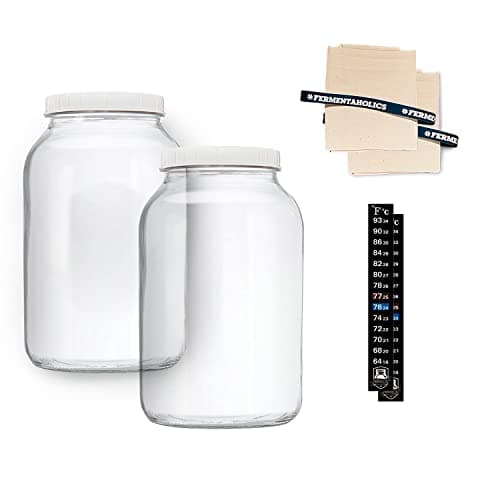
Fermentaholics printed gallon
1 gallon
—
—
Fermentaholics gallon, 2 pack
1 gallon each
—
—
Anchor Hocking Heritage Hill
2 gallons
—
Published by distributors
That table is mostly blanks, and the blanks are the point. Mouth diameter is the measurement a continuous-brew buyer most needs and the one this category most reliably omits. The Ball jar is the only vessel on this entire site that states it — three inches inside, three and a half outside — which is why it wins a page about mason jars despite being a canning jar that knows nothing about kombucha.
Half gallon or gallon
A gallon is the standard home batch and the size every culture is dosed for: the ten percent starter tea rule assumes it, kits are built around it, and a gallon of finished kombucha fills about ten twelve-ounce bottles. If you know you will drink it, brew a gallon.
A half gallon is the better first purchase for two reasons that have nothing to do with volume. It is a cheaper mistake while you find out whether your household actually drinks the stuff, and 64 ounces of liquid changes temperature faster than 128, which makes a cold week more obvious sooner rather than quietly stalling a big batch.
The trap is buying several half-gallon jars instead of one larger vessel. Four jars is four covers, four bands, four things to clean and four ferments running at slightly different rates. The sizing guide works through where the crossover sits.
The picks
A jar at each size
A half gallon that publishes its mouth diameter, a gallon built for kombucha, and a two-gallon jar for anyone moving to continuous brewing.
Score9.1no photo yet
Ball
Wide Mouth Glass Canning Jars, 64 oz (Case of 6)
The only jar on this site that publishes its mouth diameter — 3 inches inside — which is the one measurement a brewer with a pellicle to lift actually needs.
#ad No live price feed yet, so no number is shown rather than a stale one. How this is funded.
Score7.7no photo yet
Fermentaholics
Printed Gallon Kombucha Glass Jar
A gallon jar that arrives with the muslin cover, the band and a temperature strip already in the box, which is the whole non-culture half of a first batch.
#ad No live price feed yet, so no number is shown rather than a stale one. How this is funded.
Score9.1no photo yet
Anchor Hocking
Heritage Hill 2 Gallon Glass Jar with Glass Lid
Two gallons of glass whose diameter and height are both published to the eighth of an inch — the rare vessel you can check against a shelf before you buy it.
#ad No live price feed yet, so no number is shown rather than a stale one. How this is funded.
The lid it comes with is the wrong lid
A canning jar ships with a flat metal lid and a screw band, and a first fermentation needs neither. The ferment is aerobic — it wants air exchange and it does not want to build pressure — so the cover is a tight-woven cloth held with the band, or a purpose- made breathable cover. Covers, cloths, and why not a lid covers the reasoning and the failure modes.
Keep the metal lids anyway. They are exactly right for the second stage — storing finished kombucha in the fridge, or capping a SCOBY hotel that is not actively fermenting. What they must not do is sit on a jar that is still producing gas.
One material note while the lid is in your hand: the flat disc is coated steel, and a disc sitting on top of an acidic ferment for weeks is a metal-and-acid contact problem in the same family as a brass spigot. Another reason the cloth wins.
Hot tea, cold glass
Every brew day involves pouring something warm into something at room temperature, and glass does not like abrupt change. Ball publishes two useful figures here: the jar withstands temperatures up to 250 F, and it withstands a sudden 90 F temperature change.
Ninety degrees of headroom is generous for this job — you are not meant to be pouring near-boiling tea into a jar anyway, because a fresh culture goes into it afterward and the brewing method has you cool the tea to room temperature first. But it is the difference between a jar that tolerates an impatient brewer and one that cracks on the counter.
The same page publishes that the jar is not freezer safe. That matters less for brewing than for what people do with finished kombucha, and it is worth reading before anyone gets ideas about a fast chill.
What a jar does not include
A cover. Cloth and a band, or a breathable cover. The metal lid stays in a drawer during fermentation.
A way to get the kombucha out. No spigot means pouring past a pellicle or siphoning. This is the real argument for a jar with a spigot once you are brewing regularly.
A temperature reading. The jar tells you nothing about what the liquid inside it is doing. An adhesive strip on the glass is the cheapest fix on this site.
The culture, tea and sugar. A jar is glass. Everything that makes it kombucha is a separate order — see what you actually need.
Regular mouth or wide mouth
Mason jars come in two neck sizes and the difference is not cosmetic. A regular-mouth jar has an opening of roughly 2.75 inches at the outside and appreciably less inside; a wide-mouth jar publishes 3 inches inside and 3.5 outside. On a shelf of jam that is a detail. On a fermenting vessel it decides whether the job is pleasant.
The reason is the pellicle. It grows to the full width of the liquid surface, and a mason jar is widest at the shoulder and narrower at the neck. A pellicle grown at the shoulder of a regular-mouth jar has to be folded to come out, and folding a wet cellulose disc while reaching through a two-and-a-half-inch hole is the single most annoying thing about the wrong jar.
Wide mouth also makes cleaning genuinely easier — a hand with a cloth fits, so you do not need a bottle brush for the walls — and it makes covering easier, because the cloth has a broader rim to sit against and is less likely to be pulled in. There is no corresponding advantage to a regular mouth for this job. Buy wide.
How many jars you actually need
More than one, and fewer than the number people end up with. The realistic count for a working setup is three.
One brewing. The batch in progress, covered with cloth, sitting wherever your kitchen is most stable.
One as a hotel. Spare pellicles and strong kombucha, lidded, at room temperature. This is what stops a healthy culture being thrown away every time a batch produces a new layer — the SCOBY hotel explains the maintenance.
One empty. For decanting into while you clean the brewing jar, which is the step that has nowhere to happen if you own exactly two.
Six jars per case sounds like too many until you notice that three of them are working and the rest cover breakage, a second batch, and the inevitable moment somebody asks for a culture. Glass jars are the one item in this hobby that never becomes obsolete.
Where the jar lives matters as much as which jar
A mason jar is thin, plain glass with no insulation, which means it tracks the room closely and quickly. That is an advantage if the room is stable and a liability if it is not — a jar on a windowsill can swing fifteen degrees between afternoon and dawn, and a batch on that ride finishes unpredictably.
The best spot is an interior shelf away from the oven, the fridge exhaust and direct sun, at a height where you will actually look at it. Clear glass is only useful if the jar is somewhere you pass. A jar in a cupboard is a jar you will remember on day eighteen, which is how a perfectly good batch becomes something closer to vinegar.
A wide-mouth canning jar is also the cheapest sensible route into brewing less than a gallon at a time. Small batch kombucha works through the half-gallon setup and what changes at that size.
Heads up: some links on this page are affiliate links. If you buy through one we may earn a commission at no extra cost to you. It never changes a ranking, and we take no payment for placement. The full version.
The short answer
Quick picks
Ranked on the published rubric. Every row jumps to that product's full write-up below; the button goes straight to Amazon.
#
Product
Best for
Score
Price
1
Score9.1
Ball
Wide Mouth Glass Canning Jars, 64 oz (Case of 6)
The only jar on this site that publishes its mouth diameter — 3 inches inside — which is the one measurement a brewer with a pellicle to lift actually needs.
A gallon jar that arrives with the muslin cover, the band and a temperature strip already in the box, which is the whole non-culture half of a first batch.
Two gallons of glass whose diameter and height are both published to the eighth of an inch — the rare vessel you can check against a shelf before you buy it.
#1 · A half-gallon batch you can get your hand into
Ball Wide Mouth Glass Canning Jars, 64 oz (Case of 6)
The only jar on this site that publishes its mouth diameter — 3 inches inside — which is the one measurement a brewer with a pellicle to lift actually needs.
Who it is for. A brewer running small or parallel batches, or anyone who wants a jar whose opening they can check against their own hand before ordering.
Published specifications
Capacity
64 oz (half gallon)
Mouth
Wide mouth. 3 in inner diameter, 3.5 in outer
Height
9.25 in without the lid, 9.375 in with it
Case quantity
6 jars
Included
Lids and bands, screwed onto the jars
Material
Glass. Stated FDA compliant and BPA free
Heat limit
Withstands temperatures up to 250 F
Thermal shock
“Withstands sudden 90° F temperature change”
Freezer
“Not freezer safe”
Markings
Graduated in cups, ounces and mL on the glass
Origin
Made in USA
Spigot
None. This is a jar, not a brewer.
Source: Ball Wide Mouth 64 oz glass canning jar specification as published by distributor Uline (item S-19404: capacity, 3 in inner and 3.5 in outer mouth diameter, 9.25 in and 9.375 in heights, case quantity, materials, 250 F limit, 90 F thermal shock, freezer guidance, graduated markings, origin), uline.com, retrieved 2026-09-06
Rubric — 9.1 / 10
Materials9/10 · weight 28%
Documentation10/10 · weight 22%
Capacity fit8/10 · weight 16%
Cleaning9/10 · weight 18%
Value9/10 · weight 16%
What it gets right
The 3-inch inner mouth is published, which almost no brewing jar states — it is the difference between lifting a pellicle out cleanly and fishing for it
Graduated markings on the glass mean the batch and the starter tea can be measured in the vessel rather than in a jug first
Six jars per case, so a SCOBY hotel, a half-gallon batch and a spare all arrive in one order
The published 90 F sudden-change tolerance is the number that matters when hot tea meets a cold jar
What it costs you
No spigot, so a half gallon has to be poured or siphoned, and pouring past a pellicle is awkward
Not freezer safe, per the published care guidance
A metal lid and band come with it, and neither belongs on a fermenting jar — you will use a cloth instead and store the lids
Half a gallon is a small batch. Two of these is more glass to clean than one gallon jar
Skip it if. You want a gallon or more per batch. Half-gallon jars multiply fast, and four of them is a worse experience than one two-gallon vessel.
#ad No live price feed yet, so no number is shown rather than a stale one. How this is funded.
Score7.7no photo yet
#2 · A plain jar with the cover sorted
Fermentaholics Printed Gallon Kombucha Glass Jar
A gallon jar that arrives with the muslin cover, the band and a temperature strip already in the box, which is the whole non-culture half of a first batch.
Who it is for. A first-time brewer, or anyone who has learned that the fewer parts a fermentation vessel has, the fewer places a batch can go wrong.
Published specifications
Capacity
1 gallon
Material
Glass
Included
Muslin cover, rubber band, temperature strip
Spigot
None
Dimensions
Not published
Mouth diameter
Not published
Source: Fermentaholics published jar listing contents, fermentaholics.com/product/printed-gallon-kombucha-glass-jar-2-pack/, retrieved 2026-09-01
Rubric — 7.7 / 10
Materials8/10 · weight 28%
Documentation5/10 · weight 22%
Capacity fit8/10 · weight 16%
Cleaning9/10 · weight 18%
Value9/10 · weight 16%
What it gets right
The temperature strip in the box means the jar tells you its own temperature from day one
Muslin breathes and blocks fruit flies, which is exactly what a kombucha cover has to do and what a solid lid does not
No spigot means no seal, no gasket and nothing to disassemble — the easiest vessel here to actually clean
The cheapest way into a proper gallon vessel
What it costs you
No published dimensions at all
No volume markers, so the starter reserve is eyeballed
No tap, so tasting means dipping and bottling means lifting
Skip it if. You want to draw a sample without opening the jar. A plain jar has to be opened every time you taste it.
Anchor Hocking Heritage Hill 2 Gallon Glass Jar with Glass Lid
Two gallons of glass whose diameter and height are both published to the eighth of an inch — the rare vessel you can check against a shelf before you buy it.
Who it is for. Someone scaling past a gallon who would rather measure a shelf than guess, and who does not mind pouring.
Published specifications
Capacity
2 gallons (256 oz)
Top diameter
9 inches
Bottom diameter
9 inches
Maximum diameter
9 3/8 inches
Height
13 3/8 inches
Lid
Glass lid included
Spigot
None
Mouth
Wide-mouth opening; exact aperture not published separately from the 9 in top diameter
Source: Anchor Hocking 69372 published dimensions via foodservice distributor spec sheets (top, bottom and maximum diameter, height), retrieved 2026-09-01
Rubric — 9.1 / 10
Materials9/10 · weight 28%
Documentation10/10 · weight 22%
Capacity fit9/10 · weight 16%
Cleaning9/10 · weight 18%
Value8/10 · weight 16%
What it gets right
Every external dimension is published, which almost nothing else in this category manages
A 9 in top diameter is wide enough to get a full-width pellicle out without folding it
Two gallons is the smallest size Kombucha Kamp considers workable for continuous brew
The glass lid is for storage between batches; brewing still uses cloth, so the lid is a genuine bonus rather than the wrong tool
What it costs you
No spigot, and no factory route to fitting one — drilling tempered glass is not a home job
13 3/8 in tall will not fit under most upper cabinets with a cloth cover and band on top
Two gallons of finished kombucha weighs roughly 17 lb, and you will be lifting it to bottle
Skip it if. You want a tap. This jar has no spigot and no safe way to add one; buy a vessel built with a valve instead.
#ad No live price feed yet, so no number is shown rather than a stale one. How this is funded.
FAQ
Questions people actually ask
Can you brew kombucha in a mason jar?+
Yes. A wide-mouth half-gallon or gallon glass jar is a completely standard first-ferment vessel. Cover it with tight-woven cloth and a band rather than the metal lid it ships with, because the first fermentation needs air exchange and must not build pressure.
What size mason jar is best for kombucha?+
A gallon is the standard home batch and the size cultures are dosed for. A half gallon is the better first purchase — it is a cheaper mistake while you find out whether you will drink it, and 64 oz of liquid responds to a cold room faster and more visibly than 128 oz.
How wide is a wide mouth mason jar opening?+
Ball publishes 3 inches inner diameter and 3.5 inches outer for its 64 oz wide-mouth jar. That is the figure to buy on, because every batch ends with a hand going in to lift the pellicle out, and almost no brewing vessel publishes it.
Can I use the metal lid on a kombucha jar?+
Not during the first fermentation. That stage is aerobic and produces gas, so it needs a breathable cover, and a coated steel disc sitting over an acidic ferment for weeks is an unnecessary metal-and-acid contact. Keep the lids for storing finished kombucha in the fridge.
Will hot tea crack a mason jar?+
Ball publishes that its jars withstand up to 250 F and a sudden 90 F temperature change, so the margin is generous. It is still not how kombucha is brewed — the tea is cooled to room temperature before the culture goes in, because the culture will not survive hot liquid.
Sources
Every specification cited on this page came from one of these documents, retrieved on the date shown against the product it belongs to.