A gallon fills seven bottles. If you drink two a week, that is a month-old bottle at the back of the fridge — and the fix is a smaller jar, not a slower schedule.
Brew half a gallon in a wide-mouth 64 oz jar, buy a culture dosed for a half-gallon batch rather than splitting a gallon pouch, and keep every ratio exactly where it was. The only thing that genuinely changes at this size is temperature stability: less liquid swings faster with the room, so the cheap adhesive thermometer stops being optional.
Why a gallon is the wrong default for a lot of people
Every kit on this site is a gallon kit, and a gallon is 128 oz. Hold back roughly ten percent as starter tea for the next batch and you are bottling about 115 oz, which is seven 16 oz bottles.
For a household that drinks kombucha daily, that is a week. For one person having a glass every other day, it is three weeks, and the last bottles have been sitting in the fridge losing carbonation and gaining sourness since the first. The batch did not fail — it was simply sized for someone else.
Halving the batch fixes it without changing anything you know. You brew more often, each batch is fresher when you drink it, and a mistake costs half a gallon instead of a full one. That last point matters more than it sounds for a first batch.
What to look for at this size
A genuinely wide mouth. The pellicle grows to the width of the vessel, and your hand has to go in after it. At half-gallon scale, jars get narrower faster than they get shorter, which is the opposite of helpful.
A culture dosed for the batch. Starter tea should be about ten percent of the batch. Buying a gallon culture and using half the liquid leaves the other half unused; buying one sized for a half gallon does not.
Plain glass, no spigot. A tap on a half-gallon jar sits so low that the working volume above it is tiny, and a spigot is one more thing to clean. See spigot safety for why taps are a continuous-brew feature rather than a small-batch one.
A thermometer on the glass. The one requirement that gets stricter as the batch gets smaller.
Bottles you already own. Half a gallon is about three 16 oz bottles after starter tea. You do not need a case.
The ratios do not change
This is the part people overthink. Scaling down is arithmetic, not a different method.
A one-gallon batch against a half-gallon batch, using the same published proportions this site uses throughout.
1 gallon
1/2 gallon
Batch volume
128 oz
64 oz
Starter tea at ~10%
About 12-13 oz
About 6-7 oz
Bottles filled (16 oz)
About seven
About three
First ferment
7 to 14 days
7 to 14 days
Temperature band
About 75-85 F
About 75-85 F
Only the first three rows move. The ferment does not finish twice as fast because the jar is smaller — fermentation time is driven by temperature and by how much starter you poured in, not by volume. Anyone expecting a half-gallon batch to be ready in half the time will pull it early and wonder why it tastes like sweet tea. The first batch timeline applies unchanged.
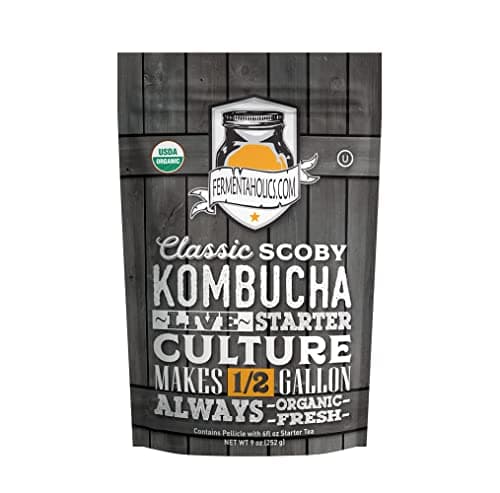
The starter tea figure is the one to get right. Fermentaholics publishes a ten percent rule and sells a culture with six ounces of starter for a half-gallon batch, which is 9.4 percent — the same ratio it ships against a gallon. That is what a correctly scaled culture looks like.
The picks
The half-gallon setup
A case of wide-mouth 64 oz jars, a culture dosed for exactly this batch size, and the instrument that matters more at small volumes than at large ones.
Score9.1no photo yet
Ball
Wide Mouth Glass Canning Jars, 64 oz (Case of 6)
The only jar on this site that publishes its mouth diameter — 3 inches inside — which is the one measurement a brewer with a pellicle to lift actually needs.
#ad No live price feed yet, so no number is shown rather than a stale one. How this is funded.
Fermentaholics
Organic Live Kombucha SCOBY, Half-Gallon Batch
The same organic culture line dosed for half a gallon — three quarters of a cup of starter tea with a pellicle, which is the right amount for a smaller jar.
A plain 64 oz wide-mouth canning jar is the honest answer here, and it is cheap enough that buying a case of them is not extravagant. Mason jars for kombucha goes through why the mouth matters more than the capacity: Ball publishes a three-inch inner mouth diameter on its wide-mouth line, which is one of the very few mouth measurements published anywhere in this category.
Buying a case rather than a single jar also sets up the thing small-batch brewers end up doing anyway, which is running two jars offset by a few days so there is always one finishing. Two half-gallon jars on a stagger produce the same drink as one gallon jar and keep it fresher.
What you do not want is a decorative jar with a narrow neck, or a lidded storage jar used as a fermenter. The first ferment needs air exchange through cloth, which is the argument made in full on covers and lids.
Two jars on a stagger
The move that makes small-batch brewing genuinely better than one big jar is running two of them offset, and it is the reason to buy a case rather than a single jar.
Start jar one. Three or four days later, start jar two. From then on, one jar is always further along than the other, and you bottle roughly every week instead of every fortnight. The total volume is the same as a gallon batch; what changes is that the drink reaches you in smaller, fresher instalments and you are never both out of kombucha and two weeks from having any.
It also removes the single biggest fragility of one-jar brewing. If one batch goes wrong — a stall, a mold scare, a forgotten jar that went to vinegar — the other jar is still running and still has a healthy culture in it. You are never one bad batch away from starting over, which is the position a single-jar brewer is always in.
The cost is counter space and a little bookkeeping. Two jars need labeling, because a jar started on Tuesday and a jar started on Friday look identical by day five. The wet-erase marker that ships with some kits exists for exactly this, and a strip of masking tape does the same job.
The one thing that gets harder
Thermal mass. A gallon of liquid takes a long time to change temperature; 64 ounces takes noticeably less. A cold night, a drafty windowsill or a door opening onto a winter hallway moves a half-gallon jar further and faster than it moves a gallon.
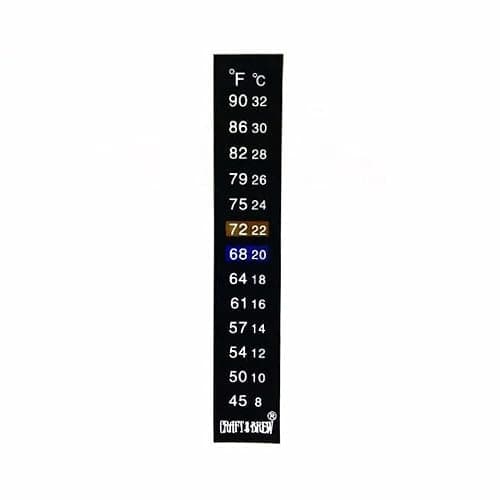
The practical consequence is not that small batches fail. It is that they are less forgiving of a spot you have not checked. An adhesive strip thermometer on the glass costs almost nothing and reads the liquid rather than the room, and brewing temperature explains why the distinction matters. If the reading sits below the band for most of the day, a heat mat with a thermostat is the fix, and a smaller jar needs a smaller one.
What it costs, and what it saves
In relative terms, because live figures are on the buy rows above.
A half-gallon setup is the cheapest genuine entry to brewing on this site: a case of plain canning jars costs less than most single brewing jars, the culture is the smallest one any of these makers sells, and you need about three bottles instead of seven. Against a full gallon kit it is a fraction of the outlay.
What it does not save is time. Two half-gallon batches take the same work as one gallon batch and more washing up. If your reason for brewing is volume per hour, brew a gallon. If it is having fresh kombucha you actually finish, the value question looks different at this scale, because the drink you throw away is the expensive part.
Scaling back up later
A culture grown in a half-gallon jar moves to a gallon jar without ceremony. The pellicle will be narrower than the new jar and that is cosmetic — a new one forms at the surface of the new vessel within a batch or two. What has to scale with the batch is the starter tea, so hold back proportionally more from the last small batch, or accept a slower start on the first big one.
Going the other way, a gallon brewer moving down has more starter tea than the new batch needs, which is the harmless direction to get it wrong. What size jar for kombucha covers the whole size question if you are still choosing.
Heads up: some links on this page are affiliate links. If you buy through one we may earn a commission at no extra cost to you. It never changes a ranking, and we take no payment for placement. The full version.
The short answer
Quick picks
Ranked on the published rubric. Every row jumps to that product's full write-up below; the button goes straight to Amazon.
#
Product
Best for
Score
Price
1
Score9.1
Ball
Wide Mouth Glass Canning Jars, 64 oz (Case of 6)
The only jar on this site that publishes its mouth diameter — 3 inches inside — which is the one measurement a brewer with a pellicle to lift actually needs.
The same organic culture line dosed for half a gallon — three quarters of a cup of starter tea with a pellicle, which is the right amount for a smaller jar.
#1 · A half-gallon batch you can get your hand into
Ball Wide Mouth Glass Canning Jars, 64 oz (Case of 6)
The only jar on this site that publishes its mouth diameter — 3 inches inside — which is the one measurement a brewer with a pellicle to lift actually needs.
Who it is for. A brewer running small or parallel batches, or anyone who wants a jar whose opening they can check against their own hand before ordering.
Published specifications
Capacity
64 oz (half gallon)
Mouth
Wide mouth. 3 in inner diameter, 3.5 in outer
Height
9.25 in without the lid, 9.375 in with it
Case quantity
6 jars
Included
Lids and bands, screwed onto the jars
Material
Glass. Stated FDA compliant and BPA free
Heat limit
Withstands temperatures up to 250 F
Thermal shock
“Withstands sudden 90° F temperature change”
Freezer
“Not freezer safe”
Markings
Graduated in cups, ounces and mL on the glass
Origin
Made in USA
Spigot
None. This is a jar, not a brewer.
Source: Ball Wide Mouth 64 oz glass canning jar specification as published by distributor Uline (item S-19404: capacity, 3 in inner and 3.5 in outer mouth diameter, 9.25 in and 9.375 in heights, case quantity, materials, 250 F limit, 90 F thermal shock, freezer guidance, graduated markings, origin), uline.com, retrieved 2026-09-06
Rubric — 9.1 / 10
Materials9/10 · weight 28%
Documentation10/10 · weight 22%
Capacity fit8/10 · weight 16%
Cleaning9/10 · weight 18%
Value9/10 · weight 16%
What it gets right
The 3-inch inner mouth is published, which almost no brewing jar states — it is the difference between lifting a pellicle out cleanly and fishing for it
Graduated markings on the glass mean the batch and the starter tea can be measured in the vessel rather than in a jug first
Six jars per case, so a SCOBY hotel, a half-gallon batch and a spare all arrive in one order
The published 90 F sudden-change tolerance is the number that matters when hot tea meets a cold jar
What it costs you
No spigot, so a half gallon has to be poured or siphoned, and pouring past a pellicle is awkward
Not freezer safe, per the published care guidance
A metal lid and band come with it, and neither belongs on a fermenting jar — you will use a cloth instead and store the lids
Half a gallon is a small batch. Two of these is more glass to clean than one gallon jar
Skip it if. You want a gallon or more per batch. Half-gallon jars multiply fast, and four of them is a worse experience than one two-gallon vessel.
#ad No live price feed yet, so no number is shown rather than a stale one. How this is funded.
#2 · A half-gallon trial batch
Fermentaholics Organic Live Kombucha SCOBY, Half-Gallon Batch
The same organic culture line dosed for half a gallon — three quarters of a cup of starter tea with a pellicle, which is the right amount for a smaller jar.
Who it is for. A cautious first-timer, or anyone testing whether they will actually drink the stuff before committing a gallon of tea.
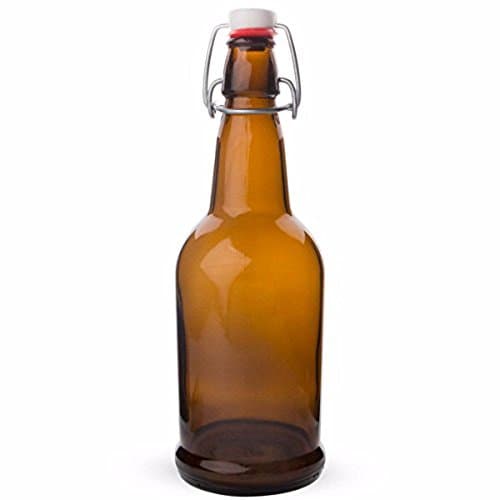
EZ Cap Swing Top Bottles, Amber Glass, 16 oz (Case of 12)
The only bottle here with a published pressure rating — 100 PSI — in amber glass, which is the combination a second ferment actually asks for.
Who it is for. Anyone doing a second ferment who wants a bottle with a number behind it rather than a shape that looks strong.
Published specifications
Capacity
16 oz
Glass color
Amber
Pressure rating
“Pressure rated to 100 PSI which means they can easily handle the carbonation of soda pop and hard seltzer”
Case quantity
12 bottles, includes 12 swing tops
Closure
Reusable swing top; also accepts a 26 mm pry-off crown cap
Maker’s note
“These swing tops are designed to be primarily sealed with a crown cap closure for long term storage.”
Dimensions
Not published
Source: MoreBeer published EZ Cap product specification (capacity, pressure rating, case contents, crown cap compatibility), morebeer.com/products/ez-cap-swing-top-bottles-amber-glass-16-oz-case-12, fetched 2026-09-01
Rubric — 8.3 / 10
Materials9/10 · weight 28%
Documentation9/10 · weight 22%
Capacity fit8/10 · weight 16%
Cleaning7/10 · weight 18%
Value8/10 · weight 16%
What it gets right
A published 100 PSI rating is the single most useful number in this whole category, and almost nobody publishes one
Amber glass blocks the light that degrades a bottle sitting out on a counter through a second ferment
The dual finish means you can crown-cap a batch you want to leave for months and swing-top the ones you will drink this week
16 oz is one serving, so a bottle gets opened once and drunk rather than losing its carbonation over three days
What it costs you
Swing-top gaskets perish, and a tired gasket is the commonest cause of a flat second ferment
No dimensions published, so fitting twelve of them on a fridge shelf is a measuring job when they arrive
Crown caps are sold separately if you want the long-storage option the maker recommends
Skip it if. You want to see the color of the finished drink. Amber hides it; the clear version of the same bottle does not.
Craft a Brew Fermometer Adhesive Strip Thermometer
A four-inch liquid crystal strip that sticks to the glass and reads the liquid rather than the air, which is the distinction that matters.
Who it is for. Every brewer. This is the cheapest way to stop guessing what temperature the batch is at.
Published specifications
Size
Approximately 0.75 x 4 in
Reads
Fahrenheit and Celsius
Application
External fermenter surface
Compatible surfaces
Glass, plastic and stainless steel fermenters
How it works
“changes color to display the current temperature of the fermenting liquid inside the vessel”
Temperature range
Not published by this maker. Comparable fermentation strips are sold in bands such as 46-82 F, 57-90 F and 46-93 F.
Accuracy
Not published
Sold as
A 5 pack on the Amazon listing; the maker's own store lists it as a single strip
Source: Craft a Brew published Fermometer specification (size, display units, compatible surfaces, operating principle), craftabrew.com/products/fermometer-adhesive-strip-thermometer, fetched 2026-09-01. Comparable-strip ranges from retailer listings, cited as comparisons only.
Rubric — 7.4 / 10
Materials7/10 · weight 28%
Documentation5/10 · weight 22%
Capacity fit8/10 · weight 16%
Cleaning8/10 · weight 18%
Value10/10 · weight 16%
What it gets right
It reads through the glass, so it tells you what the kombucha is at rather than what the shelf is at — those differ by several degrees on a sunny afternoon
It costs less than a cup of coffee and never needs a battery
It sticks to glass, plastic and stainless, so it moves with you if you change vessels
Always visible, which means you actually look at it
What it costs you
Neither range nor accuracy is published for this specific strip
Liquid crystal strips read in bands, so you get “about 76” rather than 76.2
The two listings disagree on whether it is reusable — the Amazon listing calls it reusable, the maker's own spec page says nothing about removing or reapplying it
Skip it if. You want a logged, numeric record. A strip is a glance, not a measurement you can write down with confidence.
Yes, and for one person it is often the better size. Use a wide-mouth 64 oz jar, about six to seven ounces of starter tea, and the same tea and sugar proportions scaled to half. The only practical difference is that a smaller volume changes temperature faster, so where the jar sits matters more.
How much starter tea for a half gallon of kombucha?+
About six to seven ounces, on the ten percent rule that Fermentaholics publishes and this site uses throughout. Its half-gallon culture ships six ounces, which is 9.4 percent of a 64 oz batch — the same ratio it ships against a gallon. That consistency is a good sign that the pour is measured rather than labeled.
Does a smaller batch of kombucha ferment faster?+
No. Fermentation time is driven by temperature and by how much starter tea went in, not by how much liquid is in the jar. A half-gallon batch still runs roughly 7 to 14 days. Expecting it to finish in half the time is the commonest way small-batch brewers pull a batch early and conclude it did not work.
What is the best jar for small batch kombucha?+
A plain wide-mouth 64 oz canning jar. The mouth is what matters, because the pellicle grows to the width of the vessel and your hand has to reach in past it. Ball publishes a three-inch inner mouth diameter on its wide-mouth line, which is one of very few mouth measurements published in this category. Skip spigots at this size.
Can I split a gallon SCOBY for a half gallon batch?+
You can physically, but it is the wrong purchase. Using half the starter liquid halves the acid protection on your first batch, which is exactly the margin a beginner needs. Sellers including Fermentaholics and The Kombucha Shop dose cultures for a half-gallon batch specifically; buy that instead.
How many bottles does a half gallon of kombucha fill?+
About three 16 oz bottles. A 64 oz batch minus roughly ten percent held back as starter tea leaves about 58 oz to bottle. That is one of the quiet advantages of brewing small: you do not need a case of bottles, and the ones you fill get drunk while they are still properly carbonated.
Is brewing small batches of kombucha cheaper?+
Per batch yes, per gallon no. A half-gallon setup has the lowest entry cost on this site — a case of plain canning jars, the smallest culture these makers sell and about three bottles instead of seven. But you use the same tea and sugar per unit of drink, and two half-gallon batches take more of your time and washing up than one gallon batch. The real saving is the kombucha you no longer pour away because it went sour at the back of the fridge.
Sources
Every specification cited on this page came from one of these documents, retrieved on the date shown against the product it belongs to.