Almost every answer to this online is written by someone selling a kit. Here is the arithmetic, the time cost, and the cases where the honest answer is no.
If you drink kombucha regularly, yes — decisively. The culture is free after the first purchase and reproduces itself, and the only recurring inputs are tea, sugar and water at a few cents a gallon. If you drink a bottle a month, no: the setup cost and the weekly attention are not repaid, and a shop bottle is the better purchase.
There are two costs, and only one of them repeats
The reason this question produces such wildly different answers is that people compare different things. Someone quoting the price of a starter kit is quoting a one-time cost. Someone quoting “pennies a glass” is quoting the recurring cost. Both are right, and the whole answer is in how those two relate.
What a home kombucha setup actually consumes, split by whether it repeats.
Item
One-time or recurring
Notes
The vessel
One-time
Glass does not wear out. Buy once, use for years
The culture
One-time
Reproduces every batch. You will be giving it away, not rebuying
Starter tea
One-time
After the first batch you reserve your own — about 10% of each batch
Bottles
One-time
Reusable indefinitely; swing-top gaskets are the only wear part
Tea
Recurring
A bag published at 22 gallons is about five months of weekly batches
Sugar
Recurring
One cup per gallon. Plain cane sugar, the cheapest input here
Water
Recurring
Filtered or treated if your supply is chloraminated
pH strips
Recurring, barely
100 strips per vial; about 52 a year at two tests a batch
Look at how short the recurring column is. Tea, sugar and water. That is the entire ongoing cost of a gallon of kombucha, and the published yields tell you how small it is: an eight-ounce tea pouch rated at twenty-two gallons plus a cup of sugar per gallon is a rounding error against the shelf price of a single bottle.
The culture is the part that changes the maths
This is what makes kombucha different from most make-it-yourself propositions. You are not buying an ingredient that gets consumed. You are buying an organism that reproduces.
Every batch grows a fresh pellicle, and the finished liquid becomes the starter tea for the next one — the published rule is about ten percent of batch volume held back, which the SCOBY page works through. Within two months the problem is not replacing the culture, it is finding somewhere to put the surplus, which is what a SCOBY hotel exists for.
So the culture is a one-time purchase that never needs repeating, and the starter tea line disappears from your costs entirely after batch one. Anyone quoting the price of a culture as a recurring cost has misunderstood the product.
The picks
What the one-time cost actually looks like
A complete kit if you own none of the pieces, the culture on its own if you already have a gallon jar, and the tea pouch that covers the next five months either way.
Fermentaholics
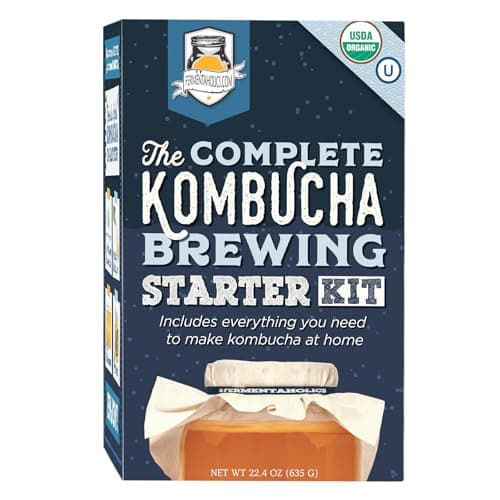
Complete Kombucha Brewing Starter Kit (1 Gallon)
Twelve fluid ounces of mature starter tea with the pellicle, measured against the maker’s own published ten percent rule — the fullest kit of the group.
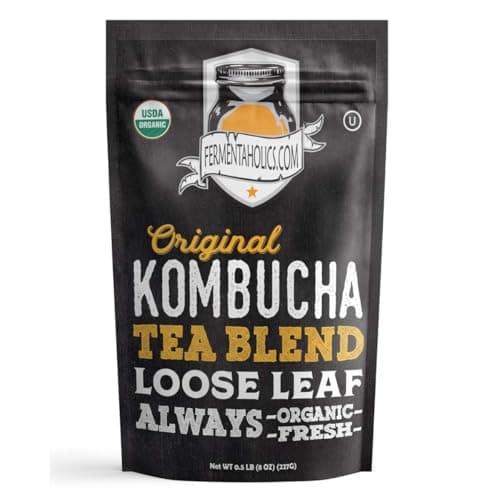
A black and green blend formulated for kombucha specifically, published at twenty-two gallons from an eight-ounce pouch — the best yield-per-dollar on this page.
Time is the real price, and it is not large — but it is regular, which is a different thing from small.
A gallon batch is about twenty minutes of actual work: brewing and cooling the tea, which is mostly waiting; adding the culture; then a fortnight of doing nothing; then twenty minutes bottling. Call it forty minutes a fortnight, plus a glance at the jar every few days.
The catch is that those forty minutes are not optional and cannot be deferred indefinitely. A batch left past its window keeps going and turns sour; bottles left warm keep building pressure. Home brewing suits people whose weeks have a rhythm and punishes people whose weeks do not.
Three cases where the answer is honestly no
You drink it occasionally. A gallon is roughly ten sixteen-ounce bottles arriving at once, every fortnight. If that is more than you will drink, you are not saving money, you are pouring kombucha away on a schedule.
You travel constantly. The first fermentation tolerates a missed week better than most ferments, but a bottled second ferment left warm does not, and a culture with nobody to feed it eventually needs rescuing. It is manageable; it is also one more thing to arrange.
You want a specific commercial flavor. Home kombucha tastes like home kombucha. It is sourer and less sweet than most shelf brands, which back-sweeten and filter. If a particular bottle is what you actually want, brewing your own is not the route to it.
There is a fourth case worth naming: if your kitchen sits below 70 F for months of the year, you will be adding a heat mat and a controller to the one-time column before the hobby works at all. That is not a reason not to brew, but it belongs in the arithmetic rather than arriving as a surprise in February.
What the cheap comparisons leave out
Two things get quietly omitted from most “pennies a glass” claims, and being straight about them is the point of this page.
The first is failure. Early batches go wrong — too cold, too little starter, forgotten for three weeks. Those are real gallons of tea and sugar that did not become a drink, and they land disproportionately in the first two months. Budget for a couple.
The second is that the equipment column expands. Almost nobody stops at a jar. Bottles arrive because the first batch has nowhere to go, a thermometer arrives because a batch stalled, a funnel arrives after the first spill. None of it is expensive and all of it is one-time, but the honest setup cost is higher than the kit price.
Set against that, the thing the comparisons also leave out on the other side: a gallon a fortnight is a lot of kombucha, and shop kombucha is not cheap. The break-even for a regular drinker arrives quickly. For an occasional one it never does.
What a gallon actually replaces
The comparison people want is against the thing they currently buy, so it is worth being concrete about volume rather than price.
A gallon is 128 fluid ounces. Hold back roughly ten percent as starter tea for the next batch and you have about 115 oz to bottle, which is seven 16 oz bottles or a little over three 32 oz ones. On a fortnightly cycle that is roughly three and a half bottles a week, indefinitely, from tea and sugar.
Set that against however many bottles of shop kombucha you currently buy in a fortnight. If the answer is seven or more, the arithmetic is not close — the recurring inputs are a fraction of an ounce of tea and a cup of sugar per gallon. If the answer is one or two, you are proposing to produce five times what you drink, and the surplus is not a saving.
This is why the honest answer depends so completely on consumption rather than on prices. The per-unit cost of home kombucha is low in essentially every scenario. Whether that matters depends entirely on the units you actually get through.
The costs that appear in month three
The first-purchase list is well documented. What nobody warns about is the second wave, and it is worth naming because it is where the real setup cost lands.
Bottles, immediately. No kit on this site includes them. The first batch finishes and has nowhere to go, which is how almost everyone discovers this — two weeks in, needing them the same day.
A second jar, by month two. One brewing, one for the surplus culture. A SCOBY hotel is not optional so much as inevitable, because the culture reproduces whether or not you have a plan for it.
A thermometer, after the first stalled batch. Cheap, and nobody buys it until a batch has already sat for three weeks tasting like sweet tea.
Heat, if you brew through a cold season. A mat and a controller are the largest single addition, and they are bought as a pair or not at all.
None of it is expensive and all of it is one-time. But an honest setup cost is the kit plus bottles plus a second jar plus a thermometer, not the kit alone — and a comparison that quotes only the kit is understating the first month by a good margin.
The surplus is part of the value
One return on this hobby never shows up in a cost comparison: within a couple of months you have more culture than you can use, and a culture is a thing other people want.
Every batch grows a fresh pellicle and the hotel fills faster than anyone expects. That surplus is how most people get started in the first place — a jar handed over by someone who had too many — and passing one on costs you nothing you were going to use. It is worth weighing against the setup cost, because you are not only buying a drink, you are buying something that keeps producing more of itself than you need.
The practical version: keep a spare jar as a hotel from month one, and you will always have a culture ready for a friend, a replacement if a batch goes wrong, and a backup if you ever want to run two ferments at once.
Heads up: some links on this page are affiliate links. If you buy through one we may earn a commission at no extra cost to you. It never changes a ranking, and we take no payment for placement. The full version.
The short answer
Quick picks
Ranked on the published rubric. Every row jumps to that product's full write-up below; the button goes straight to Amazon.
#
Product
Best for
Score
Price
1
Fermentaholics
Complete Kombucha Brewing Starter Kit (1 Gallon)
Twelve fluid ounces of mature starter tea with the pellicle, measured against the maker’s own published ten percent rule — the fullest kit of the group.
A black and green blend formulated for kombucha specifically, published at twenty-two gallons from an eight-ounce pouch — the best yield-per-dollar on this page.
The only kit here that ships pH strips, a pipette and a temperature gauge in the box, which is the difference between brewing kombucha and guessing at it.
Twelve fluid ounces of mature starter tea with the pellicle, measured against the maker’s own published ten percent rule — the fullest kit of the group.
Who it is for. Someone who wants the culture to be the strongest part of the kit rather than the jar.
Published specifications
Batch size
1 gallon
Culture
Kombucha starter culture: pellicle plus 12 fl oz of mature starter tea, measured for a 1-gallon batch
Jar
1-gallon brew jar
Tea and sugar
Tea blend, organic cane sugar, reusable cotton tea bag
Measurement gear
Adhesive thermometer, pH strips, pipette
Cover
Cotton cloth cover and rubber band
Certification
USDA Certified Organic; also stated Kosher, Non-GMO and vegan
Starter tea ingredients
Organic cane sugar, filtered water, organic black tea, live cultures
Documentation
Detailed instructions and a flavoring guide
Source: Fermentaholics published kit contents and culture specification, fermentaholics.com/product/the-complete-kombucha-brewing-starter-kit/, retrieved 2026-09-01
Rubric — 8.0 / 10
Materials8/10 · weight 28%
Documentation9/10 · weight 22%
Capacity fit8/10 · weight 16%
Cleaning7/10 · weight 18%
Value8/10 · weight 16%
What it gets right
12 fl oz against a 128 oz gallon is 9.4 percent, within a rounding error of the maker’s own 10 percent rule — the quantity matches the instruction
Both instruments a first batch needs, thermometer and pH strips, are in the box
The starter tea’s ingredients are published, which almost no culture seller does
USDA Organic, Kosher, Non-GMO and vegan claims are all stated together rather than implied
What it costs you
No jar dimensions published
The jar is plain glass with no volume markers, so the 10 percent reserve is a judgment call
Nothing in the kit addresses bottling — you finish the batch with nowhere to put it
Skip it if. You want to bottle at the end of week one. Nothing here holds pressure; budget for swing-top bottles at the same time.
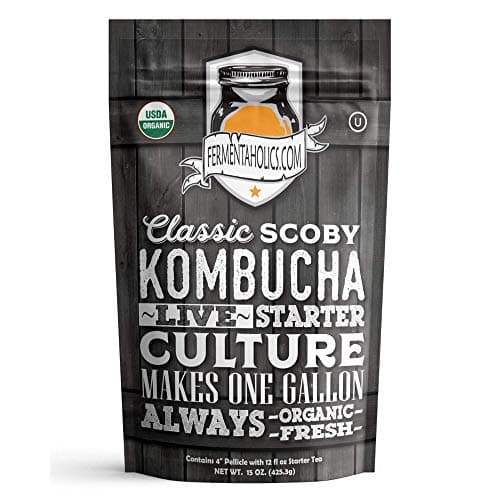
Fermentaholics Organic Kombucha SCOBY with 12 fl oz Starter Tea
A hand-selected pellicle with twelve fluid ounces of mature starter tea, measured against the maker’s own published ten percent rule for a gallon.
Who it is for. Anyone starting a standard one-gallon batch who wants the starter tea measured for them.
Published specifications
Batch size
One gallon
Starter tea volume
12 fl oz of mature, active starter tea
Pellicle
Hand-selected
Starter tea ingredients
Organic cane sugar, filtered water, organic black tea, live cultures
Certification
USDA Certified Organic, Kosher, Non-GMO, vegan
Production
Grown in the maker’s licensed lab
Maker’s dosing rule
“the rule of thumb is to use 10% starter tea per batch size”
Source: Fermentaholics published SCOBY specification (12 fl oz starter tea, 1-gallon dosing, ingredients, certifications) and its published 10 percent starter rule, retrieved 2026-09-01
Rubric — 8.5 / 10
Materials9/10 · weight 28%
Documentation9/10 · weight 22%
Capacity fit8/10 · weight 16%
Cleaning8/10 · weight 18%
Value8/10 · weight 16%
What it gets right
12 fl oz against a 128 oz gallon is 9.4 percent, within a rounding error of the maker’s own 10 percent rule — the quantity matches the instruction
Starter tea is the part that actually acidifies a new batch and protects it from mold; the pellicle is mostly a raft
Ingredients of the starter tea are published, which almost no culture seller does
Certified organic, kosher, non-GMO and vegan are stated together
What it costs you
A live culture in transit is a live culture in transit — heat and delay are real risks nobody controls
No stated shelf life once it arrives
You still need tea, sugar and a jar
Skip it if. You are brewing half a gallon. Buy the half-gallon version instead; a gallon’s worth of starter in a half-gallon batch drives the acidity too far, too fast.
A black and green blend formulated for kombucha specifically, published at twenty-two gallons from an eight-ounce pouch — the best yield-per-dollar on this page.
Who it is for. Anyone who wants the tea question settled cheaply and permanently, and who would rather spend attention on temperature and timing.
Published specifications
Blend
Organic black and green tea, loose leaf
Weight
8 oz
Published yield
“Makes 22 Gallons of Kombucha”
Certification
USDA Certified Organic, OU Kosher
Formulation claim
“Specially Formulated to Keep Your Culture Happy and Nourished” — “a Balanced Diet For Active Yeast and Bacteria”
Instructions
“Easy to Follow Kombucha Brewing Instructions printed on the resealable pouch”
Packaging
Resealable pouch
Shipped weight
0.5 lb
Source: Fermentaholics published Organic Kombucha Tea Blend listing (organic black and green loose leaf, 8 oz, stated 22 gallon yield, USDA Organic and OU Kosher, instructions printed on the resealable pouch, 0.5 lb shipped weight), Amazon B07664WTY9, retrieved 2026-09-13
Rubric — 8.6 / 10
Materials9/10 · weight 28%
Documentation9/10 · weight 22%
Capacity fit9/10 · weight 16%
Cleaning7/10 · weight 18%
Value9/10 · weight 16%
What it gets right
Twenty-two gallons from one eight-ounce pouch is roughly five months of weekly gallon batches, which makes the cost per batch trivial
A black-and-green blend is the safe default: black feeds the culture reliably, green lightens the result, and you are not choosing between them
Brewing instructions printed on the pouch itself means the ratio survives after the box is thrown away
USDA Organic and OU Kosher are both stated, and the maker is the same licensed operation behind the cultures on this site
What it costs you
The blend ratio is not published — you know it is black and green, not how much of each
No origin or grade is stated for either leaf, so you are buying the maker’s formulation rather than a named tea
Loose leaf means you need a strainer, a bag or a funnel with a mesh insert at brew time
One flavor direction. If you want to taste a specific single-origin leaf in the finished drink, a blend is the wrong purchase
Skip it if. You want to control the leaf yourself. A blend formulated for you is the opposite of that, and a single-origin black tea is the page to buy instead.
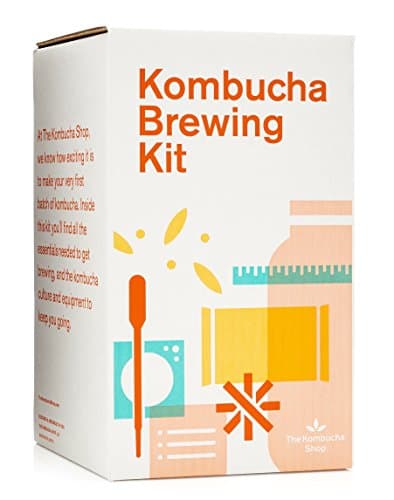
The only kit here that ships pH strips, a pipette and a temperature gauge in the box, which is the difference between brewing kombucha and guessing at it.
Who it is for. Someone brewing their first batch who wants the measurement gear included rather than ordered separately three days in.
Published specifications
Batch size
1 gallon
Jar
One Gallon Brew Jar with plastic lid, thick American glass, screen-printed Brew Notes on the side
Culture
Organic kombucha culture plus 1 cup liquid starter
Culture aging
Stated to ferment for a minimum of 6 weeks before shipping
Tea
Organic loose leaf black and oolong, with a reusable cotton tea bag
Measurement gear
pH test strips, pipette, temperature gauge, wet-erase marker
Cover
Cotton cover and rubber band
Certification
USDA Organic Certified
Spigot
None. The jar takes a plastic lid, not a tap.
Source: The Kombucha Shop published kit contents and product description, thekombuchashop.com/products/kombucha-brewing-kit, fetched 2026-09-01
Rubric — 7.4 / 10
Materials8/10 · weight 28%
Documentation7/10 · weight 22%
Capacity fit8/10 · weight 16%
Cleaning7/10 · weight 18%
Value7/10 · weight 16%
What it gets right
pH strips and a pipette in the box mean you can answer “is this safe yet” on day three instead of guessing
The culture is stated to ferment a minimum of six weeks before it ships, which is a long lead time and shows in how fast a first batch takes off
Brew Notes screen-printed on the glass keep the start date on the jar rather than on a sticky note
USDA Organic certification covers the tea, sugar and culture together
What it costs you
No jar dimensions are published anywhere, so you cannot check it against a shelf before ordering
No spigot, so bottling means lifting a full gallon and siphoning or pouring
The most expensive of the four kits here, and some of that is the marker
Skip it if. You already own a gallon jar. You are paying for glass you have, and a culture-plus-ingredients pack costs far less.
For a regular drinker, yes and by a wide margin. After the one-time cost of a vessel and a culture, the only recurring inputs are tea, sugar and water — an eight-ounce tea pouch published at 22 gallons covers about five months of weekly batches. For someone who drinks a bottle a month, the setup is never repaid.
How much does it cost to make kombucha at home?+
Split it into one-time and recurring. One-time: a gallon vessel, a culture with starter tea, bottles, and cheap instruments. Recurring: tea, sugar and water per batch. This site does not quote figures in prose because prices move; every buy button shows the live price instead.
Do I have to keep buying a new SCOBY?+
No. The culture reproduces — every batch grows a fresh pellicle, and you reserve roughly ten percent of the finished liquid as starter tea for the next batch. Within a couple of months the problem is surplus culture, not replacement, which is what a SCOBY hotel is for.
How much time does brewing kombucha take?+
About twenty minutes to start a gallon batch, a fortnight of waiting, and about twenty minutes to bottle it — roughly forty minutes a fortnight, plus a glance at the jar every few days. The work is small but it is regular, and a batch left past its window goes sour.
Is homemade kombucha better than store bought?+
It is different rather than strictly better. Home kombucha is typically sourer and less sweet, because most commercial brands back-sweeten and filter. You control the tea, the sugar and the flavoring, and you can brew far more of it — but if a specific commercial flavor is what you want, brewing your own will not reproduce it.
Sources
Every specification cited on this page came from one of these documents, retrieved on the date shown against the product it belongs to.