Every page on this site tells you to use true tea and stops there. This is the one that tells you which bag to put in the cart, and how many gallons it actually makes.
Buy a loose leaf blend sold for kombucha and judge it on published gallons per bag, not on weight. A black-and-green blend is the forgiving default; oolong rounds the finish; gunpowder green is the leaf for jun. Whatever you buy, it has to be true tea — Camellia sinensis — because herbal infusions do not feed the culture.
What actually separates one kombucha tea from another
Tea is the cheapest input in this hobby and the one people agonize over most. The agonizing is misplaced: almost any true tea works. What differs is how much you get, how predictable it is, and whether the bag tells you anything useful before you buy it.
Published yield, in gallons. The single most useful figure and the one that makes price comparable. Weight tells you nothing on its own, because stronger leaf needs less of it. A bag that says “makes 22 gallons” has done the arithmetic for you.
Blend or single leaf. A blend formulated for kombucha is a decision somebody else made on your behalf, which is either convenient or limiting depending on how much you care. A named single style — gunpowder green, Assam — is repeatable anywhere.
Certification, and what it covers. Organic matters more here than in a teacup, because the leaf steeps hard and then sits with a live culture for two weeks. USDA Organic and kosher marks are cheap signals that someone audited the supply.
What the seller is willing to say about the leaf. Most say nothing. A seller who names regions, or names the tea style, is giving you something you can check and repeat.
What is deliberately not on that list: flavor notes. We have not brewed with any of these, and a tasting note we did not earn is worth nothing. The rubric is published with its weights, and every figure below is the seller's own.
The yields, side by side
This is the table that makes the category comparable. Every number is published on the product listing.
Published yield and certification, compiled 2026-09-13. A blank means the seller publishes nothing on the subject.
Tea
Weight
Published yield
Certification
Fermentaholics blend
8 oz
22 gallons
USDA Organic, OU Kosher
Kombucha.com black blend
8 oz
Up to 25 gallons
100% USDA Organic
Fermentaholics gunpowder green
4 oz
11 gallons
USDA Organic, OU Kosher
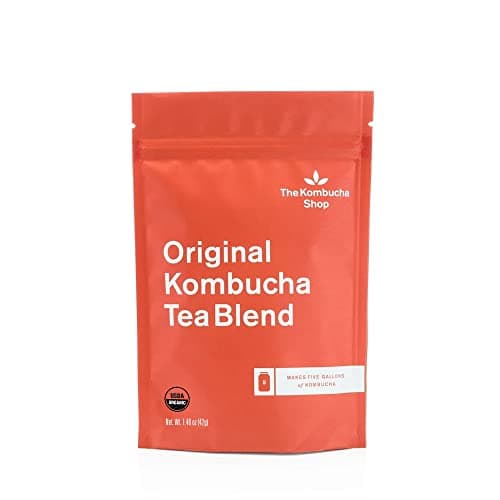
The Kombucha Shop Original
Not published
5 gallons
Organic
Read the first two rows together. Twenty-two and twenty-five gallons from half a pound are close enough that the choice between them is about what is in the blend, not about value. Both are the better part of half a year of weekly gallon batches, which is why tea is the input nobody should be optimizing.
The last row is the outlier and it is worth being plain about it: a five-gallon bag with no published weight is the most expensive way to buy tea on this page. It earns its place as a small, low-commitment way to taste an oolong blend, not as a standing supply.
Blend, or a leaf you can name
Kombucha teas split into two camps and the split is more meaningful than the branding suggests.
A blend is formulated for the culture. Fermentaholics describes its blend as “specially formulated to keep your culture happy and nourished” and as “a balanced diet for active yeast and bacteria”. That is a claim about nutrition rather than taste, and it is the honest reason blends exist: black tea feeds the culture reliably, green lightens the result, and a blend gets both without you choosing.
A named leaf — gunpowder green, a single-origin black — is repeatable. You can buy the same style from anyone, you know what you are tasting, and if a batch is good you can reproduce it. The cost is that you are now responsible for whether the leaf suits the culture, which for any true tea it almost certainly does.
Neither is better. Blends suit people who want tea to be a solved problem; named leaves suit people for whom the tea is part of the point.
The picks
The three we would actually order
A blend that publishes 22 gallons from eight ounces, a black blend that says where the leaf comes from, and the gunpowder green that jun actually wants.
Fermentaholics
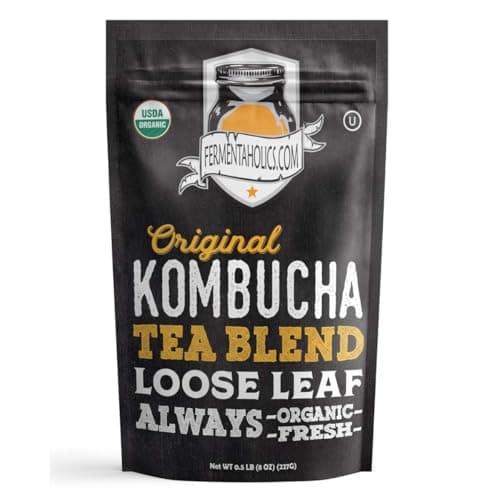
Organic Kombucha Tea Blend, 8 oz
A black and green blend formulated for kombucha specifically, published at twenty-two gallons from an eight-ounce pouch — the best yield-per-dollar on this page.
This is where batches die, and it is entirely avoidable. Tea and sugar covers the botany; the short version is that kombucha needs Camellia sinensis, and a great many things sold as “tea” are not that plant at all.
Herbal infusions. Rooibos, chamomile, peppermint, hibiscus. They are not tea, they do not carry what the culture feeds on, and a batch brewed on them will stall or weaken the culture over successive rounds.
Flavored and oiled teas. Earl Grey is the famous trap. The bergamot oil is antimicrobial, and oils in general foul a culture and coat the pellicle. Flavor belongs in the second ferment, where it cannot hurt anything.
Anything with added sweetener or fruit pieces. You are controlling the sugar deliberately; a tea that brings its own defeats the point.
Decaffeinated tea, with a caveat. It works and the culture will ferment it, but decaffeinated leaf is a weaker feedstock and cultures kept on it long term are widely reported to lose vigor. The caffeine page has the published figures and the honest limits.
How much leaf a gallon actually takes
The published working ratio across this site is two tablespoons of loose leaf, or four to six tea bags, per gallon of finished tea, with one cup of sugar. That is the number the continuous-brew guidance uses and it is the one the yields above are built on.
It is worth doing the arithmetic once. An eight-ounce bag rated at twenty-two gallons is being dosed at roughly a third of an ounce per gallon, which lines up with two tablespoons of most loose leaf. If a bag's stated yield implies far less leaf than that, the seller is being optimistic; if it implies far more, you are buying a weaker blend.
Steep it hot and steep it hard — this is not a delicate cup, it is a feedstock. Then cool it to room temperature before the culture goes anywhere near it, which the brewing method covers in order.
Storing it so the second bag is as good as the first
Loose leaf goes stale by oxidation, light and moisture, in roughly that order. A bag rated for twenty-two gallons is nearly half a year of brewing, which means storage genuinely matters — you are keeping this tea longer than most people keep any tea.
Resealable is the feature to want, and the Fermentaholics pouch publishes both a resealable closure and brewing instructions printed on the bag, which is the detail that survives after the box is gone. Keep it out of the light, away from the stove, and do not decant it into something decorative and clear.
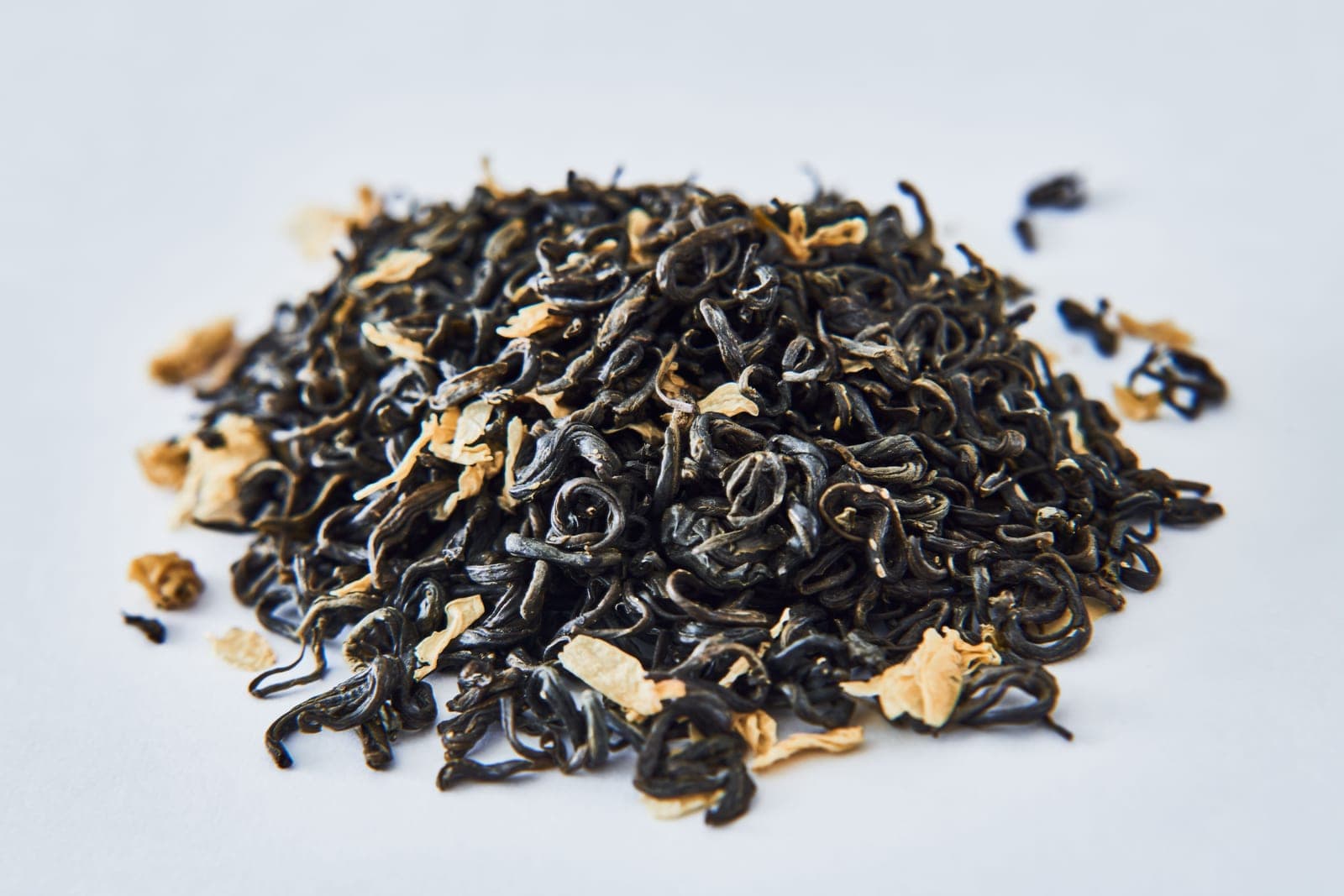
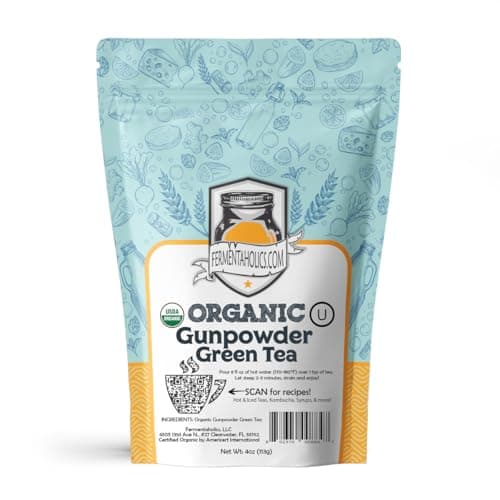
Rolled teas like gunpowder green keep noticeably better than open-leaf styles, because less surface is exposed. That is a real reason to prefer it if you brew infrequently and a bag will sit for months between batches.
Loose leaf, bags, or the reusable middle
Every tea on this page is loose leaf, and that is deliberate rather than incidental. It is cheaper per gallon, it steeps harder because the leaf can move, and it is how tea sold for fermentation is almost always packaged.
Bagged tea works perfectly well and nobody should feel they are doing it wrong. Four to six standard bags per gallon is the published working ratio, and the convenience is real: nothing to strain, nothing to fish out, no mesh to clean. The costs are that you pay more per gallon, you have less control over strength, and some bag materials are bleached or sealed with adhesives you have no information about.
The middle ground is a reusable cotton bag or a large infuser, which several kits include for exactly this reason. You get loose-leaf economy with bagged-tea convenience, and the only cost is rinsing the bag. If you are buying a pound of loose leaf, buy one of these at the same time — it removes the single most annoying part of brew day.
What each type does to the finished drink
All four true-tea types ferment. They do not produce the same drink, and the differences are consistent enough to plan around.
How the four true-tea types behave in a kombucha ferment. Published dry-leaf caffeine figures are from Cultures for Health.
Tea
Dry-leaf caffeine
In the finished kombucha
Black
28.54 mg/g
Robust, tannic, the classic profile. Feeds the culture reliably
Green
34.86 mg/g
Lighter and grassier. Ferments a little faster
White
27.17 mg/g
Delicate and easily lost. Expensive for a feedstock
Oolong
19.67 mg/g
Between black and green, rounder and less tannic
Black is the default for a reason that has nothing to do with taste: it is the most reliable feedstock, and a culture kept exclusively on green or white tea over many batches is widely reported to weaken. A blend that is mostly black with green in it gets the lighter finish without that risk, which is why the blends exist and why they are the sensible default.
The caffeine column surprises people — green has the highest published dry-leaf figure of the four, and oolong the lowest. The caffeine page works through why green tea's gentle reputation comes from how it is usually steeped rather than from the leaf.
Heads up: some links on this page are affiliate links. If you buy through one we may earn a commission at no extra cost to you. It never changes a ranking, and we take no payment for placement. The full version.
The short answer
Quick picks
Ranked on the published rubric. Every row jumps to that product's full write-up below; the button goes straight to Amazon.
#
Product
Best for
Score
Price
1
Fermentaholics
Organic Kombucha Tea Blend, 8 oz
A black and green blend formulated for kombucha specifically, published at twenty-two gallons from an eight-ounce pouch — the best yield-per-dollar on this page.
The only kit here that ships pH strips, a pipette and a temperature gauge in the box, which is the difference between brewing kombucha and guessing at it.
A black and green blend formulated for kombucha specifically, published at twenty-two gallons from an eight-ounce pouch — the best yield-per-dollar on this page.
Who it is for. Anyone who wants the tea question settled cheaply and permanently, and who would rather spend attention on temperature and timing.
Published specifications
Blend
Organic black and green tea, loose leaf
Weight
8 oz
Published yield
“Makes 22 Gallons of Kombucha”
Certification
USDA Certified Organic, OU Kosher
Formulation claim
“Specially Formulated to Keep Your Culture Happy and Nourished” — “a Balanced Diet For Active Yeast and Bacteria”
Instructions
“Easy to Follow Kombucha Brewing Instructions printed on the resealable pouch”
Packaging
Resealable pouch
Shipped weight
0.5 lb
Source: Fermentaholics published Organic Kombucha Tea Blend listing (organic black and green loose leaf, 8 oz, stated 22 gallon yield, USDA Organic and OU Kosher, instructions printed on the resealable pouch, 0.5 lb shipped weight), Amazon B07664WTY9, retrieved 2026-09-13
Rubric — 8.6 / 10
Materials9/10 · weight 28%
Documentation9/10 · weight 22%
Capacity fit9/10 · weight 16%
Cleaning7/10 · weight 18%
Value9/10 · weight 16%
What it gets right
Twenty-two gallons from one eight-ounce pouch is roughly five months of weekly gallon batches, which makes the cost per batch trivial
A black-and-green blend is the safe default: black feeds the culture reliably, green lightens the result, and you are not choosing between them
Brewing instructions printed on the pouch itself means the ratio survives after the box is thrown away
USDA Organic and OU Kosher are both stated, and the maker is the same licensed operation behind the cultures on this site
What it costs you
The blend ratio is not published — you know it is black and green, not how much of each
No origin or grade is stated for either leaf, so you are buying the maker’s formulation rather than a named tea
Loose leaf means you need a strainer, a bag or a funnel with a mesh insert at brew time
One flavor direction. If you want to taste a specific single-origin leaf in the finished drink, a blend is the wrong purchase
Skip it if. You want to control the leaf yourself. A blend formulated for you is the opposite of that, and a single-origin black tea is the page to buy instead.
#2 · A blend that states where the leaf comes from
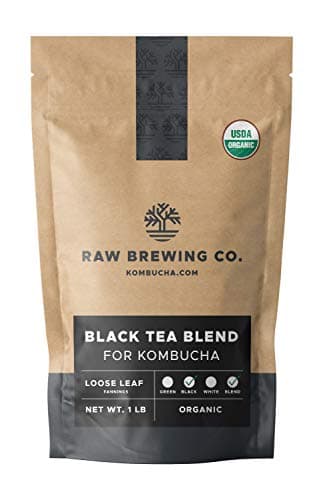
Raw Brewing Company Kombucha.com Organic Black Tea Blend, 8 oz
A black blend sourced from named regions and packed in-house, published at up to twenty-five gallons from half a pound.
Who it is for. A brewer who wants a black-forward kombucha and prefers a seller willing to say something about provenance.
Published specifications
Blend
Organic black tea blend, loose leaf
Weight
8 oz
Published yield
“Makes up to 25 gallons”
Certification
“100% USDA ORGANIC”
Sourcing
“organic teas from family farms in Asia, Africa & South America, import them directly, then blend and package them in-house”
Package dimensions
7 x 5 in
Brand note
Sold under the Kombucha.com label by Raw Brewing Company
Source: Raw Brewing Company published Kombucha.com Organic Loose Leaf Tea listing (organic black tea blend, 8 oz, stated up to 25 gallon yield, USDA Organic, direct-import sourcing statement, 7 x 5 in package), Amazon B09YS635HV, retrieved 2026-09-13
Rubric — 8.3 / 10
Materials9/10 · weight 28%
Documentation8/10 · weight 22%
Capacity fit9/10 · weight 16%
Cleaning7/10 · weight 18%
Value8/10 · weight 16%
What it gets right
The only tea here that says anything about where the leaf actually comes from — three named continents and direct import rather than an unnamed blend
Twenty-five gallons from eight ounces is the highest published yield per ounce on this page
Blended and packed in-house, which means one operation is accountable for what is in the pouch
Package dimensions are published, which sounds trivial until you are fitting it in a cupboard with the rest of the kit
What it costs you
The sourcing claim names continents, not estates or grades, so it is a step above silence and well short of a specification
The marketing leans on claims about growing “healthier scobys” that no published test supports, and we are not repeating them as fact
Black only. If you want a green or a blend you are buying a different bag from the same line
Loose leaf, so a strainer or a mesh funnel is assumed
Skip it if. You are buying on yield per dollar alone. The Fermentaholics blend is close on gallons and simpler to reason about.
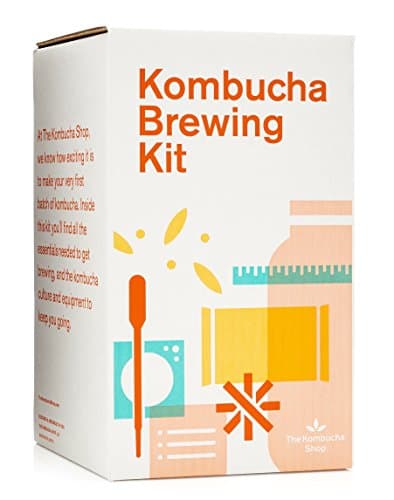
The only kit here that ships pH strips, a pipette and a temperature gauge in the box, which is the difference between brewing kombucha and guessing at it.
Who it is for. Someone brewing their first batch who wants the measurement gear included rather than ordered separately three days in.
Published specifications
Batch size
1 gallon
Jar
One Gallon Brew Jar with plastic lid, thick American glass, screen-printed Brew Notes on the side
Culture
Organic kombucha culture plus 1 cup liquid starter
Culture aging
Stated to ferment for a minimum of 6 weeks before shipping
Tea
Organic loose leaf black and oolong, with a reusable cotton tea bag
Measurement gear
pH test strips, pipette, temperature gauge, wet-erase marker
Cover
Cotton cover and rubber band
Certification
USDA Organic Certified
Spigot
None. The jar takes a plastic lid, not a tap.
Source: The Kombucha Shop published kit contents and product description, thekombuchashop.com/products/kombucha-brewing-kit, fetched 2026-09-01
Rubric — 7.4 / 10
Materials8/10 · weight 28%
Documentation7/10 · weight 22%
Capacity fit8/10 · weight 16%
Cleaning7/10 · weight 18%
Value7/10 · weight 16%
What it gets right
pH strips and a pipette in the box mean you can answer “is this safe yet” on day three instead of guessing
The culture is stated to ferment a minimum of six weeks before it ships, which is a long lead time and shows in how fast a first batch takes off
Brew Notes screen-printed on the glass keep the start date on the jar rather than on a sticky note
USDA Organic certification covers the tea, sugar and culture together
What it costs you
No jar dimensions are published anywhere, so you cannot check it against a shelf before ordering
No spigot, so bottling means lifting a full gallon and siphoning or pouring
The most expensive of the four kits here, and some of that is the marker
Skip it if. You already own a gallon jar. You are paying for glass you have, and a culture-plus-ingredients pack costs far less.
A loose leaf blend sold for kombucha, judged on published gallons per bag. A black-and-green blend is the most forgiving default — black feeds the culture reliably and green lightens the result. For jun, which ferments green tea and honey, a gunpowder green is the correct leaf.
Can I use herbal tea for kombucha?+
No. Kombucha needs true tea — Camellia sinensis. Rooibos, chamomile, peppermint and hibiscus are infusions of other plants and do not carry what the culture feeds on. A batch brewed on them stalls, and a culture kept on them weakens over successive rounds.
Can I use Earl Grey for kombucha?+
It is the classic mistake. Earl Grey is black tea with bergamot oil, and bergamot is antimicrobial — oils in general foul a culture and coat the pellicle. Use plain true tea for the first fermentation and add flavor in the second, where it cannot damage anything.
How much tea do I need per gallon of kombucha?+
Roughly two tablespoons of loose leaf, or four to six tea bags, per gallon, along with one cup of sugar. That ratio is what the published bag yields are calculated from: an eight-ounce bag rated at 22 gallons works out to about a third of an ounce per gallon.
Is loose leaf better than tea bags for kombucha?+
It is cheaper per gallon and steeps harder, which suits a feedstock rather than a delicate cup. The trade-off is that loose leaf has to be strained back out before the culture goes in, so you need a mesh funnel, a reusable cotton bag or a fine sieve.
Sources
Every specification cited on this page came from one of these documents, retrieved on the date shown against the product it belongs to.