Yes, and less than the tea it started as. How much less is genuinely unsettled — the published studies disagree, and this page says so rather than picking one.
By Scooter M.·Published September 6, 2026 · Updated September 13, 2026
The short answer
Yes. Kombucha is brewed from tea, and tea contains caffeine. Cultures for Health publishes roughly 1 to 2 mg per ounce — about 10 to 15 mg per 8 fl oz, or 3 to 6 mg per 100 ml — against about 95 mg in a cup of coffee. Health-Ade publishes 8 to 15 mg per serving for its own bottles. If you need zero caffeine, brew something that is not made of tea.
The published figures
Caffeine in kombucha is one of the few areas where several makers publish actual numbers, which is useful, and where the research is genuinely unsettled, which is worth being honest about.
Published caffeine figures, compiled 2026-09-06. Each is the figure its own publisher states.
Source
Published figure
Cultures for Health — kombucha
About 1-2 mg per ounce (about 10-15 mg per 8 fl oz)
Cultures for Health — kombucha, metric
Typically 3-6 mg per 100 ml
Health-Ade — its own bottles
“anywhere between 8mg-15mg of caffeine per serving depending on the flavor”
Cultures for Health — coffee comparison
Around 11-12 mg per fl oz (95 mg per 8 fl oz)
Cultures for Health — versus black tea
“one-third the amount of caffeine as one cup of black tea”
Those numbers agree with each other closely enough to be useful. A glass of kombucha carries roughly a tenth of the caffeine of a cup of coffee, and roughly a third of a cup of black tea. That is low, and for most people it is low enough not to matter — but it is not zero, and no home brewer should tell a caffeine-sensitive guest otherwise.
It all comes from the leaf you chose
Kombucha does not produce caffeine. Every milligram in the finished drink came in with the tea, which means the strongest lever a home brewer has is the leaf, not the ferment.
Published caffeine content of raw tea leaf by type, per Cultures for Health. These are dry-leaf figures, not brewed-cup figures.
Tea
Caffeine per gram of dry leaf
Green
34.86 mg/g
Black
28.54 mg/g
White
27.17 mg/g
Oolong
19.67 mg/g
That table surprises people, because green tea has a folk reputation as the low-caffeine option and the published dry-leaf figure is the highest of the four. The reputation comes from brewing practice rather than chemistry — green tea is usually steeped cooler and shorter than black, so less of the caffeine ends up in the cup.
For kombucha that distinction matters less than usual, because a kombucha brew steeps hard — a strong tea for a gallon, extracted thoroughly. You are closer to the dry-leaf ceiling than a casual cup would be. Oolong is the genuinely lower-caffeine option here, and it is a good kombucha tea in its own right.
What fermentation removes, and why nobody can tell you exactly
The yeast and bacteria consume some caffeine over the course of a ferment. How much is where the honest answer stops being a number.
Cultures for Health cites conflicting research directly: some studies found “a decrease in caffeine content by 40% after three weeks”, while others found “a reduction of caffeine by 25% during the first 14 days”. Health-Ade publishes a rule of thumb that “about ⅓ of the caffeine remains”, which would imply a far larger reduction than either study.
Those three positions cannot all be right, and this page is not going to pick one and present it as fact. What can be said with confidence is the direction and the rough magnitude: fermentation reduces caffeine, the reduction is real but partial, and the finished drink lands in the 10-to-15 mg per 8 oz range that several independent publishers agree on. Anyone quoting a precise percentage is quoting one study and ignoring another.
The picks
Tea you can choose, or no tea at all
Two kits that include the tea, so you know what went in — and the culture to buy instead if the answer needs to be zero caffeine.
The Kombucha Shop
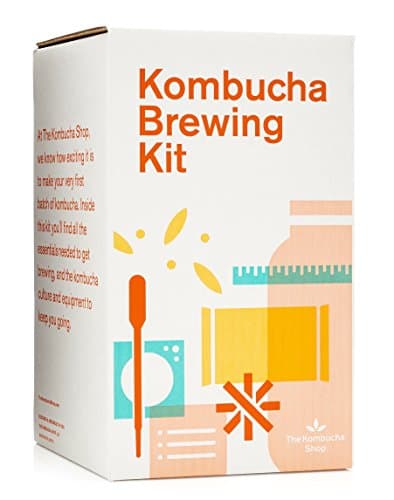
Kombucha Brewing Kit (1 Gallon)
The only kit here that ships pH strips, a pipette and a temperature gauge in the box, which is the difference between brewing kombucha and guessing at it.
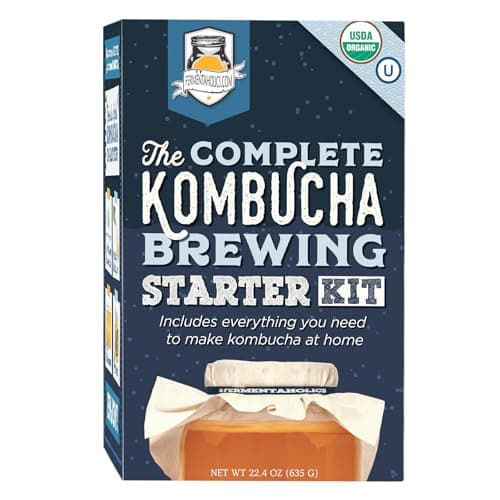
Twelve fluid ounces of mature starter tea with the pellicle, measured against the maker’s own published ten percent rule — the fullest kit of the group.
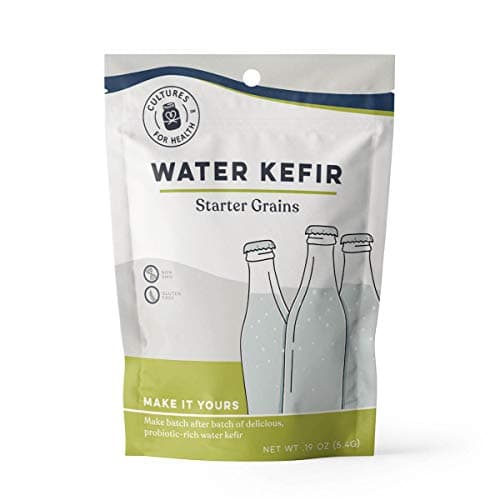
Two teaspoons of dehydrated grains that rehydrate to three or four tablespoons and then turn out two to three quarts every 24 to 48 hours, indefinitely.
Choose oolong. The lowest published dry-leaf figure of the four common types, and a perfectly good kombucha tea.
Ferment longer. Both cited studies point the same direction, so a longer ferment leaves less caffeine. It also leaves less sugar and more acid, so this is a trade against a batch that goes too sour, not a free win.
Drink smaller servings. The published figures are per 8 fl oz. A four-ounce glass carries half of it, and four ounces is a normal serving of something this acidic anyway.
Use decaffeinated tea, with a caveat. It works and the culture will ferment it, but decaffeinated leaf is a weaker feedstock overall and cultures kept on it long-term are widely reported to lose vigor. Alternating with regular tea is the usual compromise.
If it has to be zero
Nothing on this list gets a tea-based ferment to zero caffeine, because decaffeinated tea is not caffeine-free either. If the requirement is genuinely zero — a pregnancy, a medication interaction, a child — the answer is a ferment that is not made of tea.
Water kefir is the direct substitute: sugar water rather than tea, no caffeine at all, a 24-to-48-hour cycle rather than a fortnight, and it carbonates and takes fruit flavoring in a second ferment exactly like kombucha does. The full comparison covers what you give up in exchange, which is mainly the tea character.
Ginger bug sodas and tepache are also caffeine-free and even further from kombucha in taste. All three are covered on this site because “I cannot have the caffeine” is one of the commonest reasons someone leaves kombucha, and it deserves a real answer rather than a reassurance.
The second ferment does not add caffeine
One question that comes up constantly: does adding fruit, juice or ginger during a second fermentation change the caffeine content? No. Nothing in a second ferment contains caffeine, and the yeast is working on sugar rather than on anything caffeine-related.
What a second ferment does do is dilute. Adding juice to a bottle of kombucha adds volume without adding caffeine, so the concentration per ounce falls in direct proportion. A bottle that is one part juice to four parts kombucha carries roughly four-fifths of the caffeine it would otherwise have, which is a real if unremarkable effect.
The same logic applies to how you serve it. Kombucha cut with sparkling water is a normal way to drink something this acidic, and it moves the per-glass caffeine down with it.
Since every milligram arrives with the leaf, the practical lever is which bag you buy. Published dry-leaf caffeine runs from 34.86 mg/g for green down to 19.67 for oolong, and the tea buying guide covers which blends and single leaves are actually sold for kombucha.
Heads up: some links on this page are affiliate links. If you buy through one we may earn a commission at no extra cost to you. It never changes a ranking, and we take no payment for placement. The full version.
The short answer
Quick picks
Ranked on the published rubric. Every row jumps to that product's full write-up below; the button goes straight to Amazon.
#
Product
Best for
Score
Price
1
The Kombucha Shop
Kombucha Brewing Kit (1 Gallon)
The only kit here that ships pH strips, a pipette and a temperature gauge in the box, which is the difference between brewing kombucha and guessing at it.
Twelve fluid ounces of mature starter tea with the pellicle, measured against the maker’s own published ten percent rule — the fullest kit of the group.
Two teaspoons of dehydrated grains that rehydrate to three or four tablespoons and then turn out two to three quarts every 24 to 48 hours, indefinitely.
The only kit here that ships pH strips, a pipette and a temperature gauge in the box, which is the difference between brewing kombucha and guessing at it.
Who it is for. Someone brewing their first batch who wants the measurement gear included rather than ordered separately three days in.
Published specifications
Batch size
1 gallon
Jar
One Gallon Brew Jar with plastic lid, thick American glass, screen-printed Brew Notes on the side
Culture
Organic kombucha culture plus 1 cup liquid starter
Culture aging
Stated to ferment for a minimum of 6 weeks before shipping
Tea
Organic loose leaf black and oolong, with a reusable cotton tea bag
Measurement gear
pH test strips, pipette, temperature gauge, wet-erase marker
Cover
Cotton cover and rubber band
Certification
USDA Organic Certified
Spigot
None. The jar takes a plastic lid, not a tap.
Source: The Kombucha Shop published kit contents and product description, thekombuchashop.com/products/kombucha-brewing-kit, fetched 2026-09-01
Rubric — 7.4 / 10
Materials8/10 · weight 28%
Documentation7/10 · weight 22%
Capacity fit8/10 · weight 16%
Cleaning7/10 · weight 18%
Value7/10 · weight 16%
What it gets right
pH strips and a pipette in the box mean you can answer “is this safe yet” on day three instead of guessing
The culture is stated to ferment a minimum of six weeks before it ships, which is a long lead time and shows in how fast a first batch takes off
Brew Notes screen-printed on the glass keep the start date on the jar rather than on a sticky note
USDA Organic certification covers the tea, sugar and culture together
What it costs you
No jar dimensions are published anywhere, so you cannot check it against a shelf before ordering
No spigot, so bottling means lifting a full gallon and siphoning or pouring
The most expensive of the four kits here, and some of that is the marker
Skip it if. You already own a gallon jar. You are paying for glass you have, and a culture-plus-ingredients pack costs far less.
Twelve fluid ounces of mature starter tea with the pellicle, measured against the maker’s own published ten percent rule — the fullest kit of the group.
Who it is for. Someone who wants the culture to be the strongest part of the kit rather than the jar.
Published specifications
Batch size
1 gallon
Culture
Kombucha starter culture: pellicle plus 12 fl oz of mature starter tea, measured for a 1-gallon batch
Jar
1-gallon brew jar
Tea and sugar
Tea blend, organic cane sugar, reusable cotton tea bag
Measurement gear
Adhesive thermometer, pH strips, pipette
Cover
Cotton cloth cover and rubber band
Certification
USDA Certified Organic; also stated Kosher, Non-GMO and vegan
Starter tea ingredients
Organic cane sugar, filtered water, organic black tea, live cultures
Documentation
Detailed instructions and a flavoring guide
Source: Fermentaholics published kit contents and culture specification, fermentaholics.com/product/the-complete-kombucha-brewing-starter-kit/, retrieved 2026-09-01
Rubric — 8.0 / 10
Materials8/10 · weight 28%
Documentation9/10 · weight 22%
Capacity fit8/10 · weight 16%
Cleaning7/10 · weight 18%
Value8/10 · weight 16%
What it gets right
12 fl oz against a 128 oz gallon is 9.4 percent, within a rounding error of the maker’s own 10 percent rule — the quantity matches the instruction
Both instruments a first batch needs, thermometer and pH strips, are in the box
The starter tea’s ingredients are published, which almost no culture seller does
USDA Organic, Kosher, Non-GMO and vegan claims are all stated together rather than implied
What it costs you
No jar dimensions published
The jar is plain glass with no volume markers, so the 10 percent reserve is a judgment call
Nothing in the kit addresses bottling — you finish the batch with nowhere to put it
Skip it if. You want to bottle at the end of week one. Nothing here holds pressure; budget for swing-top bottles at the same time.
Cultures for Health Water Kefir Grains (Dehydrated)
Two teaspoons of dehydrated grains that rehydrate to three or four tablespoons and then turn out two to three quarts every 24 to 48 hours, indefinitely.
Who it is for. Someone who wants a fizzy home ferment on a two-day cycle, with no tea and no caffeine.
Published specifications
Shipped form
Dehydrated. Each packet contains 2 teaspoons of live active grains
Rehydration time
3-4 days; may take up to 7 days
Rehydration water
Unchlorinated, unfluoridated water with cane sugar
Activation sugar
1/4 cup cane sugar to 3-4 cups water
Rehydrated volume
3-4 tablespoons of grains
Output
2-3 quarts every 24-48 hours once established
Working ratio
1-2 teaspoons of grains per 4 cups of liquid
Culture temperature
68-85 F
Shelf life, room temperature
12-18 months at 68-78 F
Shelf life, refrigerated
18+ months at 40-45 F
Source: Cultures for Health published water kefir grain specifications (packet volume, rehydration, ratios, storage temperatures and shelf life), culturesforhealth.com water kefir FAQ and starter culture instructions, retrieved 2026-09-01
Rubric — 8.9 / 10
Materials9/10 · weight 28%
Documentation10/10 · weight 22%
Capacity fit8/10 · weight 16%
Cleaning8/10 · weight 18%
Value9/10 · weight 16%
What it gets right
A 24-to-48-hour cycle against kombucha’s 7 to 14 days — this is the ferment for someone impatient
Dehydrated grains have a published 12-to-18-month room-temperature shelf life, so the packet can sit in a drawer until you are ready
Every number a beginner needs is published: activation ratio, working ratio, temperature band, output volume
No tea and no caffeine, so it suits households that will not drink kombucha
What it costs you
Three to seven days of rehydration before the first real batch, which is longer than a kombucha SCOBY takes to get going
Chlorinated tap water will stall or kill the grains, so filtered water is not optional
Grains multiply, and you will be giving them away or throwing them out within a month
Skip it if. You want the sour, tea-driven flavor of kombucha. Water kefir is lighter, sweeter and closer to a soda; it is a different drink, not a faster kombucha.
Cultures for Health publishes about 1 to 2 mg per ounce — roughly 10 to 15 mg per 8 fl oz, or 3 to 6 mg per 100 ml. Health-Ade publishes 8 to 15 mg per serving for its own bottles. For comparison, a cup of coffee is published at around 95 mg per 8 fl oz.
Does fermentation remove the caffeine from kombucha?+
It reduces it, but the published research disagrees on how much. Cultures for Health cites one study finding a 40 percent decrease after three weeks and another finding 25 percent over the first 14 days. Anyone quoting a single precise percentage is citing one study and ignoring the other.
Which tea has the least caffeine for kombucha?+
Of the four common types, oolong has the lowest published dry-leaf figure at 19.67 mg/g, against green at 34.86, black at 28.54 and white at 27.17. Green tea's low-caffeine reputation comes from being steeped cooler and shorter than black, not from the leaf itself.
Can I make kombucha with decaffeinated tea?+
Yes, and the culture will ferment it, but decaffeinated leaf is a weaker feedstock and cultures kept on it long term are widely reported to lose vigor. Alternating with regular tea is the usual compromise. Note that decaffeinated tea is not caffeine free either.
Is there a caffeine-free alternative to kombucha?+
Water kefir is the closest substitute — sugar water instead of tea, no caffeine at all, a 24-to-48-hour cycle, and it second-ferments and carbonates just like kombucha. Ginger bug sodas and tepache are also caffeine free and taste further from kombucha.
Sources
Every specification cited on this page came from one of these documents, retrieved on the date shown against the product it belongs to.