The stage that turns flat kombucha into something fizzy. It is also the only stage with a genuine failure mode, so it is worth understanding rather than following.
By Scooter M.·Published September 1, 2026 · Updated September 21, 2026
The short answer
Bottle finished kombucha with a small amount of fruit or juice in a pressure-rated bottle, seal it, and leave it at room temperature for one to five days. Then refrigerate. The sugar feeds the yeast, the sealed bottle traps the gas, and the gas dissolves into the liquid.
What is actually happening
The first fermentation is open. The culture produces carbon dioxide and it leaves. Nothing accumulates.
Sealing a bottle changes that completely. Yeast is still present in the liquid, there is usually a little added sugar from fruit or juice, and now the gas has nowhere to go. Some dissolves into the liquid — that is the fizz — and the rest raises the pressure inside the glass. Every good and bad thing about a second ferment follows from that one fact.
How much sugar to add
Per 16 oz bottle. More sugar is more gas, and the commonest cause of an over-carbonated batch is a generous hand with the fruit.
Addition
Amount
Result
Fruit juice
1-2 tbsp
Reliable, easy to measure, easy to strain
Chopped fresh fruit
1-2 tbsp
More flavor, more sediment, harder to pour out
Plain sugar
1/2 tsp
Carbonation with no flavor change
Grated ginger
1 tsp
Some sugar, strong flavor, very common
Nothing at all
—
Some carbonation from residual sugar, usually light
Start at the low end. You can always leave a bottle longer; you cannot take gas back out once it is in there.
How long it takes
One to five days. The variables are temperature, how much sugar went in, and how active the culture is. A warm kitchen with generous fruit can be done in 24 hours; a cool one with a modest addition can take four or five days.
Nobody can tell you the number for your kitchen, which is why the plastic tester below exists. After three or four batches you will know your own timings and stop having to check.
How to know without opening every bottle
Fill one food-grade PET soda bottle from the same batch alongside your glass ones. As pressure builds it goes from squeezable to rock hard, and that transition is a direct reading of what is happening in every glass bottle in the batch — obtained without opening anything and losing the fizz you have been building.
It costs nothing and it is the only pressure reading a home brewer gets. Plastic versus glass covers the trade-off in full.
The picks
Bottles for the sealed stage
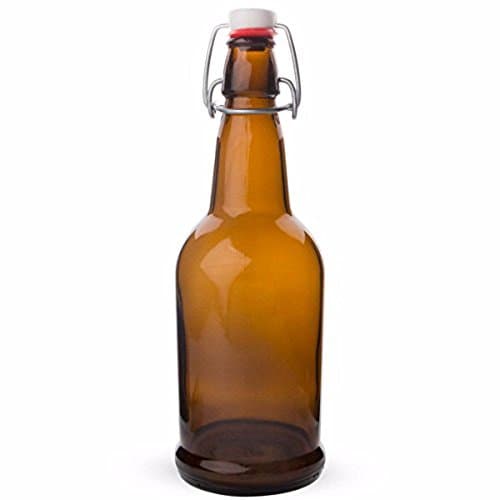
The EZ Cap 16 oz publishes a 100 PSI rating, which is the only such figure any bottle here states. The liter bottles are for storing what is already finished rather than for building pressure.
EZ Cap
Swing Top Bottles, Amber Glass, 16 oz (Case of 12)
The only bottle here with a published pressure rating — 100 PSI — in amber glass, which is the combination a second ferment actually asks for.
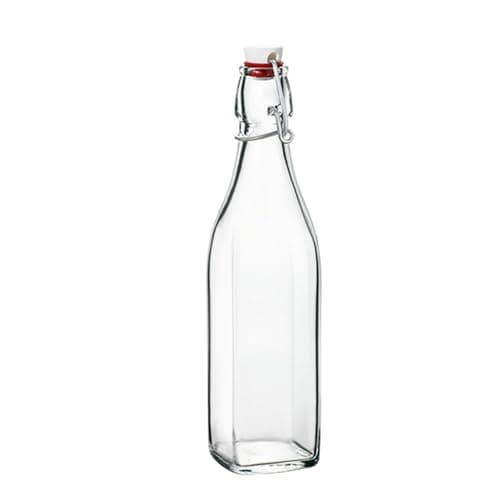
Italian soda-lime glass with a published height and diameter and a hermetic clamp seal — the bottle that looks like a bottle, with the dimensions to check it fits a fridge door.
#ad No live price feed yet, so no number is shown rather than a stale one. How this is funded.
The method
Strain the finished kombucha as you bottle it, or accept the yeast strands. Either is fine; a funnel with a mesh insert makes it easy.
Add the fruit or juice to each bottle first, then fill.
Leave about an inch of headroom. That gap is where the gas goes before it starts loading the glass.
Seal, and keep the bottles somewhere warm but not hot, out of direct sun.
Squeeze the plastic tester once a day, or burp one glass bottle.
When it is fizzy enough, refrigerate the whole batch. Cold effectively stops the process.
Opening a bottle safely
Chill it first. Cold liquid holds more dissolved gas and the headspace pressure drops, so a chilled bottle opens far more gently than a warm one — that single step turns most alarming bottles into ordinary ones.
Then open it over a sink, at arm's length, releasing the pressure in stages rather than all at once. A swing top lets you crack the seal and reclose it, which is exactly what you want on a bottle you are unsure about.
That last step is doing more work than it looks. The fridge is not preserving the kombucha, it is braking a ferment that would otherwise keep building pressure — storing kombucha covers the published temperature, how long a batch actually keeps, and why a warm sealed bottle is the one genuine hazard in this hobby.
Water kefir runs the same stage on a much shorter clock. The water kefir second ferment covers why it finishes in a day or two, and what that means for the bottle you choose.
Heads up: some links on this page are affiliate links. If you buy through one we may earn a commission at no extra cost to you. It never changes a ranking, and we take no payment for placement. The full version.
The short answer
Quick picks
Ranked on the published rubric. Every row jumps to that product's full write-up below; the button goes straight to Amazon.
#
Product
Best for
Score
Price
1
EZ Cap
Swing Top Bottles, Amber Glass, 16 oz (Case of 12)
The only bottle here with a published pressure rating — 100 PSI — in amber glass, which is the combination a second ferment actually asks for.
Italian soda-lime glass with a published height and diameter and a hermetic clamp seal — the bottle that looks like a bottle, with the dimensions to check it fits a fridge door.
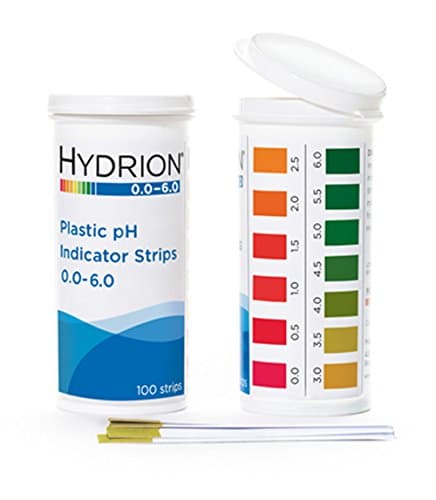
A 0.0 to 6.0 range in 0.5 steps, which puts four separate color matches inside the 2.5 to 3.5 window kombucha lives in — a 1-to-14 strip gives you one.
EZ Cap Swing Top Bottles, Amber Glass, 16 oz (Case of 12)
The only bottle here with a published pressure rating — 100 PSI — in amber glass, which is the combination a second ferment actually asks for.
Who it is for. Anyone doing a second ferment who wants a bottle with a number behind it rather than a shape that looks strong.
Published specifications
Capacity
16 oz
Glass color
Amber
Pressure rating
“Pressure rated to 100 PSI which means they can easily handle the carbonation of soda pop and hard seltzer”
Case quantity
12 bottles, includes 12 swing tops
Closure
Reusable swing top; also accepts a 26 mm pry-off crown cap
Maker’s note
“These swing tops are designed to be primarily sealed with a crown cap closure for long term storage.”
Dimensions
Not published
Source: MoreBeer published EZ Cap product specification (capacity, pressure rating, case contents, crown cap compatibility), morebeer.com/products/ez-cap-swing-top-bottles-amber-glass-16-oz-case-12, fetched 2026-09-01
Rubric — 8.3 / 10
Materials9/10 · weight 28%
Documentation9/10 · weight 22%
Capacity fit8/10 · weight 16%
Cleaning7/10 · weight 18%
Value8/10 · weight 16%
What it gets right
A published 100 PSI rating is the single most useful number in this whole category, and almost nobody publishes one
Amber glass blocks the light that degrades a bottle sitting out on a counter through a second ferment
The dual finish means you can crown-cap a batch you want to leave for months and swing-top the ones you will drink this week
16 oz is one serving, so a bottle gets opened once and drunk rather than losing its carbonation over three days
What it costs you
Swing-top gaskets perish, and a tired gasket is the commonest cause of a flat second ferment
No dimensions published, so fitting twelve of them on a fridge shelf is a measuring job when they arrive
Crown caps are sold separately if you want the long-storage option the maker recommends
Skip it if. You want to see the color of the finished drink. Amber hides it; the clear version of the same bottle does not.
Italian soda-lime glass with a published height and diameter and a hermetic clamp seal — the bottle that looks like a bottle, with the dimensions to check it fits a fridge door.
Who it is for. Someone bottling a lightly carbonated kombucha for the table, or storing finished kombucha in the fridge rather than conditioning it on a counter.
Published specifications
Capacity
33.75 oz (1 liter)
Height
12.13 inches
Diameter
3.5 inches
Glass
BPA-free and lead-free soda-lime glass
Origin
Glass and components made in Italy
Closure
Hermetic swing top: metal clasp, stopper and gasket
Care
Dishwasher safe without the swing top. Hand wash the metal clamp, stopper and gasket.
Pressure rating
Not published
Source: Bormioli Rocco published Swing bottle specification (capacity, 12.13 in height, 3.5 in diameter, soda-lime glass, hermetic seal, care instructions), retailer specification listings retrieved 2026-09-01
Rubric — 8.0 / 10
Materials8/10 · weight 28%
Documentation8/10 · weight 22%
Capacity fit8/10 · weight 16%
Cleaning8/10 · weight 18%
Value8/10 · weight 16%
What it gets right
Height and diameter both published, so you can check a fridge shelf before ordering
Lead-free soda-lime glass is stated, which matters for a container holding a pH-3 liquid for weeks
The bottle body is dishwasher safe, and only the small parts need hand washing
Genuinely presentable — this is the bottle to hand someone
What it costs you
No published pressure rating, which is the one number a second ferment cares about most
Clear glass, so light gets to the drink
A liter is a lot to open at once
Skip it if. You are chasing hard carbonation. Without a stated pressure rating, a bottle you are deliberately building pressure inside is a bottle you are guessing about — use the rated EZ Cap instead.
EZ Cap Swing Top Bottles, Amber Glass, 32 oz (Case of 12)
The same swing top and amber glass at quart size, which turns a gallon batch into six bottles instead of ten and roughly halves the bottling job.
Who it is for. An established brewer bottling a gallon a week who is tired of filling ten bottles.
Published specifications
Capacity
32 oz
Glass color
Amber
Case quantity
12 bottles
Closure
Reusable swing top
Product line
Same EZ Cap swing-top line as the 16 oz
Pressure rating
Not published for this size; the 16 oz in the same line is rated to 100 PSI
Source: MoreBeer published EZ Cap 32 oz amber listing, same product line as the specified 16 oz, morebeer.com/products/ez-cap-swing-top-bottles-amber-glass-32-oz-case-12, retrieved 2026-09-01
Rubric — 7.8 / 10
Materials9/10 · weight 28%
Documentation6/10 · weight 22%
Capacity fit9/10 · weight 16%
Cleaning7/10 · weight 18%
Value8/10 · weight 16%
What it gets right
Six bottles per gallon instead of ten is a real reduction in a job most people find tedious
Amber glass, same as the 16 oz
A quart is the right size for a household that drinks kombucha with dinner rather than alone
Fewer closures means fewer gaskets to keep track of
What it costs you
The pressure rating is published for the 16 oz in this line but not stated for the 32 oz — do not assume it carries over
Once opened, a quart goes flat before most people finish it
A quart of over-carbonated kombucha is a bigger mess than a pint of it
Skip it if. You are new to second ferment. Learn what your kitchen does to carbonation in 16 oz bottles, where the consequences are smaller.
A 0.0 to 6.0 range in 0.5 steps, which puts four separate color matches inside the 2.5 to 3.5 window kombucha lives in — a 1-to-14 strip gives you one.
Who it is for. Every kombucha brewer. This is the cheapest instrument on the site and the one that answers the safety question.
#ad No live price feed yet, so no number is shown rather than a stale one. How this is funded.
FAQ
Questions people actually ask
What is a kombucha second fermentation?+
Bottling finished kombucha with a small amount of sugar — usually fruit or juice — in a sealed pressure-rated bottle. The yeast keeps working, the gas cannot escape, and it dissolves into the liquid as carbonation.
How long does a second fermentation take?+
One to five days, driven mostly by temperature and how much sugar you added. A warm kitchen with generous fruit can finish in 24 hours; a cool one with a modest addition can take four or five days.
How much fruit should I add per bottle?+
One to two tablespoons of juice or chopped fruit per 16 oz bottle, or half a teaspoon of plain sugar for carbonation without flavor. Start at the low end — you can leave a bottle longer, but you cannot remove carbonation once it is there.
How do I know when to put the bottles in the fridge?+
Fill one food-grade PET plastic bottle from the same batch as a tester. When it goes from squeezable to rock hard, the pressure is up and the whole batch should be refrigerated. It is the only pressure reading a home brewer gets.
Do I need to do a second fermentation?+
No. Kombucha from the first fermentation is a finished drink, just flat. The second fermentation exists purely to add carbonation and flavor, and plenty of people skip it entirely.
Sources
Every specification cited on this page came from one of these documents, retrieved on the date shown against the product it belongs to.