Add flavor at bottling, never during the first fermentation. One to two tablespoons of fruit, juice or grated ginger per 16 oz bottle. High-sugar additions carbonate hardest, so start modest and refrigerate as soon as the batch is fizzy enough.
Why the jar stays plain
Three reasons, and they are all practical rather than dogmatic.
The culture is adapted to tea and sugar. Fruit acids, oils and sugars in the brewing vessel give it things it does not want and can weaken it over successive batches.
Anything in the first ferment sits there for two weeks with a living culture. Anything in the bottle sits there for two days. The exposure is completely different.
You get one flavor per batch instead of one per bottle. Bottling seven bottles gives you seven chances to try something.
Per 16 oz bottle. Carbonation column is how hard each tends to drive the second ferment.
Addition
Amount
Carbonation
Notes
Fruit juice
1-2 tbsp
Strong
Easiest to measure and to strain out
Chopped fresh fruit
1-2 tbsp
Strong
Best flavor, most sediment
Frozen berries
5-6 berries
Strong
Convenient, and they thaw into the bottle
Grated fresh ginger
1 tsp
Strong
The classic. Carbonates hard.
Fresh herbs — mint, basil
A few leaves
Weak
Almost no sugar. Pair with fruit.
Dried hibiscus or herbal tea
1 tsp
Weak
Color and flavor, little sugar
Plain sugar
1/2 tsp
Moderate
Carbonation with no flavor change
Notice the pattern: sugar content drives carbonation. Ginger and fruit juice both carbonate hard because both bring sugar. Mint brings almost none, so a mint-only bottle stays fairly flat unless you add sugar with it.
Combinations that work
Ginger and lemon — the default, and the one most commercial kombucha is built on.
Blueberry and mint — the berries carbonate it, the mint carries the aroma.
Raspberry and lime — sharp, and the color is genuinely striking in clear glass.
Mango and turmeric — heavy carbonation from the mango; turmeric stains everything, including plastic.
Hibiscus and ginger — deep red, floral, and the ginger supplies the sugar.
Apple and cinnamon — a stick rather than ground, which otherwise clouds the bottle.
The picks
Bottles for a flavored second ferment
Amber for the counter stage, because flavored kombucha conditions in the light and light degrades it. Clear for something with a color worth showing, going straight to the fridge.
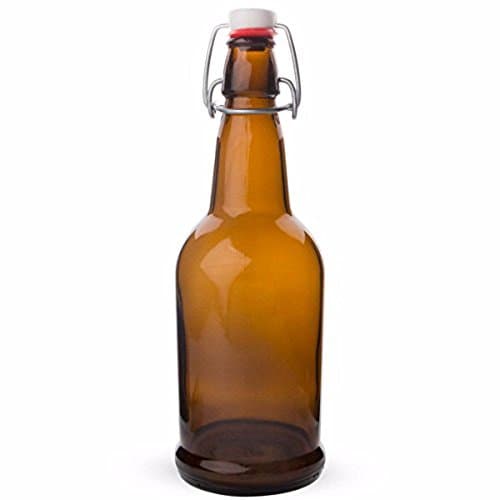
EZ Cap
Swing Top Bottles, Amber Glass, 16 oz (Case of 12)
The only bottle here with a published pressure rating — 100 PSI — in amber glass, which is the combination a second ferment actually asks for.
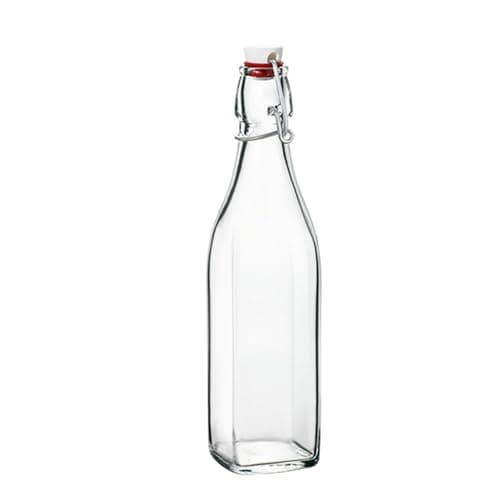
Italian soda-lime glass with a published height and diameter and a hermetic clamp seal — the bottle that looks like a bottle, with the dimensions to check it fits a fridge door.
#ad No live price feed yet, so no number is shown rather than a stale one. How this is funded.
What to avoid
Anything oily. Citrus oils, essential oils and heavily oiled teas leave a film and suppress carbonation. Zest is fine in small amounts; oil is not.
Dairy of any kind. It will curdle in an acidic liquid. There is no version of this that works.
Very large fruit pieces. They block the neck when pouring and are tedious to get out. Chop, or use juice.
Too much of anything. A bottle packed with fruit displaces the headroom you need and carbonates hard. One to two tablespoons is genuinely enough.
Staining, and the bottles you will regret
Turmeric, beetroot and blackberry stain permanently, and they stain plastic far worse than glass. If you use a plastic tester bottle, expect to replace it after a turmeric batch.
Rubber gaskets stain and hold odor too. If you rotate strong flavors through the same bottles, keeping one set for berries and turmeric and another for citrus and ginger is a small habit that keeps the second set neutral.
Heads up: some links on this page are affiliate links. If you buy through one we may earn a commission at no extra cost to you. It never changes a ranking, and we take no payment for placement. The full version.
The short answer
Quick picks
Ranked on the published rubric. Every row jumps to that product's full write-up below; the button goes straight to Amazon.
#
Product
Best for
Score
Price
1
EZ Cap
Swing Top Bottles, Amber Glass, 16 oz (Case of 12)
The only bottle here with a published pressure rating — 100 PSI — in amber glass, which is the combination a second ferment actually asks for.
Italian soda-lime glass with a published height and diameter and a hermetic clamp seal — the bottle that looks like a bottle, with the dimensions to check it fits a fridge door.
EZ Cap Swing Top Bottles, Amber Glass, 16 oz (Case of 12)
The only bottle here with a published pressure rating — 100 PSI — in amber glass, which is the combination a second ferment actually asks for.
Who it is for. Anyone doing a second ferment who wants a bottle with a number behind it rather than a shape that looks strong.
Published specifications
Capacity
16 oz
Glass color
Amber
Pressure rating
“Pressure rated to 100 PSI which means they can easily handle the carbonation of soda pop and hard seltzer”
Case quantity
12 bottles, includes 12 swing tops
Closure
Reusable swing top; also accepts a 26 mm pry-off crown cap
Maker’s note
“These swing tops are designed to be primarily sealed with a crown cap closure for long term storage.”
Dimensions
Not published
Source: MoreBeer published EZ Cap product specification (capacity, pressure rating, case contents, crown cap compatibility), morebeer.com/products/ez-cap-swing-top-bottles-amber-glass-16-oz-case-12, fetched 2026-09-01
Rubric — 8.3 / 10
Materials9/10 · weight 28%
Documentation9/10 · weight 22%
Capacity fit8/10 · weight 16%
Cleaning7/10 · weight 18%
Value8/10 · weight 16%
What it gets right
A published 100 PSI rating is the single most useful number in this whole category, and almost nobody publishes one
Amber glass blocks the light that degrades a bottle sitting out on a counter through a second ferment
The dual finish means you can crown-cap a batch you want to leave for months and swing-top the ones you will drink this week
16 oz is one serving, so a bottle gets opened once and drunk rather than losing its carbonation over three days
What it costs you
Swing-top gaskets perish, and a tired gasket is the commonest cause of a flat second ferment
No dimensions published, so fitting twelve of them on a fridge shelf is a measuring job when they arrive
Crown caps are sold separately if you want the long-storage option the maker recommends
Skip it if. You want to see the color of the finished drink. Amber hides it; the clear version of the same bottle does not.
Italian soda-lime glass with a published height and diameter and a hermetic clamp seal — the bottle that looks like a bottle, with the dimensions to check it fits a fridge door.
Who it is for. Someone bottling a lightly carbonated kombucha for the table, or storing finished kombucha in the fridge rather than conditioning it on a counter.
Published specifications
Capacity
33.75 oz (1 liter)
Height
12.13 inches
Diameter
3.5 inches
Glass
BPA-free and lead-free soda-lime glass
Origin
Glass and components made in Italy
Closure
Hermetic swing top: metal clasp, stopper and gasket
Care
Dishwasher safe without the swing top. Hand wash the metal clamp, stopper and gasket.
Pressure rating
Not published
Source: Bormioli Rocco published Swing bottle specification (capacity, 12.13 in height, 3.5 in diameter, soda-lime glass, hermetic seal, care instructions), retailer specification listings retrieved 2026-09-01
Rubric — 8.0 / 10
Materials8/10 · weight 28%
Documentation8/10 · weight 22%
Capacity fit8/10 · weight 16%
Cleaning8/10 · weight 18%
Value8/10 · weight 16%
What it gets right
Height and diameter both published, so you can check a fridge shelf before ordering
Lead-free soda-lime glass is stated, which matters for a container holding a pH-3 liquid for weeks
The bottle body is dishwasher safe, and only the small parts need hand washing
Genuinely presentable — this is the bottle to hand someone
What it costs you
No published pressure rating, which is the one number a second ferment cares about most
Clear glass, so light gets to the drink
A liter is a lot to open at once
Skip it if. You are chasing hard carbonation. Without a stated pressure rating, a bottle you are deliberately building pressure inside is a bottle you are guessing about — use the rated EZ Cap instead.
EZ Cap Swing Top Bottles, Amber Glass, 32 oz (Case of 12)
The same swing top and amber glass at quart size, which turns a gallon batch into six bottles instead of ten and roughly halves the bottling job.
Who it is for. An established brewer bottling a gallon a week who is tired of filling ten bottles.
Published specifications
Capacity
32 oz
Glass color
Amber
Case quantity
12 bottles
Closure
Reusable swing top
Product line
Same EZ Cap swing-top line as the 16 oz
Pressure rating
Not published for this size; the 16 oz in the same line is rated to 100 PSI
Source: MoreBeer published EZ Cap 32 oz amber listing, same product line as the specified 16 oz, morebeer.com/products/ez-cap-swing-top-bottles-amber-glass-32-oz-case-12, retrieved 2026-09-01
Rubric — 7.8 / 10
Materials9/10 · weight 28%
Documentation6/10 · weight 22%
Capacity fit9/10 · weight 16%
Cleaning7/10 · weight 18%
Value8/10 · weight 16%
What it gets right
Six bottles per gallon instead of ten is a real reduction in a job most people find tedious
Amber glass, same as the 16 oz
A quart is the right size for a household that drinks kombucha with dinner rather than alone
Fewer closures means fewer gaskets to keep track of
What it costs you
The pressure rating is published for the 16 oz in this line but not stated for the 32 oz — do not assume it carries over
Once opened, a quart goes flat before most people finish it
A quart of over-carbonated kombucha is a bigger mess than a pint of it
Skip it if. You are new to second ferment. Learn what your kitchen does to carbonation in 16 oz bottles, where the consequences are smaller.
#ad No live price feed yet, so no number is shown rather than a stale one. How this is funded.
FAQ
Questions people actually ask
When should I add flavor to kombucha?+
At bottling, for the second fermentation — never during the first. The culture is adapted to plain tea and sugar, and anything added to the brewing jar sits with it for two weeks rather than two days.
How much fruit should I add per bottle?+
One to two tablespoons of chopped fruit or juice per 16 oz bottle, or about a teaspoon of grated ginger. More sugar means harder carbonation, so start modest — you can leave a bottle longer but you cannot remove fizz.
Which flavorings carbonate kombucha the most?+
The high-sugar ones: fruit juice, chopped fruit, frozen berries and grated ginger all drive strong carbonation. Herbs and dried hibiscus bring flavor with almost no sugar, so they carbonate weakly unless you add sugar alongside.
Can I add fruit to the first fermentation?+
You can, and it is a poor idea. Fruit acids, oils and sugars in the brewing vessel give the culture things it is not adapted to, they make the vessel harder to clean, and you get one flavor per batch rather than one per bottle.
Do I strain the fruit out before drinking?+
Strain as you pour rather than at bottling. The fruit needs to stay in the bottle through conditioning — that is where the flavor comes from — and a small sieve over the glass handles the rest.
Sources
Every specification cited on this page came from one of these documents, retrieved on the date shown against the product it belongs to.