You can, and for the most part you should not. Glass is better for serving and for storage: it does not scratch, does not stain and does not hold odors. The exception is real and worth doing every batch — one food-grade PET soda bottle filled alongside the glass ones is the only pressure reading a home brewer gets.
The one job plastic does better
There is no home equivalent of a pressure gauge for a bottle of conditioning kombucha. You cannot see the pressure and you cannot measure it. What you can do is fill a PET soda bottle from the same batch, cap it, and squeeze it once a day.
As carbon dioxide builds, the bottle goes from squeezable to firm to genuinely hard. That transition is a direct reading of what is happening inside every glass bottle in the batch, obtained without opening anything and losing the fizz you have been building.
It costs nothing — an empty soda bottle from the recycling, rinsed — and it is the single most useful thing you can add to a second fermentation. Once the plastic is hard, the whole batch goes in the fridge.
Why glass wins for everything else
For a bottle holding kombucha at roughly pH 2.5-3.5 for days or weeks.
Glass
Food-grade plastic
Scratches
No
Yes, and scratches hold residue
Stains from fruit
No
Yes, especially berries and turmeric
Holds odors
No
Yes, over repeated use
Published pressure ratings
Available on some bottles
Not published for reused soda bottles
Pressure feedback
None — you cannot feel it
Excellent — it goes hard
Reusable long term
Yes, indefinitely
A few cycles at best
Suitable for serving
Yes
Not really
Scratching is the substantive objection, not chemistry. Every wash and every bottle brush leaves micro-abrasions in plastic, and those are where residue and organisms sit out of reach. In a bottle you refill weekly for a year, that accumulates. The same argument applies more strongly to fermentation vessels, which are in contact for far longer.
If you are going to use plastic, use PET
PET is the material commercial soda bottles are made from, and it is designed for exactly this: a carbonated, acidic liquid under pressure.
A bottle that held a carbonated drink has already demonstrated it can hold pressure. That is better evidence than any unrated glass bottle offers.
Use bottles that came with a drink in them, not generic food containers. A yoghurt pot is food-grade and is not a pressure vessel.
Replace them after a few cycles. They scratch, they stain, and they are free.
The picks
What to actually drink out of
A rated amber bottle for the conditioning stage, and two well-dimensioned glass liter bottles for keeping finished kombucha in the fridge.
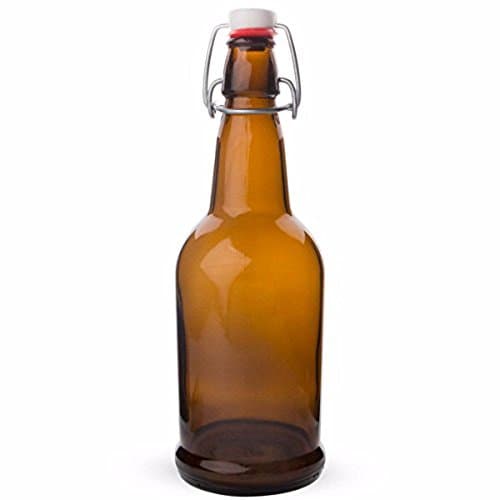
EZ Cap
Swing Top Bottles, Amber Glass, 16 oz (Case of 12)
The only bottle here with a published pressure rating — 100 PSI — in amber glass, which is the combination a second ferment actually asks for.
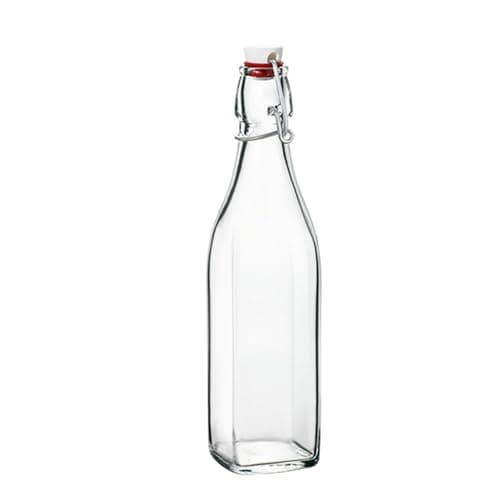
Italian soda-lime glass with a published height and diameter and a hermetic clamp seal — the bottle that looks like a bottle, with the dimensions to check it fits a fridge door.
A cheap, well-dimensioned liter bottle with a clamp stopper and a published dishwasher limit — good storage, and explicitly the wrong tool for building pressure.
#ad No live price feed yet, so no number is shown rather than a stale one. How this is funded.
What is not the problem
Plastic gets a worse reputation in fermenting circles than the evidence supports, and it is worth being accurate about which objections hold.
Holds: plastic scratches, and scratched surfaces are hard to get genuinely clean. This is the real objection and it is sufficient on its own.
Holds: plastic stains and holds odors, which matters when you rotate flavors through the same bottles.
Weaker: that acidic kombucha attacks food-grade PET meaningfully over a few days of conditioning. Commercial soda is more acidic than kombucha and is stored in PET for months.
Not a thing: that a PET bottle used as a pressure tester for three days ruins the batch inside it. It does not. It is the same drink, and most people pour it into a glass anyway.
Heads up: some links on this page are affiliate links. If you buy through one we may earn a commission at no extra cost to you. It never changes a ranking, and we take no payment for placement. The full version.
The short answer
Quick picks
Ranked on the published rubric. Every row jumps to that product's full write-up below; the button goes straight to Amazon.
#
Product
Best for
Score
Price
1
EZ Cap
Swing Top Bottles, Amber Glass, 16 oz (Case of 12)
The only bottle here with a published pressure rating — 100 PSI — in amber glass, which is the combination a second ferment actually asks for.
Italian soda-lime glass with a published height and diameter and a hermetic clamp seal — the bottle that looks like a bottle, with the dimensions to check it fits a fridge door.
A cheap, well-dimensioned liter bottle with a clamp stopper and a published dishwasher limit — good storage, and explicitly the wrong tool for building pressure.
EZ Cap Swing Top Bottles, Amber Glass, 16 oz (Case of 12)
The only bottle here with a published pressure rating — 100 PSI — in amber glass, which is the combination a second ferment actually asks for.
Who it is for. Anyone doing a second ferment who wants a bottle with a number behind it rather than a shape that looks strong.
Published specifications
Capacity
16 oz
Glass color
Amber
Pressure rating
“Pressure rated to 100 PSI which means they can easily handle the carbonation of soda pop and hard seltzer”
Case quantity
12 bottles, includes 12 swing tops
Closure
Reusable swing top; also accepts a 26 mm pry-off crown cap
Maker’s note
“These swing tops are designed to be primarily sealed with a crown cap closure for long term storage.”
Dimensions
Not published
Source: MoreBeer published EZ Cap product specification (capacity, pressure rating, case contents, crown cap compatibility), morebeer.com/products/ez-cap-swing-top-bottles-amber-glass-16-oz-case-12, fetched 2026-09-01
Rubric — 8.3 / 10
Materials9/10 · weight 28%
Documentation9/10 · weight 22%
Capacity fit8/10 · weight 16%
Cleaning7/10 · weight 18%
Value8/10 · weight 16%
What it gets right
A published 100 PSI rating is the single most useful number in this whole category, and almost nobody publishes one
Amber glass blocks the light that degrades a bottle sitting out on a counter through a second ferment
The dual finish means you can crown-cap a batch you want to leave for months and swing-top the ones you will drink this week
16 oz is one serving, so a bottle gets opened once and drunk rather than losing its carbonation over three days
What it costs you
Swing-top gaskets perish, and a tired gasket is the commonest cause of a flat second ferment
No dimensions published, so fitting twelve of them on a fridge shelf is a measuring job when they arrive
Crown caps are sold separately if you want the long-storage option the maker recommends
Skip it if. You want to see the color of the finished drink. Amber hides it; the clear version of the same bottle does not.
Italian soda-lime glass with a published height and diameter and a hermetic clamp seal — the bottle that looks like a bottle, with the dimensions to check it fits a fridge door.
Who it is for. Someone bottling a lightly carbonated kombucha for the table, or storing finished kombucha in the fridge rather than conditioning it on a counter.
Published specifications
Capacity
33.75 oz (1 liter)
Height
12.13 inches
Diameter
3.5 inches
Glass
BPA-free and lead-free soda-lime glass
Origin
Glass and components made in Italy
Closure
Hermetic swing top: metal clasp, stopper and gasket
Care
Dishwasher safe without the swing top. Hand wash the metal clamp, stopper and gasket.
Pressure rating
Not published
Source: Bormioli Rocco published Swing bottle specification (capacity, 12.13 in height, 3.5 in diameter, soda-lime glass, hermetic seal, care instructions), retailer specification listings retrieved 2026-09-01
Rubric — 8.0 / 10
Materials8/10 · weight 28%
Documentation8/10 · weight 22%
Capacity fit8/10 · weight 16%
Cleaning8/10 · weight 18%
Value8/10 · weight 16%
What it gets right
Height and diameter both published, so you can check a fridge shelf before ordering
Lead-free soda-lime glass is stated, which matters for a container holding a pH-3 liquid for weeks
The bottle body is dishwasher safe, and only the small parts need hand washing
Genuinely presentable — this is the bottle to hand someone
What it costs you
No published pressure rating, which is the one number a second ferment cares about most
Clear glass, so light gets to the drink
A liter is a lot to open at once
Skip it if. You are chasing hard carbonation. Without a stated pressure rating, a bottle you are deliberately building pressure inside is a bottle you are guessing about — use the rated EZ Cap instead.
#3 · Storing finished kombucha, not carbonating it
IKEA KORKEN Bottle with Stopper, 1 L (34 oz)
A cheap, well-dimensioned liter bottle with a clamp stopper and a published dishwasher limit — good storage, and explicitly the wrong tool for building pressure.
Who it is for. Someone who wants somewhere tidy to keep finished kombucha in the fridge, cheaply.
Source: IKEA published KORKEN product specification (capacity, 29 cm height, 9 cm diameter, materials, 70 C dishwasher limit), ikea.com KORKEN product page, retrieved 2026-09-01
Rubric — 8.1 / 10
Materials7/10 · weight 28%
Documentation8/10 · weight 22%
Capacity fit8/10 · weight 16%
Cleaning9/10 · weight 18%
Value9/10 · weight 16%
What it gets right
The cheapest liter bottle here by a wide margin, and the dimensions are published
A stainless wire and a polypropylene lid are both fine against kombucha’s acidity
A stated dishwasher temperature limit is unusually specific for a bottle at this price
Excellent for cold storage of finished, already-carbonated kombucha
What it costs you
No pressure rating and no carbonation claim anywhere in the product information
Clear glass
The stopper is a storage closure, not a pressure closure — treat it that way
Skip it if. You are doing a second ferment on the counter. Nothing published about this bottle supports holding carbonation pressure; use a rated swing top instead.
#ad No live price feed yet, so no number is shown rather than a stale one. How this is funded.
Score7.8no photo yet
#4 · Bottling a gallon in six moves
EZ Cap Swing Top Bottles, Amber Glass, 32 oz (Case of 12)
The same swing top and amber glass at quart size, which turns a gallon batch into six bottles instead of ten and roughly halves the bottling job.
Who it is for. An established brewer bottling a gallon a week who is tired of filling ten bottles.
Published specifications
Capacity
32 oz
Glass color
Amber
Case quantity
12 bottles
Closure
Reusable swing top
Product line
Same EZ Cap swing-top line as the 16 oz
Pressure rating
Not published for this size; the 16 oz in the same line is rated to 100 PSI
Source: MoreBeer published EZ Cap 32 oz amber listing, same product line as the specified 16 oz, morebeer.com/products/ez-cap-swing-top-bottles-amber-glass-32-oz-case-12, retrieved 2026-09-01
Rubric — 7.8 / 10
Materials9/10 · weight 28%
Documentation6/10 · weight 22%
Capacity fit9/10 · weight 16%
Cleaning7/10 · weight 18%
Value8/10 · weight 16%
What it gets right
Six bottles per gallon instead of ten is a real reduction in a job most people find tedious
Amber glass, same as the 16 oz
A quart is the right size for a household that drinks kombucha with dinner rather than alone
Fewer closures means fewer gaskets to keep track of
What it costs you
The pressure rating is published for the 16 oz in this line but not stated for the 32 oz — do not assume it carries over
Once opened, a quart goes flat before most people finish it
A quart of over-carbonated kombucha is a bigger mess than a pint of it
Skip it if. You are new to second ferment. Learn what your kitchen does to carbonation in 16 oz bottles, where the consequences are smaller.
#ad No live price feed yet, so no number is shown rather than a stale one. How this is funded.
FAQ
Questions people actually ask
Can you put kombucha in plastic bottles?+
Yes, in food-grade PET — the material commercial soda bottles are made from, which is designed for a carbonated acidic liquid under pressure. For serving and long-term storage glass is better, because plastic scratches, stains and holds odors.
Why do people use a plastic bottle during a second fermentation?+
As a pressure gauge. A PET bottle filled from the same batch goes from squeezable to rock hard as carbon dioxide builds, which tells you the pressure in every glass bottle in the batch without opening any of them.
Is plastic unsafe for kombucha?+
The genuine objection is surface, not chemistry: plastic scratches, and micro-abrasions hold residue that rinsing does not reach. Food-grade PET holds carbonated acidic drinks commercially for months, so a few days of conditioning is well within what it is designed for.
Can I reuse a store-bought kombucha bottle?+
Usually yes. It held a carbonated drink once, which is better evidence of pressure capability than most unrated bottles offer. Check that the cap reseals firmly, since many commercial caps are designed to be opened once.
How many times can I reuse a plastic bottle?+
A few cycles. They scratch and stain quickly, especially with berries or turmeric. Since the whole point of the plastic bottle is that it is free, replace it rather than scrubbing it.
Sources
Every specification cited on this page came from one of these documents, retrieved on the date shown against the product it belongs to.