Bottles that hold pressure, and bottles that do not
A second fermentation is a small pressure vessel sitting on your counter. The bottle is the only thing standing between the gas and your kitchen, and most bottles never publish what they can take.
Our top pick in bottling & carbonation
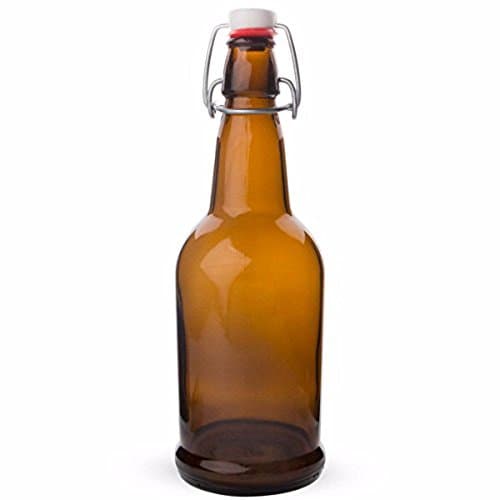
EZ Cap Swing Top Bottles, Amber Glass, 16 oz (Case of 12)
The only bottle here with a published pressure rating — 100 PSI — in amber glass, which is the combination a second ferment actually asks for.
Use a bottle with a published pressure rating and a swing-top or crown-cap closure. EZ Cap's 16 oz amber swing tops publish 100 PSI, which is the only number in this category anyone states. Never second-ferment in a jar with a screw lid, a decorative bottle, or a stopper bottle whose maker says nothing about pressure.
What is actually happening in the bottle
The first fermentation is open to the air, so the carbon dioxide the yeast produces simply leaves. A second fermentation is sealed. The same yeast, given a little more sugar — usually fruit or juice — keeps producing gas, and now the gas has nowhere to go. It dissolves into the liquid, which is the fizz you wanted, and it also raises the internal pressure, which is the part people forget.
How much pressure depends on temperature, how much sugar you added, how active the culture is and how long you leave it. Nobody bottling at home is measuring any of that precisely. The margin of safety therefore has to come from the bottle, which is why a published rating matters more here than in any other category on this site.
The one number worth having
Published closure and pressure information, compiled 2026-09-01. A blank means the maker publishes nothing on the subject.
Bottle
Closure
Pressure rating
Glass
EZ Cap 16 oz amber
Swing top + 26 mm crown
100 PSI, published
Amber
EZ Cap 32 oz amber
Swing top
Not published for this size
Amber
Bormioli Rocco Swing 1 L
Hermetic swing top
Not published
Clear
IKEA KORKEN 1 L
Clamp stopper
Not published, not marketed for it
Clear
Three of those four are perfectly good bottles. Only one of them tells you what it can take. That is the argument for the EZ Cap on a counter doing a second ferment, and it is not an argument against the others for storing finished kombucha in a fridge, which is a completely different job. Swing-top bottles compared goes further.
Swing top, crown cap, or stopper
Swing top. A wire cage, a ceramic or plastic stopper and a rubber gasket. Reusable, quick, and the gasket is the wear part — a tired gasket is the single commonest cause of a flat second ferment. See gaskets and seals.
Crown cap. A one-use metal cap crimped on with a capper. More reliable than a swing top over months, which is exactly why EZ Cap states its bottles are "designed to be primarily sealed with a crown cap closure for long term storage". The same bottles accept both. Crown caps, and when they beat a swing top covers the three purchases the method actually requires.
Clamp stopper. The IKEA KORKEN style. A storage closure, not a pressure closure. Excellent for finished kombucha in the fridge; wrong for a conditioning bottle on a counter.
Amber or clear
Amber glass filters visible and near-ultraviolet light. A bottle conditioning on a counter for three days near a window gets meaningfully more light exposure than one in a cupboard, and light degrades the drink. Clear glass shows off the color, which is genuinely nice when you are handing someone a bottle. The practical answer is amber for the counter stage and clear for anything going straight into a dark fridge.
Sizes, and how many a gallon fills
A gallon is 128 oz. Hold back roughly 10 percent as starter tea for the next batch and you have about 115 oz to bottle, which is seven 16 oz bottles or a little over three 32 oz bottles. Bottle sizes for kombucha works through the trade-off, which is really a trade-off between bottling effort and how fast a bottle goes flat once opened.
Getting the kombucha in there
The bottle is only half the problem. A gallon of kombucha has to travel from a wide vessel into a series of much narrower openings, and the tool that does it depends on whether your jar has a tap: a stainless funnel with a straining filter if it does not, a spring-tip filler on the spigot if it does. Then every bottle comes back with residue in a neck too narrow for a hand. Funnels, fillers and bottle brushes compares the three on published dimensions, including the one figure that tells you in advance whether a funnel fits the bottles you already own.
The other half of that job is deciding whether to strain the yeast out on the way, which is a preference rather than a rule — and if you also ferment kefir, the strainer is a daily tool rather than a fortnightly one. Strainers for kombucha and kefir covers the published mesh counts and which materials belong near an acidic ferment.
And there is a route that replaces the bottles altogether. Pushing CO2 into a sealed vessel makes carbonation a setting rather than a wait, and it turns bottling day into one transfer instead of seven. Kegging kombucha compares the keg sizes worth having, the gas side, and the ten-dollar cap that does the same job on a plastic bottle without a keg at all.
Two more bottling questions get their own pages. Kombucha bottles exploding covers what actually drives a runaway second ferment and the free tester-bottle habit that ends the guessing, and the EZ Cap bottle review goes through the only bottle here whose maker publishes a pressure rating.
Heads up: some links on this page are affiliate links. If you buy through one we may earn a commission at no extra cost to you. It never changes a ranking, and we take no payment for placement. The full version.
The short answer
Quick picks
Ranked on the published rubric. Every row jumps to that product's full write-up below; the button goes straight to Amazon.
#
Product
Best for
Score
Price
1
EZ Cap
Swing Top Bottles, Amber Glass, 16 oz (Case of 12)
The only bottle here with a published pressure rating — 100 PSI — in amber glass, which is the combination a second ferment actually asks for.
Italian soda-lime glass with a published height and diameter and a hermetic clamp seal — the bottle that looks like a bottle, with the dimensions to check it fits a fridge door.
A cheap, well-dimensioned liter bottle with a clamp stopper and a published dishwasher limit — good storage, and explicitly the wrong tool for building pressure.
Endurance Stainless Steel Funnel with Straining Filter
18/8 stainless with a removable straining filter and a published neck diameter — the only piece of bottling gear here that tells you in advance whether it fits your bottles.
The only strainer here whose maker states in writing that it is non-reactive and safe for acidic foods, which is the entire question a fermenter is asking.
EZ Cap Swing Top Bottles, Amber Glass, 16 oz (Case of 12)
The only bottle here with a published pressure rating — 100 PSI — in amber glass, which is the combination a second ferment actually asks for.
Who it is for. Anyone doing a second ferment who wants a bottle with a number behind it rather than a shape that looks strong.
Published specifications
Capacity
16 oz
Glass color
Amber
Pressure rating
“Pressure rated to 100 PSI which means they can easily handle the carbonation of soda pop and hard seltzer”
Case quantity
12 bottles, includes 12 swing tops
Closure
Reusable swing top; also accepts a 26 mm pry-off crown cap
Maker’s note
“These swing tops are designed to be primarily sealed with a crown cap closure for long term storage.”
Dimensions
Not published
Source: MoreBeer published EZ Cap product specification (capacity, pressure rating, case contents, crown cap compatibility), morebeer.com/products/ez-cap-swing-top-bottles-amber-glass-16-oz-case-12, fetched 2026-09-01
Rubric — 8.3 / 10
Materials9/10 · weight 28%
Documentation9/10 · weight 22%
Capacity fit8/10 · weight 16%
Cleaning7/10 · weight 18%
Value8/10 · weight 16%
What it gets right
A published 100 PSI rating is the single most useful number in this whole category, and almost nobody publishes one
Amber glass blocks the light that degrades a bottle sitting out on a counter through a second ferment
The dual finish means you can crown-cap a batch you want to leave for months and swing-top the ones you will drink this week
16 oz is one serving, so a bottle gets opened once and drunk rather than losing its carbonation over three days
What it costs you
Swing-top gaskets perish, and a tired gasket is the commonest cause of a flat second ferment
No dimensions published, so fitting twelve of them on a fridge shelf is a measuring job when they arrive
Crown caps are sold separately if you want the long-storage option the maker recommends
Skip it if. You want to see the color of the finished drink. Amber hides it; the clear version of the same bottle does not.
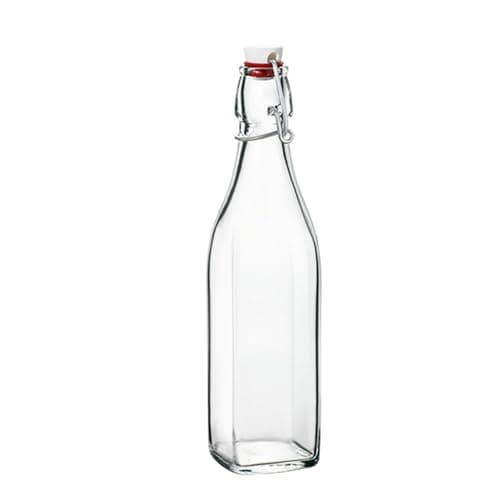
Italian soda-lime glass with a published height and diameter and a hermetic clamp seal — the bottle that looks like a bottle, with the dimensions to check it fits a fridge door.
Who it is for. Someone bottling a lightly carbonated kombucha for the table, or storing finished kombucha in the fridge rather than conditioning it on a counter.
Published specifications
Capacity
33.75 oz (1 liter)
Height
12.13 inches
Diameter
3.5 inches
Glass
BPA-free and lead-free soda-lime glass
Origin
Glass and components made in Italy
Closure
Hermetic swing top: metal clasp, stopper and gasket
Care
Dishwasher safe without the swing top. Hand wash the metal clamp, stopper and gasket.
Pressure rating
Not published
Source: Bormioli Rocco published Swing bottle specification (capacity, 12.13 in height, 3.5 in diameter, soda-lime glass, hermetic seal, care instructions), retailer specification listings retrieved 2026-09-01
Rubric — 8.0 / 10
Materials8/10 · weight 28%
Documentation8/10 · weight 22%
Capacity fit8/10 · weight 16%
Cleaning8/10 · weight 18%
Value8/10 · weight 16%
What it gets right
Height and diameter both published, so you can check a fridge shelf before ordering
Lead-free soda-lime glass is stated, which matters for a container holding a pH-3 liquid for weeks
The bottle body is dishwasher safe, and only the small parts need hand washing
Genuinely presentable — this is the bottle to hand someone
What it costs you
No published pressure rating, which is the one number a second ferment cares about most
Clear glass, so light gets to the drink
A liter is a lot to open at once
Skip it if. You are chasing hard carbonation. Without a stated pressure rating, a bottle you are deliberately building pressure inside is a bottle you are guessing about — use the rated EZ Cap instead.
EZ Cap Swing Top Bottles, Amber Glass, 32 oz (Case of 12)
The same swing top and amber glass at quart size, which turns a gallon batch into six bottles instead of ten and roughly halves the bottling job.
Who it is for. An established brewer bottling a gallon a week who is tired of filling ten bottles.
Published specifications
Capacity
32 oz
Glass color
Amber
Case quantity
12 bottles
Closure
Reusable swing top
Product line
Same EZ Cap swing-top line as the 16 oz
Pressure rating
Not published for this size; the 16 oz in the same line is rated to 100 PSI
Source: MoreBeer published EZ Cap 32 oz amber listing, same product line as the specified 16 oz, morebeer.com/products/ez-cap-swing-top-bottles-amber-glass-32-oz-case-12, retrieved 2026-09-01
Rubric — 7.8 / 10
Materials9/10 · weight 28%
Documentation6/10 · weight 22%
Capacity fit9/10 · weight 16%
Cleaning7/10 · weight 18%
Value8/10 · weight 16%
What it gets right
Six bottles per gallon instead of ten is a real reduction in a job most people find tedious
Amber glass, same as the 16 oz
A quart is the right size for a household that drinks kombucha with dinner rather than alone
Fewer closures means fewer gaskets to keep track of
What it costs you
The pressure rating is published for the 16 oz in this line but not stated for the 32 oz — do not assume it carries over
Once opened, a quart goes flat before most people finish it
A quart of over-carbonated kombucha is a bigger mess than a pint of it
Skip it if. You are new to second ferment. Learn what your kitchen does to carbonation in 16 oz bottles, where the consequences are smaller.
#ad No live price feed yet, so no number is shown rather than a stale one. How this is funded.
Score8.1no photo yet
#4 · Storing finished kombucha, not carbonating it
IKEA KORKEN Bottle with Stopper, 1 L (34 oz)
A cheap, well-dimensioned liter bottle with a clamp stopper and a published dishwasher limit — good storage, and explicitly the wrong tool for building pressure.
Who it is for. Someone who wants somewhere tidy to keep finished kombucha in the fridge, cheaply.
Source: IKEA published KORKEN product specification (capacity, 29 cm height, 9 cm diameter, materials, 70 C dishwasher limit), ikea.com KORKEN product page, retrieved 2026-09-01
Rubric — 8.1 / 10
Materials7/10 · weight 28%
Documentation8/10 · weight 22%
Capacity fit8/10 · weight 16%
Cleaning9/10 · weight 18%
Value9/10 · weight 16%
What it gets right
The cheapest liter bottle here by a wide margin, and the dimensions are published
A stainless wire and a polypropylene lid are both fine against kombucha’s acidity
A stated dishwasher temperature limit is unusually specific for a bottle at this price
Excellent for cold storage of finished, already-carbonated kombucha
What it costs you
No pressure rating and no carbonation claim anywhere in the product information
Clear glass
The stopper is a storage closure, not a pressure closure — treat it that way
Skip it if. You are doing a second ferment on the counter. Nothing published about this bottle supports holding carbonation pressure; use a rated swing top instead.
#ad No live price feed yet, so no number is shown rather than a stale one. How this is funded.
Score8.3no photo yet
#5 · Bottling a whole gallon in one sitting
MoreBeer Traditional Longneck Beer Bottles, Amber, 12 oz (Case of 24)
A published carbonation rating, amber glass and a crown finish — the cheapest way to put a gallon of kombucha under pressure it was designed for.
Who it is for. Anyone bottling a full gallon at once who wants a fresh, gasket-free seal on every bottle and does not mind owning a capper.
Published specifications
Capacity
12 fl oz
Glass
Amber
Case quantity
24 bottles, with dividers
Closure
26 mm crown cap. Pry-off, not twist-off
Pressure rating
“Up to 3 volumes of carbonation”
Light protection
“Thick amber glass offers better protection against UV rays compared to green or clear glass”
Reuse
Standard returnable-style glass, designed for repeated capping
Gasket
None. The seal is the cap liner, replaced every time
Source: MoreBeer published product specification for 12 oz amber traditional longneck beer bottles, case of 24 (capacity, glass color, case quantity and dividers, 26 mm crown finish, “up to 3 volumes of carbonation”, amber UV statement), morebeer.com, retrieved 2026-09-06
Rubric — 8.3 / 10
Materials9/10 · weight 28%
Documentation8/10 · weight 22%
Capacity fit8/10 · weight 16%
Cleaning7/10 · weight 18%
Value9/10 · weight 16%
What it gets right
A published carbonation figure — three volumes — which puts it in the same small group as EZ Cap’s 100 PSI and ahead of every unrated decorative bottle
Twenty-four twelve-ounce bottles is 288 oz, comfortably more than a gallon batch, so one case covers a brew with spares
Amber glass with a published UV claim, which matters because light degrades a second ferment
No gasket to perish. The seal is a fresh cap liner every time, which removes the commonest cause of a flat bottle
What it costs you
You cannot use it without also buying caps and a capper, so the real entry cost is three purchases, not one
Pry-off only. A twist-off beer bottle will not hold a crown reliably and should not be reused for a second ferment
The neck is narrow, so cleaning needs a bottle brush rather than a hand
No published dimensions from the retailer, so shelf height has to be measured off a bottle you already own
Skip it if. You bottle two or three at a time and want to open one without a tool. A swing top is the better fit for small, casual batches.
#ad No live price feed yet, so no number is shown rather than a stale one. How this is funded.
Score8.5no photo yet
#6 · Pouring and straining in one motion
RSVP International Endurance Stainless Steel Funnel with Straining Filter
18/8 stainless with a removable straining filter and a published neck diameter — the only piece of bottling gear here that tells you in advance whether it fits your bottles.
Who it is for. Anyone bottling out of a spigotless jar, and anyone who wants the option of straining without buying a separate sieve.
Published specifications
Material
“18/8 stainless steel construction”
Top diameter
4 in
Neck
2 in long, 5/8 in diameter
Straining filter
Removable
Dishwasher
Dishwasher safe
Published fit
“the neck will fit into our bottles with openings of 28mm or larger”
Filter aperture
Not published. The mesh size of the straining insert is not stated
Source: RSVP stainless steel funnel with straining filter specification as published by retailer Fillmore Container (18/8 construction, 4 in top diameter, 2 in x 5/8 in neck, removable filter, dishwasher safe, 28 mm minimum bottle opening), fillmorecontainer.com, retrieved 2026-09-07
Rubric — 8.5 / 10
Materials9/10 · weight 28%
Documentation8/10 · weight 22%
Capacity fit8/10 · weight 16%
Cleaning9/10 · weight 18%
Value8/10 · weight 16%
What it gets right
18/8 is the common name for 304 stainless, which is the grade this site accepts against a pH-3 liquid — and the funnel touches it for seconds, not weeks
The straining filter lifts out, so the same tool serves a brewer who wants a clear drink and one who does not
A published neck diameter and a published minimum bottle opening — you can check it against your own bottles before ordering rather than after
It comes apart into two parts with no crevices and goes in the dishwasher, which matters on a tool used with sugary liquid
What it costs you
The mesh aperture of the straining filter is not published, so how fine a strain you get is unknown until it arrives
A 5/8 in neck is generous for a swing top and tight in a narrow longneck — measure your own bottle opening against the published figure
Four inches across is a small target when you are pouring a full gallon jar one-handed
It is a funnel. It moves liquid downward and does nothing about the yeast already settled in the bottom of the jar
Skip it if. Your brewing vessel has a spigot. A bottle filler on the tap is faster, cleaner and sets the headspace for you, and the funnel becomes a spare.
#ad No live price feed yet, so no number is shown rather than a stale one. How this is funded.
#7 · Straining a ferment without metal in the acid
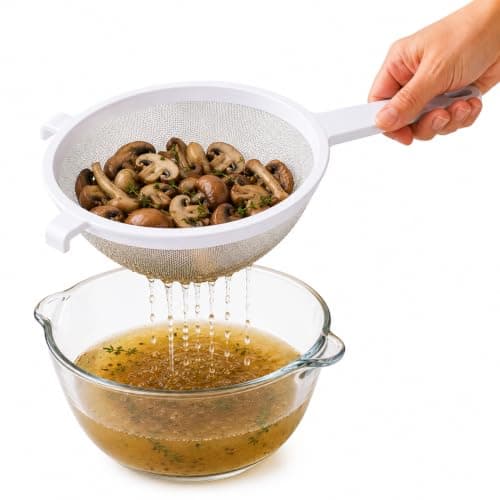
HIC Kitchen Double-Ear Fine Mesh Strainer, 7 in
The only strainer here whose maker states in writing that it is non-reactive and safe for acidic foods, which is the entire question a fermenter is asking.
Who it is for. Anyone straining a finished ferment on bottling day who wants the acid-contact question answered by the maker rather than by a forum.
Published specifications
Diameter
7 in
Material
BPA free plastic
Published acid claim
“durable, lightweight, non reactive, and safe for acidic foods”
Overall dimensions
13.25 x 7 x 3.25 in
Rim
Double-ear design that “rests securely across pots, pans, and bowls”
Dishwasher
“top-rack dishwasher safe”
Storage
Hangs for compact storage
Mesh aperture
Not published
Smaller size
The same strainer is listed at 5.5 in
Source: HIC Kitchen published Double-Ear Fine Mesh Strainer listing (7 in, BPA free plastic, “non reactive, and safe for acidic foods”, 13.25 x 7 x 3.25 in, double-ear rim, top-rack dishwasher safe, hangs for storage), Amazon B0042X9XAY, retrieved 2026-09-13
Rubric — 8.4 / 10
Materials8/10 · weight 28%
Documentation9/10 · weight 22%
Capacity fit8/10 · weight 16%
Cleaning9/10 · weight 18%
Value8/10 · weight 16%
What it gets right
A published “safe for acidic foods” claim is exactly the sentence this site spends a whole page on elsewhere, and almost no strainer maker writes it down
Plastic sidesteps the metal question entirely — no grade to verify, no alloy claim to trust, nothing to pit
The double-ear rim sits across a jug or bowl so both hands are free, which matters when you are pouring a full gallon
Top-rack dishwasher safe, which a fine mesh badly needs after sugary, yeasty liquid
What it costs you
The mesh aperture is not published, so how fine a strain you get is unknown until it arrives
Seven inches is generous for a gallon pour and far too wide to sit in a quart jar for daily kefir straining
Plastic mesh is more easily deformed than steel; a bent rim never quite sits flat again
No stated maximum temperature, and top-rack dishwasher safe is the only heat guidance given
Skip it if. You strain kefir grains daily out of a quart jar. This is the wrong size and shape for that; a small non-metal sieve set is the tool.
What bottles are best for kombucha second fermentation?+
Bottles built to hold pressure: swing-top or crown-cap glass bottles designed for beer, soda or cider. The EZ Cap 16 oz amber swing top publishes a 100 PSI pressure rating, which is the only such figure stated by any bottle on this site.
Can I use mason jars for a second fermentation?+
A standard mason jar with a two-piece screw lid is not designed to hold carbonation pressure and is a poor choice for conditioning. Mason jars are fine for the first fermentation, where the vessel is covered with cloth and open to the air.
Can you put kombucha in plastic bottles?+
For a short conditioning period, a food-grade PET soda bottle is genuinely useful because it goes hard when pressure builds, which tells you when to refrigerate. For anything longer, glass is better: plastic scratches, and scratches hold what you cannot scrub out.
How many bottles does one gallon of kombucha fill?+
About seven 16 oz bottles. A gallon is 128 oz, and roughly 10 percent is held back as starter tea for the next batch, leaving around 115 oz to bottle.
Why is amber glass recommended for kombucha?+
Because amber filters light, and a bottle conditioning on a counter for several days gets a lot of it. Light degrades the drink over time. Clear glass is fine for finished kombucha going straight into a dark fridge.