A second ferment is a pressure vessel on your counter. Three cheap habits and one published number are the difference between a fizzy drink and glass on the floor.
Bottles burst because sugar, warmth and time were all present and nobody was measuring. Use a bottle that publishes a pressure rating, fill one ordinary plastic soda bottle from the same batch as a pressure gauge you can squeeze, and move everything to the fridge the day the plastic bottle goes hard. Those three habits cost nothing and solve almost every case.
Why a bottle goes too far
A second ferment is simple physics. You put a live drink into a sealed container with some sugar. The yeast eats the sugar and makes carbon dioxide. In an open jar that gas leaves; in a sealed bottle it dissolves into the liquid and raises the pressure in the headspace. Fizz and pressure are the same process, and you cannot have one without the other.
So a bottle bomb is never mysterious. It is the ordinary process running longer, or warmer, or with more sugar than the person expected. Three variables drive it, and every one of them is under your control.
Sugar. Juice and dried fruit carbonate hardest because they bring the most sugar. Flavoring kombucha has the working amounts per bottle. Doubling the fruit does not double the flavor, but it does roughly double the gas.
Temperature. A kitchen at 78 F finishes a second ferment in a fraction of the time of one at 65 F. A radiator, a sunny windowsill or a hot week changes the timeline without changing anything you did.
Time. The variable people actually get wrong. A batch bottled on Friday and forgotten until Monday has had three warm days, not the one you intended.
Note what is not on that list: the culture being "too strong". A healthy culture is not the problem, and the opposite complaint is far commoner than this one.
What actually protects you
In the order the money is worth spending.
A published pressure rating. Nearly every bottle sold for kombucha describes itself as thick or strong and states no figure. A maker willing to publish a PSI number has measured one.
A way to read the pressure without opening the bottle. This is the free part, and it is covered below.
Refrigeration on a schedule. Cold does not stop the culture but it slows it enough that the drink stops changing. The fridge is the off switch.
Smaller bottles. A 16 oz bottle that fails is a smaller event than a liter, and it chills faster, which means you can stop a batch sooner.
Headspace. Free, and routinely skipped. Gas needs somewhere to go.
The only published number on this site
Published closure and pressure information, compiled from each maker's listing. A blank means the maker publishes nothing on the subject.
Bottle
Closure
Pressure rating
Right for a second ferment?
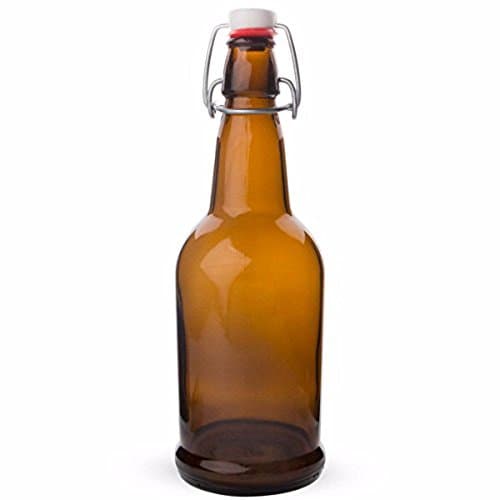
EZ Cap 16 oz amber
Swing top or 26 mm crown
100 PSI, published
Yes
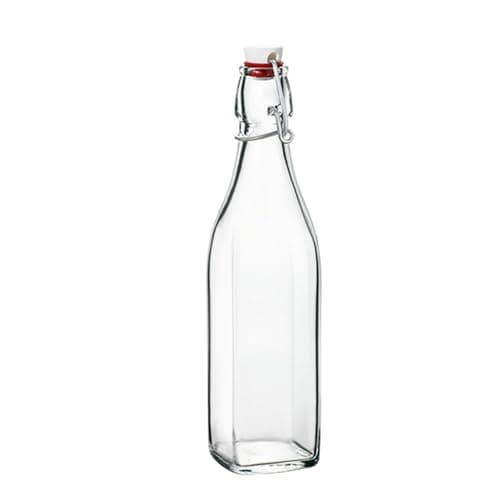
Bormioli Rocco Swing 1 L
Hermetic swing top
Not published
In practice yes, on nothing published
IKEA KORKEN 1 L
Clamp stopper
Not published, not marketed for it
No — a storage closure
A repurposed soda bottle
Screw cap
Not published
As a tester, not as your main bottle
One published figure across a whole category tells you how little the bottle trade wants to commit to a number. It is also why the EZ Cap keeps winning these pages: not because it is obviously stronger than a Bormioli, but because it is the only one whose maker will say what it takes. Swing-top bottles compared goes through the rest of the field.
The KORKEN is in that table deliberately. It is a good, cheap storage bottle and a bad conditioning bottle, and the difference is not obvious from looking at it. A clamp stopper is designed to keep air out, not to hold pressure in.
The picks
What we would buy
The bottle that publishes a rating, a larger swing top for anyone who prefers liters, and the cheapest instrument on this site — a strip that tells you how warm the glass actually is.
EZ Cap
Swing Top Bottles, Amber Glass, 16 oz (Case of 12)
The only bottle here with a published pressure rating — 100 PSI — in amber glass, which is the combination a second ferment actually asks for.
Italian soda-lime glass with a published height and diameter and a hermetic clamp seal — the bottle that looks like a bottle, with the dimensions to check it fits a fridge door.
This is the single most useful habit on this page and it costs nothing.
When you bottle a batch, fill one ordinary plastic soda bottle alongside the glass ones, with the same drink and the same flavoring. Plastic flexes; glass does not. Every day, squeeze the plastic bottle. While it gives under your thumb, the batch is still building. When it has gone rock hard, the glass bottles standing next to it are at the same pressure, and it is time to refrigerate all of them.
It converts an invisible variable into something you can feel in one second, without opening anything and without losing the carbonation from a test bottle. It is crude, it is free, and it is what the bottling hub has recommended from the start.
Headspace, and where a bottle actually fails
Headspace is the air gap between the liquid and the closure, and it is free protection that people routinely fill up with drink.
Gas produced in a full bottle has nowhere to expand into, so pressure climbs faster for the same amount of fermentation. An inch or so of headspace gives the carbon dioxide somewhere to sit while it dissolves, which slows the rise and gives you more margin between "nicely fizzy" and "alarming". It also means the bottle opens with a hiss rather than a fountain, because there is a gas volume to release before the liquid starts moving.
Where bottles fail is worth knowing too. A swing top rarely fails at the glass: the weak point is the closure, and the usual outcome of too much pressure is that the stopper lifts, the gasket vents, and you find a sticky ring on the shelf. That is the system working. Glass failure is much rarer and is associated with damaged bottles — chips around the rim, scratches from a dishwasher rack, or a bottle that has been knocked and hairline-cracked without anyone noticing.
Inspect the rim before every fill. Run a finger around it. A chip at the sealing surface is both a leak and a stress point.
Retire bottles that have been dropped. Even if they look intact. A bottle is cheap; the alternative is not.
Do not reuse bottles that never held pressure. A screw-top juice or sauce bottle was made to be filled once and thrown away.
Burping, and its limits
Burping means briefly opening each bottle during conditioning to release excess pressure, then resealing. It is standard home practice and it genuinely works as a safety valve.
It has two costs worth knowing. Every burp releases carbonation you were trying to build, so a heavily burped batch finishes flatter. And burping reintroduces air and hands to a sealed drink, which is a small hygiene cost on a drink whose own acidity is mostly protecting it.
The practical compromise most brewers land on: use a tester bottle rather than burping everything, burp only when the tester says pressure is high and the fridge is not an option yet, and shorten the conditioning window rather than managing a long one.
Refrigeration is the actual control
Everything above is about knowing when to stop. The fridge is how you stop.
Cold slows the yeast to almost nothing. A bottle that was building pressure on a warm counter becomes stable within a few hours of going cold, and it stays roughly where it was when it went in. This is also why storing kombucha is a refrigerator question rather than a cupboard question, and why a batch you cannot refrigerate is a batch you should not have bottled with much sugar.
If your fridge cannot take seven bottles at once, that is a real constraint and the honest answer is to brew less at a time rather than to leave half the batch warm.
What goes wrong
The long weekend. Bottled Friday, remembered Monday. The commonest single cause, and the tester bottle is the fix.
Too much fruit. More sugar means more gas, not more flavor past a point. Use the published working amounts.
Filled to the stopper. No headspace, nowhere for gas to go, and a violent opening.
A storage bottle used as a pressure bottle. Clamp stoppers and decorative bottles are not conditioning vessels.
A warm spot nobody noticed. On top of the fridge, beside the oven, on a sunny sill. An adhesive strip thermometer on the glass settles it.
Heads up: some links on this page are affiliate links. If you buy through one we may earn a commission at no extra cost to you. It never changes a ranking, and we take no payment for placement. The full version.
The short answer
Quick picks
Ranked on the published rubric. Every row jumps to that product's full write-up below; the button goes straight to Amazon.
#
Product
Best for
Score
Price
1
EZ Cap
Swing Top Bottles, Amber Glass, 16 oz (Case of 12)
The only bottle here with a published pressure rating — 100 PSI — in amber glass, which is the combination a second ferment actually asks for.
Italian soda-lime glass with a published height and diameter and a hermetic clamp seal — the bottle that looks like a bottle, with the dimensions to check it fits a fridge door.
A cheap, well-dimensioned liter bottle with a clamp stopper and a published dishwasher limit — good storage, and explicitly the wrong tool for building pressure.
EZ Cap Swing Top Bottles, Amber Glass, 16 oz (Case of 12)
The only bottle here with a published pressure rating — 100 PSI — in amber glass, which is the combination a second ferment actually asks for.
Who it is for. Anyone doing a second ferment who wants a bottle with a number behind it rather than a shape that looks strong.
Published specifications
Capacity
16 oz
Glass color
Amber
Pressure rating
“Pressure rated to 100 PSI which means they can easily handle the carbonation of soda pop and hard seltzer”
Case quantity
12 bottles, includes 12 swing tops
Closure
Reusable swing top; also accepts a 26 mm pry-off crown cap
Maker’s note
“These swing tops are designed to be primarily sealed with a crown cap closure for long term storage.”
Dimensions
Not published
Source: MoreBeer published EZ Cap product specification (capacity, pressure rating, case contents, crown cap compatibility), morebeer.com/products/ez-cap-swing-top-bottles-amber-glass-16-oz-case-12, fetched 2026-09-01
Rubric — 8.3 / 10
Materials9/10 · weight 28%
Documentation9/10 · weight 22%
Capacity fit8/10 · weight 16%
Cleaning7/10 · weight 18%
Value8/10 · weight 16%
What it gets right
A published 100 PSI rating is the single most useful number in this whole category, and almost nobody publishes one
Amber glass blocks the light that degrades a bottle sitting out on a counter through a second ferment
The dual finish means you can crown-cap a batch you want to leave for months and swing-top the ones you will drink this week
16 oz is one serving, so a bottle gets opened once and drunk rather than losing its carbonation over three days
What it costs you
Swing-top gaskets perish, and a tired gasket is the commonest cause of a flat second ferment
No dimensions published, so fitting twelve of them on a fridge shelf is a measuring job when they arrive
Crown caps are sold separately if you want the long-storage option the maker recommends
Skip it if. You want to see the color of the finished drink. Amber hides it; the clear version of the same bottle does not.
Italian soda-lime glass with a published height and diameter and a hermetic clamp seal — the bottle that looks like a bottle, with the dimensions to check it fits a fridge door.
Who it is for. Someone bottling a lightly carbonated kombucha for the table, or storing finished kombucha in the fridge rather than conditioning it on a counter.
Published specifications
Capacity
33.75 oz (1 liter)
Height
12.13 inches
Diameter
3.5 inches
Glass
BPA-free and lead-free soda-lime glass
Origin
Glass and components made in Italy
Closure
Hermetic swing top: metal clasp, stopper and gasket
Care
Dishwasher safe without the swing top. Hand wash the metal clamp, stopper and gasket.
Pressure rating
Not published
Source: Bormioli Rocco published Swing bottle specification (capacity, 12.13 in height, 3.5 in diameter, soda-lime glass, hermetic seal, care instructions), retailer specification listings retrieved 2026-09-01
Rubric — 8.0 / 10
Materials8/10 · weight 28%
Documentation8/10 · weight 22%
Capacity fit8/10 · weight 16%
Cleaning8/10 · weight 18%
Value8/10 · weight 16%
What it gets right
Height and diameter both published, so you can check a fridge shelf before ordering
Lead-free soda-lime glass is stated, which matters for a container holding a pH-3 liquid for weeks
The bottle body is dishwasher safe, and only the small parts need hand washing
Genuinely presentable — this is the bottle to hand someone
What it costs you
No published pressure rating, which is the one number a second ferment cares about most
Clear glass, so light gets to the drink
A liter is a lot to open at once
Skip it if. You are chasing hard carbonation. Without a stated pressure rating, a bottle you are deliberately building pressure inside is a bottle you are guessing about — use the rated EZ Cap instead.
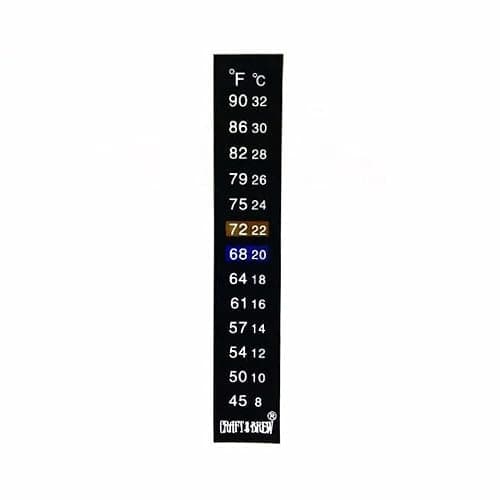
Craft a Brew Fermometer Adhesive Strip Thermometer
A four-inch liquid crystal strip that sticks to the glass and reads the liquid rather than the air, which is the distinction that matters.
Who it is for. Every brewer. This is the cheapest way to stop guessing what temperature the batch is at.
Published specifications
Size
Approximately 0.75 x 4 in
Reads
Fahrenheit and Celsius
Application
External fermenter surface
Compatible surfaces
Glass, plastic and stainless steel fermenters
How it works
“changes color to display the current temperature of the fermenting liquid inside the vessel”
Temperature range
Not published by this maker. Comparable fermentation strips are sold in bands such as 46-82 F, 57-90 F and 46-93 F.
Accuracy
Not published
Sold as
A 5 pack on the Amazon listing; the maker's own store lists it as a single strip
Source: Craft a Brew published Fermometer specification (size, display units, compatible surfaces, operating principle), craftabrew.com/products/fermometer-adhesive-strip-thermometer, fetched 2026-09-01. Comparable-strip ranges from retailer listings, cited as comparisons only.
Rubric — 7.4 / 10
Materials7/10 · weight 28%
Documentation5/10 · weight 22%
Capacity fit8/10 · weight 16%
Cleaning8/10 · weight 18%
Value10/10 · weight 16%
What it gets right
It reads through the glass, so it tells you what the kombucha is at rather than what the shelf is at — those differ by several degrees on a sunny afternoon
It costs less than a cup of coffee and never needs a battery
It sticks to glass, plastic and stainless, so it moves with you if you change vessels
Always visible, which means you actually look at it
What it costs you
Neither range nor accuracy is published for this specific strip
Liquid crystal strips read in bands, so you get “about 76” rather than 76.2
The two listings disagree on whether it is reusable — the Amazon listing calls it reusable, the maker's own spec page says nothing about removing or reapplying it
Skip it if. You want a logged, numeric record. A strip is a glance, not a measurement you can write down with confidence.
#4 · Storing finished kombucha, not carbonating it
IKEA KORKEN Bottle with Stopper, 1 L (34 oz)
A cheap, well-dimensioned liter bottle with a clamp stopper and a published dishwasher limit — good storage, and explicitly the wrong tool for building pressure.
Who it is for. Someone who wants somewhere tidy to keep finished kombucha in the fridge, cheaply.
Source: IKEA published KORKEN product specification (capacity, 29 cm height, 9 cm diameter, materials, 70 C dishwasher limit), ikea.com KORKEN product page, retrieved 2026-09-01
Rubric — 8.1 / 10
Materials7/10 · weight 28%
Documentation8/10 · weight 22%
Capacity fit8/10 · weight 16%
Cleaning9/10 · weight 18%
Value9/10 · weight 16%
What it gets right
The cheapest liter bottle here by a wide margin, and the dimensions are published
A stainless wire and a polypropylene lid are both fine against kombucha’s acidity
A stated dishwasher temperature limit is unusually specific for a bottle at this price
Excellent for cold storage of finished, already-carbonated kombucha
What it costs you
No pressure rating and no carbonation claim anywhere in the product information
Clear glass
The stopper is a storage closure, not a pressure closure — treat it that way
Skip it if. You are doing a second ferment on the counter. Nothing published about this bottle supports holding carbonation pressure; use a rated swing top instead.
#ad No live price feed yet, so no number is shown rather than a stale one. How this is funded.
FAQ
Questions people actually ask
Why do kombucha bottles explode?+
Because a second ferment is a sealed pressure vessel and the yeast kept working longer, warmer or with more sugar than expected. Carbonation and pressure are the same process, so anything that makes a bottle fizzier also makes it more likely to fail. The three drivers are added sugar, room temperature and elapsed time.
How do I know when to refrigerate kombucha bottles?+
Fill one ordinary plastic soda bottle from the same batch and squeeze it once a day. While it flexes, the batch is still building. When it has gone rock hard, the glass bottles beside it are at the same pressure and the whole batch should go in the fridge. It is free and it replaces guesswork with something you can feel.
Are swing top bottles safe for kombucha?+
Good ones are, and one on this site publishes a figure: the EZ Cap 16 oz amber states 100 PSI. Most swing tops publish nothing at all, which does not make them unsafe but does mean the maker never committed to a number. What is genuinely unsuitable is a clamp-stopper storage bottle or a decorative bottle sold for oil or syrup.
Should I burp my kombucha bottles?+
It works as a safety valve and it costs you carbonation, since every burp releases gas you were building. A better default is a plastic tester bottle plus a shorter conditioning window, with burping reserved for when the tester says pressure is high and refrigeration is not available yet.
How do I open an over-carbonated bottle safely?+
Chill it for a few hours first, because cold liquid holds more dissolved gas and the headspace pressure drops. Then open it slowly in a sink, with a cloth over the top, letting it vent in stages rather than releasing it all at once. Do not force a warm, rock-hard bottle over a table.
Does a bigger bottle explode more easily?+
The risk is driven by pressure rather than volume, but a larger bottle is a worse failure when it happens and it takes longer to chill, which means it is slower to stop. A 16 oz bottle cools quickly and limits the loss. That is one practical argument for bottling a gallon into seven small bottles rather than three big ones.
How long should kombucha condition in the bottle?+
In most kitchens one to three days, but treat that as a range rather than an instruction. Warmth and added sugar both shorten it, and a bottle in a 78 F room with juice in it can be where you want it inside 24 hours. Rather than working to a schedule, fill a plastic tester bottle from the same batch, squeeze it daily, and refrigerate everything when it stops giving under your thumb.
Sources
Every specification cited on this page came from one of these documents, retrieved on the date shown against the product it belongs to.