Temperature is the single variable that decides how fast everything else happens. Most brewing problems are temperature problems wearing a disguise.
By Scooter M.·Published September 1, 2026 · Updated September 26, 2026
The short answer
Between about 75 and 85 F. Below roughly 70 F the yeast slows dramatically and the batch stalls; above about 85 F it ferments fast and thin and turns sour quickly. Measure the liquid, not the room — an adhesive strip on the glass reads through it.
What happens at each temperature
Working bands for a kombucha first fermentation.
Temperature
What happens
Verdict
Below 65 F
Near-dormant. A batch can sit for weeks tasting like sweet tea.
Too cold. Fix it.
65-70 F
Very slow. Long time above pH 4.2, which is the risky window.
Too cold.
70-75 F
Works, slowly. Two weeks or more per batch.
Acceptable, not ideal.
75-85 F
The band. Seven to fourteen days, good balance of acid and flavor.
Target.
85-90 F
Fast and thin. Sour quickly, less complex.
Too warm.
Above 90 F
Stresses the culture. Off flavors.
Too hot.
Craft a Brew publishes a 7-to-14-day window for its kit and names temperature as the variable, which is a more honest framing than the fixed timings most recipes give. The time a batch takes is an output, not a setting.
The jar is not the room
This distinction accounts for a large share of confused brewers. A wall thermometer reads air. Your batch is a gallon of liquid, which has far more thermal mass than the air around it, and which sits on a surface that may be much colder or warmer than ambient.
A jar in afternoon sun can run several degrees above the room. A jar on a stone countertop in an unheated kitchen can run below it, and stay there long after the air has warmed up. An adhesive liquid-crystal strip stuck to the glass reads through it and tells you what the kombucha is actually at — which is the number the culture responds to. Thermometers covers the options.
Fixing a kitchen that is too cold
In order of cost, and you should genuinely try them in this order:
Move the jar. Free. The top of a fridge, a high shelf, an airing cupboard, or near — never on — a radiator. Warm air rises, so a high shelf in the same room can be several degrees warmer than a counter.
Insulate it. Nearly free. A towel wrapped around the jar buffers overnight swings, which matters more than the daytime average in a house with the heating off at night.
Add a heat mat, with a controller. VIVOSUN publishes 18 W for its 10 x 20.75 in seedling mat, and also publishes that it reaches around 104 F from a 68 to 77 F ambient — well above the band. Used bare, it over-ferments. An Inkbird ITC-308 holds a setpoint to a stated ±1 C. Heating mats.
Brew jun instead. Genuinely worth considering. Jun runs cooler by nature, so a house that stalls kombucha may be exactly right for it. Jun vs kombucha.
The picks
Measure first, then heat
A strip that reads the jar rather than the room, and — only if that reading is genuinely low — a mat and the controller that makes the mat safe to leave alone.
Craft a Brew
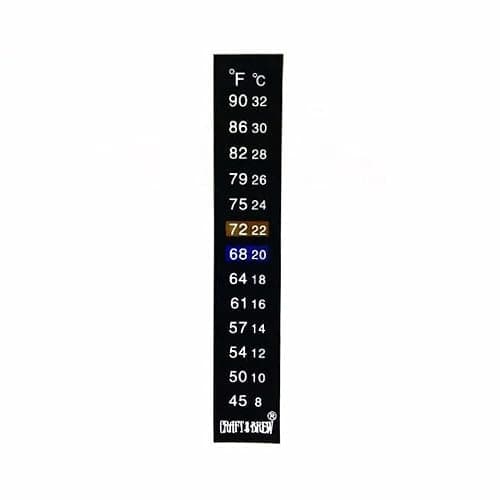
Fermometer Adhesive Strip Thermometer
A four-inch liquid crystal strip that sticks to the glass and reads the liquid rather than the air, which is the distinction that matters.
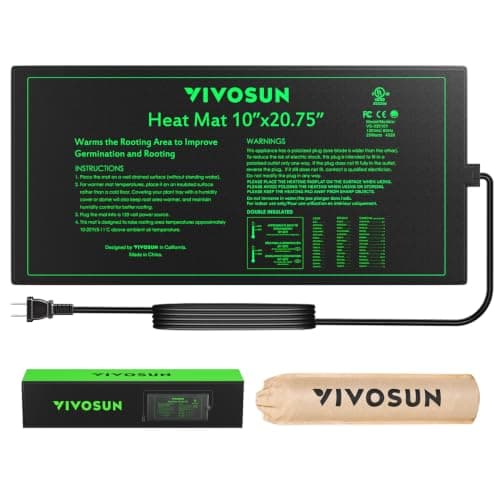
Eighteen watts, IP67, MET-certified, and published to reach about 104 F from a 68-77 F ambient — which is more heat than kombucha wants, so it belongs under a controller.
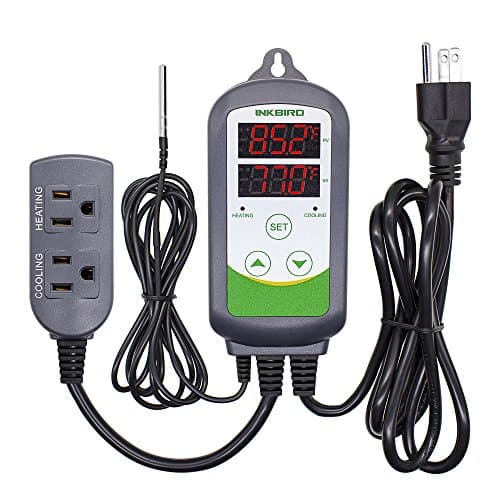
A dual-stage thermostat with published relay ratings and a stated plus or minus 1 C accuracy, which is what turns a 104 F heat mat into a jar held at 78 F.
Less common but real, particularly in summer. A batch running at 88 or 90 F finishes fast, tastes thin and sour, and can stress the culture.
Move it lower and further from the sun. A floor-level cupboard is usually the coolest place in a kitchen.
Shorten the ferment. At 88 F a batch that would take twelve days at 76 F may be done in five, so taste and test from day four.
Keep it out of the fridge. Refrigeration does not slow a kombucha batch usefully; it stops it, and restarting a cold culture takes a batch or two.
Temperature in the second ferment too
The same variable drives bottle conditioning. Warm bottles carbonate in a day; cool ones take four or five. A cold spot is one of the three usual causes of a batch that will not carbonate, along with a tired gasket and too little sugar at bottling. The full diagnostic runs them in order.
Temperature is also the commonest reason a batch overshoots in the other direction. A jar at 82 F finishes far sooner than the same jar at 72 F, which is why a schedule that worked in March produces vinegar in July — why your kombucha tastes like vinegar runs the causes in order of likelihood.
Knowing the band is one thing; knowing what your jar is actually at is another. The Fermometer review covers the cheap stick-on strip that reads the liquid through the glass rather than reading the room, and what it does not tell you.
Heads up: some links on this page are affiliate links. If you buy through one we may earn a commission at no extra cost to you. It never changes a ranking, and we take no payment for placement. The full version.
The short answer
Quick picks
Ranked on the published rubric. Every row jumps to that product's full write-up below; the button goes straight to Amazon.
#
Product
Best for
Score
Price
1
Craft a Brew
Fermometer Adhesive Strip Thermometer
A four-inch liquid crystal strip that sticks to the glass and reads the liquid rather than the air, which is the distinction that matters.
Eighteen watts, IP67, MET-certified, and published to reach about 104 F from a 68-77 F ambient — which is more heat than kombucha wants, so it belongs under a controller.
A dual-stage thermostat with published relay ratings and a stated plus or minus 1 C accuracy, which is what turns a 104 F heat mat into a jar held at 78 F.
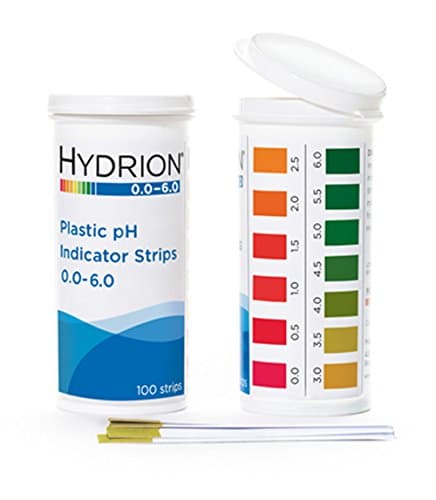
A 0.0 to 6.0 range in 0.5 steps, which puts four separate color matches inside the 2.5 to 3.5 window kombucha lives in — a 1-to-14 strip gives you one.
Craft a Brew Fermometer Adhesive Strip Thermometer
A four-inch liquid crystal strip that sticks to the glass and reads the liquid rather than the air, which is the distinction that matters.
Who it is for. Every brewer. This is the cheapest way to stop guessing what temperature the batch is at.
Published specifications
Size
Approximately 0.75 x 4 in
Reads
Fahrenheit and Celsius
Application
External fermenter surface
Compatible surfaces
Glass, plastic and stainless steel fermenters
How it works
“changes color to display the current temperature of the fermenting liquid inside the vessel”
Temperature range
Not published by this maker. Comparable fermentation strips are sold in bands such as 46-82 F, 57-90 F and 46-93 F.
Accuracy
Not published
Sold as
A 5 pack on the Amazon listing; the maker's own store lists it as a single strip
Source: Craft a Brew published Fermometer specification (size, display units, compatible surfaces, operating principle), craftabrew.com/products/fermometer-adhesive-strip-thermometer, fetched 2026-09-01. Comparable-strip ranges from retailer listings, cited as comparisons only.
Rubric — 7.4 / 10
Materials7/10 · weight 28%
Documentation5/10 · weight 22%
Capacity fit8/10 · weight 16%
Cleaning8/10 · weight 18%
Value10/10 · weight 16%
What it gets right
It reads through the glass, so it tells you what the kombucha is at rather than what the shelf is at — those differ by several degrees on a sunny afternoon
It costs less than a cup of coffee and never needs a battery
It sticks to glass, plastic and stainless, so it moves with you if you change vessels
Always visible, which means you actually look at it
What it costs you
Neither range nor accuracy is published for this specific strip
Liquid crystal strips read in bands, so you get “about 76” rather than 76.2
The two listings disagree on whether it is reusable — the Amazon listing calls it reusable, the maker's own spec page says nothing about removing or reapplying it
Skip it if. You want a logged, numeric record. A strip is a glance, not a measurement you can write down with confidence.
VIVOSUN Waterproof Seedling Heat Mat, 10 x 20.75 in
Eighteen watts, IP67, MET-certified, and published to reach about 104 F from a 68-77 F ambient — which is more heat than kombucha wants, so it belongs under a controller.
Who it is for. Anyone brewing in a room that drops below 70 F, paired with a controller rather than plugged straight into the wall.
Published specifications
Size
10 x 20.75 in
Power
18 W
Certification
UL and MET certified
Water resistance
IP67
Stated operating band
Maintains around 68-86 F (20-30 C)
Stated maximum
“can be heated up to 40 C (104 F) at an ambient temperature of 20-25 C (68-77 F)”
Tray compatibility
Fits standard 1020 trays
Thermostat
Not included
Source: VIVOSUN published heat mat specification (dimensions, 18 W, UL and MET certification, IP67, temperature band and stated maximum against ambient), vivosun.com heat mat product page, retrieved 2026-09-01
Rubric — 8.6 / 10
Materials8/10 · weight 28%
Documentation9/10 · weight 22%
Capacity fit8/10 · weight 16%
Cleaning9/10 · weight 18%
Value9/10 · weight 16%
What it gets right
18 W is a trickle of heat, which is the right scale for nudging a jar a few degrees rather than cooking it
IP67 means a spill on the mat is a wipe rather than an incident, and fermentation is a wet hobby
UL and MET certification is stated, which is worth checking on anything that runs unattended for weeks
The published maximum is stated against a specific ambient, so you can reason about what it will do in your room
What it costs you
104 F is well above kombucha’s 75-85 F band — used bare, this mat will over-ferment a batch
No thermostat included, and it needs one
A mat under a jar heats the bottom, which drives convection but reads warmer at the base than at the surface
Skip it if. Your house sits at 75 F already. You do not have a temperature problem, and adding heat without a controller creates one.
A dual-stage thermostat with published relay ratings and a stated plus or minus 1 C accuracy, which is what turns a 104 F heat mat into a jar held at 78 F.
Who it is for. Anyone who has bought a heat mat. The mat without the controller is the mistake; this is the other half.
Published specifications
Control range
-50 to 120 C (-58 to 248 F)
Accuracy
+/- 1 C (+/- 2 F)
Display resolution
0.1 C/F below 100 C/F; 1 C/F at or above 100 C/F
Relay capacity
Heating 10 A at 100-240 VAC; cooling 10 A at 100-240 VAC
Maximum load
1100 W at 110 VAC; 2200 W at 220 VAC
Input
100-240 VAC, 50/60 Hz, 10 A maximum
Outputs
Dual relay, separate heating and cooling setpoints, dual display
Protection
Compressor delay protection, high and low temperature alarms, sensor fault alarm
Source: Inkbird published ITC-308 specification (control range, accuracy, resolution, relay capacity, maximum load, alarms), inkbird.com/products/temperature-controller-itc-308, retrieved 2026-09-01
Rubric — 8.4 / 10
Materials8/10 · weight 28%
Documentation10/10 · weight 22%
Capacity fit8/10 · weight 16%
Cleaning8/10 · weight 18%
Value8/10 · weight 16%
What it gets right
Plus or minus 1 C is tight enough that a kombucha ferment stays inside a two-degree window all week
Dual stage means the same unit can drive a heat mat in winter and a fan or a cooler in summer
The sensor-fault alarm matters: a probe that falls out without an alarm is a batch cooked at full mat temperature
Relay ratings and maximum wattage are published, so you can check a mat or a fridge against it before plugging anything in
What it costs you
The probe is designed to sit against a vessel or in a thermowell, and taping it to the outside of a jar reads the room as much as the liquid
It costs several times what the mat costs
-50 to 120 C is an enormous range for a job that needs 20 to 30 C, and the extra range buys nothing here
Skip it if. You are not running a heater or a cooler. A controller with nothing to switch is an expensive thermometer.
A 0.0 to 6.0 range in 0.5 steps, which puts four separate color matches inside the 2.5 to 3.5 window kombucha lives in — a 1-to-14 strip gives you one.
Who it is for. Every kombucha brewer. This is the cheapest instrument on the site and the one that answers the safety question.
#ad No live price feed yet, so no number is shown rather than a stale one. How this is funded.
FAQ
Questions people actually ask
What temperature should kombucha be brewed at?+
Between about 75 and 85 F. Below roughly 70 F the yeast slows sharply and the batch stalls; above about 85 F it ferments fast and thin and turns sour quickly.
Can kombucha ferment at room temperature?+
It depends on your room. A kitchen sitting at 76 F is ideal; one at 66 F will barely ferment at all. That is why the measurement that matters is a strip on the jar rather than an assumption about what 'room temperature' means in your house.
What happens if kombucha gets too hot?+
It ferments fast and thin, turns sour quickly, and above about 90 F the culture is genuinely stressed and off flavors appear. Move the jar lower and away from sun, and shorten the ferment — a batch at 88 F may be done in five days.
Will my kombucha survive a cold spell?+
Almost certainly. Cold stalls a batch rather than killing it. A jar that has sat at 65 F for a fortnight tasting like sweet tea will usually restart within a couple of days of being moved somewhere warm.
Where is the best place in a house to brew kombucha?+
Somewhere warm, dark, undisturbed and away from bins and fruit bowls. Warm air rises, so a high shelf or the top of a cupboard is often several degrees warmer than a counter in the same room, and costs nothing to try.
Sources
Every specification cited on this page came from one of these documents, retrieved on the date shown against the product it belongs to.
Chlorine versus chloramine, what boiling and standing overnight actually remove, and the published flow rate a carbon filter needs to handle chloramine.