Most first-batch anxiety is not knowing what normal looks like. Here is the whole fortnight, with the things that alarm people marked as fine.
By Scooter M.·Published September 1, 2026 · Updated September 26, 2026
The short answer
Days 1 to 3: not much visible, but the pH should be falling. Days 3 to 7: a thin film forms across the surface and yeast strands appear. Days 7 to 14: taste and test until it suits you. The whole timeline stretches or compresses with temperature.
The fortnight
A first batch at 75 to 85 F. In a cooler room, everything below happens later.
When
What you should see
Is it normal?
Day 0
Sweet tea, a pellicle floating or sunk, no activity
Yes. Buoyancy means nothing.
Day 1
Nothing visible. pH already below 4.5 from the starter tea
Yes
Day 2-3
Faint bubbles at the edges. pH heading below 4.2
Yes — this is the important part
Day 3-5
A thin translucent film across the surface
Yes. That is a new pellicle.
Day 5-7
Brown stringy strands hanging below the surface
Yes. Yeast. Alarming and healthy.
Day 7
Noticeably tart on tasting. Film thickening
Yes. Start tasting daily.
Day 7-14
Continued souring; the new pellicle thickens and whitens
Yes
Day 14+
Sharply sour, possibly vinegary
Fine, but past most people's preference
The four things that alarm people and are fine
The pellicle sank. Buoyancy depends on gas trapped in the mat and varies constantly. Floating, sinking and standing on edge are all normal and none indicates anything about health.
Brown stringy things. Yeast. It looks like something has gone badly wrong and it is a sign of an active culture. It settles at the bottom and hangs from the pellicle.
Brown patches on the new pellicle. Usually tea staining, particularly with black tea. Flat and wet, not raised and fuzzy.
Two pellicles, or a lumpy one. The old one and the new one, or a new one forming unevenly because the jar was moved. Neither is a problem.
The one thing that is not fine: anything fuzzy, dry and raised above the surface, in blue, green, black or white spots. That is mold, and the batch and the culture both go.
Two checkpoints worth keeping
Day 3: has the pH passed 4.2? This is the safety checkpoint. Above it, the batch is still relying on whatever protection the starter tea gave it; below, it has built its own. If it has not moved by day three in a warm room, look at the temperature before anything else.
Day 7: what does it taste like? This is the preference checkpoint. It should be recognizably tart. Sweet at day seven in a warm room means the batch is slow; sweet at day seven in a cold room means the room is the problem.
The picks
What turns a first batch from a mystery into a process
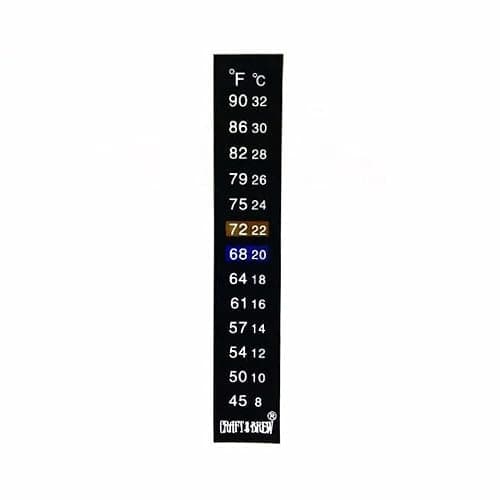
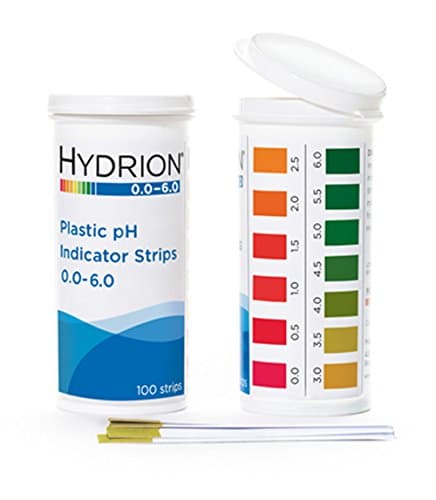
A strip on the glass and a vial of pH strips answer both checkpoints above. The culture is the third thing, and the only one with no substitute.
Craft a Brew
Fermometer Adhesive Strip Thermometer
A four-inch liquid crystal strip that sticks to the glass and reads the liquid rather than the air, which is the distinction that matters.
A 0.0 to 6.0 range in 0.5 steps, which puts four separate color matches inside the 2.5 to 3.5 window kombucha lives in — a 1-to-14 strip gives you one.
Every row in that table assumes 75 to 85 F. At 70 F, expect everything to take roughly half as long again. At 66 F, a batch can genuinely sit for three weeks looking almost unchanged.
This is not a failed batch and it does not mean the culture is dead. Move the jar somewhere warmer — the top of a fridge, a high shelf, an airing cupboard — and it will usually start moving within a couple of days. Temperature covers the fixes in order of cost.
What happens after day fourteen
Nothing dramatic. The batch keeps getting more sour and eventually approaches vinegar. It stays safe — the acidity is the protection — but it stops being pleasant to drink.
A batch that has gone too far is not wasted. It is excellent starter tea for the next round, it works as a drinking vinegar diluted heavily, and it is a good base for a second ferment with plenty of fruit, which brings the sweetness back up.
There is a third checkpoint nobody schedules, which is the day the batch goes past where you wanted it. That is a timing and temperature problem rather than a broken culture, and why your kombucha tastes like vinegar covers the four causes and what to do with the sour batch you already have.
Every day on this timeline assumes the jar is in the right temperature band, and the cheapest way to know that is a strip on the glass. The Fermometer review covers what it reads, what its maker declines to publish, and where to stick it.
Heads up: some links on this page are affiliate links. If you buy through one we may earn a commission at no extra cost to you. It never changes a ranking, and we take no payment for placement. The full version.
The short answer
Quick picks
Ranked on the published rubric. Every row jumps to that product's full write-up below; the button goes straight to Amazon.
#
Product
Best for
Score
Price
1
Craft a Brew
Fermometer Adhesive Strip Thermometer
A four-inch liquid crystal strip that sticks to the glass and reads the liquid rather than the air, which is the distinction that matters.
A 0.0 to 6.0 range in 0.5 steps, which puts four separate color matches inside the 2.5 to 3.5 window kombucha lives in — a 1-to-14 strip gives you one.
Craft a Brew Fermometer Adhesive Strip Thermometer
A four-inch liquid crystal strip that sticks to the glass and reads the liquid rather than the air, which is the distinction that matters.
Who it is for. Every brewer. This is the cheapest way to stop guessing what temperature the batch is at.
Published specifications
Size
Approximately 0.75 x 4 in
Reads
Fahrenheit and Celsius
Application
External fermenter surface
Compatible surfaces
Glass, plastic and stainless steel fermenters
How it works
“changes color to display the current temperature of the fermenting liquid inside the vessel”
Temperature range
Not published by this maker. Comparable fermentation strips are sold in bands such as 46-82 F, 57-90 F and 46-93 F.
Accuracy
Not published
Sold as
A 5 pack on the Amazon listing; the maker's own store lists it as a single strip
Source: Craft a Brew published Fermometer specification (size, display units, compatible surfaces, operating principle), craftabrew.com/products/fermometer-adhesive-strip-thermometer, fetched 2026-09-01. Comparable-strip ranges from retailer listings, cited as comparisons only.
Rubric — 7.4 / 10
Materials7/10 · weight 28%
Documentation5/10 · weight 22%
Capacity fit8/10 · weight 16%
Cleaning8/10 · weight 18%
Value10/10 · weight 16%
What it gets right
It reads through the glass, so it tells you what the kombucha is at rather than what the shelf is at — those differ by several degrees on a sunny afternoon
It costs less than a cup of coffee and never needs a battery
It sticks to glass, plastic and stainless, so it moves with you if you change vessels
Always visible, which means you actually look at it
What it costs you
Neither range nor accuracy is published for this specific strip
Liquid crystal strips read in bands, so you get “about 76” rather than 76.2
The two listings disagree on whether it is reusable — the Amazon listing calls it reusable, the maker's own spec page says nothing about removing or reapplying it
Skip it if. You want a logged, numeric record. A strip is a glance, not a measurement you can write down with confidence.
A 0.0 to 6.0 range in 0.5 steps, which puts four separate color matches inside the 2.5 to 3.5 window kombucha lives in — a 1-to-14 strip gives you one.
Who it is for. Every kombucha brewer. This is the cheapest instrument on the site and the one that answers the safety question.
#ad No live price feed yet, so no number is shown rather than a stale one. How this is funded.
#3 · A one-gallon first batch
Fermentaholics Organic Kombucha SCOBY with 12 fl oz Starter Tea
A hand-selected pellicle with twelve fluid ounces of mature starter tea, measured against the maker’s own published ten percent rule for a gallon.
Who it is for. Anyone starting a standard one-gallon batch who wants the starter tea measured for them.
Published specifications
Batch size
One gallon
Starter tea volume
12 fl oz of mature, active starter tea
Pellicle
Hand-selected
Starter tea ingredients
Organic cane sugar, filtered water, organic black tea, live cultures
Certification
USDA Certified Organic, Kosher, Non-GMO, vegan
Production
Grown in the maker’s licensed lab
Maker’s dosing rule
“the rule of thumb is to use 10% starter tea per batch size”
Source: Fermentaholics published SCOBY specification (12 fl oz starter tea, 1-gallon dosing, ingredients, certifications) and its published 10 percent starter rule, retrieved 2026-09-01
Rubric — 8.5 / 10
Materials9/10 · weight 28%
Documentation9/10 · weight 22%
Capacity fit8/10 · weight 16%
Cleaning8/10 · weight 18%
Value8/10 · weight 16%
What it gets right
12 fl oz against a 128 oz gallon is 9.4 percent, within a rounding error of the maker’s own 10 percent rule — the quantity matches the instruction
Starter tea is the part that actually acidifies a new batch and protects it from mold; the pellicle is mostly a raft
Ingredients of the starter tea are published, which almost no culture seller does
Certified organic, kosher, non-GMO and vegan are stated together
What it costs you
A live culture in transit is a live culture in transit — heat and delay are real risks nobody controls
No stated shelf life once it arrives
You still need tea, sugar and a jar
Skip it if. You are brewing half a gallon. Buy the half-gallon version instead; a gallon’s worth of starter in a half-gallon batch drives the acidity too far, too fast.
Seven to fourteen days at 75 to 85 F. In a cooler room everything takes longer — at 70 F expect roughly half as long again, and at 66 F a batch can sit for three weeks looking almost unchanged.
When should a new SCOBY start forming?+
A thin translucent film usually appears across the surface between days three and five in a warm room, and thickens from there. It starts almost invisible and is easy to miss until it is a few days old.
Why is my kombucha still sweet after a week?+
Almost always temperature. Below about 70 F the culture works so slowly that a batch can taste like sweet tea after a fortnight. Check a thermometer strip on the jar before concluding anything is wrong with the culture.
What are the brown stringy bits in my kombucha?+
Yeast. It hangs below the pellicle and settles at the bottom, it looks alarming, and it is a sign of an active healthy culture. Strain it out at bottling if you would rather not have it in the glass.
Can I leave kombucha fermenting longer than two weeks?+
Yes, and it stays safe — the acidity is the protective mechanism. It simply gets more sour, eventually approaching vinegar. An over-fermented batch makes excellent starter tea and a good base for a second ferment with fruit.
Sources
Every specification cited on this page came from one of these documents, retrieved on the date shown against the product it belongs to.