Jun is often described as kombucha's refined cousin. The differences that matter are the feedstock, the temperature and the fact that you cannot make one into the other.
By Scooter M.·Published September 1, 2026 · Updated September 14, 2026
The short answer
Jun ferments green tea and honey; kombucha ferments black tea and cane sugar. Jun runs cooler and finishes faster, and it needs its own culture — feeding a kombucha SCOBY honey does not convert it, it weakens it. Start jun with a jun culture or do not start it.
The differences, side by side
Working characteristics of the two ferments.
Kombucha
Jun
Tea
Black, or green
Green
Sweetener
Plain cane sugar
Raw honey
Culture
Kombucha SCOBY
A distinct jun culture
Typical temperature
75-85 F
Cooler — comfortably below kombucha's band
Typical first ferment
7-14 days
Faster, often under a week
Flavor
Sour, tea-forward, robust
Lighter, floral, less sharp
Cost per batch
Low — sugar is cheap
Higher — honey is not
The culture is the real difference
Everything else on that table follows from this one. A jun culture is a different community of organisms, adapted to honey and to a cooler environment. It is not a kombucha SCOBY that has been given different food.
Which is why the widely circulated shortcut — feed your kombucha SCOBY honey for a few batches and it becomes a jun culture — does not work. Raw honey carries its own antimicrobial properties and its own microbial population, and a kombucha culture put on it tends to slow, thin and struggle rather than adapt. You end up with a weak kombucha culture and no jun.
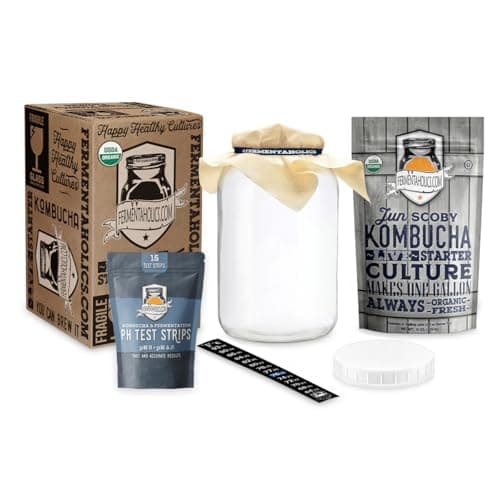
Buy a jun culture as a jun culture. Fermentaholics sells one as a USDA Certified Organic jun kit, structured the same way as its Essentials kombucha kit.
Temperature is the practical advantage
Kombucha wants roughly 75 to 85 F, and a great many kitchens simply do not sit there for half the year. Jun runs cooler, which makes it genuinely easier in a cold house — the ferment that stalls a kombucha batch is closer to jun's comfortable range.
If your kombucha keeps stalling and you have concluded the problem is the culture, check the temperature first. If the room is the problem and you would rather not run a heat mat, jun is a legitimate answer rather than a workaround.
The picks
Starting jun, or checking whether you need to
A jun culture bought as a jun culture, a strip that tells you what your room is actually doing, and the kombucha culture if the answer turns out to be that your kitchen is fine.
Fermentaholics
Essentials Jun Kombucha Brewing Kit
A jun culture is a different organism community to a kombucha SCOBY, and it will not appear by feeding a kombucha culture honey — this is the way to start jun properly.
Jun uses raw honey, and raw honey is a live product with antimicrobial activity of its own. That is precisely why it needs a culture adapted to it, and it is also why jun batches are more sensitive to honey quality than kombucha batches are to sugar quality — plain white sugar is inert, honey is not.
It is also considerably more expensive per batch, and jun uses a lot of it. That is a real running cost, and it is worth knowing before you commit rather than after your third gallon.
Which should you brew?
Kombucha, if you are starting out. Cheaper per batch, more forgiving, far more written about it, and the culture is easier to source. The skills transfer completely.
Jun, if your house is cold. This is the strongest practical argument for it and it is a genuinely good one.
Jun, if you want the flavor. Lighter, more floral, less sharp. It is a real difference and some people much prefer it.
Kombucha, if cost matters. Sugar against honey, batch after batch, is not a small gap.
If jun is on your list because kombucha does not suit your kitchen or your household, it is worth seeing the other options at the same time. Kits for the ferments that are not kombucha compares jun against water and milk kefir on the thing that actually decides it: how often each one needs you.
Which leaves the practical question this page does not answer: where to get one, and what should be in the box when it arrives. Buying a jun SCOBY covers the published starter tea volumes and whether to buy the culture alone or the kit around it.
If jun is the one you want, the practical next step is the method rather than another comparison. How to make jun walks a one-gallon batch from brewing the green tea to bottling it, using the published starter ratio.
Heads up: some links on this page are affiliate links. If you buy through one we may earn a commission at no extra cost to you. It never changes a ranking, and we take no payment for placement. The full version.
The short answer
Quick picks
Ranked on the published rubric. Every row jumps to that product's full write-up below; the button goes straight to Amazon.
#
Product
Best for
Score
Price
1
Fermentaholics
Essentials Jun Kombucha Brewing Kit
A jun culture is a different organism community to a kombucha SCOBY, and it will not appear by feeding a kombucha culture honey — this is the way to start jun properly.
Fermentaholics Essentials Jun Kombucha Brewing Kit
A jun culture is a different organism community to a kombucha SCOBY, and it will not appear by feeding a kombucha culture honey — this is the way to start jun properly.
Who it is for. Someone who has read that jun is lighter and faster, and wants the culture that actually does that.
Published specifications
Culture
USDA Certified Organic jun culture
Feedstock
Green tea and honey, not black tea and sugar
Kit type
Essentials — jar, cover, band, culture
Certification
USDA Certified Organic
Source: Fermentaholics published Jun kit listing, fermentaholics.com/product/essentials-jun-kombucha-brewing-kit/, retrieved 2026-09-01
Rubric — 7.2 / 10
Materials8/10 · weight 28%
Documentation6/10 · weight 22%
Capacity fit7/10 · weight 16%
Cleaning8/10 · weight 18%
Value7/10 · weight 16%
What it gets right
A jun culture bought as a jun culture is the only reliable way to get one — converting a kombucha SCOBY to honey is a well-known way to weaken it
Same Essentials structure as the kombucha kit, so the jar and cover are the parts you already understand
Jun ferments cooler and faster than kombucha, which suits a house that never gets to 78F
What it costs you
Honey is meaningfully more expensive per batch than cane sugar, and jun wants a lot of it
Fewer published details than the kombucha kits from the same maker
No tea, sugar, honey or pH strips included
Skip it if. You have not brewed kombucha yet. Jun is less forgiving of a cold room and a weak starter; the ordinary kombucha route teaches the same skills more cheaply.
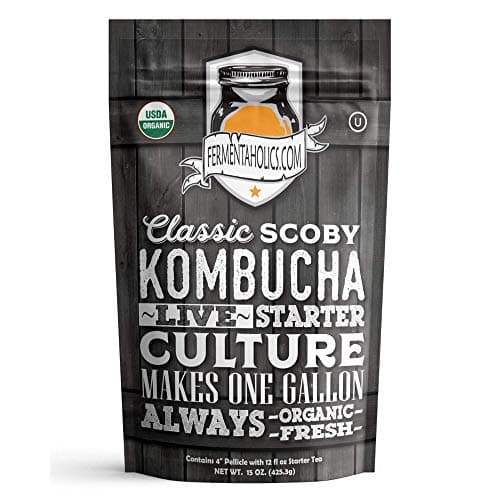
Fermentaholics Organic Kombucha SCOBY with 12 fl oz Starter Tea
A hand-selected pellicle with twelve fluid ounces of mature starter tea, measured against the maker’s own published ten percent rule for a gallon.
Who it is for. Anyone starting a standard one-gallon batch who wants the starter tea measured for them.
Published specifications
Batch size
One gallon
Starter tea volume
12 fl oz of mature, active starter tea
Pellicle
Hand-selected
Starter tea ingredients
Organic cane sugar, filtered water, organic black tea, live cultures
Certification
USDA Certified Organic, Kosher, Non-GMO, vegan
Production
Grown in the maker’s licensed lab
Maker’s dosing rule
“the rule of thumb is to use 10% starter tea per batch size”
Source: Fermentaholics published SCOBY specification (12 fl oz starter tea, 1-gallon dosing, ingredients, certifications) and its published 10 percent starter rule, retrieved 2026-09-01
Rubric — 8.5 / 10
Materials9/10 · weight 28%
Documentation9/10 · weight 22%
Capacity fit8/10 · weight 16%
Cleaning8/10 · weight 18%
Value8/10 · weight 16%
What it gets right
12 fl oz against a 128 oz gallon is 9.4 percent, within a rounding error of the maker’s own 10 percent rule — the quantity matches the instruction
Starter tea is the part that actually acidifies a new batch and protects it from mold; the pellicle is mostly a raft
Ingredients of the starter tea are published, which almost no culture seller does
Certified organic, kosher, non-GMO and vegan are stated together
What it costs you
A live culture in transit is a live culture in transit — heat and delay are real risks nobody controls
No stated shelf life once it arrives
You still need tea, sugar and a jar
Skip it if. You are brewing half a gallon. Buy the half-gallon version instead; a gallon’s worth of starter in a half-gallon batch drives the acidity too far, too fast.
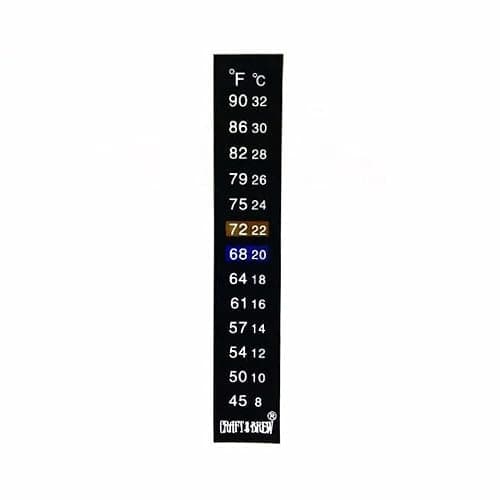
Craft a Brew Fermometer Adhesive Strip Thermometer
A four-inch liquid crystal strip that sticks to the glass and reads the liquid rather than the air, which is the distinction that matters.
Who it is for. Every brewer. This is the cheapest way to stop guessing what temperature the batch is at.
Published specifications
Size
Approximately 0.75 x 4 in
Reads
Fahrenheit and Celsius
Application
External fermenter surface
Compatible surfaces
Glass, plastic and stainless steel fermenters
How it works
“changes color to display the current temperature of the fermenting liquid inside the vessel”
Temperature range
Not published by this maker. Comparable fermentation strips are sold in bands such as 46-82 F, 57-90 F and 46-93 F.
Accuracy
Not published
Sold as
A 5 pack on the Amazon listing; the maker's own store lists it as a single strip
Source: Craft a Brew published Fermometer specification (size, display units, compatible surfaces, operating principle), craftabrew.com/products/fermometer-adhesive-strip-thermometer, fetched 2026-09-01. Comparable-strip ranges from retailer listings, cited as comparisons only.
Rubric — 7.4 / 10
Materials7/10 · weight 28%
Documentation5/10 · weight 22%
Capacity fit8/10 · weight 16%
Cleaning8/10 · weight 18%
Value10/10 · weight 16%
What it gets right
It reads through the glass, so it tells you what the kombucha is at rather than what the shelf is at — those differ by several degrees on a sunny afternoon
It costs less than a cup of coffee and never needs a battery
It sticks to glass, plastic and stainless, so it moves with you if you change vessels
Always visible, which means you actually look at it
What it costs you
Neither range nor accuracy is published for this specific strip
Liquid crystal strips read in bands, so you get “about 76” rather than 76.2
The two listings disagree on whether it is reusable — the Amazon listing calls it reusable, the maker's own spec page says nothing about removing or reapplying it
Skip it if. You want a logged, numeric record. A strip is a glance, not a measurement you can write down with confidence.
#ad No live price feed yet, so no number is shown rather than a stale one. How this is funded.
FAQ
Questions people actually ask
What is the difference between jun and kombucha?+
Jun ferments green tea and honey with its own distinct culture and runs cooler and faster. Kombucha ferments black or green tea and cane sugar with a kombucha SCOBY, and wants roughly 75 to 85 F. The flavor of jun is lighter and more floral.
Can I turn a kombucha SCOBY into a jun culture?+
No. Feeding a kombucha culture honey tends to weaken it rather than adapt it — raw honey carries its own antimicrobial activity and its own microbial population. Jun is sold as a separate culture for exactly this reason.
Is jun healthier than kombucha?+
We are not qualified to make health comparisons and we do not make them. What we can say is that jun uses honey rather than refined sugar and green rather than black tea, which are compositional differences, not established health claims.
Why does jun ferment faster?+
The jun culture is adapted to a cooler working range and to honey as a feedstock, and in practice a jun first fermentation commonly finishes in under a week against kombucha's seven to fourteen days.
Can I brew jun and kombucha at the same time?+
Yes, in separate jars kept apart. Cross-contaminating the two cultures gives you a hybrid that is neither, and there is no practical way to separate them afterwards. Keep separate hotels as well.
Sources
Every specification cited on this page came from one of these documents, retrieved on the date shown against the product it belongs to.