The one culture people most often try to improvise, and the one that least rewards it. Here is what you actually get in the box.
By Scooter M.·Published September 13, 2026 · Updated September 17, 2026
The short answer
Buy a culture sold as jun, from a seller who publishes the volume of starter tea in the box. You cannot make one by feeding a kombucha SCOBY honey — that weakens the culture rather than converting it. If you already own a gallon jar, buy the culture on its own; if you own nothing, the kit bundles the jar, cover and band for not much more.
What a jun culture actually is
Jun is a distinct symbiotic culture adapted to green tea and honey, not a kombucha SCOBY with a different diet. It looks similar in a jar — the same rubbery pellicle floating on the surface — and it behaves quite differently: it works at a lower temperature and finishes faster, which is most of its appeal. Jun vs kombucha compares the two ferments properly.
The conversion myth is worth killing off directly, because it costs people good cultures. Feeding a kombucha SCOBY honey does not adapt it to jun. Honey is antimicrobial by nature, and a culture selected for cane sugar and black tea handles it badly: it slows, thins and produces weaker pellicles over successive rounds. What you get is not jun, it is a struggling kombucha culture.
That is precisely why jun is sold as its own culture, and why the sellers who publish anything at all describe it as a separate organism community rather than a feeding regime.
What to check before you order
Live cultures are the hardest category on this site to buy well, because most listings describe a feeling rather than a quantity. Three things are checkable.
The volume of starter tea, in fluid ounces. This is the number that matters most and the one most sellers omit. The starter tea carries the organisms and the acidity that protect a fresh batch through its vulnerable first days. A pellicle arriving in a splash of liquid is a far weaker start than one arriving in a measured twelve ounces.
The batch size it is dosed for. A culture sold for a gallon and a culture sold for a half gallon are different products. Using gallon-sized starter in a half-gallon batch drives the acidity too far too fast.
Certification, and where it was grown. USDA Organic and kosher marks are cheap signals that someone audited the process, and a seller who names a licensed lab is telling you the culture was grown rather than harvested from a jar.
What you cannot check, and nobody should pretend otherwise, is how the culture survived transit. A live organism in a box travels through unheated and overheated spaces and can sit in a depot over a weekend. That risk is real, it is not the seller's fault, and it is the reason a generous pour of starter tea matters — it is the margin that carries a stressed culture through its first batch.
The published figures
What each jun option publishes, compiled 2026-09-13.
Option
Culture
Starter tea
Also included
Jun Starter Culture
USDA Organic jun SCOBY
12 fl oz, pre-measured
Nothing — culture only
Jun Essentials Kit
USDA Organic jun SCOBY
Not published separately
1-gallon jar, breathable cover, band, thermometer
Twelve fluid ounces against a 128 oz gallon is 9.4 percent, which lands almost exactly on the ten percent starter rule the same maker publishes for its kombucha cultures. That consistency is the strongest signal here: the quantity in the box matches the instruction on the box, which is rarer in this category than it should be.
The picks
The culture, the kit, and the leaf it wants
Buy the culture alone if you own a gallon jar. Buy the kit if you own nothing. Either way jun needs green tea, and a gunpowder green is the leaf the maker points at.
Fermentaholics
Jun Kombucha Starter Culture, 12 fl oz
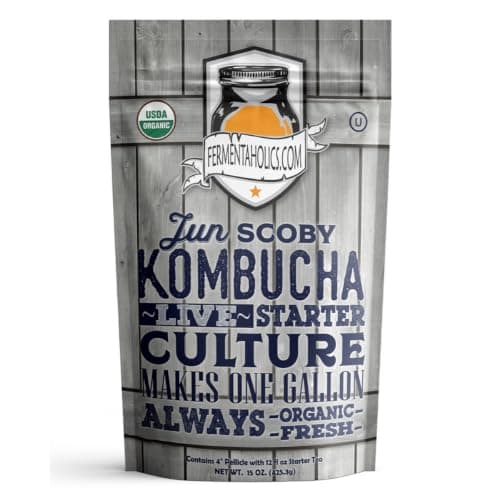
A jun pellicle with twelve fluid ounces of pre-measured mature starter tea — the culture on its own, for anyone who already owns a gallon jar.
A jun culture is a different organism community to a kombucha SCOBY, and it will not appear by feeding a kombucha culture honey — this is the way to start jun properly.
This is the only real decision, and it turns entirely on whether you already brew.
If you have a kombucha jar, you have everything jun needs except the culture. The vessel is identical, the cloth cover is identical, the band is identical, and the bottles for a second ferment are identical. Buying a kit means buying a second gallon jar you do not need, and the glass is the single largest line item in any kit.
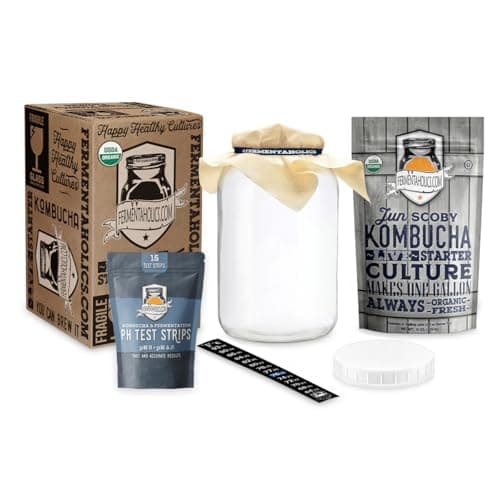
If you own nothing, the kit is the better purchase — the same culture arrives with the jar, a breathable cover, a band and an adhesive thermometer, and the thermometer is genuinely useful because jun runs cooler than kombucha and the difference is invisible without one.
One honest caveat on the kit: it has repeatedly shown as available-to-order rather than in stock, while the culture on its own has stayed available. If the kit is showing a future date, the culture plus a gallon jar is the same outcome sooner.
What jun costs to keep running
The culture is a one-time purchase — like any kombucha culture it reproduces, grows a fresh pellicle every batch, and the finished liquid becomes the next batch's starter tea. The recurring cost is the feedstock, and here jun differs from kombucha in a way worth knowing before you commit.
Jun runs on green tea and honey. Honey is meaningfully more expensive per batch than cane sugar, and jun wants a lot of it — roughly the same volume kombucha takes in sugar. That makes jun the costliest of the reusable-culture ferments on this site to run, even though the equipment is identical to kombucha's.
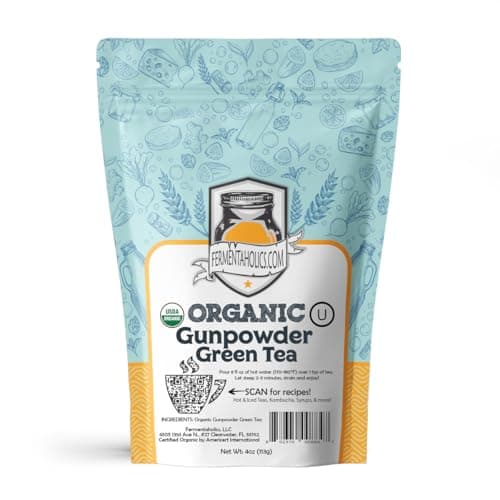
The tea side is cheap and uncomplicated. A gunpowder green published at eleven gallons from four ounces covers a long run of batches, and the tea buying guide works through why a named leaf is easier to repeat than a blend.
Getting the first jun batch right
Two differences from kombucha catch people out, and neither is difficult once it is named.
The first is temperature. Jun ferments cooler and faster, so a schedule calibrated to kombucha will overshoot. Taste from day three rather than day seven, and put a strip thermometer on the glass so you are reading the liquid rather than the room.
The second is the honey itself. Raw honey carries its own microbes and its own antimicrobial compounds, and opinions differ on whether it helps or hinders a young jun culture. What is not in dispute is that the culture is the fragile party in that relationship for the first couple of batches. Build up before experimenting.
What arrives, and what healthy looks like
A live culture in a bag looks alarming the first time, and a great many perfectly good jun cultures get thrown away by people who expected something tidier.
Expect a pale, rubbery, uneven disc — possibly wrinkled, possibly with brown patches, quite likely sunk to the bottom of the liquid rather than floating. All of that is normal. Brown stringy strands hanging off it are yeast, which is the working half of the culture and a sign of vigor rather than spoilage. The liquid should smell sharp and vinegary; sharp is good.
What is not normal is dry, fuzzy growth sitting on the surface in white, green, blue or black, which is mold and means the whole thing goes. Mold versus SCOBY is the page to read before discarding anything, because the two are confused constantly and the consequences run in both directions.
A sunk pellicle is the single most common false alarm. It says nothing about health — the organisms live in the liquid, not in the disc, and a new pellicle will form at the surface within days of the culture going into fresh sweet tea.
The first jun batch, in numbers
Jun follows the same shape as kombucha with three substitutions, and having the figures in one place removes most of the guesswork.
A first one-gallon jun batch, using the published starter volume and this site's working ratios.
Input
Figure
Note
Batch volume
1 gallon (128 oz)
The size the culture is dosed for
Starter tea
12 fl oz
Published, 9.4 percent — the 10 percent rule
Tea
Green, about 2 tbsp loose leaf
Not black. Gunpowder green is the stated fit
Sweetener
Honey, roughly a cup
Not cane sugar. This is the expensive part
Temperature
Cooler than kombucha
Taste from day three, not day seven
Cover
Cloth and a band
Aerobic, like any first fermentation
The honey goes in after the tea has cooled, not into hot water — heat degrades it and there is no benefit to dissolving it hot. Stir until it is fully dispersed, because honey settles and a layer of it on the bottom of the jar is not doing the culture any good.
Bottle it exactly as you would kombucha, in pressure-rated bottles. Jun carbonates readily and the second ferment behaves no differently.
Keeping a jun culture between batches
Jun is fed honey and green tea, and that applies to storage as much as to brewing. A jun culture parked in a kombucha hotel — strong black-tea kombucha, fed sugar — is being kept on the wrong feedstock and will drift.
Keep the surplus in its own jar of strong finished jun, at room temperature, topped up with sweetened green tea when it looks thin. Label it, because a jun pellicle and a kombucha pellicle are indistinguishable at a glance and the mistake is not reversible once two cultures have been combined.
Once the culture arrives, the method is the other half of the job — and it differs from kombucha in one step that matters. How to make jun covers the ratios, why the honey must never meet hot tea, and the failure modes that are specific to honey rather than sugar.
The jun culture on this page comes from a seller whose kombucha cultures are dosed the same way, twelve ounces for a gallon. Our Fermentaholics review puts the jun culture beside the rest of that maker's line and checks every starter tea volume against its published ten percent rule.
Heads up: some links on this page are affiliate links. If you buy through one we may earn a commission at no extra cost to you. It never changes a ranking, and we take no payment for placement. The full version.
The short answer
Quick picks
Ranked on the published rubric. Every row jumps to that product's full write-up below; the button goes straight to Amazon.
#
Product
Best for
Score
Price
1
Fermentaholics
Jun Kombucha Starter Culture, 12 fl oz
A jun pellicle with twelve fluid ounces of pre-measured mature starter tea — the culture on its own, for anyone who already owns a gallon jar.
A jun culture is a different organism community to a kombucha SCOBY, and it will not appear by feeding a kombucha culture honey — this is the way to start jun properly.
A gallon jar that arrives with the muslin cover, the band and a temperature strip already in the box, which is the whole non-culture half of a first batch.
Fermentaholics Jun Kombucha Starter Culture, 12 fl oz
A jun pellicle with twelve fluid ounces of pre-measured mature starter tea — the culture on its own, for anyone who already owns a gallon jar.
Who it is for. A kombucha brewer with a spare jar who wants to try jun without buying a second set of hardware.
Published specifications
Culture
USDA Certified Organic jun SCOBY
Starter tea volume
12 fl oz
Batch size
“Makes 1 Gallon”
What ships
“pre-measured strong, mature liquid starter tea packaged with a starter pellicle”
Feedstock
Green tea and honey, not black tea and cane sugar
Certification
USDA Certified Organic, Kosher
Production
“grown in our fully licensed lab”
Shipped weight
0.5 lb
Jar
None. This is the culture only
Source: Fermentaholics published Jun Kombucha Starter Culture listing (organic jun SCOBY, 12 fl oz pre-measured mature starter tea with a starter pellicle, makes 1 gallon, green tea and honey feedstock, USDA Organic and Kosher, licensed lab, 0.5 lb shipped weight), Amazon B01NADMSEJ, retrieved 2026-09-13
Rubric — 8.4 / 10
Materials9/10 · weight 28%
Documentation8/10 · weight 22%
Capacity fit8/10 · weight 16%
Cleaning8/10 · weight 18%
Value9/10 · weight 16%
What it gets right
Twelve fluid ounces against a 128 oz gallon is 9.4 percent, which lands on the same ten percent starter rule the maker publishes for its kombucha cultures
It is the culture on its own, so it costs a fraction of the jun kit if you already own a gallon jar
A jun culture bought as a jun culture is the only reliable way to get one — feeding a kombucha SCOBY honey weakens it rather than converting it
Same licensed lab and the same organic and kosher certification as the maker’s kombucha line
What it costs you
You still need a jar, a cover, a band, green tea and honey before anything ferments
Honey is meaningfully more expensive per batch than cane sugar, and jun wants a lot of it
A live culture in transit is a live culture in transit — heat and delay are risks nobody controls
No shelf life is published once it arrives
Skip it if. You own no gallon jar. The Essentials jun kit bundles the same culture with the jar, cover and band for not much more.
Fermentaholics Essentials Jun Kombucha Brewing Kit
A jun culture is a different organism community to a kombucha SCOBY, and it will not appear by feeding a kombucha culture honey — this is the way to start jun properly.
Who it is for. Someone who has read that jun is lighter and faster, and wants the culture that actually does that.
Published specifications
Culture
USDA Certified Organic jun culture
Feedstock
Green tea and honey, not black tea and sugar
Kit type
Essentials — jar, cover, band, culture
Certification
USDA Certified Organic
Source: Fermentaholics published Jun kit listing, fermentaholics.com/product/essentials-jun-kombucha-brewing-kit/, retrieved 2026-09-01
Rubric — 7.2 / 10
Materials8/10 · weight 28%
Documentation6/10 · weight 22%
Capacity fit7/10 · weight 16%
Cleaning8/10 · weight 18%
Value7/10 · weight 16%
What it gets right
A jun culture bought as a jun culture is the only reliable way to get one — converting a kombucha SCOBY to honey is a well-known way to weaken it
Same Essentials structure as the kombucha kit, so the jar and cover are the parts you already understand
Jun ferments cooler and faster than kombucha, which suits a house that never gets to 78F
What it costs you
Honey is meaningfully more expensive per batch than cane sugar, and jun wants a lot of it
Fewer published details than the kombucha kits from the same maker
No tea, sugar, honey or pH strips included
Skip it if. You have not brewed kombucha yet. Jun is less forgiving of a cold room and a weak starter; the ordinary kombucha route teaches the same skills more cheaply.
A gallon jar that arrives with the muslin cover, the band and a temperature strip already in the box, which is the whole non-culture half of a first batch.
Who it is for. A first-time brewer, or anyone who has learned that the fewer parts a fermentation vessel has, the fewer places a batch can go wrong.
Published specifications
Capacity
1 gallon
Material
Glass
Included
Muslin cover, rubber band, temperature strip
Spigot
None
Dimensions
Not published
Mouth diameter
Not published
Source: Fermentaholics published jar listing contents, fermentaholics.com/product/printed-gallon-kombucha-glass-jar-2-pack/, retrieved 2026-09-01
Rubric — 7.7 / 10
Materials8/10 · weight 28%
Documentation5/10 · weight 22%
Capacity fit8/10 · weight 16%
Cleaning9/10 · weight 18%
Value9/10 · weight 16%
What it gets right
The temperature strip in the box means the jar tells you its own temperature from day one
Muslin breathes and blocks fruit flies, which is exactly what a kombucha cover has to do and what a solid lid does not
No spigot means no seal, no gasket and nothing to disassemble — the easiest vessel here to actually clean
The cheapest way into a proper gallon vessel
What it costs you
No published dimensions at all
No volume markers, so the starter reserve is eyeballed
No tap, so tasting means dipping and bottling means lifting
Skip it if. You want to draw a sample without opening the jar. A plain jar has to be opened every time you taste it.
#ad No live price feed yet, so no number is shown rather than a stale one. How this is funded.
FAQ
Questions people actually ask
Where can I buy a jun SCOBY?+
From a culture seller who sells it as jun and publishes the volume of starter tea in the box. Fermentaholics lists a jun starter culture with 12 fl oz of pre-measured mature starter tea and an organic jun pellicle, dosed for a one-gallon batch, and a jun essentials kit that adds the jar, cover, band and thermometer.
Can I turn a kombucha SCOBY into a jun SCOBY?+
No. Jun is a distinct organism community adapted to green tea and honey. Honey is antimicrobial, and a culture selected for cane sugar and black tea handles it badly — it slows, thins and produces weaker pellicles. You end up with a struggling kombucha culture, not jun.
How much starter tea should come with a jun culture?+
About ten percent of the batch it is sold for. For a one-gallon batch that is roughly 12 to 13 fluid ounces, and a 12 fl oz pour works out at 9.4 percent — near enough that the quantity matches the published rule. A pellicle arriving in a splash of liquid is a much weaker start.
Should I buy a jun culture on its own or a jun kit?+
If you already brew kombucha, buy the culture alone — the jar, cover, band and bottles are identical, and a kit makes you buy a second gallon jar. If you own nothing, the kit is better value and its adhesive thermometer is genuinely useful, because jun runs cooler than kombucha.
Is jun more expensive to brew than kombucha?+
Yes, on running cost. The equipment is identical and the culture is a one-time purchase that reproduces, but jun is fed honey rather than cane sugar and wants roughly the same volume. Honey is meaningfully more expensive, which makes jun the costliest reusable-culture ferment on this site to keep running.
Sources
Every specification cited on this page came from one of these documents, retrieved on the date shown against the product it belongs to.