Yes — in 304 or 316 stainless steel, and in no other metal. Kombucha Kamp's published guidance is that “high-grade stainless steel 304/316 or better is the only exception because it is non-corrosive”, and that kombucha “is not safe with any kind of metal except stainless steel (304 grade)”. Brief contact with a stainless spoon or mesh strainer is fine. Constant contact with anything else is not.
Why metal is a question at all
Kombucha spends one to two weeks sitting at roughly pH 2.5 to 3.5. That is a genuinely aggressive environment — comparable to vinegar, more acidic than most things a kitchen container ever holds — and it is held there continuously, not for the twenty minutes a tomato sauce spends in a pan.
Duration is the whole issue. As the published guidance puts it, kombucha “is a powerful liquid that can leach toxins from metal (or any material) if left in constant contact”, while “briefly using a metal spoon or mesh strainer is not likely to cause an issue”. Almost every anxious question about metal and kombucha is really a question about time, and the answer is that seconds are fine and weeks are not.
What 304 and 316 actually mean
Stainless steel is not one material. The grade numbers describe what is alloyed into the iron, and that alloy is the entire reason a grade resists acid or does not.
304. The common food-grade austenitic stainless, often labeled 18/8 for its chromium and nickel content. It is the grade named in the published kombucha guidance, and it is what a good brewing spigot is made from.
316. Adds molybdenum, which improves resistance to chlorides and acids further. It is what marine and pharmaceutical equipment uses, and it is named alongside 304 as acceptable.
Anything unlabeled. “Stainless steel” with no grade is a marketing phrase, not a specification. It may be 430, it may be a plated base metal, and neither belongs in contact with a two-week ferment.
Brass, aluminum, copper, galvanized. Not candidates. The spigot page works through why brass in particular keeps appearing on kombucha vessels and why it should not.
The practical version: if a listing says 304 or 316, it is telling you something. If it says “stainless” and stops, it is telling you nothing, and the safe assumption for a part that sits in the liquid is that it is not the grade you want.
A stainless vessel, or stainless parts
Almost nobody brewing kombucha at home has a stainless vessel, and almost everybody has stainless parts. That distinction is worth drawing clearly, because the two decisions are not the same.
Where stainless steel shows up in a home kombucha setup, and how long it is in contact with the liquid.
Component
Contact time
Grade that matters?
Spigot on a brewing vessel
Weeks, continuously
Yes — 304 or better
Vessel body
Weeks, continuously
Yes — 304 or better
Mesh strainer
Seconds per use
Prefer stainless; brief contact
Stirring spoon
Seconds per use
Prefer stainless; brief contact
Funnel while bottling
Seconds per use
Prefer stainless; brief contact
The first two rows are the ones to be careful about. A spigot is the most common stainless component in a home setup and the one in constant contact, which is exactly why which spigot materials are safe with kombucha is a page of its own on this site.
The picks
Vessels that get the material question right
A glass jar with a valve, a glass continuous brewer, and a stoneware crock — the three routes that avoid the problem rather than managing it.
Craft a Brew
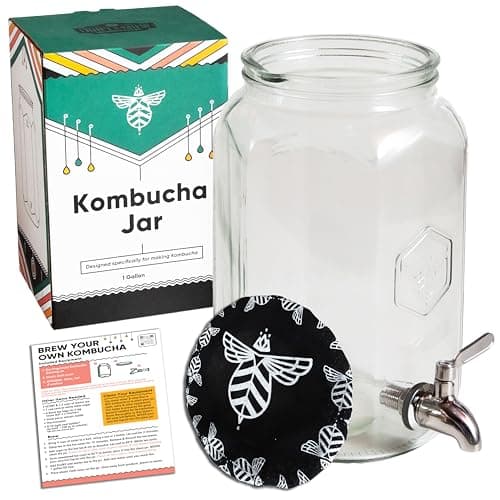
Kombucha Jar with Valve (1 Gallon)
The one gallon jar in this group whose valve grade is published — 304 stainless — which is the single specification that decides whether a spigot belongs anywhere near kombucha.
About 2.2 gallons of glass on an acacia stand with a stainless spigot, and the only vessel here where you can see the pellicle, the yeast strands and the fill line at a glance.
#ad No live price feed yet, so no number is shown rather than a stale one. How this is funded.
Score8.3no photo yet
Kombucha Kamp
USA Handmade Stoneware Continuous Brewer Crock
Roughly 2.5 gallons of US-made handmade stoneware with a stainless spigot, and the only vessel here whose dimensions are given as a range because each one is thrown by hand.
#ad No live price feed yet, so no number is shown rather than a stale one. How this is funded.
So why is every vessel here still glass?
If 304 stainless is safe, the obvious question is why this site keeps recommending glass and ceramic. Three reasons, none of them about safety.
The first is that you cannot see into steel. A kombucha brewer looks at the jar constantly — for the new pellicle, for yeast strands, for the one thing you must not miss. Diagnosing a batch by smell alone is a real handicap, and it is the single strongest argument for transparent glass at home.
The second is verification. A glass jar is glass; there is no grade to trust, no undisclosed alloy, no plating to wear through. With steel you are relying on a manufacturer's claim about a number you cannot check with your eyes.
The third is simply supply. Stainless fermenters exist and they are built for brewing beer at volumes no kombucha household needs, at prices that make a two-gallon glass jar look like a rounding error. Glass or ceramic is the choice most home brewers are actually making.
Cleaning stainless that touches kombucha
Where you do have stainless in the system — spigots, strainers, spoons — the cleaning rule is the same one that applies everywhere else in the cleaning routine: hot water, unscented soap where needed, thorough rinsing, and nothing chlorine-based left behind.
One steel-specific note: chloride is what actually attacks stainless, which is why 316 with its molybdenum is rated better for it. Bleach-based sanitizers left in contact with a spigot are therefore a worse idea on steel than on glass. Rinse them off properly, or use something that is not chlorinated.
Do not scour stainless with steel wool or an abrasive pad either. The passive chromium oxide layer is what makes the alloy non-corrosive in the first place, and scratching it off repeatedly is the one thing a home user can do to make good steel behave like bad steel.
Reading a listing honestly
Most of the practical work here is done before anything arrives, by reading what the seller was willing to write down. Four phrases and what each one is worth:
What listing language actually tells you about a metal part that will sit in kombucha.
What the listing says
What it means
“304 stainless steel” or “18/8”
A real claim about a named grade. This is what to look for.
“316 stainless steel”
The same, with better acid and chloride resistance. Better than needed, not worse.
“Food grade stainless steel”
Unverifiable. Food grade is not a single specification and no grade is named.
“Stainless steel”, alone
No claim at all. Treat as unknown for anything in constant contact.
“Rust proof metal”, “premium alloy”
Marketing. Not a specification and not a grade.
The pattern is simple: a number is a claim somebody can be held to, and an adjective is not. This is the same test the rest of this site applies to pressure ratings and dimensions, and it works exactly as well on alloys.
One further check once the part arrives. A well-made 304 fitting has an even, slightly soft gray finish with no plating line at the edges, and it does not discolor after a few batches. A plated base metal often shows a faint seam where the coating stops, and it will eventually pit or stain at the point where it sits in the liquid. If a spigot starts staining, replace it rather than scrubbing it.
Heads up: some links on this page are affiliate links. If you buy through one we may earn a commission at no extra cost to you. It never changes a ranking, and we take no payment for placement. The full version.
The short answer
Quick picks
Ranked on the published rubric. Every row jumps to that product's full write-up below; the button goes straight to Amazon.
#
Product
Best for
Score
Price
1
Craft a Brew
Kombucha Jar with Valve (1 Gallon)
The one gallon jar in this group whose valve grade is published — 304 stainless — which is the single specification that decides whether a spigot belongs anywhere near kombucha.
About 2.2 gallons of glass on an acacia stand with a stainless spigot, and the only vessel here where you can see the pellicle, the yeast strands and the fill line at a glance.
Roughly 2.5 gallons of US-made handmade stoneware with a stainless spigot, and the only vessel here whose dimensions are given as a range because each one is thrown by hand.
The one gallon jar in this group whose valve grade is published — 304 stainless — which is the single specification that decides whether a spigot belongs anywhere near kombucha.
Who it is for. A batch brewer who wants a tap for tasting and bottling, and who wants the spigot’s material in writing.
Published specifications
Capacity
1 gallon
Height
10 inches
Diameter
6 inches
Diameter including valve
7.75 inches
Valve material
304 grade stainless steel
Volume markers
1 gallon and 2 cup markers
Care
Hand wash only — not dishwasher safe
Mouth diameter
Not published
Source: Craft a Brew published dimensions, valve grade and care instructions, craftabrew.com/products/kombucha-jar-with-valve, fetched 2026-09-01
Rubric — 8.0 / 10
Materials9/10 · weight 28%
Documentation9/10 · weight 22%
Capacity fit7/10 · weight 16%
Cleaning6/10 · weight 18%
Value8/10 · weight 16%
What it gets right
304 grade is stated outright, so you are not inferring a spigot’s alloy from a photograph
10 in tall by 7.75 in across including the valve is a published footprint you can check against a counter and a cupboard
Volume markers at 1 gallon and 2 cups line up exactly with a batch and its starter reserve
A tap means you can taste on day six without lifting the jar or dropping anything into it
What it costs you
Hand wash only, and a spigot is the part that most wants a dishwasher
Mouth diameter is not published, which matters because a pellicle grows to the width of the vessel and has to come back out
At one gallon it is small for true continuous brewing — Kombucha Kamp is explicit that a 1-gallon jar is not a good continuous-brew choice
Skip it if. You want to run continuous brew. One gallon does not hold enough liquid to keep a stable culture while you draw off a bottle at a time; go to 2 gallons or more.
About 2.2 gallons of glass on an acacia stand with a stainless spigot, and the only vessel here where you can see the pellicle, the yeast strands and the fill line at a glance.
Who it is for. A continuous brewer who wants to see what is happening, and who has an open shelf or an island to put it on.
Published specifications
Capacity
Approximately 2.2 gallons
Vessel height
13 inches
Vessel width
9 inches
Height with stand
18 inches
Spigot
Stainless steel
Stand
Acacia wood
Material
Glass
Source: Kombucha Kamp published vessel specifications (capacity, vessel and stand heights, spigot material), kombuchakamp.com/glass-continuous-brewer.html, retrieved 2026-09-01
Rubric — 8.5 / 10
Materials9/10 · weight 28%
Documentation9/10 · weight 22%
Capacity fit9/10 · weight 16%
Cleaning8/10 · weight 18%
Value7/10 · weight 16%
What it gets right
Glass is chemically inert at kombucha’s pH and shows you the state of the culture without opening anything
A stainless spigot as standard rather than as an upgrade
18 in on the stand is published, so you can check the clearance to a cabinet before ordering
2.2 gallons sits inside the 2-to-5-gallon band Kombucha Kamp recommends for continuous brew
What it costs you
Light reaches the culture, and continuous brew is a long exposure — it needs a dark corner or a cloth over it
Glass at 2.2 gallons is heavy and unforgiving of a knock against a tap
18 in tall on the stand rules out most under-cabinet counters
Skip it if. Your only free counter is under a cabinet. At 18 in with the stand you will not get the cover off, let alone the pellicle out.
#ad No live price feed yet, so no number is shown rather than a stale one. How this is funded.
Score8.3no photo yet
#3 · The largest published capacity
Kombucha Kamp USA Handmade Stoneware Continuous Brewer Crock
Roughly 2.5 gallons of US-made handmade stoneware with a stainless spigot, and the only vessel here whose dimensions are given as a range because each one is thrown by hand.
Who it is for. A committed continuous brewer with counter space, who wants the biggest published capacity and a stainless tap in the box.
Published specifications
Capacity
Approximately 2.5 gallons
Vessel height
12 to 14 inches
Vessel width
10 to 12 inches at the shoulders
Material
Stoneware, handmade in the USA
Spigot
Brew-safe stainless steel upgrade included
Dimension variance
Published as a range because each crock is individually made
Source: Kombucha Kamp published crock specifications (capacity, height and shoulder-width ranges, stainless spigot), kombuchakamp.com/usa-handmade-stoneware-continuous-brewer-crock.html, retrieved 2026-09-01
Rubric — 8.3 / 10
Materials9/10 · weight 28%
Documentation8/10 · weight 22%
Capacity fit10/10 · weight 16%
Cleaning7/10 · weight 18%
Value7/10 · weight 16%
What it gets right
2.5 gallons is the largest here and sits in the middle of the 2-to-5-gallon continuous brew band
Stainless spigot included rather than offered as an extra
Opaque stoneware keeps light off the ferment
Publishing dimensions as a range rather than a false precision is the honest way to spec a handmade vessel, and it tells you to leave clearance
What it costs you
Up to 14 in tall and 12 in wide at the shoulders — you have to plan for the top of the range, not the bottom
Handmade stoneware at 2.5 gallons is heavy before you fill it and very heavy after
No visibility into the vessel at all
Skip it if. You measure your shelf to the inch. A vessel whose height can be 12 in or 14 in is not the one to buy for a tight gap.
#ad No live price feed yet, so no number is shown rather than a stale one. How this is funded.
FAQ
Questions people actually ask
Is stainless steel safe for kombucha?+
In 304 or 316 grade, yes. Published guidance from Kombucha Kamp states that high-grade stainless steel 304/316 or better is the only metal exception because it is non-corrosive, and that kombucha is not safe with any other kind of metal.
Can I stir kombucha with a metal spoon?+
Yes, briefly. The published guidance is that kombucha can leach from metal left in constant contact, but that briefly using a metal spoon or mesh strainer is not likely to cause an issue. The problem is duration, not the momentary touch.
What is the difference between 304 and 316 stainless steel?+
316 adds molybdenum, which improves resistance to chlorides and acids. Both are named as acceptable for kombucha. The grade that is not acceptable is unlabeled 'stainless', which could be a lower grade or a plated base metal.
Why does everyone use glass for kombucha instead of steel?+
Not for safety. Glass lets you watch the batch, which matters for spotting a new pellicle, yeast strands or mold; it needs no grade claim to be trusted; and stainless fermenters are built for beer volumes at prices a home kombucha brewer has no reason to pay.
Can I use a magnet to test if stainless steel is food safe?+
No. Cold working during manufacture can make 304 mildly magnetic, and some food-safe grades are magnetic anyway. A published grade number on the product listing is the only meaningful check.
Sources
Every specification cited on this page came from one of these documents, retrieved on the date shown against the product it belongs to.