Beer brewers sanitize everything. Kombucha brewers mostly should not, and knowing the difference saves both effort and cultures.
By Scooter M.·Published September 1, 2026 · Updated October 18, 2026
The short answer
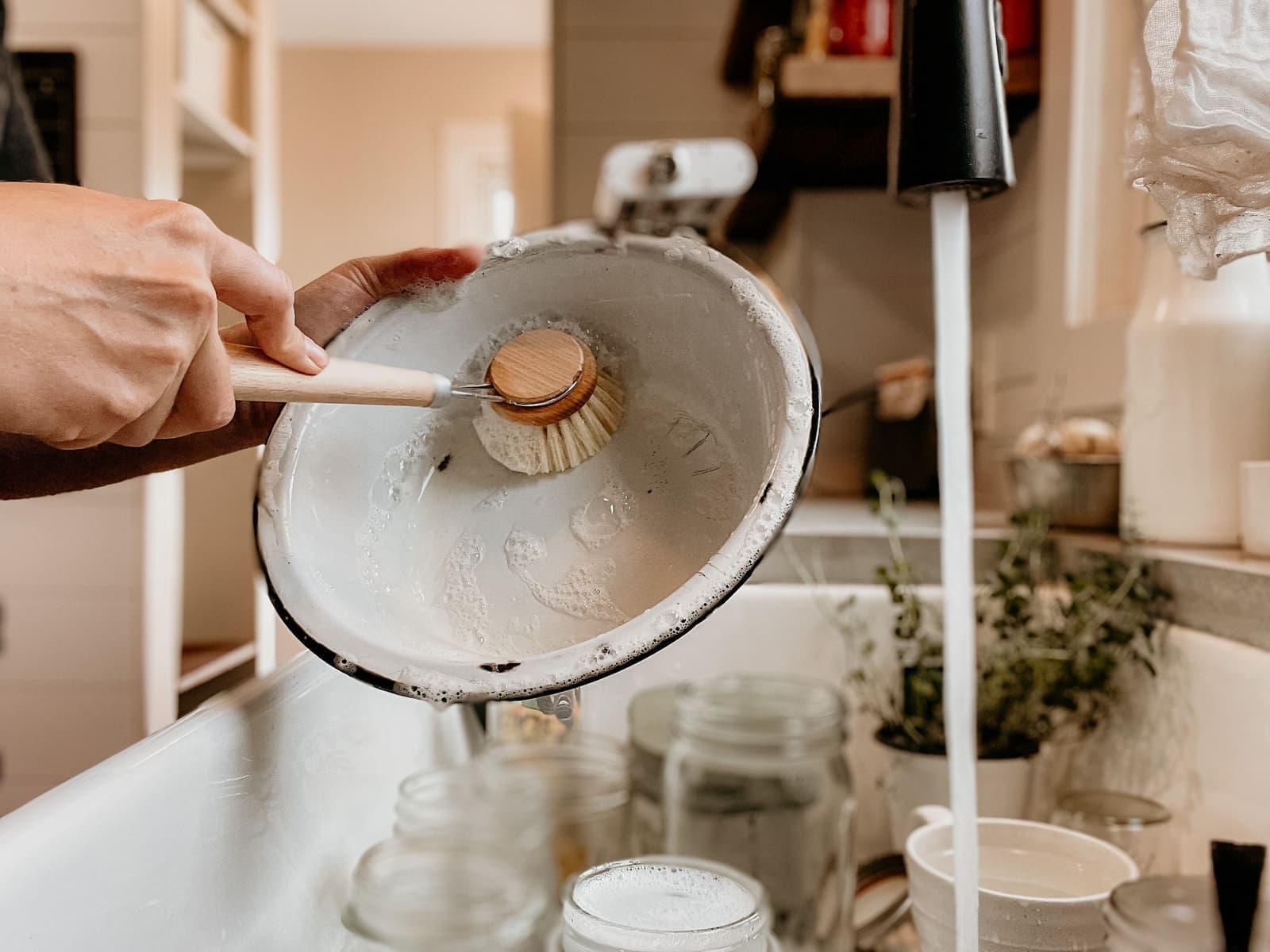
Hot water and plain unscented dish soap, rinsed thoroughly, is enough for almost everything. Kombucha protects itself with acidity rather than sterility, so it does not need beer's sanitizing regime. Never let soap residue reach the culture, and never rinse a pellicle under chlorinated tap water.
Why kombucha is not beer
Beer wort is a sweet, near-neutral liquid with nothing in it to stop an unwanted organism, which is why homebrewers sanitize obsessively — the batch has no defense of its own until the yeast takes hold.
Kombucha starts with a slug of mature, acidic starter tea and drops below pH 4.2 within days. That acidity is the defense, and it works continuously. So the standard here is clean, not sterile — and chasing sterility with strong chemicals introduces a bigger risk than the one it removes, because residue is genuinely harmful to a culture.
If you came here from beer, that distinction is the one to carry across and the hardest to act on, because the sanitizing habit is so well drilled. Brewing kombucha when you already brew beer splits the routine in two: sanitize bottles exactly as you always have, and rinse everything that touches the culture rather than relying on a no-rinse residue.
What to use
For vessels, bottles, spigots and utensils.
Product
Use it?
Notes
Hot water and plain dish soap
Yes — the default
Rinse thoroughly. Residue is the risk, not the soap.
Distilled white vinegar
Yes
Excellent for mineral film and for a final rinse.
A dishwasher, for dishwasher-safe items
Yes
Check the maker. Craft a Brew's valve jar is published hand wash only.
Bottle brush
Yes
Essential for bottle necks and spigot bores.
Scented or antibacterial soap
No
Perfume and antibacterials both linger.
Bleach
Rarely
Only for a mold incident, and rinse exhaustively afterwards.
Star San and brewing sanitizers
Not needed
Designed for a problem kombucha does not have.
Abrasive scourers on plastic
No
Scratches hold residue you cannot then remove.
How often
Brewing vessel, batch brewing: between every batch. It is empty anyway, and it takes two minutes.
Brewing vessel, continuous brew: every few months, or when the yeast sediment at the bottom becomes substantial. Remove the culture into some of its own liquid, wash, and put everything back.
Spigot: every time you clean the vessel, disassembled. Spigot safety explains why this is a buying criterion as well as a chore.
Bottles: after every use, immediately. Dried kombucha sediment is much harder to remove than wet.
Gaskets: hand wash with the bottles, and store the closures open. Gaskets and seals.
The picks
Equipment that is easy or hard to clean
A plain jar with no parts is the easiest vessel here to keep clean. A spigot jar is published hand wash only and has a bore to brush. Both are legitimate choices; only one is a chore.
Score7.7no photo yet
Fermentaholics
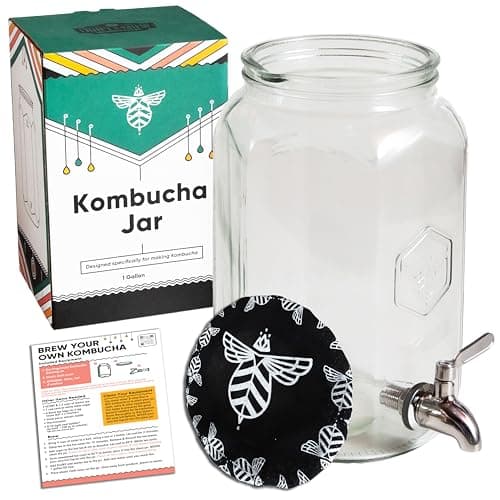
Printed Gallon Kombucha Glass Jar
A gallon jar that arrives with the muslin cover, the band and a temperature strip already in the box, which is the whole non-culture half of a first batch.
#ad No live price feed yet, so no number is shown rather than a stale one. How this is funded.
Craft a Brew
Kombucha Jar with Valve (1 Gallon)
The one gallon jar in this group whose valve grade is published — 304 stainless — which is the single specification that decides whether a spigot belongs anywhere near kombucha.
The one place where the usual kitchen habits are actively wrong.
Never rinse a pellicle under the tap. Chlorine and chloramine are hostile to it. If it needs rinsing, use a little of its own kombucha.
Clean hands, no soap residue. Wash, rinse very thoroughly, and dry. Soap on a hand is the one thing a culture genuinely objects to.
Do not scrub a pellicle. There is nothing to remove. Brown patches are staining and yeast, both of which are supposed to be there.
Do not trim it. There is no benefit, and a cut surface is an entry point.
The exception: after a mold incident
This is the one case where a stronger clean is justified. After discarding a moldy batch, wash the vessel with hot soapy water, then either run it through a dishwasher if it is dishwasher safe, or wipe it with a dilute bleach solution and rinse exhaustively — several rinses, and then one more.
Bleach residue will kill the next culture, so the rinsing is not optional. If a vessel is hand wash only, a long soak in hot soapy water followed by a vinegar rinse is the safer route. Mold versus SCOBY covers what to discard.
One tool is worth naming, because a hand cannot do its job. Narrow-necked bottles hold residue exactly where you can neither reach nor see it, and a brush is the only mechanical answer — the bottling gear page has the published sizing, along with the funnels and fillers that need the same wash afterwards.
The rule about never rinsing a pellicle under the tap has a corollary that catches people out: the same chemical is in the water you brew the tea with, and that is most of the batch by volume. Tap water for kombucha works through what boiling and standing overnight actually remove, and what they do not.
Heads up: some links on this page are affiliate links. If you buy through one we may earn a commission at no extra cost to you. It never changes a ranking, and we take no payment for placement. The full version.
The short answer
Quick picks
Ranked on the published rubric. Every row jumps to that product's full write-up below; the button goes straight to Amazon.
#
Product
Best for
Score
Price
1
Score7.7
Fermentaholics
Printed Gallon Kombucha Glass Jar
A gallon jar that arrives with the muslin cover, the band and a temperature strip already in the box, which is the whole non-culture half of a first batch.
The one gallon jar in this group whose valve grade is published — 304 stainless — which is the single specification that decides whether a spigot belongs anywhere near kombucha.
A gallon jar that arrives with the muslin cover, the band and a temperature strip already in the box, which is the whole non-culture half of a first batch.
Who it is for. A first-time brewer, or anyone who has learned that the fewer parts a fermentation vessel has, the fewer places a batch can go wrong.
Published specifications
Capacity
1 gallon
Material
Glass
Included
Muslin cover, rubber band, temperature strip
Spigot
None
Dimensions
Not published
Mouth diameter
Not published
Source: Fermentaholics published jar listing contents, fermentaholics.com/product/printed-gallon-kombucha-glass-jar-2-pack/, retrieved 2026-09-01
Rubric — 7.7 / 10
Materials8/10 · weight 28%
Documentation5/10 · weight 22%
Capacity fit8/10 · weight 16%
Cleaning9/10 · weight 18%
Value9/10 · weight 16%
What it gets right
The temperature strip in the box means the jar tells you its own temperature from day one
Muslin breathes and blocks fruit flies, which is exactly what a kombucha cover has to do and what a solid lid does not
No spigot means no seal, no gasket and nothing to disassemble — the easiest vessel here to actually clean
The cheapest way into a proper gallon vessel
What it costs you
No published dimensions at all
No volume markers, so the starter reserve is eyeballed
No tap, so tasting means dipping and bottling means lifting
Skip it if. You want to draw a sample without opening the jar. A plain jar has to be opened every time you taste it.
#ad No live price feed yet, so no number is shown rather than a stale one. How this is funded.
#2 · A spigot you can check
Craft a Brew Kombucha Jar with Valve (1 Gallon)
The one gallon jar in this group whose valve grade is published — 304 stainless — which is the single specification that decides whether a spigot belongs anywhere near kombucha.
Who it is for. A batch brewer who wants a tap for tasting and bottling, and who wants the spigot’s material in writing.
Published specifications
Capacity
1 gallon
Height
10 inches
Diameter
6 inches
Diameter including valve
7.75 inches
Valve material
304 grade stainless steel
Volume markers
1 gallon and 2 cup markers
Care
Hand wash only — not dishwasher safe
Mouth diameter
Not published
Source: Craft a Brew published dimensions, valve grade and care instructions, craftabrew.com/products/kombucha-jar-with-valve, fetched 2026-09-01
Rubric — 8.0 / 10
Materials9/10 · weight 28%
Documentation9/10 · weight 22%
Capacity fit7/10 · weight 16%
Cleaning6/10 · weight 18%
Value8/10 · weight 16%
What it gets right
304 grade is stated outright, so you are not inferring a spigot’s alloy from a photograph
10 in tall by 7.75 in across including the valve is a published footprint you can check against a counter and a cupboard
Volume markers at 1 gallon and 2 cups line up exactly with a batch and its starter reserve
A tap means you can taste on day six without lifting the jar or dropping anything into it
What it costs you
Hand wash only, and a spigot is the part that most wants a dishwasher
Mouth diameter is not published, which matters because a pellicle grows to the width of the vessel and has to come back out
At one gallon it is small for true continuous brewing — Kombucha Kamp is explicit that a 1-gallon jar is not a good continuous-brew choice
Skip it if. You want to run continuous brew. One gallon does not hold enough liquid to keep a stable culture while you draw off a bottle at a time; go to 2 gallons or more.
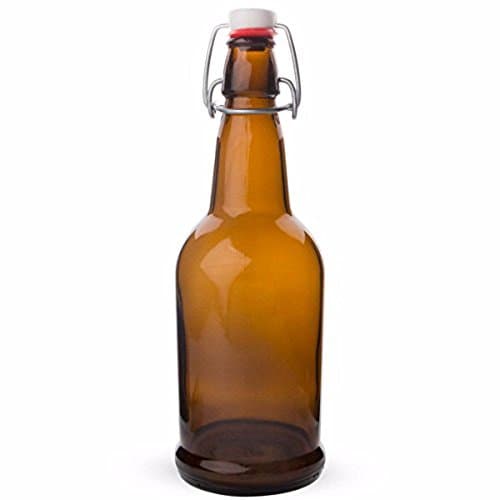
EZ Cap Swing Top Bottles, Amber Glass, 16 oz (Case of 12)
The only bottle here with a published pressure rating — 100 PSI — in amber glass, which is the combination a second ferment actually asks for.
Who it is for. Anyone doing a second ferment who wants a bottle with a number behind it rather than a shape that looks strong.
Published specifications
Capacity
16 oz
Glass color
Amber
Pressure rating
“Pressure rated to 100 PSI which means they can easily handle the carbonation of soda pop and hard seltzer”
Case quantity
12 bottles, includes 12 swing tops
Closure
Reusable swing top; also accepts a 26 mm pry-off crown cap
Maker’s note
“These swing tops are designed to be primarily sealed with a crown cap closure for long term storage.”
Dimensions
Not published
Source: MoreBeer published EZ Cap product specification (capacity, pressure rating, case contents, crown cap compatibility), morebeer.com/products/ez-cap-swing-top-bottles-amber-glass-16-oz-case-12, fetched 2026-09-01
Rubric — 8.3 / 10
Materials9/10 · weight 28%
Documentation9/10 · weight 22%
Capacity fit8/10 · weight 16%
Cleaning7/10 · weight 18%
Value8/10 · weight 16%
What it gets right
A published 100 PSI rating is the single most useful number in this whole category, and almost nobody publishes one
Amber glass blocks the light that degrades a bottle sitting out on a counter through a second ferment
The dual finish means you can crown-cap a batch you want to leave for months and swing-top the ones you will drink this week
16 oz is one serving, so a bottle gets opened once and drunk rather than losing its carbonation over three days
What it costs you
Swing-top gaskets perish, and a tired gasket is the commonest cause of a flat second ferment
No dimensions published, so fitting twelve of them on a fridge shelf is a measuring job when they arrive
Crown caps are sold separately if you want the long-storage option the maker recommends
Skip it if. You want to see the color of the finished drink. Amber hides it; the clear version of the same bottle does not.
Not the way beer brewing requires. Kombucha protects itself with acidity from the starter tea rather than relying on sterility, so hot water and plain unscented dish soap, rinsed thoroughly, is enough for almost everything.
Can I use Star San on kombucha equipment?+
You can, and it is generally unnecessary. Brewing sanitizers are designed for a near-neutral wort with no defenses of its own. Kombucha's acidity does that job, and the practical risk in a kombucha setup is chemical residue rather than insufficient sanitation.
How do I clean a kombucha spigot?+
Disassemble it. Kombucha throws long yeast strands that lodge in the bore where nothing reaches them. Lay the parts out in order on a towel, run a small bottle brush through the bore, rinse well and reassemble, then water-test before trusting it with a batch.
Can I rinse my SCOBY under the tap?+
No. Chlorine and chloramine in municipal water are hostile to the culture. If a pellicle genuinely needs rinsing, use a little of its own kombucha instead.
Are kombucha jars dishwasher safe?+
It depends on the vessel and it is usually published. Craft a Brew states its valve jar is hand wash only; Bormioli Rocco states its Swing bottle body is dishwasher safe without the closure; IKEA publishes a 158 F limit for KORKEN. Check the maker rather than assuming.
Sources
Every specification cited on this page came from one of these documents, retrieved on the date shown against the product it belongs to.
Chlorine versus chloramine, what boiling and standing overnight actually remove, and the published flow rate a carbon filter needs to handle chloramine.