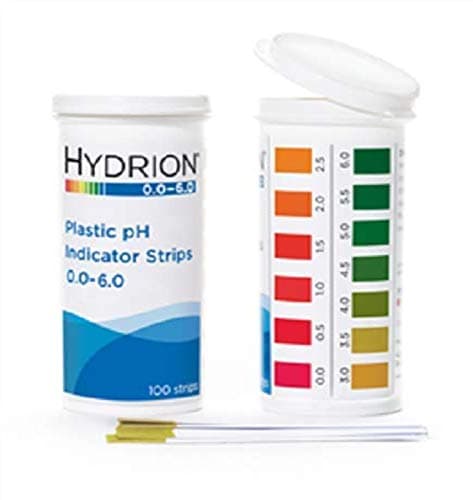
If you already brew beer you need to buy two things: a live culture with its starter liquid and a wide-mouth one-gallon glass jar. Everything else on a normal homebrew shelf either transfers directly — bottles, capper, bottling wand, brushes, thermometer — or should stay in the cupboard. The three to leave alone are the airlock, the carboy and the no-rinse sanitizer, and none of those is a close call. Add pH strips if you do not already keep them; kombucha is judged on pH rather than gravity.
Why your instincts are mostly wrong here
Beer and kombucha are both fermentation, and almost everything a brewer knows about sanitation, patience and record-keeping carries over intact. The process goals are opposite in one specific way, and nearly every mistake an experienced brewer makes with kombucha traces back to it.
Beer fermentation is anaerobic, and your whole kit is built to exclude oxygen: airlocks, sealed fermenters, minimal headspace, careful transfers. Kombucha's first fermentation is aerobic. The culture needs air exchange across a wide liquid surface, which is why it lives in an open-mouthed jar under a cloth and why a pellicle forms at the air-liquid boundary rather than anywhere else. Covers, cloths and why not a lid covers the cover question in full.
The second difference is the safety mechanism. In beer, alcohol and hops do the protecting. In kombucha, acid does — the starter liquid drops the pH immediately and a pH-3 environment is hostile to almost everything else. The SCOBY page works through why the liquid matters more than the disc. Which means the number you watch is pH, not gravity, and the instrument you need is a strip rather than a hydrometer.
What transfers, exactly
A typical homebrew shelf, audited against a one-gallon kombucha batch.
Equipment
Use it for kombucha?
Why
Crown-cap bottles and capper
Yes, directly
A crown cap is the most reliable seal available for a second ferment and the bottles are built for carbonation.
Swing-top bottles
Yes
Same job, reusable closure, no consumables.
Bottling wand / spring-tip filler
Yes
Fills from the bottom and sets the headspace for you, which matters more here than in beer.
Bottle brush
Yes, and you will need it
Kombucha leaves a yeast film in a narrow neck exactly as beer does.
Thermometer, digital or strip
Yes
The 75-85 F band is the one variable most new kombucha brewers never measure.
Large stock pot for brewing tea
Yes
Brief contact with stainless is fine; you are only steeping and cooling.
Kitchen scale
Yes
Tea and sugar by weight is more repeatable than by volume.
Glass carboy or bucket fermenter
No, for the first ferment
A narrow neck gives almost no surface area, and you cannot get a full-width pellicle back out.
Airlock and bung
No
The first fermentation is aerobic. An airlock is the right tool for beer and the wrong one here.
No-rinse sanitizer
Not on anything touching the culture
Rinse and dry instead; see below.
Hydrometer or refractometer
No
Gravity tells you little here, and a sample is liquid you have to remove from the jar.
Auto-siphon
Optional, rarely needed
A gallon pours. If you move to a vessel with a tap, it becomes redundant.
The sanitizer question, which is the one that catches people
This is where an experienced brewer is most likely to do active harm, precisely because the habit is so well drilled.
Sanitize your bottles as you always would. That half of the process is unchanged, and bottles go into a sealed second fermentation where you want nothing surprising coming along for the ride.
Do not put sanitizer anywhere near the culture or the brewing jar's interior without rinsing it out thoroughly first. A no-rinse acid sanitizer is formulated to leave a residue that is harmless to you and harmless to yeast at pitch rate — but you are not pitching a yeast slurry into five gallons, you are placing a living mat and a cup of liquid into a gallon jar. Cleaning kombucha equipment sets out the approach: hot water, a clean brush, a thorough rinse, and air dry. A kombucha jar is protected by its own acidity, not by a chemical film.
The same logic applies to your hands. Rinse them in plain water, or in a little of the kombucha itself, before handling a pellicle. Soap residue is the one thing on a hand that a culture genuinely objects to.
The picks
The two things you actually have to buy
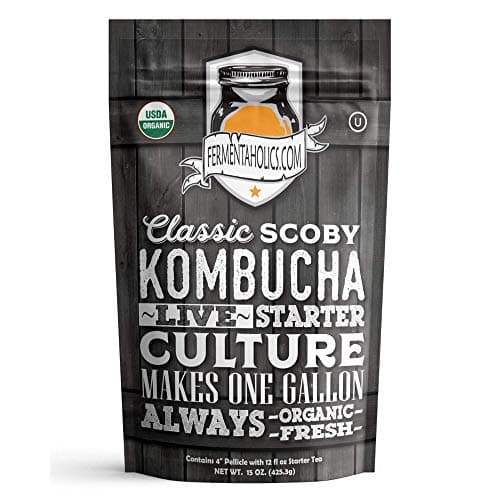
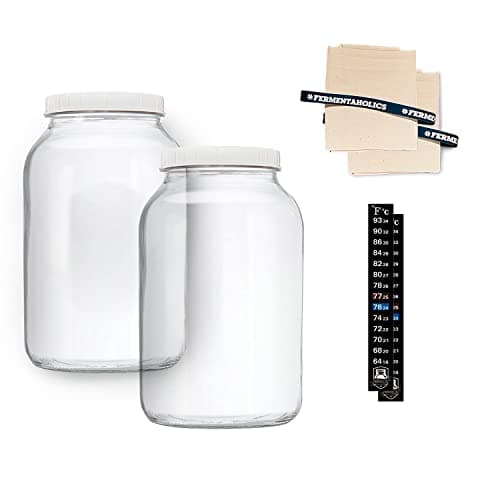
A live culture with its starter liquid published as a volume, and a pair of wide-mouth gallon jars that ship with muslin covers and bands rather than lids. Everything else is already on your shelf.
Fermentaholics
Organic Kombucha SCOBY with 12 fl oz Starter Tea
A hand-selected pellicle with twelve fluid ounces of mature starter tea, measured against the maker’s own published ten percent rule for a gallon.
The temptation to use a carboy or a bucket is strong — it is sitting right there, it is food-safe, it is bigger. Resist it for the first fermentation, for two reasons that are both about geometry.
First, surface area. The culture works at the air-liquid boundary and the pellicle grows to the full width of that surface. A vessel with a narrow neck gives you a tiny working surface for a large volume, which slows the whole ferment and gives you a thick cylinder of a pellicle instead of a sheet.
Second, retrieval. Every batch grows a new pellicle, and at some point you have to get it out. A full-width mat does not come out through a carboy neck in one piece, and cutting it up to extract it is a job nobody enjoys twice. What size jar covers the headroom and shape questions, and can you brew kombucha in plastic covers the bucket question specifically — the answer is yes for food-grade HDPE and no for anything whose history you do not know, because a scratched bucket that once held something else is a different proposition at pH 3 than at beer pH.
A bucket or carboy is useful at the other end, though. If you end up running several gallons, a sanitized fermenter makes a fine holding vessel for finished kombucha before bottling, and kegging kombucha covers the route where your existing corny keg setup does the serving.
The part where your kit is better than most
Bottling is where a homebrewer has a genuine advantage, and it is worth saying plainly because most kombucha advice is written for people who own nothing.
You already have pressure-rated bottles, a capper and a wand. That is the entire bottling problem solved, and it is the single most common gap for a new kombucha brewer — no kit on this site includes bottles. Crown caps versus swing tops compares the two closures, and the short version for you is that the crown caps you already use are the more reliable seal and the swing tops are the more convenient one.
Two adjustments to your normal routine. Leave more headspace than you would for beer — a kombucha second ferment can run hard and fast at room temperature, and over-carbonation is the one failure mode here that breaks glass. And refrigerate earlier than instinct suggests; cold is the brake, and there is no conditioning benefit to leaving kombucha warm the way there is with a bottle-conditioned beer.
The question you will ask, and the honest answer
Every brewer asks this one within about ten minutes: how much alcohol is in it, and can I measure it the way I measure everything else?
Kombucha contains a small amount of ethanol as a normal by-product — the yeast produces it and the bacteria consume most of it. The regulatory line for a non-alcoholic beverage in the US is 0.5 percent ABV, and a home second ferment in a sealed bottle can push past it.
What you cannot do is measure it with your hydrometer. A kombucha batch has sugar being consumed and acid being produced at the same time, so a gravity reading does not separate the two, and the concentrations involved are below what home equipment can resolve anyway. Kombucha alcohol content sets out what raises the figure and why no home measurement is reliable. Treat it as a known unknown rather than a number to chase — it is the one area where your usual instruments genuinely cannot help.
Your first batch, compressed
You do not need the beginner walkthrough, so here is the whole thing in one paragraph. Brew strong black tea, dissolve plain white sugar in it, cool it to room temperature, pour it into a wide-mouth gallon jar leaving a few inches of headroom, add the culture with all of its liquid at roughly ten percent of batch volume, cover with tight cotton and a band, and leave it somewhere warm and out of direct sun for seven to fourteen days. Taste from day five. When it is where you want it, hold back two cups for the next batch and bottle the rest.
The full version is on how to brew kombucha, the ratios are on tea and sugar, and the day-by-day of what you will see is on your first batch, day by day. The one thing that will feel wrong is how little you do. There is no transfer, no airlock to watch, no gravity to log. You cover it and leave it alone.
Heads up: some links on this page are affiliate links. If you buy through one we may earn a commission at no extra cost to you. It never changes a ranking, and we take no payment for placement. The full version.
The short answer
Quick picks
Ranked on the published rubric. Every row jumps to that product's full write-up below; the button goes straight to Amazon.
#
Product
Best for
Score
Price
1
Fermentaholics
Organic Kombucha SCOBY with 12 fl oz Starter Tea
A hand-selected pellicle with twelve fluid ounces of mature starter tea, measured against the maker’s own published ten percent rule for a gallon.
Fermentaholics Organic Kombucha SCOBY with 12 fl oz Starter Tea
A hand-selected pellicle with twelve fluid ounces of mature starter tea, measured against the maker’s own published ten percent rule for a gallon.
Who it is for. Anyone starting a standard one-gallon batch who wants the starter tea measured for them.
Published specifications
Batch size
One gallon
Starter tea volume
12 fl oz of mature, active starter tea
Pellicle
Hand-selected
Starter tea ingredients
Organic cane sugar, filtered water, organic black tea, live cultures
Certification
USDA Certified Organic, Kosher, Non-GMO, vegan
Production
Grown in the maker’s licensed lab
Maker’s dosing rule
“the rule of thumb is to use 10% starter tea per batch size”
Source: Fermentaholics published SCOBY specification (12 fl oz starter tea, 1-gallon dosing, ingredients, certifications) and its published 10 percent starter rule, retrieved 2026-09-01
Rubric — 8.5 / 10
Materials9/10 · weight 28%
Documentation9/10 · weight 22%
Capacity fit8/10 · weight 16%
Cleaning8/10 · weight 18%
Value8/10 · weight 16%
What it gets right
12 fl oz against a 128 oz gallon is 9.4 percent, within a rounding error of the maker’s own 10 percent rule — the quantity matches the instruction
Starter tea is the part that actually acidifies a new batch and protects it from mold; the pellicle is mostly a raft
Ingredients of the starter tea are published, which almost no culture seller does
Certified organic, kosher, non-GMO and vegan are stated together
What it costs you
A live culture in transit is a live culture in transit — heat and delay are real risks nobody controls
No stated shelf life once it arrives
You still need tea, sugar and a jar
Skip it if. You are brewing half a gallon. Buy the half-gallon version instead; a gallon’s worth of starter in a half-gallon batch drives the acidity too far, too fast.
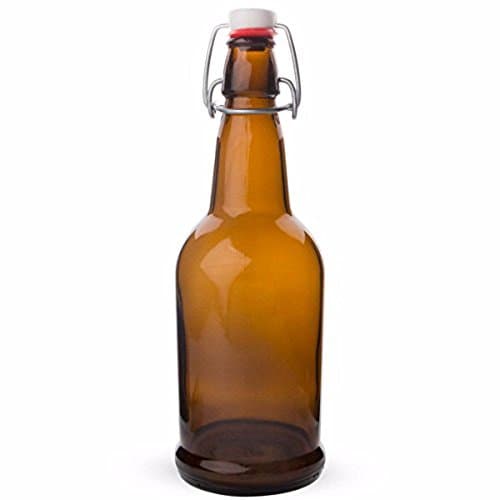
EZ Cap Swing Top Bottles, Amber Glass, 16 oz (Case of 12)
The only bottle here with a published pressure rating — 100 PSI — in amber glass, which is the combination a second ferment actually asks for.
Who it is for. Anyone doing a second ferment who wants a bottle with a number behind it rather than a shape that looks strong.
Published specifications
Capacity
16 oz
Glass color
Amber
Pressure rating
“Pressure rated to 100 PSI which means they can easily handle the carbonation of soda pop and hard seltzer”
Case quantity
12 bottles, includes 12 swing tops
Closure
Reusable swing top; also accepts a 26 mm pry-off crown cap
Maker’s note
“These swing tops are designed to be primarily sealed with a crown cap closure for long term storage.”
Dimensions
Not published
Source: MoreBeer published EZ Cap product specification (capacity, pressure rating, case contents, crown cap compatibility), morebeer.com/products/ez-cap-swing-top-bottles-amber-glass-16-oz-case-12, fetched 2026-09-01
Rubric — 8.3 / 10
Materials9/10 · weight 28%
Documentation9/10 · weight 22%
Capacity fit8/10 · weight 16%
Cleaning7/10 · weight 18%
Value8/10 · weight 16%
What it gets right
A published 100 PSI rating is the single most useful number in this whole category, and almost nobody publishes one
Amber glass blocks the light that degrades a bottle sitting out on a counter through a second ferment
The dual finish means you can crown-cap a batch you want to leave for months and swing-top the ones you will drink this week
16 oz is one serving, so a bottle gets opened once and drunk rather than losing its carbonation over three days
What it costs you
Swing-top gaskets perish, and a tired gasket is the commonest cause of a flat second ferment
No dimensions published, so fitting twelve of them on a fridge shelf is a measuring job when they arrive
Crown caps are sold separately if you want the long-storage option the maker recommends
Skip it if. You want to see the color of the finished drink. Amber hides it; the clear version of the same bottle does not.
Can I use my beer brewing equipment for kombucha?+
Much of it, yes. Crown-cap or swing-top bottles, a capper, a bottling wand, bottle brushes, a thermometer, a stock pot and a scale all transfer directly. What does not transfer is the airlock and the carboy, because kombucha's first fermentation is aerobic and needs a wide open surface under cloth, and the hydrometer, because kombucha is judged on pH rather than gravity.
Can I brew kombucha in a carboy?+
You can, but it works badly. The culture works at the air-liquid surface and the pellicle grows to the full width of it, so a narrow neck gives a small working surface for a large volume and slows the ferment. The bigger problem is retrieval: a full-width pellicle does not come back out through a carboy neck in one piece. Use a wide-mouth jar for the first ferment and keep the carboy for holding finished kombucha before bottling.
Can I use Star San or another no-rinse sanitizer for kombucha?+
On bottles, yes, exactly as you would for beer. On anything that touches the culture, rinse thoroughly rather than relying on a no-rinse residue — you are placing a living mat and a cup of starter liquid into a one-gallon jar rather than pitching a yeast slurry into five gallons. Hot water, a clean brush, a thorough rinse and air drying is the standard approach for the brewing jar.
Do I need an airlock for kombucha?+
No. Kombucha's first fermentation is aerobic and the culture needs air exchange, so the vessel is covered with tight-weave cloth and a band rather than sealed. An airlock is the correct tool for beer and wine and the wrong one here. The second fermentation is sealed, but that happens in pressure-rated bottles rather than in a fermenter.
Will kombucha contaminate my beer?+
The risk runs that direction rather than the other way, which is why it is worth a thought. Kombucha is strongly acidic and well defended; a fermenting beer is not, and has no defense against stray acetic acid bacteria. Keep an open kombucha jar away from an actively fermenting beer and do not share bottle brushes between the two without a thorough clean.
Can I measure kombucha ABV with a hydrometer?+
Not usefully. Sugar is being consumed and acid produced at the same time, so a gravity reading does not separate the two, and the ethanol concentrations involved sit below what home equipment resolves. Kombucha contains a small amount of alcohol as a normal by-product, and a sealed second ferment can push past the 0.5 percent threshold used for non-alcoholic beverages in the US, but no home measurement will tell you by how much.
Sources
Every specification cited on this page came from one of these documents, retrieved on the date shown against the product it belongs to.