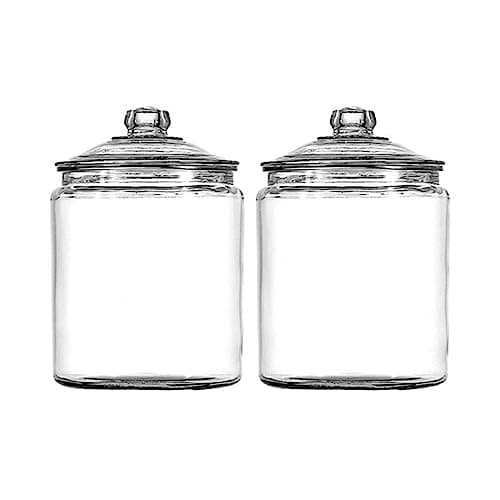
The maker sells these for flour and rice and never mentions fermentation. That is worth knowing before you buy two of them for kombucha, because one detail makes them unusually good at one job.
Buy these as SCOBY hotel jars, not as fermenters. The glass lid is the whole story: the maker states it does not suction seal, which is a defect in a storage jar and exactly what you want on a vessel holding spare cultures. As a primary fermenter it is wrong — a first ferment needs cloth and air exchange, not a lid. Two heavy American-made jars for the price of one branded brewing jar is the other half of the argument.
What this review is
This site has no lab and has not brewed in these jars. What it can do is read what Anchor Hocking publishes, check it against the job a kombucha brewer actually has, and be clear about which claims are the maker's and which are a buyer's inference.
That distinction matters more here than on most products, because this jar is not sold for fermentation at all. Every figure below came from the published listing, read on 2026-09-21.
What the maker publishes
Anchor Hocking's published figures for the Heritage Hill 1 gallon jar, set of 2, retrieved 2026-09-21.
Parameter
Published value
Contents
Two 1-gallon jars, two glass lids
Material
All-clear glass, stated lead free and BPA free
Lid
Glass with an oversized knob. Stated: they do not suction seal
Mouth
Described as wide mouthed. No diameter published
Construction
Described as thick walled, with a substantial weight to stay sturdy
Origin
Made in the USA, stated as Ohio since 1905
Intended use
Dry goods: flour, cookies, rice, coffee, spices
Package
16.75 x 8.9 x 9.5 in, 4.28 lb for the pair
Jar dimensions
Not published
Read that table and the gap jumps out. There is no height, no diameter and no capacity tolerance for the individual jar — the only measurements are for the shipping box with two jars in it. For a vessel whose mouth decides whether your hand fits past a pellicle, that is the one omission that matters, and it is the same omission nearly every gallon jar on this site shares.
The lid is the product
One published phrase decides what this jar is for: they don't suction seal. Anchor Hocking writes it as a caveat, because a storage jar that does not seal is a storage jar that will not keep crackers crisp.
For a fermenter it is the correct behavior. A resting glass lid keeps dust and fruit flies out while letting pressure equalize, which means a jar of live culture cannot quietly build pressure behind a gasket. That is precisely the property you want on a SCOBY hotel — a jar of spare cultures in sweet tea, fed occasionally, opened rarely, and left for weeks.
It is not, however, a substitute for a cloth cover during a first fermentation. That stage is aerobic: the culture needs real air exchange across the surface, not the trickle that gets past a resting lid. Covers and lids makes the full argument. Using this jar as a primary fermenter means putting cloth and a band on it and setting the glass lid aside, at which point you have bought a lid you do not use.
The picks
Two ways to buy a pair of gallon jars
One is a storage jar with glass lids that happens to suit a hotel; the other is sold for brewing and ships the cloth covers and bands this one does not.
Anchor Hocking
Heritage Hill 1 Gallon Glass Jar with Lid, Set of 2
Two thick American-made gallon jars with glass lids that deliberately do not seal — wrong for a primary ferment, close to ideal for a SCOBY hotel.
A hotel is not a fermenter and the requirements genuinely differ, which is why a jar that is mediocre at one job can be the best thing available for the other.
A cover that keeps insects out for weeks, not days. A cloth and band works on a jar you open every few days. On a jar opened once a fortnight, cloth sags, gets damp at the edge and becomes an invitation — which is the whole problem described on the fruit fly page. A resting glass lid does not sag.
A closure that cannot trap pressure. Cultures in sweet tea keep working slowly. A sealing lid on a jar nobody opens for a month is how a storage vessel becomes a pressure vessel.
Room to stack pellicles. Hotels grow. A gallon is the sensible unit, and a second jar is better than one oversized one because you can split cultures rather than stack them into a brick.
A mouth your hand fits through. You will be reaching in to pull layers out, and a hotel pellicle is thicker and less flexible than a fresh one.
Darkness, or a cloth over the top. Weeks of counter light degrade a culture in a way that days do not.
Measured against that list, this jar scores on three of five outright, fails nothing, and leaves one unanswered — the mouth diameter nobody publishes.
Against the brewing jars
The honest comparison is not against a single fancy brewing vessel but against the other two-jar purchase on this site.
Published contents and claims for two-jar gallon purchases, compiled from each maker's listing.
Heritage Hill 2-pack
Fermentaholics 2-pack
Jars
2 x 1 gallon
2 x 1 gallon
Cover supplied
Glass lid, does not seal
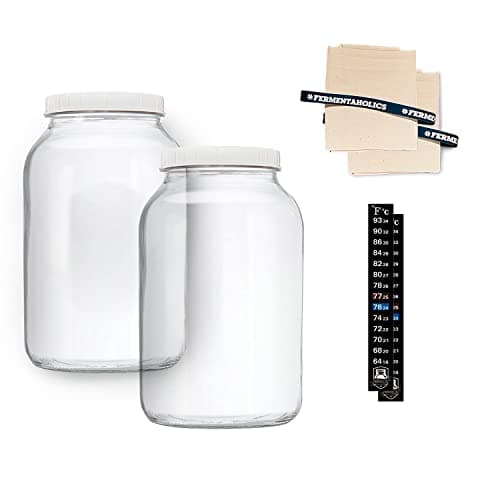
Breathable muslin cloth and band
Thermometer
None
Temperature strip per jar
Sold for
Dry goods storage
Kombucha brewing
Origin stated
Made in USA
Not stated
Dimensions published
Package only
None
For brewing, the Fermentaholics pack is the more complete purchase: it arrives with the cover you actually need and a thermometer on each jar. For a hotel, the Heritage Hill pack is better, because a cloth cover on a jar you open once a fortnight is an invitation to fruit flies and a resting glass lid is not.
There is also a materials point worth making plainly. This jar is glass and glass only — no gasket, no metal band, no plastic anywhere near the liquid. Against a drink that sits at roughly pH 2.5 to 3.5 for weeks, that is the cleanest possible answer, and it is the same reasoning behind the materials page.
Who should buy it
Anyone running a SCOBY hotel. This is the case where the non-sealing glass lid is a genuine feature rather than a compromise.
Brewers who already own cloth covers. Two heavy gallon jars for less than most single brewing jars, and you supply the cloth.
Anyone storing finished kombucha in bulk. Glass will not stain, warp or hold smells, and the lid keeps the fridge out of the drink.
Not a first-time brewer buying one vessel. A kit or a purpose-sold brewing jar arrives with the cover and often the thermometer, and this does not.
The verdict
On materials and build this is a straightforwardly good jar: thick all-clear glass, made in Ohio, stated lead free, no gasket and no metal, two of them for the price most makers charge for one. On documentation it is poor — no jar dimensions at all, and not a word about fermentation, which means every brewing claim on this page including ours is inference from a storage-jar listing.
Judged as what it is, a lidded storage jar, it happens to be the best SCOBY hotel vessel this site has sourced, for the single reason that its lid does not seal. Judged as a fermenter it is incomplete, and the maker never claimed otherwise.
Heads up: some links on this page are affiliate links. If you buy through one we may earn a commission at no extra cost to you. It never changes a ranking, and we take no payment for placement. The full version.
The short answer
Quick picks
Ranked on the published rubric. Every row jumps to that product's full write-up below; the button goes straight to Amazon.
#
Product
Best for
Score
Price
1
Anchor Hocking
Heritage Hill 1 Gallon Glass Jar with Lid, Set of 2
Two thick American-made gallon jars with glass lids that deliberately do not seal — wrong for a primary ferment, close to ideal for a SCOBY hotel.
The only jar on this site that publishes its mouth diameter — 3 inches inside — which is the one measurement a brewer with a pellicle to lift actually needs.
Anchor Hocking Heritage Hill 1 Gallon Glass Jar with Lid, Set of 2
Two thick American-made gallon jars with glass lids that deliberately do not seal — wrong for a primary ferment, close to ideal for a SCOBY hotel.
Who it is for. Anyone running a SCOBY hotel, or keeping finished kombucha and spare cultures in glass that will not stain, warp or hold smells.
Published specifications
Quantity
2 jars with 2 glass lids
Capacity
1 gallon each
Material
All-clear glass, stated lead free and BPA free
Lid
Glass lid with an oversized knob. “Though they don’t suction seal” — the maker states the lid rests rather than seals
Mouth
Described as wide mouthed. No diameter is published
Origin
Made in the USA, stated as Ohio since 1905
Published use
Dry goods storage — flour, rice, coffee, spices. Fermentation is not named
Package
16.75 x 8.9 x 9.5 in, 4.28 lb for the pair
Jar dimensions
Not published for the individual jar
Source: Anchor Hocking published Heritage Hill 1 Gallon Glass Jar with Lid, Set of 2 listing (two 1-gallon jars with two glass lids, all-clear glass with oversized knobs, stated not to suction seal, wide mouthed and thick walled, lead free and BPA free, made in the USA, published for dry goods storage, 16.75 x 8.9 x 9.5 in and 4.28 lb package), Amazon B01EIJ0P6W, retrieved 2026-09-21
Rubric — 8.0 / 10
Materials9/10 · weight 28%
Documentation5/10 · weight 22%
Capacity fit8/10 · weight 16%
Cleaning9/10 · weight 18%
Value9/10 · weight 16%
What it gets right
A glass lid that rests rather than seals is exactly what a SCOBY hotel wants: it keeps dust and flies out and still lets pressure equalize
Two jars in one order, which is what a hotel plus a spare batch actually needs
Thick, heavy all-glass construction with no gasket, no metal and no plastic anywhere near a pH-3 liquid
Made in the USA and stated lead free, which is more than most import jars put in writing
What it costs you
The maker publishes it for dry goods and never mentions fermentation, so every brewing claim about it is a buyer's inference
No mouth diameter and no individual jar dimensions are published — the only figures are for the shipping box
A resting glass lid is not a cloth cover. For a primary ferment you still need cloth and a band
Clear glass, so a hotel on a sunny counter needs a cupboard or a cloth over it
Skip it if. You want a primary fermenting vessel. This is a storage jar with a lid, and a first fermentation needs air exchange through cloth.
#3 · A half-gallon batch you can get your hand into
Ball Wide Mouth Glass Canning Jars, 64 oz (Case of 6)
The only jar on this site that publishes its mouth diameter — 3 inches inside — which is the one measurement a brewer with a pellicle to lift actually needs.
Who it is for. A brewer running small or parallel batches, or anyone who wants a jar whose opening they can check against their own hand before ordering.
Published specifications
Capacity
64 oz (half gallon)
Mouth
Wide mouth. 3 in inner diameter, 3.5 in outer
Height
9.25 in without the lid, 9.375 in with it
Case quantity
6 jars
Included
Lids and bands, screwed onto the jars
Material
Glass. Stated FDA compliant and BPA free
Heat limit
Withstands temperatures up to 250 F
Thermal shock
“Withstands sudden 90° F temperature change”
Freezer
“Not freezer safe”
Markings
Graduated in cups, ounces and mL on the glass
Origin
Made in USA
Spigot
None. This is a jar, not a brewer.
Source: Ball Wide Mouth 64 oz glass canning jar specification as published by distributor Uline (item S-19404: capacity, 3 in inner and 3.5 in outer mouth diameter, 9.25 in and 9.375 in heights, case quantity, materials, 250 F limit, 90 F thermal shock, freezer guidance, graduated markings, origin), uline.com, retrieved 2026-09-06
Rubric — 9.1 / 10
Materials9/10 · weight 28%
Documentation10/10 · weight 22%
Capacity fit8/10 · weight 16%
Cleaning9/10 · weight 18%
Value9/10 · weight 16%
What it gets right
The 3-inch inner mouth is published, which almost no brewing jar states — it is the difference between lifting a pellicle out cleanly and fishing for it
Graduated markings on the glass mean the batch and the starter tea can be measured in the vessel rather than in a jug first
Six jars per case, so a SCOBY hotel, a half-gallon batch and a spare all arrive in one order
The published 90 F sudden-change tolerance is the number that matters when hot tea meets a cold jar
What it costs you
No spigot, so a half gallon has to be poured or siphoned, and pouring past a pellicle is awkward
Not freezer safe, per the published care guidance
A metal lid and band come with it, and neither belongs on a fermenting jar — you will use a cloth instead and store the lids
Half a gallon is a small batch. Two of these is more glass to clean than one gallon jar
Skip it if. You want a gallon or more per batch. Half-gallon jars multiply fast, and four of them is a worse experience than one two-gallon vessel.
#ad No live price feed yet, so no number is shown rather than a stale one. How this is funded.
FAQ
Questions people actually ask
Is the Anchor Hocking Heritage Hill jar good for kombucha?+
As a SCOBY hotel, yes — better than most, because the maker states the glass lid does not suction seal, so it keeps dust and flies out without letting pressure build. As a primary fermenter it is incomplete: a first ferment is aerobic and needs a cloth cover and band, which this jar does not include. Anchor Hocking sells it for dry goods and never mentions fermentation.
Can you ferment in a jar with a glass lid?+
Not a first fermentation. That stage needs air exchange across the surface, which is why every brewing jar on this site takes cloth and a band rather than a lid. A resting, non-sealing glass lid is fine for a SCOBY hotel or for storing finished kombucha, where the vessel is opened rarely and nothing needs to breathe.
What size is the Heritage Hill jar?+
One gallon each, sold as a set of two. Beyond that the listing publishes nothing about the individual jar — no height, no footprint and no mouth diameter. The only measurements given are for the shipping box, at 16.75 by 8.9 by 9.5 inches and 4.28 pounds for the pair.
Heritage Hill or a purpose-made kombucha jar?+
For brewing, a purpose-sold jar is the more complete purchase because it arrives with the breathable cover you need and often a temperature strip. For a hotel, Heritage Hill wins on the lid, and it is two heavy American-made jars for roughly what a single branded brewing jar costs.
Is Anchor Hocking glass safe for fermented drinks?+
Glass is the least reactive common vessel material and this one is stated lead free and BPA free, with no gasket, metal band or plastic anywhere near the liquid. Against a drink sitting at roughly pH 2.5 to 3.5 for weeks, that is the cleanest answer available. The caveat is documentation rather than safety: the maker does not address fermentation use at all.
Can you use a Heritage Hill jar for continuous brewing?+
Not really. Continuous brewing depends on drawing from a tap near the base so the culture is never disturbed, and this jar has no spigot and no practical way to add one — drilling tempered glass is not a home operation. It is a batch vessel or a hotel jar. For continuous brewing, a purpose-made jar with a 304 stainless spigot is the right purchase.
Sources
Every specification cited on this page came from one of these documents, retrieved on the date shown against the product it belongs to.