It works, it costs almost nothing, and it is slower and less reliable than buying a culture. All three of those are true, and which one matters depends on what you are short of.
Pour a bottle of raw, unpasteurized, unflavored kombucha into a jar with about twice its volume of strong sweet tea, cover it with cloth, and leave it somewhere warm for two to four weeks. A pellicle forms on the surface and that is your culture. The honest caveats: it depends entirely on the bottle being genuinely live, it takes several times longer than ordering one, and the first batch brewed on it is usually slow. If you want kombucha this month rather than next, buy a culture.
Why anyone does this
Three reasons, and only one of them is money.
The first is availability. A live culture has to be shipped alive, and if you are somewhere shipping is slow or expensive, a bottle from a supermarket chiller is already local.
The second is that it is genuinely interesting. Watching a pellicle assemble itself out of what looks like flat tea is the clearest demonstration of what a SCOBY actually is — a raft the culture builds, not the culture itself.
The third is cost, and it is smaller than people expect. A bottle of raw kombucha plus the tea and sugar is not free, and a purchased culture is not expensive. What you save is a few dollars; what you spend is two to four weeks.
The bottle is the whole decision
Everything about whether this works is decided before you pour anything, by which bottle you picked up.
Raw and unpasteurized. Non-negotiable. Pasteurization is designed to kill exactly the organisms you are trying to recruit. If the label does not say raw or unpasteurized, assume it is not.
Unflavored, or as close as the shelf allows. Fruit juice and flavorings bring sugars and acids the culture did not evolve on, and they make the jar harder to read. The plain, original version of a brand is what you want.
Cloudy, with sediment. Strands and cloud at the bottom of the bottle are yeast, and yeast is half of what you are trying to grow. A perfectly clear bottle is a worse candidate.
Refrigerated the whole time. Raw kombucha is sold cold because it is alive. A bottle that has been warm on a shelf is a bottle whose history you do not know.
As fresh as you can find. Check the date. Older bottles are not dead, but they have less of everything.
One honest note about buying the bottle. The obvious candidate — the plain, unflavored version of the big raw kombucha brand — was not purchasable through this site's links when this page was written, while its flavored versions were. That is a good argument for buying the bottle from a grocery chiller rather than ordering it, and it is why there is no bottle in the picks below.
What the process needs
Almost nothing, and everything on this list is reusable afterward.
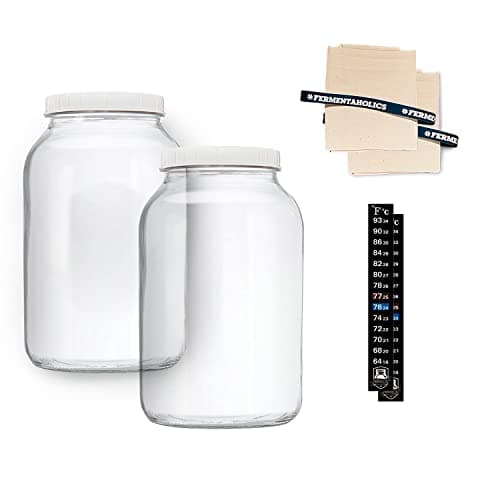
A wide-mouth glass jar. The pellicle forms at the surface, so surface area is what you are buying. A gallon jar is more than you need for this stage but is what you will brew in afterward.
A tight-woven cloth cover and a band. Not a lid. This stage is aerobic and it is also slow, which is a long time for fruit flies to find an uncovered jar of sweet tea.
Plain black tea and plain white sugar. No herbal infusions, no decaf as a first choice, nothing oiled like Earl Grey. Tea and sugar for kombucha explains why.
A warm spot. This is the variable that decides whether it takes two weeks or six.
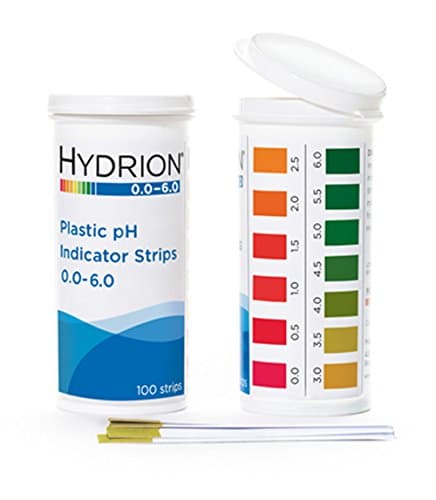
pH strips, ideally. Not to run the process, but to answer the one question that actually matters at the end.
The method
Brew tea about as strong as you would for a normal batch and sweeten it as you normally would, then let it cool completely. Pour it into the jar, add the entire bottle of raw kombucha, and aim for roughly one part bottle to two parts sweet tea. Cover with cloth, band it, and put it somewhere warm and out of direct sun.
Then leave it alone. The temptation is to stir it, move it, or peer under the cloth daily. A new pellicle forms at the undisturbed surface, and stirring the jar sets it back.
Over the first week you may see nothing, or a faint film. Over the second and third a thin translucent skin forms and thickens into something that looks like a soft, wet disc. Two to four weeks is the normal window, and a cold room can stretch it well past that.
What the timeline actually looks like
Growing a culture from a bottle against ordering one. Timings are the working figures used across this site, not a published standard.
Grown from a bottle
Bought
Time to a usable culture
2 to 4 weeks, longer if cool
Shipping time
Starter tea you end up with
Whatever is in the jar, of unknown strength
A published volume, often 12 fl oz
First batch after that
Often slow; the culture is young
Normal, 7 to 14 days
Reliability
Depends entirely on the bottle
Documented and guaranteed by some sellers
Cost
A bottle, plus tea and sugar
The price of a culture
The row that catches people is the third one. Growing a pellicle is not the same as having a mature culture: the liquid it grew in is weak, and weak starter tea is exactly what makes a first batch vulnerable. Expect the batch after this one to be slower than the timelines on the first batch page, and do not conclude anything is wrong.
The picks
What we would actually buy
The honest ranking puts the culture first, because for most people it is the faster and more certain route. The jar and the tea you need either way.
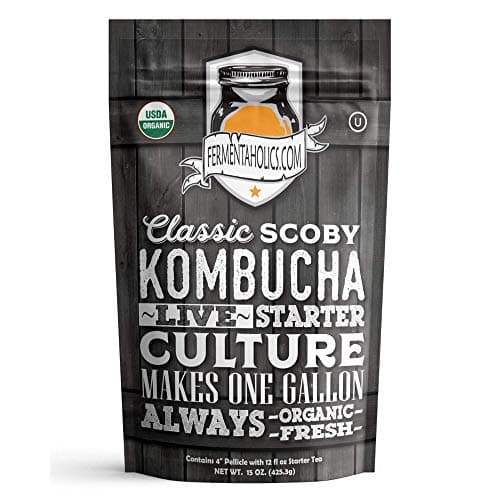
Fermentaholics
Organic Kombucha SCOBY with 12 fl oz Starter Tea
A hand-selected pellicle with twelve fluid ounces of mature starter tea, measured against the maker’s own published ten percent rule for a gallon.
Temperature. The dominant variable, as it is everywhere else in this hobby. A jar at 78 F forms a pellicle far faster than the same jar at 66 F, and a cold room can push this past a month. Brewing temperature covers the band.
How live the bottle was. The one you do not control after the purchase. A fresh, cloudy, properly refrigerated bottle brings more organisms to the jar than one that has been sitting near the front of a warm shelf.
Surface area. The pellicle forms at the top, so a wide jar builds a usable disc sooner than a narrow one holding the same liquid.
Being left alone. Free, and the one people get wrong. Every stir breaks up a forming film and restarts that part of the process.
Knowing when it is ready, and whether it is safe
A pellicle thick enough to lift without tearing — a few millimeters, opaque rather than gossamer — is usable. Thicker is not better; it is just older.
The more important question is acidity. A jar that has been sitting for weeks should smell sharply sour, like a mild vinegar. If it smells sweet, or of nothing much, the bottle probably was not as live as the label suggested and the jar has been sitting at a hospitable pH for a long time. That is the one scenario in this process worth being careful about, and it is why a strip is worth having: a healthy jar reads well down in the acidic range.
Fuzzy growth that sits proud of the surface — blue, green, black or white and dry-looking — is mold, and the jar goes in the bin along with the liquid. Mold versus SCOBY has the distinction in detail. Brown stringy strands hanging beneath the disc are yeast and are entirely normal.
When buying is simply the better call
You want kombucha soon. Ordering a culture compresses a month into a shipping window.
You want a known quantity of starter tea. Sellers publish it in fluid ounces; where to buy a SCOBY works through who states what, and it is the figure that protects your first batch.
Your kitchen is cold. A slow process in a cold room is a very slow process, and a long warm-up spent near a hospitable pH is the least good version of this.
You want a guarantee. Some sellers publish one. A supermarket bottle comes with no promise that it will do anything at all.
You are nervous about telling mold from yeast. A bought culture arrives obviously healthy; a jar grown from scratch asks you to make that call yourself, early, with nothing to compare against.
What goes wrong
The bottle was pasteurized. Nothing happens, for weeks. This is the commonest failure and it is decided at the shop.
A flavored bottle. It can work, and it muddies both the flavor and your ability to read the jar.
Too little sweet tea, or too much. Roughly one part bottle to two parts tea is the working proportion. Drowning the bottle in tea dilutes the acidity that protects the jar.
Moving and stirring it. The pellicle forms at an undisturbed surface. Every stir starts it over.
Giving up at day ten. Two weeks is normal; three is common in a cool kitchen.
Heads up: some links on this page are affiliate links. If you buy through one we may earn a commission at no extra cost to you. It never changes a ranking, and we take no payment for placement. The full version.
The short answer
Quick picks
Ranked on the published rubric. Every row jumps to that product's full write-up below; the button goes straight to Amazon.
#
Product
Best for
Score
Price
1
Fermentaholics
Organic Kombucha SCOBY with 12 fl oz Starter Tea
A hand-selected pellicle with twelve fluid ounces of mature starter tea, measured against the maker’s own published ten percent rule for a gallon.
A 0.0 to 6.0 range in 0.5 steps, which puts four separate color matches inside the 2.5 to 3.5 window kombucha lives in — a 1-to-14 strip gives you one.
Fermentaholics Organic Kombucha SCOBY with 12 fl oz Starter Tea
A hand-selected pellicle with twelve fluid ounces of mature starter tea, measured against the maker’s own published ten percent rule for a gallon.
Who it is for. Anyone starting a standard one-gallon batch who wants the starter tea measured for them.
Published specifications
Batch size
One gallon
Starter tea volume
12 fl oz of mature, active starter tea
Pellicle
Hand-selected
Starter tea ingredients
Organic cane sugar, filtered water, organic black tea, live cultures
Certification
USDA Certified Organic, Kosher, Non-GMO, vegan
Production
Grown in the maker’s licensed lab
Maker’s dosing rule
“the rule of thumb is to use 10% starter tea per batch size”
Source: Fermentaholics published SCOBY specification (12 fl oz starter tea, 1-gallon dosing, ingredients, certifications) and its published 10 percent starter rule, retrieved 2026-09-01
Rubric — 8.5 / 10
Materials9/10 · weight 28%
Documentation9/10 · weight 22%
Capacity fit8/10 · weight 16%
Cleaning8/10 · weight 18%
Value8/10 · weight 16%
What it gets right
12 fl oz against a 128 oz gallon is 9.4 percent, within a rounding error of the maker’s own 10 percent rule — the quantity matches the instruction
Starter tea is the part that actually acidifies a new batch and protects it from mold; the pellicle is mostly a raft
Ingredients of the starter tea are published, which almost no culture seller does
Certified organic, kosher, non-GMO and vegan are stated together
What it costs you
A live culture in transit is a live culture in transit — heat and delay are real risks nobody controls
No stated shelf life once it arrives
You still need tea, sugar and a jar
Skip it if. You are brewing half a gallon. Buy the half-gallon version instead; a gallon’s worth of starter in a half-gallon batch drives the acidity too far, too fast.
A 0.0 to 6.0 range in 0.5 steps, which puts four separate color matches inside the 2.5 to 3.5 window kombucha lives in — a 1-to-14 strip gives you one.
Who it is for. Every kombucha brewer. This is the cheapest instrument on the site and the one that answers the safety question.
#ad No live price feed yet, so no number is shown rather than a stale one. How this is funded.
FAQ
Questions people actually ask
Can you grow a SCOBY from store-bought kombucha?+
Yes, provided the bottle is raw and unpasteurized. Combine it with roughly twice its volume of cooled sweet black tea in a wide-mouth jar, cover with cloth and leave it somewhere warm and undisturbed. A pellicle usually forms within two to four weeks. A pasteurized bottle will never work, because pasteurization kills the organisms you are trying to recruit.
How long does it take to grow a SCOBY from a bottle?+
Two to four weeks is the normal window, and a cool kitchen can stretch it well beyond that. Expect to see nothing for the first week, a faint film in the second, and a liftable disc by the third or fourth. Giving up at day ten is the commonest reason people conclude it did not work.
Which store-bought kombucha works best for growing a SCOBY?+
A raw, unpasteurized, unflavored bottle from the refrigerated section, as fresh as you can find, ideally cloudy with visible sediment — that sediment is yeast, which is half of what you are growing. Flavored bottles can work but bring sugars and acids the culture did not evolve on and make the jar harder to read.
Is growing your own SCOBY cheaper than buying one?+
Marginally. A bottle of raw kombucha plus tea and sugar is not free, and a purchased culture is not expensive. What you genuinely save is a few dollars; what you spend is two to four weeks and a less certain outcome. The stronger arguments for growing one are availability and curiosity rather than cost.
Why is my first batch slow after growing a SCOBY?+
Because the liquid it grew in is weak. A bought culture ships with a measured volume of mature starter tea, often 12 fluid ounces for a gallon; a home-grown pellicle comes with whatever acidity the jar happened to develop. Weak starter means a slower, more vulnerable first batch. Keep the liquid, use all of it, and expect the batch to take longer than the standard timeline.
How do I know if my home-grown SCOBY is safe to use?+
It should smell sharply sour, like a mild vinegar, and the disc should lift without tearing. Fuzzy growth standing proud of the surface in blue, green, black or dry white is mold, and the whole jar goes out. Brown stringy strands hanging below the disc are yeast and are normal. A jar that still smells sweet after weeks is a jar whose bottle probably was not live.
Sources
Every specification cited on this page came from one of these documents, retrieved on the date shown against the product it belongs to.