The specification is genuinely excellent and most kombucha brewers should not buy it. Both of those things are true, and this page explains why.
By Scooter M.·Published September 13, 2026 · Updated September 21, 2026
The short answer
The PH60 is the best-specified pocket meter this site has sourced: ±0.01 pH, three-point automatic calibration with buffers in the box, a replaceable probe and an IP67 rating. For most kombucha brewers it is still the wrong purchase, because the question they are asking — is this batch under 4.2 — is answered by a vial of strips.
What this review is
We have not calibrated a PH60, dipped it in a batch, or measured its drift over a year. This site has no lab and says so on the methodology page. What this review does is take every figure Apera publishes for this instrument, hold it against the one measurement a kombucha brewer actually makes, and work out whether the specification earns its price in this specific application.
That is a narrower question than “is this a good meter”, and a more useful one. It is a very good meter. Whether it is a good meter for kombucha is a different matter, and the answer turns on a single number.
The published specification
Apera's published figures for the PH60 (SKU AI311), retrieved 2026-09-06.
Parameter
Published value
Range
-2.00 to 16.00 pH
Accuracy
±0.01 pH ±1 digit
Resolution
0.01 / 0.1 pH
Temperature compensation
Automatic, 0 to 50 C (32 to 122 F)
Calibration
Automatic 1 to 3 points, recognizes 5 buffer types
Probe
Replaceable, model PH60-E
Sealing
IP67, floatable
Battery
4 x AAA, up to 2000 hours continuous
Warranty
2 years instrument, 6 months probe
There is nothing to complain about there. Every figure a buyer would want is published, the buffers ship in the box so the instrument can be made trustworthy on day one, and the probe is a serviceable component with its own model number rather than a sealed part that dooms the whole device.
The number that decides it
Kombucha brewing involves exactly one pH decision: has this batch dropped below roughly 4.2, the point at which its own acidity is protecting it. The pH page works through where that figure comes from.
Against that line, ±0.01 pH is an instrument roughly an order of magnitude finer than the question. That is the right direction to err — a tolerance that straddles the decision is useless, and Apera's own cheaper PH20 further down this page is published at ±0.1, workable rather than comfortable — but it is also far more resolution than the decision consumes.
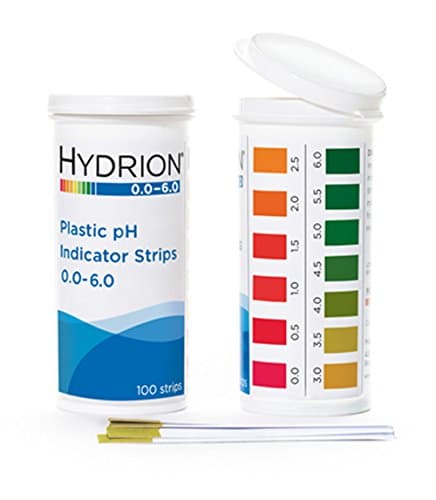
A vial of narrow-range strips reads 2.5, 3.0, 3.5 and 4.0 as four distinct colors inside the kombucha window. That is coarse, and it is entirely sufficient to answer a binary question about 4.2. The strips cost a fraction of the meter, never need calibrating, and cannot drift silently.
The picks
Strips first, then the meter
For most brewers the strips are the right answer and the meter is not. The order here reflects that rather than the specification.
Micro Essential Lab
Hydrion 9200 Spectral pH Strips, 0.0-6.0
A 0.0 to 6.0 range in 0.5 steps, which puts four separate color matches inside the 2.5 to 3.5 window kombucha lives in — a 1-to-14 strip gives you one.
#ad No live price feed yet, so no number is shown rather than a stale one. How this is funded.
Apera Instruments
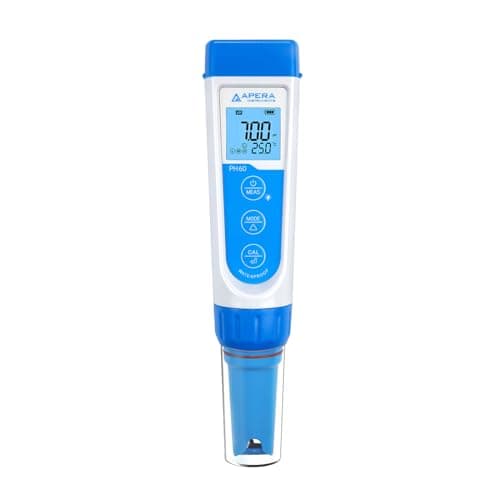
PH60 Premium Pocket pH Tester Kit (AI311)
The only meter here whose published accuracy — ±0.01 pH — is finer than the decision you are using it to make, with a probe you can replace instead of the whole instrument.
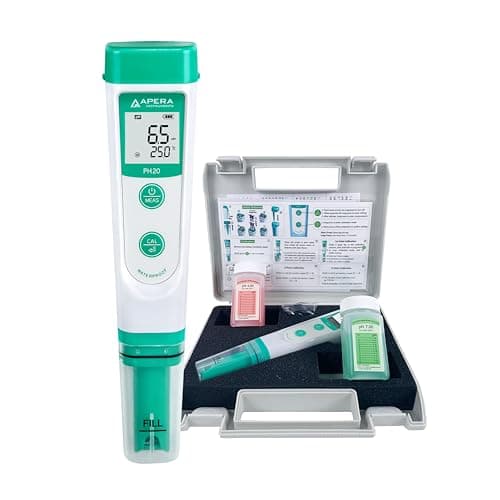
Value Series PH20 Waterproof pH Tester Kit (AI209)
Apera's value meter publishes ±0.1 pH — workable against the 4.2 line rather than comfortable — with temperature compensation and IP67, but its probe is sealed in and cannot be replaced.
Continuous brewers. A vessel that is never emptied has a pH that moves slowly and continuously rather than in batch-sized steps. A number you can log across weeks is genuinely more useful there than a color you eyeball, and the continuous brew method is a routine where drift matters.
Anyone steering a batch toward vinegar. Strips top out at 6.0 in 0.5 steps, which is too coarse to follow the last stretch below 2.5. Kombucha vs apple cider vinegar covers why that end of the range is worth watching.
People running several ferments. If there is already a meter in the house for hydroponics, an aquarium or beer, the marginal cost of using it for kombucha is zero and this is the instrument to have.
Anyone who needs a written record. “It read 3.14” travels between people; “about the same orange as last time” does not.
The catch is the probe, and the maker says so
The single most honest thing in this specification is the warranty split: two years on the instrument, six months on the probe. Apera is telling you plainly which part wears out.
A glass pH electrode dies by drying out. The bulb has to stay wet in storage solution, which is why the kit ships 3M potassium chloride and why a meter kept dry in a drawer for a year will switch on, display two decimal places, and be wrong. That failure mode is the real argument against a meter for occasional use: a strip that has degraded looks degraded, and a meter that has drifted looks exactly like one that has not.
Kombucha is also a harder sample than the water-treatment and hydroponics applications this class of meter is written for. It is acidic, carries suspended yeast and cellulose, and leaves a film. None of that damages a probe, but it means rinsing immediately after every reading rather than at the end of a session — and neither Apera nor anyone else publishes guidance for this specific liquid.
The honest verdict
On specification, this is the meter to buy in its class: the accuracy is finer than the decision, the calibration is automatic across three points with buffers included, the probe is replaceable, and the ingress rating is appropriate for a device used over an open jar. Nothing in the published figures is hedged or missing.
On fit, most kombucha brewers should buy strips. The PH60 answers a question they are not asking, at a price that buys years of strips, and it introduces a maintenance obligation — storage solution, periodic recalibration — that a vial in a cupboard does not have.
Buy it if you brew continuously, make vinegar deliberately, keep records, or already own a meter for something else. The full pH meter comparison sets it against Apera's cheaper PH20, whose tolerance is workable but whose probe cannot be replaced — the trade-off that actually separates the two.
Calibrating it, and how often
Calibration is three minutes and it is the step that separates a measurement from a number on a screen. The kit ships pH 4.00, 7.00 and 10.01 solutions precisely so this can be done on day one.
For kombucha, calibrate at 4.00 and 7.00. Those two bracket the range the drink actually occupies, and a meter calibrated at 7.00 and 10.01 and then used at 3.0 is extrapolating well outside where it was checked — which is exactly where a well-specified instrument quietly stops being accurate.
How often depends on use rather than the calendar: before any session where the number matters, after the probe has been dry for any length of time, and whenever a reading disagrees with a strip by more than the published tolerance. A meter used weekly and stored wet holds calibration for weeks. One that lives in a drawer needs it every time.
The value-tier sibling gets the same treatment. The Apera PH20 review sets its ±0.1 tolerance and non-replaceable probe against this instrument, which is the comparison most buyers are actually making.
Heads up: some links on this page are affiliate links. If you buy through one we may earn a commission at no extra cost to you. It never changes a ranking, and we take no payment for placement. The full version.
The short answer
Quick picks
Ranked on the published rubric. Every row jumps to that product's full write-up below; the button goes straight to Amazon.
#
Product
Best for
Score
Price
1
Apera Instruments
PH60 Premium Pocket pH Tester Kit (AI311)
The only meter here whose published accuracy — ±0.01 pH — is finer than the decision you are using it to make, with a probe you can replace instead of the whole instrument.
A 0.0 to 6.0 range in 0.5 steps, which puts four separate color matches inside the 2.5 to 3.5 window kombucha lives in — a 1-to-14 strip gives you one.
Value Series PH20 Waterproof pH Tester Kit (AI209)
Apera's value meter publishes ±0.1 pH — workable against the 4.2 line rather than comfortable — with temperature compensation and IP67, but its probe is sealed in and cannot be replaced.
The only meter here whose published accuracy — ±0.01 pH — is finer than the decision you are using it to make, with a probe you can replace instead of the whole instrument.
Who it is for. Someone brewing continuously, tracking a number over time, or pushing a batch toward vinegar and wanting to know exactly where it is.
Published specifications
Model
PH60, SKU AI311
Range
“-2.00 to 16.00 pH”
Accuracy
“±0.01 pH ±1 digit”
Resolution
“0.01/0.1 pH”
Temperature compensation
“Auto Temperature Compensation 0 to 50°C (32 to 122°F)”
“TWO YEARS for the instrument and SIX MONTHS for the probe”
Source: Apera Instruments published PH60 product specification (model/SKU, range, accuracy, resolution, ATC range, calibration points and recognized buffers, replaceable PH60-E probe, IP67 rating, battery type and 2000-hour life, kit contents, warranty terms), aperainst.com, retrieved 2026-09-06
Rubric — 8.4 / 10
Materials9/10 · weight 28%
Documentation10/10 · weight 22%
Capacity fit9/10 · weight 16%
Cleaning7/10 · weight 18%
Value6/10 · weight 16%
What it gets right
±0.01 pH published accuracy against a decision line at 4.2 — the instrument is an order of magnitude finer than the question, which is the right way round
Three-point automatic calibration with buffers in the box, so it arrives ready to be made trustworthy rather than merely switched on
The probe is a replaceable part with its own model number, so a dead electrode is a component failure and not a landfill event
IP67 and floatable, which is a sensible specification for a device used over an open jar
What it costs you
The published probe warranty is six months against two years for the instrument, which tells you honestly where the wear is
It needs storage solution and periodic recalibration. A meter left dry in a drawer for a year reads confidently and wrongly
It costs many times a vial of strips to answer a question strips already answer well enough for most brewers
Four AAA batteries and a case make it a thing you own, not a thing you keep next to the jar
Skip it if. You test once a batch to confirm the ferment is under 4.2. Strips do that for a fraction of the money and never need calibrating.
A 0.0 to 6.0 range in 0.5 steps, which puts four separate color matches inside the 2.5 to 3.5 window kombucha lives in — a 1-to-14 strip gives you one.
Who it is for. Every kombucha brewer. This is the cheapest instrument on the site and the one that answers the safety question.
#ad No live price feed yet, so no number is shown rather than a stale one. How this is funded.
#3 · A cheaper meter at a workable tolerance
Apera Instruments Value Series PH20 Waterproof pH Tester Kit (AI209)
Apera's value meter publishes ±0.1 pH — workable against the 4.2 line rather than comfortable — with temperature compensation and IP67, but its probe is sealed in and cannot be replaced.
Who it is for. A brewer who wants a number to log at the lowest price from an established instrument maker, and accepts replacing the meter when its probe wears out.
Published specifications
Model
Value Series PH20, SKU AI209
Range
0 to 14.0 pH
Resolution
0.1 pH
Accuracy
±0.1 pH
Calibration
Automatic, 1 to 3 points, with buffer recognition
Temperature compensation
Automatic, 0 to 50 C (32 to 122 F), temperature accuracy ±0.5 C
Probe
Glass bulb, single-junction ceramic, Ag/AgCl reference in KCl gel. Not replaceable
Published application
Regular water solutions: pools and spas, hydroponics, tap and drinking water, water treatment, aquaculture
Sealing
IP67, floatable
Battery
4 x AAA. Stated as up to 2000 hours continuous in the specification table and up to 1000 hours in the feature list
Supplied with
pH 4 and pH 7 calibration buffers, batteries, lanyard, rugged carrying case
Size
178 x 40 x 31 mm, 107 g
Warranty
2 years instrument, 6 months probe
Source: Apera Instruments published Value Series PH20 specification (SKU AI209; 0 to 14.0 pH range, 0.1 pH resolution, ±0.1 pH accuracy, automatic 1 to 3 point calibration, ATC 0 to 50 C with ±0.5 C temperature accuracy, IP67 floatable, 4 x AAA with battery life stated as both 2000 and 1000 hours, 178 x 40 x 31 mm and 107 g, non-replaceable glass bulb electrode with single-junction ceramic and Ag/AgCl reference in KCl gel, published application for regular water solutions, 2-year instrument and 6-month probe warranty), aperainst.com, retrieved 2026-09-17; kit contents and buffer recognition from Amazon listing B01ENFOHN8, retrieved 2026-09-17
Rubric — 7.2 / 10
Materials7/10 · weight 28%
Documentation8/10 · weight 22%
Capacity fit7/10 · weight 16%
Cleaning7/10 · weight 18%
Value7/10 · weight 16%
What it gets right
±0.1 pH sits inside the tolerance this site calls workable at the 4.2 line — a displayed 4.2 is somewhere between 4.1 and 4.3
Automatic temperature compensation from 32 to 122 F, published with its own temperature accuracy rather than just claimed
IP67 and floatable, which is the right rating for an instrument used over an open jar
Calibration buffers ship in the kit and the meter recognizes them automatically, so it can be calibrated on the day it arrives
What it costs you
The probe is not replaceable. When the glass electrode wears out the whole meter is finished, and Apera's own warranty on that probe is six months
±0.1 pH is workable, not comfortable. A reading near 4.2 still needs a safety margin rather than being treated as a line
Apera publishes the electrode for regular water solutions such as pools, hydroponics and drinking water, and names no food or beverage use
Battery life is published two ways on the maker's own page: up to 2000 hours in the specification table and up to 1000 hours in the feature list
Skip it if. You want one meter to last years of weekly readings. A sealed probe makes this a consumable, and the PH60's replaceable probe is the better long-term buy.
Only if you need more than a yes-or-no answer about the 4.2 line. Its published ±0.01 pH accuracy is excellent and roughly an order of magnitude finer than the decision most brewers make. Continuous brewers, people steering a batch toward vinegar and anyone keeping records will use that precision; most brewers will not.
How accurate is the Apera PH60?+
Apera publishes ±0.01 pH ±1 digit, with 0.01/0.1 pH resolution and automatic temperature compensation from 0 to 50 C. It supports automatic one-to-three-point calibration and recognizes five buffer types, with pH 4.00, 7.00 and 10.01 solutions included in the kit.
Does the Apera PH60 have a replaceable probe?+
Yes — the probe is sold separately as model PH60-E. The warranty is two years on the instrument and six months on the probe, which is the maker being straightforward about which component is consumable.
Do I need a pH meter or will strips do for kombucha?+
Strips do, for almost everyone. The home brewer's pH question is whether a batch has passed below about 4.2, and narrow-range strips give four distinct color matches inside the kombucha window. A meter earns its place when you want a number you can track over time.
How do I look after the Apera PH60 probe?+
Keep the bulb wet in the 3M potassium chloride storage solution that ships with the kit rather than letting it dry out, rinse it immediately after each reading because kombucha leaves a yeast and cellulose film, and recalibrate with the included buffers before any session where the reading matters.
Sources
Every specification cited on this page came from one of these documents, retrieved on the date shown against the product it belongs to.