The cheaper Apera does the kombucha job on paper. The catch is not the accuracy — it is that the probe is sealed in, and the probe is the part that dies.
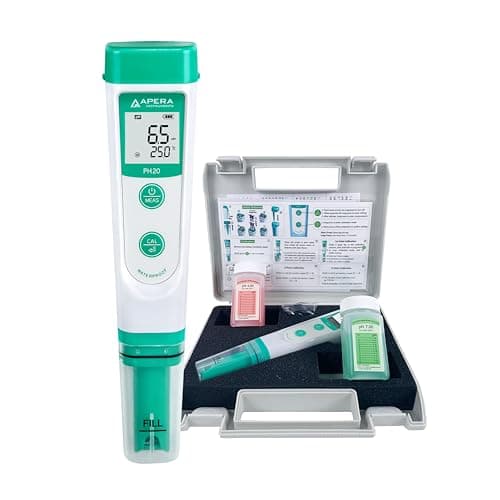
The PH20 is the cheapest meter this site would recommend at all: ±0.1 pH, automatic calibration to three points, temperature compensation and an IP67 rating, with the buffers in the box. For most kombucha brewers it is still the wrong purchase, because strips answer the only question you are asking. If you do want a meter, the honest comparison is not PH20 against strips but PH20 against the PH60 — and the deciding figure is that the PH20 probe cannot be replaced.
What this review is
We have not calibrated a PH20, dipped it in a batch or measured its drift over a year. This site has no lab and says so on the methodology page.
What this review does is take the figures Apera publishes for this instrument, hold them against the one measurement a kombucha brewer actually makes, and work out whether the cheaper meter gives anything away that matters. Every figure below is from Apera's published specification and the live Amazon listing, read on 2026-09-21.
The published specification
Apera's published figures for the Value Series PH20 (SKU AI209), retrieved 2026-09-21.
Parameter
Published value
Range
0 to 14.0 pH
Accuracy
±0.1 pH
Resolution
0.1 pH
Calibration
Automatic, 1 to 3 points, with buffer recognition
Temperature compensation
Automatic, 0 to 50 C (32 to 122 F), ±0.5 C
Probe
Glass bulb, single-junction ceramic, Ag/AgCl in KCl gel. Not replaceable
Sealing
IP67, floatable
Power
4 x AAA. Stated as up to 2000 hours, and as up to 1000 hours
Supplied with
pH 4 and pH 7 buffers, batteries, lanyard, carrying case
Warranty
2 years instrument, 6 months probe
Two things stand out. The first is that this is a properly specified instrument: a maker that publishes electrode construction, an IP rating and a split warranty is not selling an unbranded pen. The second is the contradiction in the power row — the specification table says up to 2000 hours and the feature list on the same page says up to 1000. Neither figure changes a buying decision, but a maker disagreeing with itself on its own page is worth recording.
Is ±0.1 enough?
Kombucha brewing involves exactly one pH decision: has this batch dropped below roughly 4.2, the point at which its own acidity protects it. The pH page works through where that figure comes from.
Against that line, ±0.1 means a displayed 4.2 is somewhere between 4.1 and 4.3. That straddles nothing important: at 4.3 you wait another day, which is what you were going to do anyway. Compare that with a meter published at ±0.2, where a displayed 4.2 could be 4.0 or 4.4 — one of those is comfortably safe and the other is not, and the instrument cannot tell you which.
So the accuracy is genuinely adequate. This site's criteria call ±0.1 workable rather than comfortable, and for a binary safety check workable is the right word. Where ±0.1 falls down is tracking: if you want to compare this week's batch with last week's to a tenth, a tenth of tolerance eats the difference you were looking for.
The picks
The three honest options
The value meter, the meter with a replaceable probe, and the strips that answer the safety question for most brewers without any of this.
Apera Instruments
Value Series PH20 Waterproof pH Tester Kit (AI209)
Apera's value meter publishes ±0.1 pH — workable against the 4.2 line rather than comfortable — with temperature compensation and IP67, but its probe is sealed in and cannot be replaced.
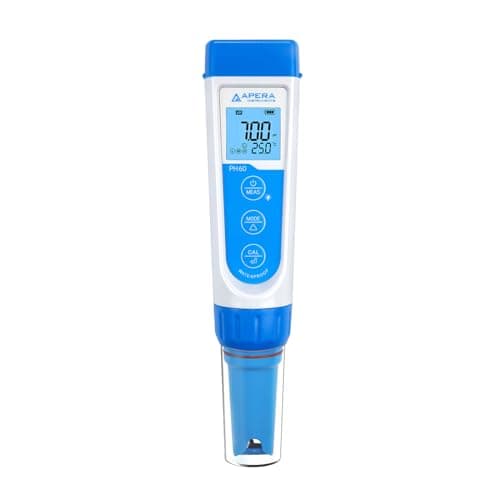
The only meter here whose published accuracy — ±0.01 pH — is finer than the decision you are using it to make, with a probe you can replace instead of the whole instrument.
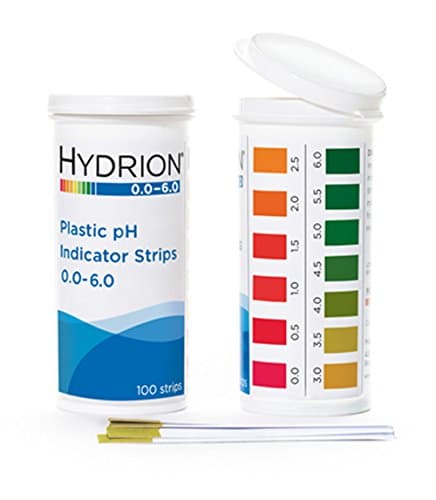
A 0.0 to 6.0 range in 0.5 steps, which puts four separate color matches inside the 2.5 to 3.5 window kombucha lives in — a 1-to-14 strip gives you one.
#ad No live price feed yet, so no number is shown rather than a stale one. How this is funded.
The probe is the whole argument
Every specification on a pH meter is really a specification about its glass electrode, and the electrode is a consumable. Apera is straight about this: two years on the instrument, six months on the probe. That split is the maker telling you which part wears out.
On the PH60, that is a maintenance note, because the probe is a separately sold part with its own model number. On the PH20, Apera publishes Replaceable: No. When the glass bulb stops holding calibration, the instrument is finished.
That is the real difference between the two meters, and it is a bigger one than the accuracy gap. Buying the cheaper meter is not buying a slightly less precise version of the same thing; it is buying a disposable instrument instead of a serviceable one. Over several years of weekly readings, the cheaper meter is not obviously the cheaper purchase.
The two Apera meters on the figures that decide between them, from each product's published specification.
PH20 (AI209)
PH60 (AI311)
Accuracy
±0.1 pH
±0.01 pH ±1 digit
Resolution
0.1 pH
0.01 / 0.1 pH
Probe replaceable
No
Yes (PH60-E)
Calibration
Automatic, 1 to 3 points
Automatic, 1 to 3 points, 5 buffer types
Sealing
IP67, floatable
IP67, floatable
Warranty
2 years instrument, 6 months probe
2 years instrument, 6 months probe
What Apera does not say about kombucha
The PH20 electrode is published for "regular water solution testing, such as pools and spas, hydroponics, tap water, drinking water, water treatment, aquaculture". Kombucha is not on that list, and neither is any food or beverage.
That is not a warning; it is an absence. Nobody has published a claim about this electrode in a sugary, acidic, yeast-laden liquid that leaves a film. What follows from it is practical rather than alarming: rinse the probe immediately after every reading rather than at the end of the session, take the reading from a drawn sample rather than dipping the instrument in the vessel, and do not assume a single-junction ceramic junction will behave in kombucha the way it does in tap water.
Taking a reading from a live batch
A meter is only as good as the sample, and kombucha is an awkward sample: acidic, carrying suspended yeast and cellulose, and covered by a pellicle you should not be poking an instrument through.
Draw a small sample into a clean cup rather than dipping the meter into the jar. That keeps the instrument away from the culture, keeps the culture away from whatever was last on the instrument, and gives you a still sample to read — a probe held in moving liquid takes longer to settle. Rinse the probe in clean water immediately afterward rather than at the end of the session, because the film kombucha leaves is much easier to remove before it dries.
Read at a consistent temperature if you are comparing batches. The PH20 compensates automatically across its published range, which corrects the electrode's behavior, but the pH of a fermenting liquid genuinely shifts with temperature as well. A reading off a warm jar and a reading off a refrigerated bottle are not measuring the same thing, and an adhesive strip thermometer on the glass is the cheapest way to know which you have.
Who should buy it
Someone who wants a number occasionally and cheaply. Continuous brewers logging a slow drift, or anyone steering a batch toward vinegar, who does not want to spend instrument money.
Someone who already owns strips. The two complement each other: strips for the routine safety check, a meter when you want a figure to write down.
Not someone brewing weekly for years. A sealed probe makes this a consumable, and the PH60 is the better long-run purchase.
On specification, the PH20 is more meter than the kombucha question needs: ±0.1 clears the 4.2 decision, temperature compensation is built in and published with its own tolerance, and IP67 is the right rating for something used over an open jar. Apera publishes the electrode construction, which most makers at this price do not.
On fit, it sits in an awkward place. It costs several times a vial of strips and answers the same binary question; it costs meaningfully less than the PH60 and gives up the one thing that makes a meter last. If you are buying a meter to keep, buy the one with the replaceable probe. If you are buying a meter to try, this is the one to try — and strips remain the honest recommendation for most brewers.
Heads up: some links on this page are affiliate links. If you buy through one we may earn a commission at no extra cost to you. It never changes a ranking, and we take no payment for placement. The full version.
The short answer
Quick picks
Ranked on the published rubric. Every row jumps to that product's full write-up below; the button goes straight to Amazon.
#
Product
Best for
Score
Price
1
Apera Instruments
Value Series PH20 Waterproof pH Tester Kit (AI209)
Apera's value meter publishes ±0.1 pH — workable against the 4.2 line rather than comfortable — with temperature compensation and IP67, but its probe is sealed in and cannot be replaced.
The only meter here whose published accuracy — ±0.01 pH — is finer than the decision you are using it to make, with a probe you can replace instead of the whole instrument.
A 0.0 to 6.0 range in 0.5 steps, which puts four separate color matches inside the 2.5 to 3.5 window kombucha lives in — a 1-to-14 strip gives you one.
Apera Instruments Value Series PH20 Waterproof pH Tester Kit (AI209)
Apera's value meter publishes ±0.1 pH — workable against the 4.2 line rather than comfortable — with temperature compensation and IP67, but its probe is sealed in and cannot be replaced.
Who it is for. A brewer who wants a number to log at the lowest price from an established instrument maker, and accepts replacing the meter when its probe wears out.
Published specifications
Model
Value Series PH20, SKU AI209
Range
0 to 14.0 pH
Resolution
0.1 pH
Accuracy
±0.1 pH
Calibration
Automatic, 1 to 3 points, with buffer recognition
Temperature compensation
Automatic, 0 to 50 C (32 to 122 F), temperature accuracy ±0.5 C
Probe
Glass bulb, single-junction ceramic, Ag/AgCl reference in KCl gel. Not replaceable
Published application
Regular water solutions: pools and spas, hydroponics, tap and drinking water, water treatment, aquaculture
Sealing
IP67, floatable
Battery
4 x AAA. Stated as up to 2000 hours continuous in the specification table and up to 1000 hours in the feature list
Supplied with
pH 4 and pH 7 calibration buffers, batteries, lanyard, rugged carrying case
Size
178 x 40 x 31 mm, 107 g
Warranty
2 years instrument, 6 months probe
Source: Apera Instruments published Value Series PH20 specification (SKU AI209; 0 to 14.0 pH range, 0.1 pH resolution, ±0.1 pH accuracy, automatic 1 to 3 point calibration, ATC 0 to 50 C with ±0.5 C temperature accuracy, IP67 floatable, 4 x AAA with battery life stated as both 2000 and 1000 hours, 178 x 40 x 31 mm and 107 g, non-replaceable glass bulb electrode with single-junction ceramic and Ag/AgCl reference in KCl gel, published application for regular water solutions, 2-year instrument and 6-month probe warranty), aperainst.com, retrieved 2026-09-17; kit contents and buffer recognition from Amazon listing B01ENFOHN8, retrieved 2026-09-17
Rubric — 7.2 / 10
Materials7/10 · weight 28%
Documentation8/10 · weight 22%
Capacity fit7/10 · weight 16%
Cleaning7/10 · weight 18%
Value7/10 · weight 16%
What it gets right
±0.1 pH sits inside the tolerance this site calls workable at the 4.2 line — a displayed 4.2 is somewhere between 4.1 and 4.3
Automatic temperature compensation from 32 to 122 F, published with its own temperature accuracy rather than just claimed
IP67 and floatable, which is the right rating for an instrument used over an open jar
Calibration buffers ship in the kit and the meter recognizes them automatically, so it can be calibrated on the day it arrives
What it costs you
The probe is not replaceable. When the glass electrode wears out the whole meter is finished, and Apera's own warranty on that probe is six months
±0.1 pH is workable, not comfortable. A reading near 4.2 still needs a safety margin rather than being treated as a line
Apera publishes the electrode for regular water solutions such as pools, hydroponics and drinking water, and names no food or beverage use
Battery life is published two ways on the maker's own page: up to 2000 hours in the specification table and up to 1000 hours in the feature list
Skip it if. You want one meter to last years of weekly readings. A sealed probe makes this a consumable, and the PH60's replaceable probe is the better long-term buy.
The only meter here whose published accuracy — ±0.01 pH — is finer than the decision you are using it to make, with a probe you can replace instead of the whole instrument.
Who it is for. Someone brewing continuously, tracking a number over time, or pushing a batch toward vinegar and wanting to know exactly where it is.
Published specifications
Model
PH60, SKU AI311
Range
“-2.00 to 16.00 pH”
Accuracy
“±0.01 pH ±1 digit”
Resolution
“0.01/0.1 pH”
Temperature compensation
“Auto Temperature Compensation 0 to 50°C (32 to 122°F)”
“TWO YEARS for the instrument and SIX MONTHS for the probe”
Source: Apera Instruments published PH60 product specification (model/SKU, range, accuracy, resolution, ATC range, calibration points and recognized buffers, replaceable PH60-E probe, IP67 rating, battery type and 2000-hour life, kit contents, warranty terms), aperainst.com, retrieved 2026-09-06
Rubric — 8.4 / 10
Materials9/10 · weight 28%
Documentation10/10 · weight 22%
Capacity fit9/10 · weight 16%
Cleaning7/10 · weight 18%
Value6/10 · weight 16%
What it gets right
±0.01 pH published accuracy against a decision line at 4.2 — the instrument is an order of magnitude finer than the question, which is the right way round
Three-point automatic calibration with buffers in the box, so it arrives ready to be made trustworthy rather than merely switched on
The probe is a replaceable part with its own model number, so a dead electrode is a component failure and not a landfill event
IP67 and floatable, which is a sensible specification for a device used over an open jar
What it costs you
The published probe warranty is six months against two years for the instrument, which tells you honestly where the wear is
It needs storage solution and periodic recalibration. A meter left dry in a drawer for a year reads confidently and wrongly
It costs many times a vial of strips to answer a question strips already answer well enough for most brewers
Four AAA batteries and a case make it a thing you own, not a thing you keep next to the jar
Skip it if. You test once a batch to confirm the ferment is under 4.2. Strips do that for a fraction of the money and never need calibrating.
A 0.0 to 6.0 range in 0.5 steps, which puts four separate color matches inside the 2.5 to 3.5 window kombucha lives in — a 1-to-14 strip gives you one.
Who it is for. Every kombucha brewer. This is the cheapest instrument on the site and the one that answers the safety question.
#ad No live price feed yet, so no number is shown rather than a stale one. How this is funded.
FAQ
Questions people actually ask
Is the Apera PH20 accurate enough for kombucha?+
Yes, for the decision kombucha actually turns on. Its published ±0.1 pH means a displayed 4.2 is between 4.1 and 4.3, and both of those lead to the same action. Where it falls short is tracking: comparing batches to a tenth of a pH is not meaningful when the tolerance is a tenth.
Can you replace the probe on an Apera PH20?+
No. Apera publishes Replaceable: No for this electrode, while giving the instrument a two-year warranty and the probe six months. When the glass bulb stops holding calibration the whole meter is finished. The PH60 costs more and has a replaceable PH60-E probe, which is the main reason to spend the difference.
Apera PH20 or PH60 for kombucha?+
PH60 if you intend to keep a meter for years, because its probe is a serviceable part. PH20 if you want a numeric reading cheaply and accept replacing the instrument when the electrode wears out. The accuracy gap — ±0.1 against ±0.01 — matters far less for kombucha than the replaceable-probe difference.
Do I need a pH meter for kombucha at all?+
Most brewers do not. The question is whether the batch has dropped below about 4.2, and narrow-range strips answer that for a fraction of the price, never drift silently and need no calibration. A meter earns its place for continuous brewing, for deliberately making vinegar, or for anyone who wants a number they can log.
Is the Apera PH20 waterproof?+
Apera publishes IP67 and states it floats, which is the appropriate rating for an instrument used over an open jar of liquid. That covers accidental immersion; it does not mean the probe should live in the vessel. Take readings from a drawn sample and rinse the probe immediately afterward.
Sources
Every specification cited on this page came from one of these documents, retrieved on the date shown against the product it belongs to.